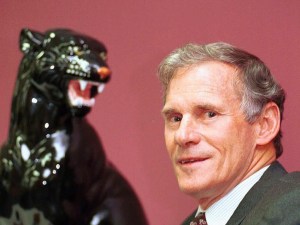
My purpose in getting involved with this book was at first quite narrow. I wanted to the set the record straight.
Over the last six years of my career as CEO of Panthers there was a sustained effort to discredit and damage me and it was, in many ways, very successful. To see a 40-year career come to a climax of consistent attacks by a small group of locals, the state government and The Sydney Morning Herald was a huge disappointment. There was a concerted effort by some powerful individuals and organisations to to brand me with the corruption label.
However, I eventually came to the conclusion that it serves no useful purpose to be driven by revenge. Cheap shots at those who tried so hard to destroy my reputation would only reduce the credibility of a story that is important in many ways. The facts speak for themselves and the reader will undoubtedly see many instances of dishonesty or corruption in these pages. Placing labels where they fit best will be left to the reader to a very great extent.
For most of my career at the Club I enjoyed excellent relationships with boards. The growth of Panthers would not have been possible otherwise. Throughout sections of the book, there are a number of criticisms of the ‘board’. They relate to events that occurred during some conflicts that occurred in the latter part of my tenure with Panthers. I wish to make it very clear that no criticism was ever intended of the four stalwarts who were in the minority during that period, and in no position to insist on better outcomes. The Panthers board that exists today1 is far different, and no current director could be criticised for any of the injustices described here. In fact, it could well be argued that today’s Panthers board ranks as one of the best the club has ever had.2
On a number of occasions people told me that they did not need a book to convince them of the truth. They are friends of course, and there were more than I anticipated who stood by me – some because they were close to the action and knew the truth, and others because they were so supportive, they refused to belief the headlines.
But there are many thousands who would have believed the headlines. One example is the businessman who was attending a meeting of a company of which I am a director. He did not know me, or anything about my background. He was explaining to the meeting, as an example of dishonesty, the recent case of the CEO of Panthers ripping the club off through his private company. This was more than a year after Ian Temby had handed down his findings.
My friends put him straight, but – for me – the point was made.
The author, Jennie Bentley, had a long-held ambition to tell the Panthers story from the business point of view and, after some initial doubts, I could see that just focusing on the more recent years was far too narrow a view of a business that grew from such a tiny seed to its position today. So, we agreed that she would write the history of Panthers. I warned her she would have to do all the research and she had to remain as objective and factual as possible. There are sections of this book highly critical of dishonesty in the media and it would be hypocritical to the extreme to publish this book without a strong regard for objectivity and accuracy.
Of course, there are opinions expressed but, hopefully always in such a way that they are obviously opinion and not mistaken for fact.
The last six years or so stand out in my memories of Panthers history, and Jennie sometimes had to work hard to get my mind off it. I hope she was sufficiently successful to ensure that the book is a valuable edition to the history and, to a lesser extent, the entire club industry. Some of the events will undoubtedly find their way into the history of the state government.
Many people would categorise some of the behaviour of the NSW Labor government as dishonesty and injustice. But that is not the story.
The message in this book, as I see it, is more important than that.
The history of Panthers shows how a wonderful, community focused business can be built by the co-operative, unselfish efforts of thousands of people working together.
But it also gives frightening proof of how easily it can be undermined by a clash of values, and the negative influence of small numbers of people pursuing their own agenda.
Every day we are confronted with graphic examples of TV beat ups to win ratings, and dishonest statements made to win elections. Excesses in the media and in government are damaging the fabsic of our society and we accept it as a way of life.
Horrendously oppressive legislation is still in place that denies normal levels of justice to officers of clubs, and nobody is screaming for its repeal.3
I cannot resist having my say about one of the more interesting events, and to admit that it was only in the last couple of months of preparation for publication that I came to an astonishing realisation. Unfortunately it came two years too late. Had I been smart enough to see it earlier I think I would have handled some major events in my life much differently.
Why did I miss it? The explanation is simple. I was not sufficiently strong of mind to avoid going into complete defence mode when I was attacked. What was going on consumed my mind for every minute of every day for many months. Hundreds of hours were spent digging through old records, preparing reports, analysing evidence and meeting with solicitors.
The lesson I learnt is this:
When you are being attacked – no matter how viciously – and you are absolutely absorbed by the need to defend, you must stop. For sufficient blocks of time every day, move out of defence mode and focus on fully understanding what you are defending.
Working through those events for this book, I realised that I had spent all that time trying to defend allegations that actually had no merit and could not possibly have justified being placed in a Royal Commission category. With that realization, every grain of logical thought could only take me on possible conclusion:
The Temby Inquiry was called by the government for one, and only one, purpose – to help the government win the battle for public perception of its unfair tax impost on clubs.
A media eager to feast on stories about high profile people and organisations could only help it justify its actions.
I came to believe there is overwhelming evidence that a democratically elected government and a major newspaper were so intent on building a particular public perception that they were willing to sacrifice my reputation, my health, and my financial security. They showed willingness also to sacrifice the rights of citizens of this supposedly “fair-go” country for their own ends.
The book suffers a little in its objectivity because some of the main actors in the most recent years refused to be interviewed or even answer written questions.
So, now I’ve got that off my chest, let’s get focused on Jennie’s tale of the growth of Panthers, and say how much we appreciate the contribution of all those who agreed to be interviewed. Unfortunately Jennie wasn’t able to use all the material she collected but we are just as appreciative to those who finished on the cutting room floor as to those who are reported.
I believe Jennie did an excellent job of putting her extensive research into an interesting format. I appreciate her sincerity and thoroughness; and the great teamwork we built during the process. The excellent guidance of Matthew Richardson of Halstead Press – who no doubt took very little time we were first book novices – made an enormous difference to the final product.
I am especially grateful to my wife, Phyllis, for helping me through some pretty nasty periods and my three sons and their wives for their unwavering support and faith in me.
And I dedicate this book to my seven grandchildren, whose future in this country will be more assured when honesty becomes the number one value in both government and media and we have sufficient insight to know when it is being violated.
Roger Cowan
1 This Foreword was written in 2006. By 2008-9, Panthers’ governance took a dramatic change in direction with the Board deciding that the Executive of the Board should be heavily involved in the management of the business.
2 Roger is talking about the Board as it was until approximately 2011 when it had representatives from regional Panthers clubs. This was before he was approached by the representatives of the Board for advice Board taking up management roles in the organisation. He informed those representatives that you cannot sit on the Board and be responsible for managing the Club at the same time. There have also been changes the governance regulations that apply to clubs – now the Panthers Board is 7 Directors, 5 elected and 2 appointed. In recent years one of the protagonists in this story was invited to rejoin the Board.
3 Section 41X has now been removed from the Act.
 Panthers, Passion & Politics - The Roger Cowan Years