
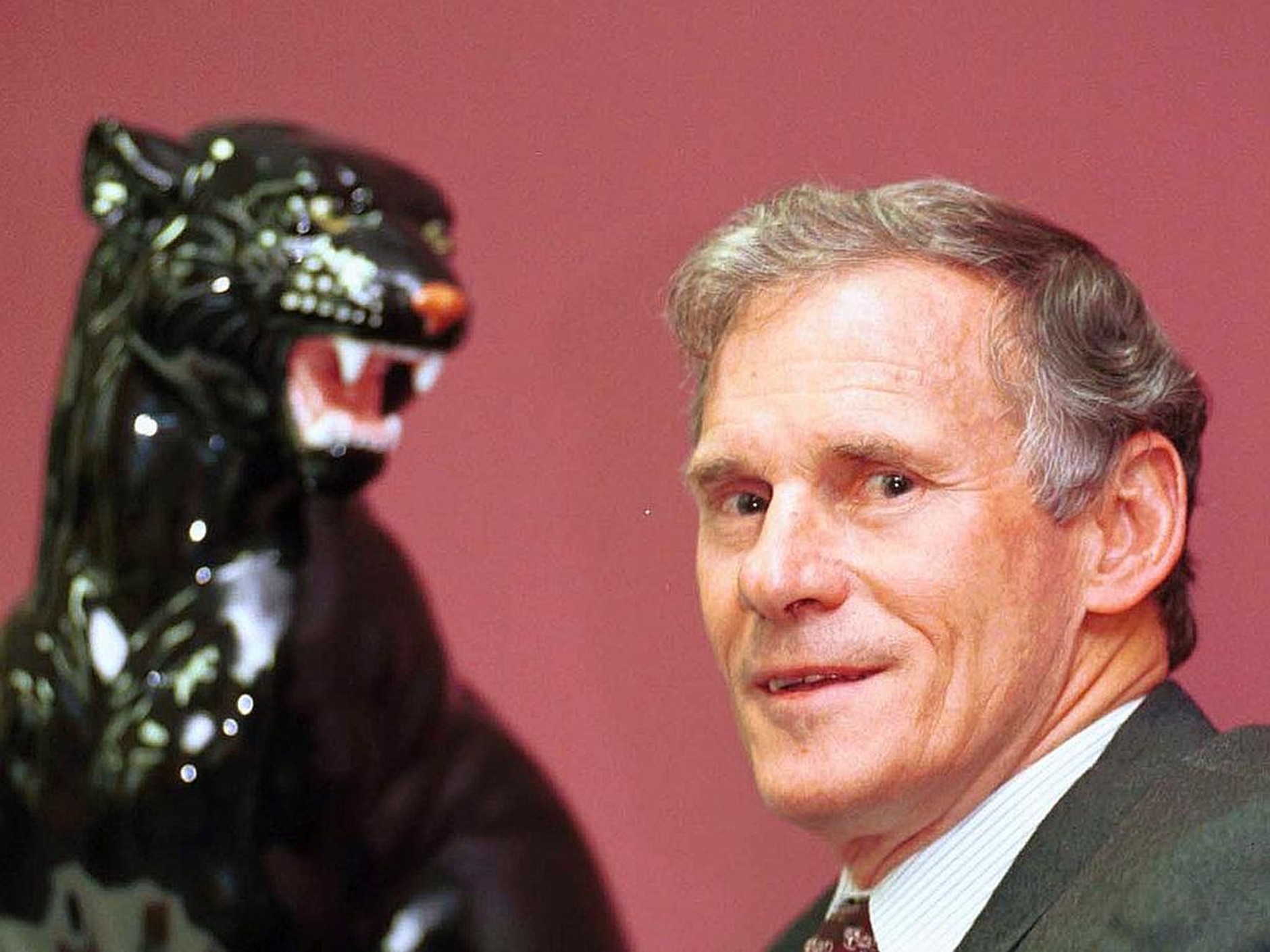
Roger Cowan OAM (1935–2017) was a central figure in the development of the Penrith Panthers and a significant contributor to the evolution of the licensed club industry in Australia.
Note for readers:
This page presents a structured biographical overview of Roger Cowan. Readers seeking a more narrative account — including additional context, perspective, and interpretation — may wish to refer to Part 5 of The Series.
Born in rural New South Wales and educated in Lithgow, Cowan demonstrated early academic and leadership ability, graduating as dux of his school at the age of fifteen. After training as a teacher at Bathurst Teachers College, and taking a teaching post at Blacktown Boys High, he settled in the Penrith district in the 1958.
In 1959 he briefly left teaching to pursue small business ventures. He purchased and operated a greengrocery business and later expanded into an ice-cream run, which grew into a small fleet of vans. While ultimately returning to teaching in 1964, this period reflected an entrepreneurial instinct and willingness to take commercial risks that would later characterise aspects of his leadership.
Following a period of voluntary involvement with the Penrith Rugby League Club, Cowan assumed a formal leadership role in 1965. Over the next four decades, he oversaw sustained growth, structural reform and organisational development that transformed Panthers into one of the leading clubs in the country.
He was awarded the Medal of the Order of Australia in 1992 in recognition of his service to rugby league and the club industry.
Early Life And Education
Roger Cowan was born on 9 November 1935 and spent his early years in rural New South Wales, the son of Norman and Mary Cowan. His upbringing was shaped by modest circumstances and a strong emphasis on education, discipline and personal responsibility.
Frequent family moves during his childhood, influenced in part by his father’s health, exposed him to a range of schooling environments. Despite these disruptions, Cowan demonstrated strong academic ability from an early age. While attending school in Lithgow, he progressed rapidly through his studies, entering high school at a young age and completing his Leaving Certificate at fifteen.
During his school years, he was dux, vice-captain and captain of the first-grade rugby league team, reflecting both academic and leadership capability. Outside the classroom, he worked extensively with his father in timber cutting and share farming, experiences that contributed to a strong work ethic and practical outlook.
Following completion of his schooling, Cowan attended Bathurst Teachers College, where he trained as a teacher and met Phyllis Snape, whom he married in 1954. He began his teaching career in western Sydney and settled in the Penrith district in the late 1950s, where his involvement with the local rugby league club would soon begin.
Early Leadership and Reform (1964-1967)
Cowan’s deeper involvement with the club followed a period of financial instability that exposed weaknesses in its administration. As honorary treasurer, he identified the absence of basic financial controls and introduced systems aimed at stabilising operations.
In 1965, at the age of 29, he resigned from teaching to take on the role of Secretary-Manager on a trial basis. The decision marked the beginning of a forty-year period of leadership.
Within a relatively short period, the club’s financial position was stabilised. By 1967, Penrith had secured entry into the Sydney Rugby League premiership, establishing a platform for future development.
Leadership at Penrith Panthers (1965-2005)
Over the following four decades, Cowan oversaw a sustained period of expansion and structural development. From modest facilities in Station Street, the organisation evolved into a major licensed club and regional institution. Central to this transformation was the acquisition of land at Mulgoa Road in 1971 and the eventual relocation of operations to that site in 1984, establishing the foundation for sustained long-term growth.
The development of the Mulgoa Road precinct had a broader impact beyond the organisation itself, contributing to the commercial and social evolution of Penrith as a regional centre and reinforcing the club’s role within the local community.
During this period, the club expanded significantly in scale and scope. Membership, assets and employment increased substantially, and the organisation developed into a multi-site operation through a program of amalgamations with clubs across New South Wales. By the time of his retirement in 2005, Panthers had become one of the largest and most influential clubs in the country.
Cowan’s leadership was characterised by a willingness to adopt new approaches in both governance and operations. Initiatives introduced during his tenure included strengthened financial oversight, internal audit structures and governance frameworks that were later reflected more broadly across the club industry. He also supported the development of community-focused programs and services, including early forms of independent counselling support related to gambling harm.
In parallel with organisational growth, Cowan placed emphasis on the integration of the licensed club and football operations. The unification of governance structures in the mid-1980s provided a more stable platform for both business and sporting success. This period coincided with the emergence of a strong cohort of locally developed players, supported by structured development initiatives including the “5×5 Plan” introduced in the mid-1980s. The plan focused on building a pipeline of local talent and contributed to the club’s progression to finals contention in 1988, a grand final appearance in 1990, and its first premiership in 1991.
Beyond Penrith, Cowan contributed to the broader development of the club industry in Australia. He served as President of the Registered Clubs Association from 1990 to 1992 and was involved in initiatives relating to governance standards, disciplinary frameworks and community funding models.
Governance and Structural Philosophy
Cowan believed that long-term success depended on unified governance. The separation between the licensed club and the football club created ongoing tension, particularly around financial control and decision-making.
These experiences, especially during the late 1960s and early 1970s, shaped his enduring view that the organisation could only succeed if both entities operated under a coordinated and aligned structure — a principle that would later underpin key structural reforms.
Order of Australia Medal (1992)
In June 1992, Roger Cowan was awarded the Medal of the Order of Australia (OAM) in recognition of his service to rugby league and to the licensed club industry.
The award acknowledged more than two decades of leadership at Penrith, during which the organisation underwent significant structural and financial transformation. It also reflected his broader contribution to the development of the club industry, including governance practices, community engagement and support for the game of rugby league.
The honour came at a time when Panthers had emerged as a leading organisation within the sector, both in scale and in influence.
Recognition by Panthers
- Life Member, Penrith Panthers (1994)
- Panthers Legend (2026)
Key Milestones
- 1965 – Appointed Secretary-manager, Penrith District Rugby League Football Club.
- 1967 – Entry into Sydney Rugby League competition.
- 1971 – Acquisition of Mulgoa Road site.
- 1984 – Relocation to Mulgoa Road precinct.
- 1991 – First Premiership.
- 1992 – OAM awarded.
- 2000 – Expansion through amalgamation begins.
- 2005 – Retirement.
Legacy
Roger Cowan’s contribution to Penrith Panthers extended beyond tenure or position. His influence was structural, cultural and long-lasting.
Under his leadership, the organisation developed from a local club into a major regional and industry presence. This growth was reflected across multiple measures, including membership, visitation, financial performance and the expansion of facilities and services. By the time of his retirement in 2005, Panthers had become one of the most prominent licensed clubs in Australia.
A defining feature of Cowan’s approach was his emphasis on participation, development and shared responsibility. His leadership style encouraged involvement across all levels of the organisation and contributed to a culture in which individuals were expected to contribute, improve and take ownership of outcomes.
He was also recognised for his role in broader industry development, including contributions to community engagement initiatives and support services that influenced practices beyond Panthers itself.
Cowan’s impact is most clearly seen not only in the physical and organisational growth of the club, but in the systems, standards and culture that continued beyond his tenure and shaped the organisation for many years.
Sources
- Footprints on the Banks of the Nepean — Bruce Turner AM
- Triumphs from the Banks of the Nepean — Bruce Turner AM
- The NSW Club Movement 1838–2009 — Gary Lester & Nick Hartgerink
 Panthers, Passion & Politics - The Roger Cowan Years