Part 1 of 70 — Chapter 1: Introduction
This article forms part of the serialised republication of Panthers, Passion & Politics – The Roger Cowan Years.
WHAT A STRANGE TALE this turned out to be!
The chronicle of a business — a struggling back-street club in a semi-rural town that grew to have assets worth more than half a billion dollars.
A story of well-intentioned people working together to achieve great results.
A story that adds significantly to the history of registered clubs in NSW.
And yet the story of building great success and positive culture gives way to a troubling tale of relationships falling apart.
There are elements that will trouble those who assume democratic governments are immune from overreach — that they are above persecuting its citizens. Readers who believe in free speech and the obligation of the media to report the truth may also wonder at some of the events described here.
One of the main players is Roger Cowan, who spent 40 years as CEO of Panthers and led the Club through incredible growth, and finished his career in the most difficult and disappointing circumstances.
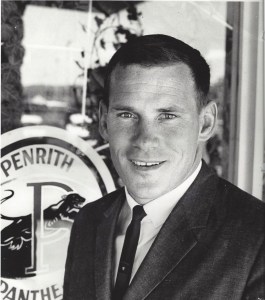
The Club’s journey from a tiny club first licensed in 1956 to the giant enterprise1 it is today included some great successes and excitement — and plenty of disappointment and failure. When Roger took the reins the tiny Club was close to closing. Under his stewardship it grew to include 14 clubs and their lands, various playing fields, bowling greens and other facilities, a ten-pin bowling centre and a mobile-home village near the Nepean River.
The growth and expansion of the Panthers enterprise was accompanied by the nurturing and development of an enormous wealth of talent, skills and a culture that has grown and spread throughout the entire New South Wales club industry.
Cowan recalls the years from 1997 until his retirement in 2005 as being easily the most difficult and frustrating in his 40-year tenure. The final outcome was an unnecessary and deeply damaging Government Inquiry.
During this eight-year period the principal actors included a group who became known as the Footy Five2; past and present members of the NSW Labor government; Ron Mulock, a former NSW deputy premier; and The Sydney Morning Herald.
But history extends more than eight years.
To understand those years, we need to look at the entire journey of Panthers.
In 1967 it was, by far, the smallest of all the clubs supporting a first-grade rugby league team. Today, it is the largest.3 We also need insight into the demarcation between the two club entities — football club and registered club4 and the men that controlled them.
Cowan’s conviction that a single management structure was essential to the success of both clubs created great animosity and indirectly led to a police investigation and the charging of Cowan with fraud.5
The Super League disputes of the late 90s, and Penrith’s difficulty in qualifying for a place in the new NRL competition divided a city and led to a bitter conflict within the cloisters of Panthers.
The growth of Panthers, through amalgamations with struggling clubs caused even more serious relationship difficulties, despite its success in building the assets of Panthers.
Eventually open hostility broke out between Board and Management.6
In the background were other influences. The Treasurer of the NSW government and the state’s gaming minister had both condemned the growth of large clubs, singling out Panthers; the government was planning crippling taxation increases; a local council election was looming in Penrith; and the city hosted several events when the Olympic Games came to Sydney in 2000.
For Roger Cowan, things would converge in June 2004.
Strict mechanisms were already in place to regulate the club industry but faced with massive protests over new gaming taxes, the government introduced legislation that would enable it to mount Royal Commission-style inquiries into clubs and their officials, on the basis of mere allegations. The move was unprecedented. Royal Commissions are almost sacrosanct and to instigate one against an individual was previously unheard of. Cowan and Panthers endured six months of inquisition under Commissioner Ian Temby — high profile veteran of ICAC inquiries, such as the one which had ousted Premier Greiner.
No charges were laid. No action was taken.
The monetary costs — to Panthers, Cowan, and to the NSW taxpayer — were enormous.
But there were other costs.
Temby was directed to investigate six allegations about practices at Panthers. Beneath the public posturing lay what Cowan regarded as a profound misuse of power — a government prepared to violate our systems of justice for its own ends.7
Not one of the allegations was based on evidence that could possibly survive a court hearing and lead to criminal charges. Not one.
The outcome was bloody,
- The Footy Five were removed from the positions they had fought so hard to preserve,
- Panthers incurred huge costs,
- Cowan’s reputation, health (physical and mental) and finances were battered.
- The NSW Labor Government demonstrated a strange code of justice and,
- The lack of balance in the coverage by the Herald will probably go unnoticed in the flood of exaggeration, beat-ups and lies that are evident in the media every day.
Roger Cowan admits that he handled several events badly. Given the time over, he says, there would be a lot of changes. It is possible that other participants would say the same, but many were unwilling to provide information.
To receive new Parts and occasional project updates by email, you may subscribe below.
Readers who hold recollections, documents, or material relevant to this history are welcome to contribute via the Commentary & Contributions page.
Project Updates
Receive updates when new parts are published.
- Panthers Passion and Politics was published in 2006. Since that time, the size and structure of Panthers has changed considerably. Today Panthers includes the Penrith Panthers NRL team, the flagship registered club at Penrith, Cables Wakeboard Park (leased to an operator), and clubs at North Richmond, Port Macquarie, and Glenbrook. Several previously amalgamated clubs and properties have since been divested, and portions of the Penrith site have been sold for redevelopment. A Convention Centre has recently been completed at Penrith and leased to Pullman, and a Panthers Rugby League Academy has been established.
↩︎ - “The Footy Five” was a label applied to five Panthers directors who held a majority on the Board during the years of conflict. According to director John Bateman, the term emerged toward the end of the dispute and may overstate the extent to which the five directors acted as a unified voting bloc throughout the period.
↩︎ - This claim reflects the position at the of publication in 2006. While Panthers remains one of the largest clubs supporting a first-grade rugby league team, it relative size and standing within the NSW Club Industry has diminished since that time.
↩︎ - The two entities are Penrith District Rugby League Football Club (PDRLFC) and Penrith Rugby League Club Ltd (PRLC). The first is the football club; the second is the licensed club.
↩︎ - Roger’s persistence with this belief contributed to a later claim that he was anti–Rugby League. That perception was also influenced by his criticism of excessive spending by some Rugby League committees. The fraud charges referenced here were subsequently dismissed. The circumstances surrounding those charges are explained later.
↩︎ - This sentence may suggest that such conflict was inevitable. Some degree of tension exists in all organisations, and when managed constructively it can generate energy and growth — a dynamic evident throughout much of Roger’s 40 years at Panthers. The escalation in this period, however, required a particular convergence of personalities and circumstances, and proved unusually destructive.
↩︎ - This episode resembles what is now sometimes described as “lawfare” — the strategic use of legal or quasi-legal processes in political disputes. The mechanisms employed raised questions about the practical operation of the separation of powers within the Westminster system. These constitutional issues are discussed later.
↩︎
 Panthers, Passion & Politics - The Roger Cowan Years