Image: Panthers 2016 Annual Report
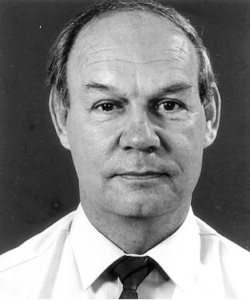
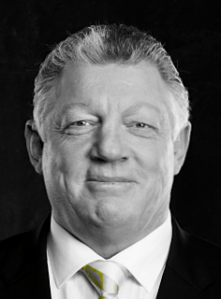
Philip Ronald Gould AM
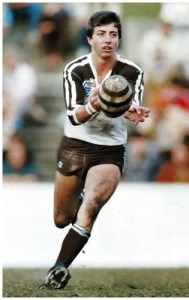
Few individuals have made a greater contribution to Australian rugby league, or played as many different roles within the game, as Phil “Gus” Gould. Player, captain, premiership-winning coach, State of Origin coach, football administrator and commentator, Gould has been one of rugby league’s most influential — and occasionally controversial — figures for almost five decades.
His relationship with Penrith Panthers has been particularly remarkable. Beginning his first-grade career at the club in the 1970s, he returned as coach in 1990 and guided Penrith to its first Grand Final and, a year later, its first premiership. Almost two decades after leaving, he returned again to help rebuild the club’s football operations, contributing to the foundations of another extraordinary period of success.
Yet Gould’s significance to the Panthers story extends beyond those achievements. His arrival as coach coincided with the culmination of years of investment in junior development, football administration and organisational reform. His success demonstrated what could be achieved when an exceptional coach inherited a club increasingly capable of supporting his ambitions.
His subsequent departure in 1994, following a difficult period for the football club, also provides an insight into the challenges that accompanied Penrith’s transition towards a more professional football operation.
Across three distinct periods, Gould was both a participant in and an important influence upon the transformation of Panthers. His story illustrates not only the impact of individual leadership, but also the importance of the organisational foundations upon which sporting success depends.
Role in the Narrative
Gould’s importance to Panthers, Passion & Politics centres on his return to Penrith as first-grade coach in 1990 and his role in converting the club’s growing football strength into its first premiership.
His coaching career began at Canterbury in 1988, where he won a premiership in his first season as a first-grade coach. The achievement immediately established him as one of the game’s outstanding emerging coaches.
His departure from Canterbury at the end of 1989 created an opportunity for Penrith.
The Panthers had already undergone a remarkable transformation. Tim Sheens had helped establish a new football culture and taken the club into its first finals series in 1985. Ron Willey had subsequently strengthened the team’s competitiveness and resilience, taking Penrith back to the finals in 1988.
A generation of talented young footballers had emerged through the club’s junior development system, while organisational and financial reforms had created a stronger foundation for the football operation.
Penrith was no longer a club struggling merely to compete. It was approaching the point where winning a premiership had become a realistic ambition.
Gould’s appointment was nevertheless far from inevitable. Roger Cowan and the Panthers Board considered other coaching possibilities, and Gould’s departure from Canterbury attracted considerable public attention.
The circumstances surrounding his recruitment, including the proposed arrangement involving Steve Mortimer and the discussions that eventually led to his appointment, are examined separately in Bringing Phil Gould Back to Penrith.
What made Gould’s appointment so significant was the convergence of two developments: a coach with an exceptional understanding of the game and a club whose long-term investment in junior development, organisational reform and football infrastructure had brought it within reach of a premiership. Gould possessed the skills to capitalise on that opportunity.
Gould introduced an uncompromising approach to preparation, fitness, discipline and selection. Players were expected to meet demanding standards, regardless of their experience or reputation.
His approach was not always comfortable. Some decisions, particularly those involving established senior players, caused considerable controversy.
But Gould was prepared to challenge existing practices if he believed doing so would improve the team’s prospects.
In 1990, Penrith reached its first Grand Final, losing to Canberra. Twelve months later, the Panthers returned to face the same opponents and won the club’s first premiership.
The achievement secured Gould an enduring place in Panthers history.
Unlike his predecessors, Gould arrived at a time when Penrith possessed many of the essential ingredients for success. His achievement was to convert their potential and take the football team to a level it had never previously reached.
Background
Gould played junior rugby league with Wentworthville before joining Penrith in 1976.
He came off-the-bench to make his first-grade debut on July 18, 1976 at Penrith Park against the Balmain Tigers before a crowd of 8,879 — Penrith lost 5-12, with Gould kicking a goal from two attempts.
On 7 May 1978, he became Penrith’s first-grade captain. At just 20 years of age he was the youngest player to captain the Club — and the second youngest in the history of the game in Australia.1 This was a considerable responsibility for a young player at a club still struggling to establish itself in the Sydney competition. The Panthers defeated Eastern Suburbs 15–13 in his first match as captain.
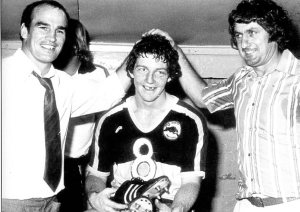
Significantly, this game had an impact on Gould that would resonate through his coaching career. See Beyond the Book — The Mental Game — Roger, Gus and an Idea Ahead of its Time.
His playing career was subsequently disrupted by injuries, including a serious eye problem (detached retina) that threatened his future in the game. Nevertheless, he developed a reputation as an intelligent, tactically aware forward whose understanding of rugby league extended beyond his own playing position.
After leaving Penrith, Gould played with Newtown, Canterbury and South Sydney. These experiences brought him into contact with coaches and football cultures that would profoundly influence his own approach to the game.
Particularly important was his association with Warren Ryan, first at Newtown and later at Canterbury. Ryan’s emphasis on defensive organisation, tactical preparation and disciplined team structures helped shape Gould’s understanding of what was required to win at the highest level.
By the time Gould’s playing career ended in 1986, he had already developed many of the qualities that would distinguish him as a coach.
Profession: Rugby League player, Coach, Administrator, Commentator
Panthers Involvement
• First Grade Player (1976 – 1980)
• Penrith First-Grade Captain — First Appointed 1978
• Head Coach (1990-1994)
• General Manager (Rugby League) (2011-2019)
Representative Honours
• NSW State of Origin — Coach (24 games)
Major Honours
• 1988 — Dally M Coach of the Year
• 1988, 1991 — NSWRL Premiership (Coach)
• 1992, 1993, 1994, 1996, 2003, 2004 State of Origin Series Winning Coach
• 2014 Member of the Order of Australia (AM)
• 2015 Life Member Panthers
Relevance to Events Described
A different kind of football leadership
Gould’s influence extended beyond match-day tactics.
He brought a highly structured approach to coaching, emphasising preparation, physical conditioning, defensive organisation and the education of players in their individual and collective responsibilities.
Royce Simmons, reflecting on the changes introduced in 1990 in Hooked on League, described the arrival of specialist weight coaches, increased opportunities for players to train, and a more structured approach to how the team played.
These developments coincided with rugby league’s gradual transition towards greater professionalism.
Gould also demonstrated a willingness to make difficult selection decisions. His handling of Simmons during the 1990 season became one of the most prominent examples.
Such decisions were controversial, but they reflected Gould’s determination to establish standards that applied throughout the playing group. As Simmons reflected,
I can see now that it must have been very hard for ‘Gus’ —a guy who was not that much older than me, to tell a player in his testimonial year at Penrith, the club’s first Australian rep and club captain for nine seasons, that he had been dropped.2
The result was a team capable not only of competing with the strongest clubs but of defeating them when the stakes were highest.
The first premiership
The 1991 premiership was the defining achievement of Gould’s first period at Penrith.
It was also the culmination of a much longer organisational journey.
The football team included players whose development stretched back through the reforms of the early and mid-1980s, among them Greg Alexander, John Cartwright, Brad Fittler, Mark Geyer and Royce Simmons.
Gould built a disciplined and increasingly sophisticated football system, giving the talented group of players the greatest chance to shine.
His contribution was decisive, but it was not made in isolation.
The premiership belonged to the players, coaches, administrators, directors, staff and supporters whose combined efforts had helped bring Penrith to that point.
After the Premiership
The triumph of 1991 was followed by a far more difficult period for Penrith and its premiership-winning coach.
The death of Ben Alexander in June 1992 had a profound effect on the club, particularly on his brother Greg and other members of the playing group. The tragedy occurred at a time when Panthers were already experiencing difficulties involving injuries, player relationships, morale and performance.
Internal reports prepared by Panthers Chief Executive Don Feltis during 1992 and 1993 reveal the extent of those concerns. They describe a football operation struggling to maintain the cohesion and confidence that had contributed to its premiership success.
The circumstances confronting Gould were very different from those he had encountered during the premiership campaigns of 1990 and 1991. Relationships within the playing group had become increasingly complicated, while injuries and the loss of experienced players placed additional pressure on the team.
Yet the contemporary documents also demonstrate that the club’s difficulties could not reasonably be attributed to its coach alone.
In a detailed report to Feltis and the Board in August 1993, Gould acknowledged the team’s disappointing performances and accepted responsibility for aspects of the season. He also identified the impact of injuries, the emotional consequences of Ben Alexander’s death, problems involving individual players and the challenges of developing sufficient depth within the playing squad.
Gould’s assessment of Greg Alexander was particularly revealing. While describing him as the greatest player to have represented Panthers, Gould acknowledged the profound effect of Ben’s death and expressed concern about the difficulties Alexander was experiencing. His observations illustrated both the personal complexities confronting the playing group and the challenge of restoring the confidence and cohesion that had characterised the premiership-winning team.
His report reflected both frustration with the team’s performances and confidence in the younger players emerging through the club’s development system.
At the same time, Panthers were confronting broader organisational challenges. The increasing financial demands of professional rugby league, particularly player recruitment and retention, were placing pressure on the club’s resources and administrative arrangements.
Correspondence between Feltis and Roger Cowan during 1993 and 1994 reveals differences in their approaches to management, responsibility and the relationship between rugby league operations and the wider Panthers organisation. Those disagreements formed part of the environment in which Gould worked, although it is unknown how much impact it had on Gould.
Despite the difficulties, Gould remained one of the game’s most highly regarded coaches. He had also taken charge of New South Wales in State of Origin football, further enhancing his standing beyond Penrith.
In July 1994, Gould announced his departure from Panthers to take up the coaching position at Eastern Suburbs.
Contemporary newspaper reports indicate that Eastern Suburbs had pursued Gould as part of an ambitious effort to strengthen its football operation. However, his departure followed a period of increasingly strained relationships and uncertainty about his future at Penrith. Gould publicly stated that he would have left the club even without the Eastern Suburbs opportunity, suggesting that his decision involved more than simply accepting another coaching appointment.3
His departure brought to an end a remarkable five-year coaching association with Panthers — one that had delivered the club’s first Grand Final appearance and its first premiership, but had also encompassed some of the most difficult circumstances faced by the football operation in its history.
Whatever the complexities surrounding his departure, Gould’s contribution to Penrith’s breakthrough success remained undiminished.
A wider influence on rugby league
Gould’s influence on the game continued long after his departure from Penrith.
He continued with coaching New South Wales in the State of Origin series adding victories in 1996, 2003 and 2004. At the Sydney Roosters, his years as both coach and coaching director were significant in their development as a leadin rugby league organisation.
He also became one of the game’s most prominent commentators, developing a reputation for strong opinions about coaching, administration and the direction of rugby league.
In 2014, Gould was appointed a Member of the Order of Australia (AM) for significant service to rugby league as an administrator, commentator, coach and player, and to the community.
A Second Return to Penrith4
In 2011, Gould returned to Penrith in a senior football management role, beginning a third significant period of involvement with the club.
Panthers were confronting substantial financial and football challenges. Gould became a central figure in efforts to restructure football operations, strengthen junior development and recruitment pathways, and establish a more sustainable approach to building competitive teams.
His work formed part of a broader period of organisational and financial restructuring, during which the club sought to address longstanding problems and create the foundations for renewed success.
The results were not immediate. However, the changes introduced during this period contributed to the development of the football operation that would subsequently achieve unprecedented success.
Gould departed Panthers in 2019, before the club’s remarkable run of premiership victories began. Nevertheless, his contribution to the rebuilding process remains an important part of his legacy.
He subsequently held football administration roles with other NRL clubs, including Canterbury-Bankstown.
Significance to Panthers
Phil Gould occupies a distinctive place in Penrith’s history.
His involvement in the club covering such different stages of its development is unique — as a young player during its early struggles, as the coach who delivered its first premiership, and later as an administrator during another major period of rebuilding.
His contribution to the 1991 premiership was immense.
But understanding that achievement requires recognising the work that preceded it.
Tim Sheens helped transform the football culture. Ron Willey consolidated the team’s competitiveness. The club’s junior development system produced an exceptional generation of players. Roger Cowan, successive Boards and many others built the organisational capacity needed to sustain a successful football operation.
Gould arrived when those developments had begun to converge.
His subsequent departure in 1994, following a difficult period for the club, demonstrated that even the most successful sporting relationships can be affected by changing circumstances.
Yet Gould’s connection with Panthers did not end there. His return in 2011 placed him at the centre of another significant period of football development and rebuilding.
Across three distinct periods, Gould contributed to Penrith’s evolution from a struggling club into one of rugby league’s most successful organisations.
His achievements, particularly the breakthrough premiership of 1991, secure his place among the most significant figures in Panthers history.
Related Topics
- Beyond the Book — Bringing Phil Gould Back to Penrith
- Beyond the Book — The Mental Game — Roger, Gus and an Idea Ahead of its Time
- Major Player: Greg “Brandy” Alexander
- Major Player: Donald Feltis OAM
Related Themes:
Governance · Culture · Football Club · Growth
To receive new Parts and occasional project updates by email, you may subscribe below.
Readers who hold recollections, documents, or material relevant to this history are welcome to contribute via the Commentary & Contributions page.
Project Updates
Receive updates when new parts are published.
Editorial Note
This profile is presented as contextual background.
Additional material may be introduced as the narrative progresses.
- The youngest captain in history is Dave Brown who was appointed captain of the Eastern Suburbs Roosters for the start of the 1932 Season. His first game as capatin was against the North Sydney Bears on Saturday 16th April 1932 — it was just 12 days after his 19th birthday (4 April). Easts won 15-7. The third youngest captain was Bob Fulton for Manly-Warringah.
↩︎ - Hooked on League: Royce Simmons with Alan Whiticker published 2001. p. 42.
↩︎ - See Steve Mascord, “I Would Have Left Panthers Anyway — Gus”, The Sydney Morning Herald, 20 July 1994, and Daniel Williams, “Panthers Under Siege”, The Sydney Morning Herald, 23 July 1994. The reports describe tensions within the football operation and uncertainty surrounding Gould’s future. Gould maintained that his decision to leave was not dependent on receiving an offer from Eastern Suburbs.
↩︎ - This period is outside the era covered by Panthers, Passion & Politics. The impact of Gould during this period will undoubtedly be covered in detail by a future Panther historian
↩︎