
Image: Panthers Group website
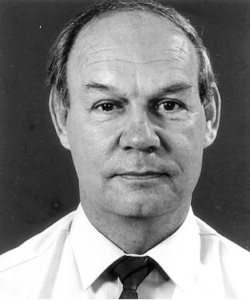
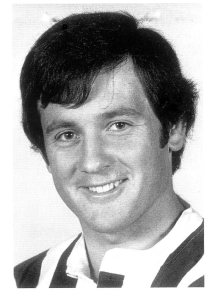
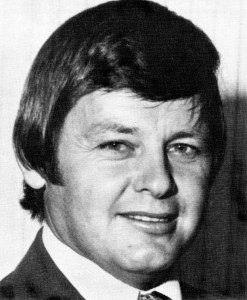
Greg “Brandy” Alexander
Player, Premiership Captain, Director, Commentator
Not many individuals connect the different eras of the Panthers story as completely as Greg Brandy Alexander.
He emerged from the Penrith district as one of the most gifted footballers the club had produced, became its first premiership-winning captain, represented New South Wales and Australia, and eventually returned to Panthers in another capacity — as a director.
His playing career coincided with the period in which Penrith finally moved from being an occasional contender to one of rugby league’s leading clubs. More than a decade later, his election to the Board placed him inside an entirely different Panthers story: the bitter struggle over governance and direction that forms an important part of Panthers, Passion & Politics.
Those two roles — player and director — make Alexander a significant figure in the narrative for quite different reasons.
Role in the Narrative
Greg Alexander represents perhaps the clearest footballing expression of the transformation Panthers had been attempting since the early 1980s.
The changes begun during that period were not simply about finding better first-grade players. They involved restructuring the relationship between the Football Club and the licensed club, improving coaching and development systems, and placing much greater emphasis on producing elite footballers from the enormous junior base available to Penrith.
Alexander became one of the clearest demonstrations of what that emerging system could produce.
By the time Penrith reached its first Grand Final in 1990 and won its first premiership the following year, he had become both captain and one of the most recognisable players in Australian rugby league.
His importance to Panthers, Passion & Politics, however, extends beyond the playing field.
Eleven years after lifting the premiership trophy, Alexander stood for election to the Panthers Board during the bitter 2002 election campaign. His election therefore provides an unusual bridge between the footballing rise of the 1980s and early 1990s and the governance conflicts that dominate the later chapters of the book.
Background
Gregory Peter Stephen Alexander was born in Penrith on 4 March 1965 and grew up in the district. He attended St Dominic’s College before completing his schooling at Patrician Brothers’ College, Fairfield, and represented the Australian Schoolboys in 1983.
His emergence was immediate.
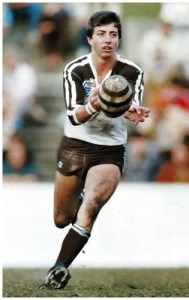
Alexander was both Penrith’s and the Dally M Rookie of the Year in 1984. A year later, still only in his second season of first grade, he won the Dally M Player of the Year, Dally M Halfback of the Year and Penrith’s Player of the Year award in 1990.
His emergence coincided almost exactly with a fundamental change in the way Panthers approached football.
The move to the Mulgoa Road complex and the adoption of a unified approach to the licensed club and football operations were accompanied by a deliberate effort to develop elite players from Penrith’s junior system. Alexander became compelling evidence that the district could produce players capable not merely of playing first grade, but of competing at the highest levels of the game.
In 1986 Alexander and Royce Simmons became the first Penrith players selected for a Kangaroo Tour. Alexander subsequently represented New South Wales and Australia and developed into one of the outstanding attacking players of his generation.
By the end of the decade, Penrith itself was changing around him.
Tim Sheens had helped rebuild the football operation and Ron Willey consolidated that progress, while players including Alexander, Simmons, John Cartwright, Mark Geyer, Brad Izzard and the emerging Brad Fittler gave the club a playing strength it had rarely possessed before.
When Phil Gould arrived as coach in 1990, he therefore inherited a very different football operation from the one Sheens had encountered earlier in the decade. The foundations were already there. Gould provided the standards, preparation and tactical discipline that helped take the team the final step.
Profession: Rugby League player, Media Commentator; Director
Panthers Involvement
• First Grade Player (1984-94; 1997-99)
• Premiership-winning Captain (1991)
• Director (2002-current)
Representative Honours
• Australian Schoolboys (1983)
• NSW State of Origin (6 games)
• NSW Super League Tri-Series (1997)
• Australia (6 Test matches)
Major Honours
• 1984 — Dally M Rookie of the Year
• 1984 — Panthers Rookie of the Year
• 1985 — PDally M Player of the Year
• 1985, 1989, 1991 — Dally M Halfback of the Year
• 1985, 1990 — Panthers Player of the Year (renamed Merv Cartwright Medal)
• 1991 — NSWRL Premiership winning Captain
• 2000 — Australian Sports Medal
• 2001 — Panthers Life Membership
• 2006 — Panthers Team of Legends
• 2016 — Inaugural Inductee, Panthers Hall of Fame
Relevance to Events Described
Alexander captained Penrith into previously unexplored territory.
In 1990 the Panthers reached their first Grand Final, losing 18–14 to Canberra. Twelve months later the same clubs met again.
This time Penrith won.
Alexander’s contribution to the 1991 Grand Final was characteristic of the player he had become. His second-half kicking game helped turn the match, including a long-range field goal that put Penrith ahead, before his sideline conversion of Royce Simmons’ late try helped seal the club’s first premiership.
Yet Alexander’s significance was greater than his performance in one match.
The premiership represented the culmination of changes that had taken place over many years. Penrith had developed from a club hoping to compete into one capable of producing its own international players and ultimately its own premiership-winning captain.
Alexander stood at the centre of that transformation.
What followed gave the story a profoundly different dimension.
In June 1992, Greg’s younger brother and Panthers teammate Ben Alexander was killed in a motor vehicle accident. Greg had already been sidelined by a knee injury and returned only later in the season. The loss had a deep impact on Greg personally, the Panthers playing group, the entire Panthers staff, and the wider community.
The full story of Ben Alexander belongs elsewhere in Beyond the Book. Within Greg’s profile it is enough to recognise that the tragedy became inseparable from the years that followed.
Alexander eventually left Penrith for the newly established Auckland Warriors, spending two seasons there before returning to the Panthers in 1997. He remained until his retirement in 1999. Across his two periods with Penrith he played 228 first-grade matches and scored 1,100 points.
Retirement did not end his association with Panthers.
In 2002 Alexander nominated for the Football Club Board at a time when the organisation was deeply divided. His candidacy would subsequently become associated with the group of candidates commonly described as the “management ticket”, but Alexander himself presented his nomination rather differently.
Alexander had told the Penrith Press that he had been considering standing for the Board for three years, since retiring from football, and wanted to give something back to the club. He also spoke positively of Roger Cowan’s contribution to Panthers. In a subsequent interview with the Western Weekender, Alexander acknowledged speculation about whose election “ticket” he might be running on, but said he had given it little thought. He wanted to be regarded as his “own man”, elected on merit, and said that decisions coming before the Board should be assessed individually.

Alexander also circulated his own recommended group of candidates. Significantly, it did not simply reproduce either of the principal groupings contesting the election. Among those he recommended was John Bateman, one of the five sitting directors whose conflict with senior management lay at the centre of the Board dispute. The issue later arose during the Temby Inquiry, when Alexander said that Rob Weaver had assisted him with the wording accompanying that recommendation.
Alexander topped the poll.
The election was subsequently examined closely by Ian Temby QC, particularly the extent to which senior management had become involved in determining the composition of the Board to which management itself was accountable. When Temby put that governance problem directly to Alexander, Alexander accepted the difficulty.
The episode placed Alexander in a very different Panthers environment from the one in which he had first become prominent.
The premiership captain had become a director.
The questions were no longer about football tactics, leadership on the field or winning Grand Finals. They were about accountability, organisational authority and the relationship between management and the Board.
Alexander’s relationships within Panthers also extended well beyond the Boardroom. Glenn Matthews later recalled that, when he decided to resign as Panthers CEO, Alexander was the only person outside his immediate family whom he told before announcing the decision to the Board. Matthews described a friendship stretching across virtually their entire adult lives.
Beyond Panthers, Alexander also established a substantial post-playing career in rugby league media, becoming a prominent television and radio commentator and analyst.
Legacy
Greg Alexander occupies a distinctive place in Panthers history.
There have been more premierships since 1991, more representative players and new generations of local juniors who have achieved things that once seemed almost unimaginable.
But somebody had to be first.
Alexander belonged to the generation that demonstrated what Penrith’s enormous junior base and increasingly sophisticated football system could produce. He became an Australian representative, an elite player and, ultimately, the captain who lifted the premiership trophy when Panthers won the competition for the first time.
That alone would secure his place in the club’s history.
Panthers subsequently recognised that contribution formally. Alexander was made a Life Member in 2001, selected at halfback in the club’s Team of Legends and, in 2016, became one of the four inaugural inductees into the Panthers Hall of Fame. He had also received the Australian Sports Medal in 2000.
His later service as a director adds another dimension. It connected one of the defining figures of Panthers’ first great football era with the difficult organisational period described in the later chapters of Panthers, Passion & Politics.
In that sense Alexander’s Panthers story spans an unusually wide arc.
He became the captain who helped vindicate it.
And years later, he became — and remains — one of those entrusted with helping govern the organisation it had helped create.
Related Topics
- Beyond the Book — The 1983 Strategic Reset
- Beyond the Book — The 1983 Strategic Reset — Did it Work?
- Part 65 — Hoist By Their Own Petard: The Footy Five Defeated
Related Themes:
Governance · Board Decisions · Football Club
To receive new Parts and occasional project updates by email, you may subscribe below.
Readers who hold recollections, documents, or material relevant to this history are welcome to contribute via the Commentary & Contributions page.
Project Updates
Receive updates when new parts are published.
Editorial Note
This profile is presented as contextual background.
Additional material may be introduced as the narrative progresses.