Part 8 of 70 — Original Chapter: Chapter 4: Insolvency to First Division in One Year
This article forms part of the serialised republication of Panthers, Passion & Politics – The Roger Cowan Years.
The licensed club was going from strength to strength despite ongoing problems between its board and the football committee. This conflict was to plague Cowan for fourteen years. He would tell every board member in those years,
This club is never going to be truly successful until we bring it all together – the club and the football. We have to be totally united.
There had always been two bodies. Merv Cartwright was the first secretary of the football club, while Cowan managed the registered club.1
Prior to the commencement of the 1967 season, the board of the licensed club had been asked to approve a budget of £40,000 to cover all rugby league-related expenses for the year. At the end of the season, Cartwright informed the committee that he would need £90,000.
The blow-out of more than 100 per cent was a huge impost on a club that was still struggling to establish itself. At that time it was easily the smallest registered club supporting a first grade team. Cowan was furious. So much hard work had been put into making the club profitable and Cartwright appeared to have little regard for budgets and financial controls. He seemed to have the view that there was a bottomless pit of money. Cowan says there were absolutely no controls over the football spending, with money continually wasted on unnecessary things.
When he took the job on the three-month trial, Cowan was confident that if he worked hard for a few months he would be on top of it all and then could take it easy. He was halfway through a university course as an external student of Armidale University. His plan was to get everything sorted out, and once that was done, “I’ll have plenty of time to study and take some time off”.
It did not quite work out that way. At the beginning of 1967, after 16 months of working 7 days a week, Cowan took his first day off since taking on the job. The Cowan family enjoyed a four-day break, driving to Broken Hill and returning via Mildura. The university course was never touched again.
Football expenditure in 1968 again exceeded the budget, and a couple of other problems had arisen with Cartwright during the year.
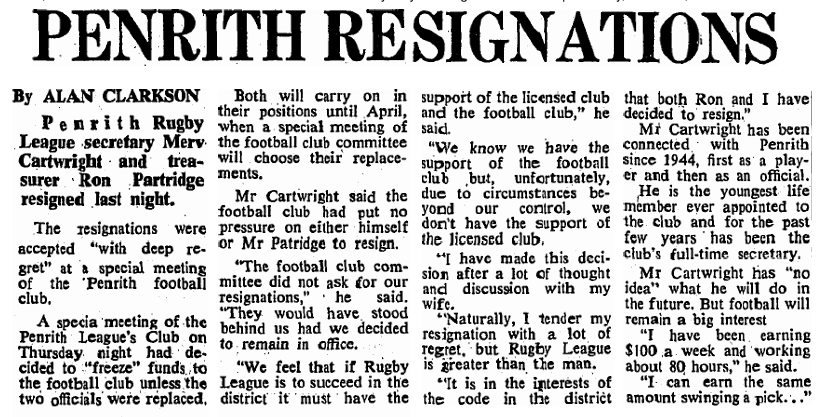
By 1969, the registered club Board had had enough. The events surrounding the removal of secretary and treasurer —Merv Cartwright and Ron Partrdige — are examined further in Beyond the Book: Removing the Football Club Secretary and Treasurer.
Eventually they called an extraordinary meeting of members. Realising the controversial nature of the event, they invited the mayor, Bill Chapman, to be chairman for the day. The Board’s recommendation was for the licensed club to cease rugby league funding unless Merv Cartwright resigned.2
Directors involved with the club during that period later described Cartwright in mixed but revealing terms.
Merv was an excellent PR man. He had the ability to influence and manipulate people. He did do a lot to build rugby league in the area and was very involved in the campaign for Penrith to join first division.
But he had lots of problems managing the money. Merv was always overspending, and Roger was trying to build a reliable business. That’s where a lot of the friction started.
The issues underlying that recommendation were more complex than this account suggests, particularly in relation to the Club’s financial position and governance arrangements at the time.
Around 1,000 of the club’s 6,000 members attended, with 80 per cent supporting the recommendation.
Cartwright did resign and moves were made to heal the rift between the two boards.
The District Club committee approached Cowan and asked him to take over as Secretary of the football club, a move that surprised him, given the history. The committee members said that they hoped such a move might help build a more co-operative relationship between the two clubs.
Cowan decided to give it a try. The move gave him responsibility for both entities but after less than a year, the frustrations of managing both sides of the organisation while reporting to separate Boards with competing interests proved unworkable. So, Cowan began advocating his policy to unite them under one board and one CEO.
On two separate occasions after his removal as secretary, Cartwright ran foul of the board of the licensed club and had his membership suspended. The board was adamant that he would never be allowed back into the club. This issue remained unresolved for many years, and intensified, particularly when his sons started to show outstanding rugby league skills and were selected to play for the Panthers.
The board received regular written appeals to lift his suspension.
Long-time director Barry Hubbard (1973-85)3 told of the meetings in the years after Cartwright left:
Every AGM, Tom O’Connor, who was on the board at that time, would stand up and ask for the reinstatement of Merv Cartwright’s membership. This would get a very cool reception from the chairman, Ken [Poker] Ausburn, and the ensuing debates were the fieriest I experienced in my whole time on the board. Ausburn and O’Connor would scream at each other across the room, and O’Connor would invariably end the argument with the words, “It is not British justice that Merv Cartwright, who has done so much for rugby league in this area, is barred from this club”.
Hubbard says the resolution was always beaten, and Ausburn would rule that the matter was resolved and was not to be raised again for the rest of the year. Apart from O’Connor the entire board was against the reinstatement of Cartwright’s membership.
At times, the disputes became highly confrontational, even farcical. In a heated discussion at one of those AGMs, the deputy chairman, Murray Clarke, who was the most vocal critic of Cartwright, was told never to venture into St Marys. If he did, said the speaker, he would never get out alive. It was Clarke who had previously cited Cartwright to appear before the Board after allegedly abusing him and threatening him in public.
The removal of Cartwright was to have ramifications for Cowan far into the future. The two had repeatedly clashed. Cartwright and his supporters blamed Cowan, not the board, for the loss of his membership. It was a festering antagonism that wouldn’t go away. In fact, it was one of the many small pieces in an intricate maze of events that would place Roger Cowan before Ian Temby in June 2004.
To receive new Parts and occasional project updates by email, you may subscribe below.
Readers who hold recollections, documents, or material relevant to this history are welcome to contribute via the Commentary & Contributions page.
Project Updates
Receive updates when new parts are published.
- At this time, both football and licensed club operated under the single entity of Penrith District Rugby League Football Club (PDRLFC). Separate committees had oversight of the football and licensed club operations. Penrith Rugby League Club Ltd was established in June 1967 to take responsibility for the registered club. ↩︎
- Related Board papers from 1968 and 1969 illustrate the growing conflict between the licensed club board and football administration. These papers are included in full in Beyond the Book: Removing the Football Club Secretary and Treasurer. ↩︎
- Barry passed away in 2021, aged 90. ↩︎

