Among the most complicated allegations examined by the Temby Inquiry were those concerning Phyro Holdings. The arrangements between Phyro and Panthers dated back to the early 1970s, making their reconstruction particularly demanding. Cowan says,
One of the criticisms that Temby made was that the Club didn’t really know what it owed me, and in 2002, I probably wasn’t sure either
From the time that the arrangement with Phyro began, I had always kept meticulous records of the work it did for the club. The trouble was, from about 1998, I had allowed myself to be drawn into conflict with some directors. By mid-2001 things were really starting to go downhill between Board and management. Then I had a heart attack and a bypass operation in January 2002. Six weeks later we were in the middle of a major conflict and I was back at work, full bang into the fight. They called Boon in, we had the aborted election and it was almost an all-in brawl a lot of the time.
Conflict in the boardroom was taking a lot of my time and energy. It started to dominate my thoughts and I began to take short cuts. I always made sure I was taking less than the contracts stipulated but sometimes I would put off doing an exact invoice because of more pressing issues. There was a time when the board executive used to come in every month and tick everything off, and the auditors used to check it regularly. My biggest regret during the inquiry was that I had not continued to maintain that quality of accounting.
The difficulty, as Cowan described it, was not the absence of records but the need to reconcile historical transactions with the contractual entitlements they represented.
Terrence Lynch says it was obvious from the outset that Phyro would be a contentious issue. In the months leading up to the announcement of the Inquiry the media had focused on its arrangements with Panthers. Michael Egan had made a number of comments on it, both in parliament and to the media. Phyro had been the subject of a front-page story and a feature article in the weekend Herald in September 2003, mentioning $2.9 million which had been paid by the Club to Phyro. This sum would be trotted out again and again by Herald journalist Paola Totaro in her stories covering the Inquiry, even after the facts surrounding it were brought out in evidence.
Most of the $2.9 million had been paid to third parties. More than $1 million went towards publishing and distributing 140,000 copies of Panthers Magazine each month, while another $1 million or more was spent on advertising. These were two examples of where the money went.
The contracts, in fact, spelled out very clearly that Cowan could not use his position to push more business to Phyro. How did this work? It was actually a quite simple arrangement. The contracts placed limits on the remuneration Phyro could receive from specified advertising and sponsorship activities. Those limits were intended to prevent Phyro’s financial benefit from increasing indefinitely as Panthers’ business expanded. However, the adequacy of the auditing and accounting arrangements would itself become an issue during the Inquiry.
Cowan agrees that it would have been inappropriate for his private company to hold open-ended contracts that could have been fattened by his decisions. That was never the case. He adds that if that had happened, it would certainly have come out in the extensive questioning and in the tens of thousands of pages of documents in the Temby Inquiry.
But from the day that Phyro started doing work for the Club, there was a limit on profit, and that was set in concrete by agreement with the Board executive. The Herald made continuous reference to a payment of $2.9 million to Phyro. It would have made no difference whether the sum was $2.9 million, or $29 million. The Phyro benefit would have been the same.
By the time the book was published in 2007, Phyro was no longer providing those services, and Panthers was paying other suppliers directly.
Allegations about Phyro in recent events could be countered readily enough. But Phyro’s longevity and Cowan’s insistence on confidentiality in his contracts obliged the Club’s counsel to rely on Cowan’s records for earlier years. Lynch describes how it was done:
Roger had told us that he had kept all these records, so very early in the piece, we actually forced him to go back over the previous ten years. We asked him to work out month by month what he was charging the club, and what he was getting over that entire period. It took some to-ing and fro-ing for Roger to get the idea of what we wanted, and the process was happening through the first part of the inquiry.
Something becomes obvious in Roger’s testimony if you read it – maybe if you didn’t see it happening, you wouldn’t know – but I could see it. As the reconstruction exercise progressed and clarified, Roger’s self-confidence in the witness box grew. At times in those first days, he sounded hesitant and fumbled over answers. One of the great fears you have when you face something like this is that you’re going to get a question about things eight years ago without notice. In that instant, how do you know whether you did something that long ago?
Reconstructing what he had done month by month was reassurance for himself, to let him know what he had done. So by the time they tried to drop a bundle on him, he had a very strong sense of how he had conducted himself.
And I believe that Temby responded to that. I think at some stage it started to dawn on him. I’m sure that at first, he probably did think there was corruption, but it dawned on him that there were deals, and some hanky panky accounting, but not corruption. No taking of money. For instance, when Roger said the figures were arbitrary in those first days, it sounded really bad, and everyone made a big issue of it, including the media. But through the process it came out, and Temby eventually got this, that the arbitrariness was about how you describe it, not about the actual figures. It was an arbitrary description that had nothing to do with dishonesty or corruption.
Cowan says there was one lucky break for him amongst all the blackness of the time.
I was becoming frustrated by questions that seemed to go around and around in circles, go nowhere, but leave the impression that I had taken more than my entitlements under the contracts. It was maximising the value of the inquiry for the media and making me look dishonest. Several times I gave evidence that I had taken less than my entitlements, and that the club owed me money. But of course there was no news value in that.
I asked John de Mestre, my legal counsel, to write a letter to the inquiry and offer a way to bring it to a head. The letter told them that they could select any forensic accountant of their choice to carry out a thorough audit of Phyro. I said I would pay for it, and I would make everything available to assist in such an audit. They refused my offer.
I thought it weird at the time, but now I wonder whether my goal – of killing off media speculation – was one they preferred not to pursue.
Later, I discovered that the exercise would have cost me around $200,000, so they did me a big favour.
To receive new Parts and occasional project updates by email, you may subscribe below.
Readers who hold recollections, documents, or material relevant to this history are welcome to contribute via the Commentary & Contributions page.
Barry Walsh recalled that Panthers had 20 people working night and day for months, assembling material for the Inquiry.
They were digging through files and going through archives, trying to put everything together, and the photocopier ran non-stop. We’d think we’d finished, there’d be another day of sittings and they’d want more.
The Inquiry eventually generated approximately 50,000 pages of documentation, filling some 200 lever-arch files. Most of the material was provided by Panthers.
The first sitting day was 8 June. The first witnesses, called for 15 June, were Barry Walsh and Roger Cowan. Walsh recalled being subjected to particularly rigorous questioning, which he considered at times amounted to badgering.
He says that every time he walked into the inquiry, he never knew what was coming.
I had no idea what I would be asked, and it was an extremely stressful time for everyone who was on the list to appear. They were asking you about things that happened sometimes twenty or more years ago, and to be perfectly honest, sometimes when you get older, you can forget some things. But they made it sound bad that you didn’t remember. Once you’d been there, you would worry night and day, waiting for the call to say that you had to appear again.
Walsh believed that the government was treating the five former directors who had made complaints as ‘Crown witnesses’. There were also rumours that members of the Footy Five met with DGR lawyers before giving evidence. Whether those meetings occurred, and what their purpose might have been, was not established.
Witnesses appearing before the Inquiry were subject to investigative powers that differed significantly from the procedures and evidentiary protections applying in ordinary criminal proceedings.
There was a period of frenzied activity at Panthers.
In the preamble to his final report, Ian Temby spoke of the legal requirements covering his appointment. He said that the one essential outcome was the provision of a report to the director of Liquor and Gaming stating his findings. If the director believed there had been a breach of the law in any Australian jurisdiction, or of any relevant act, he could then refer the matter to a law enforcement agency or any other interested body. The director could also order the Club to provide details on findings to all members, and to hold an election of the Board.
Temby also noted that the Royal Commission Act empowered him not just to summon witnesses. The Act states that witnesses shall not be excused from answering questions or producing documents on the grounds that doing so may incriminate them. These rules do not apply in a normal court of law. He added that under the Act, a person presiding at an inquiry such as this ‘is not bound by the rules or practice of evidence’. Temby reported,
While most of the evidence received by the inquiry was of the sort that would be admissible in an ordinary court, there were exceptions.
The Inquiry had extensive powers to compel witnesses to answer questions and produce documents, subject to the applicable legislation. Where second-hand or overheard remarks are inadmissible in a normal court of law, they were acceptable by Ian Temby under the rules of this Inquiry.
Some witnesses recounted conversations in which unnamed Panthers employees had allegedly claimed they were intimidated before an election. Those employees did not appear before the Inquiry, but the accounts were admitted into evidence. Their admission did not, of itself, establish that intimidation had occurred.
Staff intimidation was among the more serious allegations dealt with by the Inquiry. The way it was handled raises questions. One witness did appear, saying she felt that she had been intimidated before the October 2002 election. Her name was on a list of around 40 staff members that Panthers had provided to the DGR, at the DGR’s request. The DGR was given their names, addresses and contact phone numbers. Glenn Matthews says:
The names primarily came from attendees at the SCOT meeting1[the team leaders’ meeting] and from some friends of the Footy Five who tried to insist that management were pressuring staff.
Two others from the list of 40 appeared as witnesses, both denied any intimidation.
Greg Evans claimed to have the names of employees who said they had been intimidated. However, the manuscript records no evidence that those names, or supporting statements from the employees concerned, were produced during the Inquiry.
We know that some of the Five signed letters to the DGR. Logically the Five would have been interviewed about such allegations. If they had names, or affidavits, to back up some of their claims, wouldn’t they have handed them over to the DGR? The evidence was never produced – but such allegations are on the record anyway.
Terrence Lynch asked DGR counsel in final submissions to the Inquiry – did any, or all of the remaining 39 employees2 on the list deny having been intimidated? Lynch argued that the absence of testimony from other employees raised serious questions about how the allegations had been investigated. If those employees could substantiate the claims, he questioned why they had not been called. If they could not, he believed their absence cast doubt on the objectivity of the investigation.3
To receive new Parts and occasional project updates by email, you may subscribe below.
Readers who hold recollections, documents, or material relevant to this history are welcome to contribute via the Commentary & Contributions page.
Project Updates
Receive updates when new parts are published.
[1] SCOT Meetings included all the team leaders at Panthers (approx. 50) and the focus of these meetings was the Synergy and Cooperation Of Teams (SCOT). ↩︎
The original publication says “the remaining 379 employees”. That number makes no sense as Panthers had almost 1000 employees. This refers to the remaining employees who were on the list provided to the DGR. ↩︎
In his final report, Temby criticised Glenn Matthews’ conduct at the September 2002 staff meeting, concluding that he had encouraged support for the management ticket. The Report distinguished this conduct from the broader allegations of employee intimidation. ↩︎
On 16 May 2004, Sydney’s Sun-Herald newspaper ran a story with the headline ‘Mega-clubs face inquiry of ICAC proportions’. Alex Mitchell, the writer, revealed that Premier Bob Carr was about to announce that former ICAC chief Ian Temby QC would head up an investigation into the NSW clubs industry. According to the report, the proposed inquiry would have powers comparable to those of a Royal Commission. It would target mega-clubs such as Panthers, Bulldogs, Cronulla Sharks and Parramatta Leagues. The hearings would start on 1 June, said Mitchell.
ClubsNSW CEO David Costello questioned the fact that the new legislation would only target clubs. Hotels, casinos, online betting companies and a number of other industries also come under the department’s jurisdiction.
Of course, the Department of Gaming and Racing receives complaints. But only about one third of them pertain to clubs. And of that number – as in any system of complaints to government bodies – many are frivolous or vexatious.
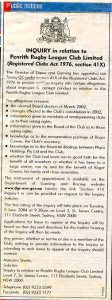
In the last week of May 2004, a small, one-column ad was run in two Sydney newspapers and publications in Penrith, Newcastle and Port Macquarie. It was headed ‘Inquiry into Penrith Rugby League Club Limited’. This was the first and only notification to Panthers that they specifically would be the focus of the new legislation. Cowan and the club had less than three weeks to prepare.
The ad, under the NSW Coat of Arms, went on to say that the director of Gaming and Racing had appointed Ian Temby to preside over an inquiry into allegations in relation to the club, under the new section 41X of the Registered Clubs Act. Six allegations were listed, and readers were directed to the DGR website. It said that anyone could seek leave to appear at the inquiry.
The six allegations fell broadly into three areas. The first four concerned the aborted March 2002 Board election, subsequent constitutional changes affecting voting rights, and whether members of amalgamating clubs or the Panthers Board had been misled about those rights.
The fifth concerned the disclosure of information about Cowan’s remuneration and the financial dealings between Panthers and Phyro Holdings. The sixth, and most serious, alleged that the Club had been run for the benefit of Cowan, his family and close associates, rather than in the interests of its members.
The allegations were set out in the public notice announcing the Inquiry. The notice in appeared in various metropolitan and regional publications. It is reproduced here.
Click to enlarge.
There was a period of frenzied activity at Panthers.
The allegations gave some idea of what would be required, but the extent of the investigations was yet unknown. In retrospect, a more measured assessment of the allegations might have led Panthers to approach the Inquiry differently. At the time, however, management began assembling whatever documentation it believed might be required, even though no subpoenas had yet been issued. Chairman Barry Walsh said they were flying blind.
That week, a story appeared in the Penrith Press in which Roger Cowan said ‘Bring it on’. Neither he nor the club had anything to fear, he said. But it was obvious to everyone at Panthers in June 2004 that the government meant business.
Ron Mulock asserted that Cowan’s challenge to ‘bring it on’ was the catalyst for calling the Inquiry, even though it had already been announced. Cowan calls Mulock’s claim nonsense.
He repeated the comment at a Panthers annual meeting after I said I believed he had lobbied for the Inquiry.
As for the remark, when the reporter asked me for my reaction to the calling of the Inquiry, I was certainly not going to say, “Please don’t”. That would have looked like an admission of guilt. The only thing I could say was that we had nothing to hide, and basically – if there had to be an inquiry, so be it. There was nothing we could do about it, except cop it sweet.
One thing I learned very early in life. You don’t stop the bully by looking scared or asking for mercy.
Former ClubsNSW chairman Pat Rogan says the government was very confident going into the Inquiry.
They were sure they were going to get something. Egan was looking for a scalp with the new tax coming in. If they could get a big one, the clubs would fall into line.
Souris believed that the government needed to discredit the club movement to justify the new taxes, and that they deliberately targeted the highest profile club and its CEO.
What really struck me was the fact that they actually got to the point of creating new legislation. Then they decided. We choose Penrith Panthers, we choose Roger Cowan.
George Souris, the Shadow Minister for Gaming and Racing agrees,
They were getting a bit of needle, particularly from some of those members from strong western suburbs electorates. They were cock-a-hoop that if they could scandalise Panthers to a great extent, the public mood would turn against the clubs. And their back bench would calm down.
Souris says the opposition’s support of the clubs on this issue was much more than token opposition.
It was the vindictiveness of Egan and Carr. They were peddling this personal hatred stuff, trying to win the argument over the taxes by killing off one of the star players. It was a campaign of personal denigration, singling out one club and one man.
We had become greater friends with the club movement anyway. We’d marched in the street with them. But I was amazed at the level of fervour from a government that seemed intent on attacking its own heartland.
And suddenly you’ve got this brand new legislation with the powers of a Royal Commission. What was that all about? The DGR has always been able to conduct investigations under the act, and it does so – quite vigorously. There’s probably a couple of hundred investigations going on at any one time.
So here’s 41X and the first time they use it, they pick Ian Temby – sure to attract the maximum media coverage – to run it’, Souris said. ‘It was specifically designed to escalate into some kind of judicial, some kind of Royal Commission circus, and it did.
Terrence Lynch appeared for Panthers at the Inquiry. He says the government knew what it was doing when it appointed Temby.
They thought that he would suit them, because if they really believed there was corruption, he was someone who would be aggressive about it.
Temby’s a moralist. He was once quoted as saying “to lie is corruption”. He had run high-profile inquiries, prosecuting Neville Wran and Lionel Murphy. He also made the finding of corruption against Nick Greiner – which of course was later overturned.1This is the point with Temby. What he regarded as corruption might be so in a perfectly moral world, but we live in the real world, and we must be judged – and judge others – by its standards. Basically, you have to assess the quality of conduct within some objective standards.
But the DGR had to act. Even Roger Cowan agreed on that point.
The DGR had no choice. It was the government that betrayed our system of justice and democracy when it decided to investigate the complaints by establishing a specially designed fishing expedition with quite extraordinary powers.
It was virtually saying, “Our investigators haven’t come up with the results we want. Let’s throw a big net over everything under Royal Commission powers, and we’re sure to find something”.
Such a high level of confidence on the part of the DGR and the government might explain what Cowan perceived as frustration in Mr Staehli, who was one of the counsel assisting the Inquiry. Cowan believed that the government’s expectations influenced the conduct of the Inquiry. Looking back, he offers his interpretation of the approach taken by David Staehli:
In this case Staehli was acting as a prosecutor. There can be no doubt that his task was to find evidence that would justify the allegations that had been made. Before it all started I believed in fairies, I think. I really thought that the inquiry would be looking for all the facts in an objective and impartial manner. In my opinion it did not happen that way at all.
I don’t know how a prosecutor works, but I imagine he would have made a detailed plan before he started. He had obviously been given a lot of information by the DGR, he would have information provided by the Footy Five, and there was all the information that I had been asked to provide for the previous ten years for Phyro Holdings, my wife and myself.
The DGR had spent the past year or so investigating the Club and taken no action. If Egan and his people were not expecting Temby to dig out something the DGR couldn’t find, there is a second possibility that is too horrible to contemplate – that the government knew from the start there was nothing to find. What if they suspected or knew the complaints didn’t hold water and that the claims had been discredited very early in the investigation by a team of competent DGR officers? If this were the case, it would mean that the Inquiry had no intended outcome for the government other than to heap negative publicity on the club industry.
Still, if there was an air of confidence Staehli would have drawn up his battle plans. I imagine he would have listed all the crimes I might have committed. Then he would have taken each one and drawn up a plan to lead me through events leading up to it.
He would start with questions that seemed broad and innocuous, questions that would encourage me to think I could twist the truth. As I became more comfortable, the questions would become more focused and more specific. Variations or contradictions in my answers would be highlighted. Gradually I would be led into each of the traps and there would be no escape route.
One reason it did not work was that I had no reason to twist the truth at any time. In fact, I believed that getting at the truth was the only thing that could save me from the jaws of a very formidable predator – the NSW Government.
A second reason is that Staehli had probably based his list of possible crimes on information that had been supplied to him but was not true.
I was patiently led up the paths of questioning. But there were no contradictions, no lies and therefore no trap to spring when Staehli arrived at each of his destinations. Towards the end of the Inquiry, his frustrationbubbled over into anger.
Cowan later recalled being told an anecdote about Staehli’s frustration during the Inquiry. Although he had no firsthand knowledge of the conversation, he found the story consistent with his experience:
After the inquiry ended, I was told an interesting story. Staehli was speaking to some legal friends of his frustrations during the Inquiry. He likened the experience to playing the old thimble and pea trick, where there is one pea and three thimbles, and the trick is to pick which thimble the pea is under. On a number of occasions he said he was convinced that a certain line of questioning would find the corruption he was seeking, but every time he lifted the thimble, there was no pea.
To receive new Parts and occasional project updates by email, you may subscribe below.
Readers who hold recollections, documents, or material relevant to this history are welcome to contribute via the Commentary & Contributions page.
Project Updates
Receive updates when new parts are published.
Ian Temby and the Greiner case: As NSW’s first ICAC Commissioner, Ian Temby presided over the investigation into Premier Nick Greiner’s appointment of former minister Terry Metherell to a public service position. ICAC found Greiner’s conduct to be technically corrupt under the legislation. The NSW Court of Appeal subsequently overturned the findings, although Greiner had already resigned as Premier in 1992. See ICAC Explained – a 2016 article from ABC News. ↩︎
In September 2003, while the Treasurer was fighting off the flak generated by the new taxes, Panthers suddenly began to receive adverse media coverage.
When the allegations against Roger Cowan came to light in The Sydney Morning Herald, their timing was politically advantageous for Michael Egan. But was it just coincidence? We know that the government and the Herald were sent the same allegations in 2002. The newspaper had the information for around a year.
Was it just coincidental that the Herald timed its coverage perfectly for the government?1
The two Herald journalists – Anne Davies and Paola Totaro – were to play a big part in the story. In many articles through 2003, Totaro’s by-line carried the title ‘State Political Editor’. In her later stories covering the inquiry, this by-line was not used.
The first major hit on Panthers came in the weekend edition of the Herald, 27-28 September 2003, with the lead story by the two journalists in the paper’s News Review section. The story made allegations about Roger Cowan’s family company and its dealings with Panthers. The Herald ran stories about Cowan and the Club over four consecutive days. In another apparent coincidence, 28 September was the day that former directors Geoff James and John Bateman spoke to Ray Hadley on the radio. James boasted that he and his colleagues had initiated complaints to the DGR.
According to a number of sources from the press gallery and Macquarie Street that Ron Mulock was walking the halls of Parliament around this time, lobbying on the subject of Roger Cowan and Panthers.
Though he did not admit to that accusation when Cowan put it to him at a Panthers 2005 AGM, Mulock said that “questions needed to be asked and answers needed to be given and they haven’t been given over the past 27 years”.
The club industry’s protest rally was scheduled for 1st October, three days after the article appeared. The rally would see 15,000 people march on Parliament House in Sydney. The crowd included club patrons, management and staff, representatives of religious and community groups, entertainers, suppliers, sporting people and federal and state politicians.
George Souris, Shadow Minister for Gaming and Racing, was one of the leaders of the march, as was Pat Rogan. Speaking late in 2005, Souris said,
In attacking the clubs, Labor is attacking its own heartland, I can’t understand this. People that go to clubs are the everyday people out there in the suburbs. The bowling clubs, the soccer clubs, they often provide the only sports facilities for the community in their areas. If the tax forces them to close, those facilities are lost forever.
At the time of the Allen report2, sporting venues maintained by clubs included 1,621 bowling greens, 102 gyms, 325 sporting fields and 338 golf courses. While some clubs own their facilities, others are council owned, and the clubs take responsibility for maintaining them. Panthers’ rugby league ground — Penrith Stadium — is an example. It is held in trust by Penrith City Council, but it has been maintained by the club since Penrith joined the rugby league first division in 1967.
The ten electorates to be hardest hit by the tax were held by Labor.3 Egan was facing a backbench revolt. The day after the rally, a vote was taken in the ALP caucus on a motion to review the tax. The count was 34 all.4
Against that background, the publication of serious allegations against the CEO of the country’s biggest licensed club came at a politically convenient time for the government.
Cowan recalls a further burst of activity by the DGR at Panthers soon after the revelations in the Sydney Morning Herald and wonders whether the government was putting extra pressure on DGR officers.
A few weeks after the October rally, planned changes to the Registered Clubs Act 1976 were announced that would provide broad new powers of inquiry. The new provision became Section 41X.5
George Souris had entered the fight against the new legislation quite early in the picture. In 2005 he said,
41X came in during the campaign against the clubs. It was never part of the Act before 2003. This whole thing with Royal Commission/inquisition inquiry powers [is new]. It’s always been possible to have investigations under the Act. There are investigations going on all the time – about 200 going on now, as we speak. And in appointing Ian Temby, they knew they’d get maximum mileage.
Souris believed that the government needed to discredit the club movement to justify the new taxes, and that they deliberately targeted the highest profile club and its CEO.
What really struck me was the fact that they actually got to the point of creating new legislation. Then they decided. We choose Penrith Panthers, we choose Roger Cowan.
He added,
And then there’s the sub-plot; they were being fed all this crap which gave them the ammunition they needed.
Panthers was going to be one of the worst affected by this tax regime. It would be expected to pay a minimum of $17 million additional tax each year. By the time the tax was fully implemented, the club’s tax would increase from $26 million to $43 million, provided that its revenue remained at the same level.
Apart from being an outspoken critic of the NSW government’s moves against the clubs, Roger Cowan was seen by some in the government as the prime mover behind the Registered Clubs Party6, which formed in the late 90s and ran candidates for the Upper House.
Second on the party’s ticket was Cowan’s son, Stephen.
But Cowan always questioned the wisdom of running candidates representing the club industry.
I was particularly averse to the use of the name Registered Club Party. In my mind, we were on a hiding to nothing. I thought any gains from a win would be marginal, and a loss would demonstrate that the industry was politically weak.
Till recently, I never really held to the common belief that the two million plus club members in NSW could be mobilised to a strong electoral advantage. The government has made such an enormous attack on the industry that circumstances might have changed … they haven’t moved the goalposts, they’ve chopped them down.
In the late 90s, despite his reservations, some people identified Cowan with the new party.
It later became clear that some people within the Labor party were hostile about the entire episode, and to a large extent, they held me responsible. The fact is, I had nothing to do with the decision to form a party. Once it was decided, I felt I had to recommend that Panthers support it. If it had been my choice, there would never have been a Registered Clubs Party.
Looking back, it was probably a tactical error, but the government reaction is still difficult to understand. It is just one example of some of the spitefulness that existed within the Carr government. To me, none of this seemed to fit the image of the traditional ‘light-on the-hill’ party built by, and for the working man.
But I was once warned in no uncertain terms, over a completely different issue, that this party does not forgive, or forget those who oppose it. The warning came from someone who should know – a former deputy premier of NSW, Ron Mulock.
Cowan says he always tried to ensure that club management worked with the industry regulatory bodies in a spirit of open and honest co-operation. Phil Bennett, who was an inspector for the Liquor Administration Board – the forerunner of the DGR – in the seventies, bears this out.
‘Roger was usually very co-operative in his dealings with the LAB’, said Bennett.
He always used to put his hand up. He was a man of conviction, and if he believed something was wrong, he would always stick his hand up and say so. He didn’t always go with the flow, but he always tried to work with the department to educate officers about new trends and innovations, which most LAB people saw as positive.
Glenn Matthews confirmed this:
We were always totally open with the DGR – still are. Roger always maintained that it was best to work with them and co-operate fully. We had such good systems in place that everything was easy to track anyway.
The result was what Cowan describes as ‘a very good working relationship with the department and its principal officers’. Cowan says they worked out quite quickly that the investigations in October 2003 related to elections and amalgamations. Geoff James’ call to Ray Hadley had confirmed the origin – and the timing – of the complaints, and also that a second letter had been sent in June of 2003.
An unnamed source gave Cowan details of the June letter. It was worded much more strongly and threatened that the matters would be taken to ICAC (NSW’s Independent Commission Against Corruption) unless urgent attention was given by the DGR to the original allegations. It seemed that the Footy Five were not about to let the matter die.
But most of the complaints had already been investigated, and the DGR had taken no action. We knew that there were allegations related to Phyro, and several questions about that subject had been answered. The new legislation relating to salary disclosures was in the pipeline, so I assumed the DGR would want more when that came through. I was still not really concerned. I could see no areas where we would have anything to answer.
During the investigations into my own situation, the inspector made one appointment [to see me] on the pretext of verifying the accuracy of salary disclosures given by the club. He made it sound routine, and said they were carrying out the same exercise with the top 50 clubs. This appeared quite logical, given the new legislation.
Very soon into the interview, his questions made it quite obvious there were broader objectives in play.
One of the criticisms levelled at Roger Cowan is that for a man of his talents and business acumen, he has, at times in his life, been incredibly trusting, even naïve. This time things suddenly began to fall into place in his head, and he started to become concerned.
It became obvious in the mad flurry of publicity and investigations that I needed to take some good legal advice. The gist of it [the advice] was that the combination of recent events made it very foolish to continue our policy of openness and co-operation with the DGR.
This caused some conflict for me. I asked for a meeting with Darryl Freeman from the DGR and reiterated my preference to maintain our policy of openness. But I also needed to protect my own interests. Yes, they had a right to expect my co-operation, but I questioned their right to go on a wild fishing trip into my affairs.
I explained my suspicions that the DGR was under pressure to find anything, no matter how minor, to discredit me and thus to discredit Panthers.
Memories of the police investigation some 15 years earlier7 had made Cowan a little shy of co-operating with people who may be on a witch hunt. Despite his experience, when the inquiry began Cowan still did not have personal legal representation. The Club was represented by Terrence Lynch.
I appointed my own legal representative a few weeks after the Inquiry commenced, when I belated came to understand that my interests and the interest of the Club were quite separate.
To receive new Parts and occasional project updates by email, you may subscribe below.
Readers who hold recollections, documents, or material relevant to this history are welcome to contribute via the Commentary & Contributions page.
Project Updates
Receive updates when new parts are published.
In Part 67 we noted that the very well respected journalist, Paola Totaro, worked in Bob Carr’s team for period between 1988 and 1995. ↩︎
The Allen Consulting Group’s 2004 report, commissioned by ClubsNSW, examined the economic and community contribution of registered clubs in NSW and the potential consequences of the proposed gaming tax increases. The report was also discussed in Part 67. ↩︎
Speaking in the NSW Legislative Assembly on 15 October 2003, Liberal MP Anthony Roberts (Member for Lane Cove) claimed that the electorates most heavily affected by the proposed gaming tax increases were held by Labor. He identified Cabramatta, Penrith, Bankstown, Lakemba, Smithfield, Mount Druitt, Tweed, Parramatta and Strathfield, stating that the affected electorates contributed approximately $807 or more per voter. (NSW Parliamentary Hansard, Legislative Assembly, 15 October 2003.) ↩︎
Under NSW Labor’s caucus rules, a caucus majority could require the government to reconsider a Cabinet decision. A motion was put seeking to reopen negotiations over the proposed gaming tax thresholds. The vote was tied at 34–34. As the motion failed to secure a majority, it was defeated, leaving the government’s position unchanged. ↩︎
Section 41X of the Registered Clubs Act 1976 provided for formal inquiries into registered clubs. The provision was introduced in 2003 and later repealed in 2011. Its significance is discussed in Part 66. ↩︎
The Registered Clubs Party was established in the late 1990s to represent the interests of the registered-club industry in NSW politics. It contested seats in the NSW Legislative Council but did not achieve electoral success. Its involvement in state politics became another source of tension between the industry and the Labor Government. ↩︎
This investigation is covered in Chaprter 8 — A Taste of Injustice (Parts 22-25). ↩︎
When Michael Egan brought down his 2003 Budget on 24 June 2003,1 it contained massive tax increases on registered clubs. The announcement caused great consternation across the club industry and its communities and triggered major protests, including two rallies held in Sydney.
In the year leading up to the increase, the government was in discussion with the state’s registered clubs’ peak body, ClubsNSW. Pat Rogan2, the organisation’s president, was assured that before any changes were made to taxes on poker machine revenue, there would be a period of consultation.
ClubsNSW CEO David Costello said both the former treasurer and the former minister for Gaming and Racing, Richard Face, had promised to consult the community before increasing the taxes. Some increase in tax was expected, and that was accepted in some quarters.
Speaking in early 2006, Costello said,
The industry has never been shy about paying a fair level of tax. But we’ve demonstrated – and the study carried out by the Allen Consulting Group bears this out — that the proposed legislation has the potential to destroy the industry.
Allen Consulting was the consulting firm engaged by ClubsNSW later in 2003 to carry out a study of the impact of the tax on the industry.
When the 2003 tax hikes were announced, Roger Cowan was one of the strongest critics. He believed the Labor government had no understanding of the potential of the club industry and that the tax increase was a short-sighted strategy that would destroy that potential.
The very people who have always been looked upon as the traditional supporters of the Labor Party were those who would be most hurt by the greedy tax grab. If there were an iota of business sense in the party, it would demand a proper study into the potential of clubs in the areas of community support, tourism, sport and recreation.
A clever government might even think of ways to maximise that potential by decreasing club taxes in such a way that its revenues would grow through increased business activity within the state, rather than destroying the potential.
They have no idea what they are destroying. But then they have the same shortsighted approach when they greedily grab extra revenue out of property transactions, and saddle motorists with tolls inflated because of secret deals with tollway operators. All these short-term grabs have dampened investment and damaged business momentum in NSW.
They were supposed to be running the biggest business in the country and they had no idea of one of the most basic principles: you must reinvest in the business to build it.
The day before the Budget was brought down, ClubsNSW representatives – including Pat Rogan – were called to Parliament House. Rogan recalls how the Treasurer told them about the changes.
I asked the Treasurer “What about our agreement? What about the review we were promised?”
Egan’s answer was, “We’ve done our own inquiries, and this is it.”
There was no more discussion. When I asked about the actual figures, I was told, “You’ll find out tomorrow night.”
It was an especially bitter pill for Pat Rogan. He had spent more than 25 years in the NSW Parliament as the Labor member for East Hills and felt he was entitled to expect better treatment from the government.
Speaking in 2006, Rogan said it didn’t matter what anyone tried to say to Egan about the club industry.
He would say “You can talk to me all day about clubs, you’ll never convince me”.
Rogan and Egan had been comrades in parliament for 25 years. He believes that Egan was the driving force behind the campaign against the industry. Says Rogan:
Egan was vindictive, and Roger was a particular subject of his vindictiveness. Egan once told me, “Panthers will be gone in a couple of years”.
In their first story focusing on Panthers in September 2003, Sydney Morning Herald journalists Anne Davies and Paola Totaro3 describe Michael Egan as a ‘prodigious hater’.
They quoted Egan:
Panthers is no longer a community club. Penrith might be premiership material on the footy field but the registered club is a wooden spooner when it comes to supporting the community.4
The journalists noted that the club had made community donations of $2.26 million in 2001-02, given its football team $2.8 million, and that its net profit was $2 million. Rogan says,
Roger was always at the forefront of the fight.
Quite early on, I told him that big clubs had a problem with Egan.
On top of that, Richard Face saw Panthers’ amalgamations as head-hunting. Of course it wasn’t like that at all. All those clubs were in some type of financial difficulty, and they were approaching Panthers – at the rate of about one a week. But Face could never grasp it – he said that Panthers was “gobbling up the industry”.
Many in the club industry didn’t regard Face highly as the minister responsible for clubs. They thought he did to make any real attempt to get a proper understanding of the industry workings.
To Cowan and others in the club industry, statements made by Egan around the time of the Budget indicated that he did not fully understand the role of clubs in the community, the way they operated or the profits they made. He certainly was quick to disregard all the rationale presented by those opposed to the tax.
For instance, unlike regular company tax, it was clubs’ revenue that was being taxed, not their profits. ‘This tax applies irrespective of profit’, says David Costello. ‘And it poses a serious threat to the financial viability of many clubs.’
Roger Cowan had first-hand experience of Treasury’s level of understanding of the way that clubs work. In the late 1990s, he had organised a meeting with the Treasurer, and was in the waiting room outside his office.
There was a woman also waiting for the Treasurer. She told me that she was there for the meeting; Egan apparently wanted somebody from his department to sit in. I think she said she was the head of the Treasury department, but it was certainly some high-level job.
While we were waiting, we got into a conversation about some of the difficulties of running clubs and trying to make a profit. I made the point that it’s not as easy to make a profit as some people think it is.
She looked quite surprised and said, “Why would you need to worry about that? You’re a non-profit organisation – you don’t have to worry about making a profit”.
At first I thought she was joking, but then I realised she was quite serious.
I told her, “Well, if we don’t make a profit, we make a loss, and if we keep making losses, we go out the back door. We have to make a profit!”
This was a person high up in the Treasury department, and she just did not have a clue about the way clubs work.
Rogan says that Egan had his own perception of what a club should be – small, intimate, friendly, like the old-style local club, where everyone knew everyone else. Old Fred Smith came in at the same time every day and sat in his same chair; the staff knew everyone by name, and vice versa. He claims that Egan held the view that the club industry had lost its way.
But clubs had to grow. The members demanded it. The clubs that were getting the crowds were the ones that had better facilities, better food, good entertainment. If members don’t get what they want from their club, they’ll go somewhere else. Clubs are like companies in that they are directed by their members – who are the shareholders.
The club industry’s criticism of Egan was reinforced by Treasury documents later obtained by ClubsNSW under Freedom of Information.
Documents obtained by ClubsNSW under Freedom of Information reveal that just six weeks before Michael Egan announced his billion dollar tax increases, senior Treasury officials Michael Clark-Lewis, (Director, Revenue Strategy) and Robert Carling (Executive Director, Economic and Fiscal), had signed off on a top rate of 30.59 per cent. The rate for the top-earning clubs at the time was 26.25 per cent (on a post GST basis).
When the figures were presented to the Treasurer, he would not accept them. He sent the officials away to rework the figures. The top rate in the revised option – again signed off by Clark-Lewis and Carling – was 34.59 per cent. The recommendation was again rejected.
Eventually the Treasury officials appear to have got the message.
On the third attempt, they came up with a tax rate increase ranging up to 49.09 per cent for the top clubs.
Pat Rogan claims Egan had a special place in the Carr Government:
Egan was a unique character in the ALP, one of the untouchables in the Carr government. All the other ministers had to go to the Premier to get things checked off. But this did not apply to Egan.
In fact, Rogan claims it was the other way around. Egan ran his own race, and Bob Carr had to go to him. He also believes that at one stage the Premier was willing to have another look at the tax, but Egan said no.
Rogan remembers Egan once being asked,
“What about due diligence, what about the social impacts of the tax?”
His answer: “We don’t have to do things like that.”
No independent study of the kind sought by the industry was commissioned by the government. In fact, in 2004 – in answer to criticisms that there had been no economic study of the impact of the tax increases on either clubs or the community – Michael Egan said there was no need for an independent analysis of the tax.
He told a budget estimates committee at Parliament House in September that year that the only economic analysis of the tax had been that of ‘commonsense’.
Egan repeated the statement in an interview on Sydney radio station 2GB on the day of the second Axe the Tax rally.
The assessment can be made on a commonsense basis, and I’ve made that.
Also in September 2003, ClubsNSW commissioned the Allen Consulting Group to conduct a study on levels of taxes that could be sustained by the industry. Allen Consulting had previously done work for the government, a fact that ClubsNSW felt would help give its findings credibility.
The Allen Report, released in May 2004, painted a bleak picture for the club industry. It predicted job losses of 24,000 in the first seven years of the tax, along with massive cuts to community funding and many club closures.
The report gave what it called a conservative estimate of clubs’ overall contribution to the NSW community. This was $1.8 billion annually, including all taxes paid by clubs. On top of this, clubs also provide sports and fitness facilities; venues for socialising and meeting friends; food and beverage at reasonable prices and quality, said the report. The figure does not take into account the many volunteers who work with clubs, particularly in junior sport. Clubs also provide free or subsidised services – such as the use of meeting rooms and other club facilities – to community clubs and organisations.
In addition to cash donations of $102 million annually, the report noted that a great deal of in-kind support often accompanied those donations, making the total contribution difficult to quantify.
The report contained a scale of taxation levels that the authors saw as sustainable by the club industry. The figures were in line with the first set of figures presented to Michael Egan by Clark-Lewis and Carling before the 2003 Budget. Cowan laments the need to investigate sustainable tax rates imposed by a state government wearing blinkers.
It is short-sighted and illogical to set an objective of finding out what tax rate is sustainable. That is like saying “what is the highest tax the industry can afford to pay?”. The object should be to identify the potential of the industry in areas that would also generate government income. The next step is to see how that potential could be used in a way that would provide wins for all concerned — the government coffers, community amenities, tourism, other business sectors.
If the federal government took such a narrow approach it would increase company tax to 50% or so. But it wants to encourage investment and business growth, and make Australia so prosperous that taxes roll in from all directions. Imagine the investment that would occur in NSW if poker machine taxes were only 15%, for example. The result would be a big boost to tourism, sporting facilities, employment, sales tax, payroll tax, and support for charities. There would be wins everywhere. In the long run the government might actually gain financially by setting reasonable tax levels.
Reasonable is a long way below the ridiculous rates now in place. The same argument applies in real estate and property taxes. A government just can’t be an armed bandit and the builder of business at the same time.
Unfortunately, such changes would require the sort of long-term thinking that seemed to have no place in the greedy Carr-Egan government.
To receive new Parts and occasional project updates by email, you may subscribe below.
Readers who hold recollections, documents, or material relevant to this history are welcome to contribute via the Commentary & Contributions page.
Project Updates
Receive updates when new parts are published.
The tax increases announced in the June 2003 NSW Budget applied to what the legislation and government described as gaming machine “profits” — broadly, the amount wagered through poker machines less the prizes paid to players. In conventional business terminology, this was closer to gaming revenue or gross gaming revenue: operating expenses such as wages, premises, administration and other costs had not been deducted. This distinction was central to the clubs industry’s objection that the tax applied irrespective of whether a club itself made a profit. The increases were to be phased in progressively over eight years and were heavily weighted towards larger, higher-earning clubs. Clubs earning less than $200,000 from gaming machines remained exempt, while those earning between $200,000 and $1 million received a slight reduction in their tax rate. Approximately 515 clubs earning more than $1 million bore the increases, with the marginal rate for the highest-earning registered clubs eventually intended to reach 40 per cent. ↩︎
Pat Rogan (1936-2015) was prominent Australian Labor Party politician who served as a member of the New South Wales Legislative Assembly for East Hills from 1973 to 1999. He later served as the Chairman of ClubsNSW. He was posthumously honored with the Order of Australia Medal (OAM) for his extensive service to local communities and NSW clubs. ↩︎
Paola Totaro worked in a media role (press secretary, media advisor) for Bob Carr while he was the Opposition Leader (1988-1995). She had left The Daily Telegraph and had not yet joined the Sydney Morning Herald. She continued to follow the Panthers story through the Inquiry. ↩︎
The longest walks I ever made in my life were down Elizabeth Street1, and turning the corner to face all those journalists and cameras outside the court.
Panthers chairman Barry Walsh made that walk a number of times in 2004.
In May 2004, Cowan and Panthers were called to appear before the first inquiry conducted under the NSW government’s Section 41X legislation.2 This new section of the NSW Registered Clubs Act had appeared at the end of the previous year, around the time of major demonstrations against new taxes on clubs.
In late September 2003, the NSW government was in a spot over tax increases on clubs, and a major protest was imminent. A story broke in The Sydney Morning Herald about the dealings of Roger Cowan, his family company, Phyro Holdings, and Panthers. And the state Labor Government was breaking legislative ground by preparing to introduce legislation that would give it Royal Commission-style powers to investigate allegations concerning clubs.
In the aftermath of the second election — the October 2002, election — some members of the Five made allegations to the Department of Gaming and Racing (DGR).3
Darryl Freeman, from the DGR’s legal section, was contacted several times to request copies of the complaints, but he maintains that the DGR protects its informants, and that he would never approve a Freedom of Information request for the letter. He did, however, confirm the existence of a long letter with at least two signatures and possibly more. Later, a formal application under Freedom of Information was also rejected.
So, neither Cowan nor Panthers’ legal representatives have ever seen the allegations in those letters. Subsequent events indicate that they concerned the election itself, Roger Cowan and his family company, and accusations that Cowan misled both the Board and members of amalgamating clubs.
Allegations of this type would subsequently form part of the government’s action against Cowan and Panthers.
Some in the group [the Five] admitted contacting The Sydney Morning Herald at the same time.
Ron Mulock had strongly supported the Five. In 1998, without any discussion or negotiation, he embarked on a campaign to discredit Cowan.
When the dust settled after the election in October 2002, things seemed to go back to normal at Panthers. The new board — nine from Penrith and five from the amalgamated clubs — came together well. Cowan and the management team breathed a sigh of relief, happy to return their full focus to running the business.
Throughout the election campaign, and indeed even earlier, the DGR had a presence at the Club. The aborted board election of the previous March had gained DGR attention, and if — as Geoff James claimed — a letter had been sent by the Five in August, there was even more reason for them to be there.
Dennis Coffey had complained to journalist Roy Masters at a Melbourne Cup day function in November 2002 that a letter had also been sent to The Sydney Morning Herald but there had been no response. Coffey said the group had sent complaints to the DGR, and to the Herald. At the time Masters shrugged it off. He later told Cowan that nobody at the newspaper saw any reason to follow it up — or to mention it to anyone at Panthers. It was seen as bravado – or sour grapes — from a group of embittered men. It would be another year before the newspaper would see any news value in the allegations.
Quite soon after the second election, the DGR activity increased. Nobody was particularly concerned. The new board and management believed they had nothing to hide, and nothing to answer.
From around Christmas 2002 until well into 2003, the DGR officers spent a great deal of time at the club. According to Glenn Matthews, then financial controller, they were extremely thorough, and appeared to be satisfied with their findings in each of the areas of complaint. No action was taken against Panthers throughout this period.
To receive new Parts and occasional project updates by email, you may subscribe below.
Readers who hold recollections, documents, or material relevant to this history are welcome to contribute via the Commentary & Contributions page.
Project Updates
Receive updates when new parts are published.
Barry was headed toward the St James Centre at 111 Elizabeth St, Sydney. On the third floor of that building was the hearing room used by the Police Integrity Commission (now called Law Enforcement Conduct Commission). This room was used for the Inquiry conducted by Ian Temby for the Department of Gaming and Racing. ↩︎
Section 41X of the Registered Clubs Act gave the Director of Liquor and Gaming power to appoint an investigator to inquire into specified matters concerning a registered club, with extensive powers to obtain evidence and require the production of documents. Panthers was the first club investigated under the provision. A second Section 41X inquiry, concerning Paddington Bowling Club, was conducted in 2007. The provision was repealed in 2011. ↩︎
The Department of Gaming and Racing (DGR) was then the NSW government agency responsible for the regulation of registered clubs, liquor and gaming. ↩︎
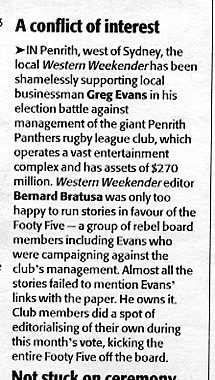
Leading up to the election, Cowan was on holiday in Malaysia, but he was in contact with senior management and the non-aligned board members. Matthews was acting CEO. When the Western Weekender story hit, there were some urgent changes in strategy at the Club.
The Board conflict had also taken a toll on senior management. John Wilson was among those whose morale had suffered, while Glenn Matthews had begun applying for positions elsewhere. Matthews, who had risen through the Panthers organisation and had been identified as Cowan’s eventual successor, could see little future in remaining if the conflict continued.
Cowan had become increasingly concerned for the future of the Club if the Five retained their Board majority. And once the Weekender published the ‘Board Wars’ story, Barry Walsh was ready to pull out all stops. Cowan and Walsh discovered they had different ideas on strategy during a phone conversation from Malaysia. Cowan recalls,
My feeling was that we only had to remove two of the Five to remove their domination. Barry had already released a ticket with Bateman and Coffey, and I thought we could soften our attitude towards Geoff James. He had been a director a long time, and he was going through some personal crises. I even felt some sympathy for him at the time but I soon learned how easy it is to misplace such a valuable emotion.
I said to Barry,
“Maybe you are biting off too much here? It would be a lot easier to have two voted off than five”.
But they decided to go for the lot. It proved to be a wise move.
Until the Board Wars article, the extent of the Board conflict had not been widely known among Club staff. Now it seemed there was an attack on the management and on some directors who were quite popular with the staff. And now, for the first time, staff had an opportunity to vote
Ian Temby investigated the proposition that staff were pressured into voting against the Five. Glenn Matthews told the Inquiry that after the Weekender came out on Wednesday he had been inundated with requests from staff asking him what was going on.
I even had union delegates asking what’s happening. I could see how important it was for the majority of the 800 or 900 employees of that site.
Matthews headed up a regular team leaders’ meeting on the Friday after the Board Wars story hit.
I had a couple of outcomes I wanted to achieve at that meeting. Roger was away and the place was chaotic. First of all, I wanted to answer any questions about the article itself. I think I actually mentioned a no-confidence motion in the CEO. I was also being asked whether staff could vote.
Matthews says he held up the article, and that he told those at the meeting,
If you want to get rid of management, here is your chance.
He says he answered questions about the content of the article and explained that staff could vote. He told them that if they felt strongly about what was happening, they might exercise their right to vote.
He admits that he told the managers at the meeting that those calling themselves the Footy Five were in direct conflict with Cowan but says that was merely confirmation of what had been printed in the Weekender. He categorically denies that he told those at the meeting either to vote, or how to vote, although that particular allegation was put to him many times.
Evans and Bateman maintained that they had information, even affidavits, from staff members who said they had been pressured or intimidated. No affidavits were produced at the Inquiry, although one staff member appeared saying she felt intimidated. The DGR had been given a contact list of 40 Panthers employees. Terrence Lynch questioned opposing counsel as to why only three of those were called to give evidence.
What about the rest? If you’re not prepared to tell us what they said, then the inference is that they had nothing bad to say.
Matthews says there were two how-to-vote cards at the meeting – the one that had appeared in the Weekender, and the one that Temby took to calling the ‘management ticket’. Matthew says,
Members obviously made their own decisions about voting. They must have consciously decided how they voted. There were not following asterisks this time. Some people have said the fact that Greg was running, and had spoken out convinced them to go out and vote. But his ticket was not followed fully, or Bateman and Coffey would have got up. Also, staff voting the ‘management ticket’ could not have tipped the balance if the majority of other members had gone for Greg’s ticket without changes.
With any football team there is a group of diehard supporters who live and breathe their club. These are the people who make the massive coloured flags that fly at games all over the country. They are there through wind, rain and in freezing conditions. They travel on overnight buses to Melbourne or Brisbane to support their team. They are also a very strong network, with some very vocal leaders.
Some long time Panthers fans interviewed for this book said they were shocked when the Weekender story appeared, especially when it suggested that four of the directors were too old and should therefore go. Walsh, Rhind, Heidtmann and Armstrong were well known among supporters. For many years they had seen them, spoken to them, at Penrith and when they travelled to away games. A full-page ad, endorsed by Mulock and Cartwright supported the Footy Five and suggested the other four directors did not care about League.
The supporters said none of it rang true, and word went out. Up till then most had been casual about board elections but that was about to change. Alexander was certainly a factor but, if the members were just following his ticket, two of the Five would have been re-elected.
Matthews says that everyone at the inquiry seemed to assume that all the staff voted the one way and that that was what swung the election. ‘I know for a fact that’s not the case’.
Our employees have always been encouraged to think for themselves. They’re not sheep, or brainwashed, they can make up their own minds. And as for dragging people to polling booths – even if that had happened, which it certainly didn’t, once they’re there – how do I know what they put on their ballot papers?
And there was so much stuff going on anyway. Newspaper ads, all kinds of tickets flying around. Geoff James had people sitting in the foyer watching everything – including who was voting, and that was far more intimidating than anything management could have done. People were handing out Footy Five electioneering material at the railway station to passengers coming off trains, or standing like pizza boys at the lights giving voting cards to drivers.
Roger Cowan says that the end of voting was approached with excitement and apprehension.
The counting of the votes commenced at 6:00 pm on Saturday 5 October. By 7:00 pm, it was becoming obvious that the Five were in trouble. The only one that even appeared to be in the running was John Bateman. Dennis Coffey was also polling reasonably well, no doubt because both were on the tickets of Alexander and Walsh.
A few days after the election, I had no problem convincing Glenn Matthews and John Wilson they should drop any plans for leaving. On the other hand, the election result was greeted with anger and disbelief by some of the Footy Five.
Barry Walsh says the Five ‘kept shooting themselves in the foot’. The election result, he says, could never have happened without their ‘comedy of errors’.
The first change in the constitution drew the attention of prospective directors in Newcastle and Port to the fact that they could stand. Maybe they would never have even thought of it. But then the Five aborted the election, when all of them would have been returned.
Then they pushed and pushed for the second lot of changes to the constitution, which meant staff could vote. I’m not sure if even that would have been enough to change the result. But the craziest thing they did was that ‘Board Wars’ thing. They underestimated the power of the people, and that was really stupid.
John Bateman told the Inquiry that it was staff voting that made the difference.
There is no doubt we created the instrument of our own demise in terms of the amendments to the constitution in September 2002, because those amendments brought into play staff voting.
In a 2006 interview for this book Greg Evans said that he didn’t expect that ‘management would turn against them’.
According to Cowan, management had an inkling that the Five had a plan to lull management into a false sense of security. Suspicions were raised at a meeting in the weeks leading up to the election when Bateman congratulated management for keeping the conflict out of the media. Cowan warned his team to be alert. He speculated that a media attack was probably in their plan and would happen at the latest possible time to prevent a good response. The Western Weekender’s Board Wars story reinforced Cowan’s belief that his suspicions had been justified.
‘Staff voting was a big factor but so was Greg Alexander, I accept that,’ says Evans. ‘Greg was always going to get people’s votes.’
Evans also says he heard that ballot boxes had been tampered with, but everyone involved in the election, including the independent company engaged by Panthers to run it, says this is not possible. The DGR, during their initial investigation of the claims by the Five, viewed video footage of the voting and found nothing to substantiate claims of tampering.
Another point made by Evans in the interview was that management involvement in the election was inappropriate. He also denied that he used his newspaper to campaign during the election. Evans’ ownership had been the subject of questioning by Ian Temby at the end of his evidence, but Evans said that he did not have editorial control. However, in the election coverage and material reviewed for this book, his connection with the paper was not disclosed.
Questions about Greg Evans’ ownership of the Western Weekender and the newspaper’s coverage of the Board election also attracted attention outside Penrith. This item appeared in The Australian shortly after the election.
Publication: The Australian 17th October 2002 Column: The Diary (media) Journalist: Stephen Brook.
This clipping courtesy of Rob Weaver.
Note: A broader archive of contemporary media coverage of the October 2002 Board election is currently being curated and will be added to Panthers Passion & Politics.
Throughout the Inquiry and since, Evans has made interesting statements. He claims there was a planned takeover of Panthers by the unions and says he could produce affidavits from employees intimidated during the October 2002 election. None of these allegations was ever substantiated.
It would have been in the interests of the Footy Five if such evidence had been produced. It was exactly what the Inquiry wanted. There was nothing presented that gave any support to the statements by Evans. There was nothing supporting his claims in CCTV real-time footage of the election, evidence from Newcastle directors, the investigation by the DGR or in any evidence of other witnesses.
In September 2003, one year after the defeat of the Five in the election, Geoff James revealed on Ray Hadley program on Radio 2GB:
We wrote a letter of complaint [to the DGR] in August of last year, and again in June of this year.
The 2002 elections formed part of the directors’ complaints and were part of the allegations listed in Ian Temby’s Instrument of Appointment for the Section 41X inquiry.
Cowan later expressed frustration that members of the Five received relatively little cross-examination from the Club’s legal team. He believed the approach was intended to avoid damaging the standing of the Board as a whole by exposing inconsistencies in directors’ evidence. In his view, a number of claims — particularly those made by Evans — could therefore have been tested more thoroughly.
To receive new Parts and occasional project updates by email, you may subscribe below.
Readers who hold recollections, documents, or material relevant to this history are welcome to contribute via the Commentary & Contributions page.
Barry Walsh’s association with the Penrith Panthers extended across almost four decades and encompassed both sides of an organisation that, for much of its early history, struggled to reconcile the competing interests of football and the licensed club.
A Football Club director from the early 1970s, Walsh became a director of the Licensed Club in the 1980s and ultimately Chairman of Panthers. Along the way he served for decades as a delegate to the NSW Rugby League, managed a NSW representative side, became a Life Member of Panthers in 1987 and a Life Member of the NSW Rugby League in 2002.
His importance to the events described in Panthers, Passion & Politics, however, extends well beyond his longevity.
At several critical points in Panthers’ history, Walsh occupied a position between competing interests.
Around 1980 he helped bridge the deep divide between the Football Club and Licensed Club.
Almost two decades later, he became Chairman as divisions within the Panthers Board were becoming increasingly bitter.
He would occupy the chair through the Parramatta merger controversy, the expansion of the Panthers Group through amalgamations, the Board conflicts of 2002 and the subsequent Temby Inquiry.
Throughout much of that period he was also a longstanding colleague, supporter and friend of Roger Cowan. It was a relationship that placed Walsh close to many of the events that dominate the later chapters of this story, but one that did not always mean agreement.
Role in the Narrative
Barry Walsh first assumes particular significance in the narrative during one of the earliest struggles over how Panthers should be governed.
By the end of the 1970s, relations between the Licensed Club — which generated the money — and the Football Club — which needed much of it — had become increasingly difficult. Roger Cowan believed the answer was to bring both organisations under the control of a single board.
Walsh was then acting secretary (CEO) of the Football Club after replacing Ian Maurice — Walsh’s roots were therefore firmly on the football side of the divide.
According to Walsh’s later recollection, published in Men in Black, Cowan convinced him that the existing arrangement was becoming untenable. Walsh then took the argument back to his fellow Football Club directors. There were 14 directors on the Football Club Board and 12 on the Licensed Club Board and, as Walsh recalled it, the two groups were increasingly pulling in different directions. He urged his colleagues to think about Penrith rather than about themselves.
Eventually both boards agreed to amalgamate.
The decision placed the positions of 14 directors in jeopardy — so there were no guarantees for anyone. When the new Board was elected in December 1980, the Licensed Club directors had the numbers and secured all 12 positions. Not one Football Club director was elected.
Walsh had therefore helped persuade his colleagues to support a structural change that ultimately cost all of them their Board positions.
In December 1983, Walsh was elected to the combined Board until he resigned in 2010.
The episode established a role that would recur during his Panthers career.
Walsh was fundamentally a rugby league man, but this episode demonstrated his willingness to look beyond the immediate interests of the Football Club and towards what he believed were the wider interests of Panthers and its future.
Background
Away from Panthers, Walsh spent his working career with John Fairfax, where he was a press room manager before his retirement.
His involvement with Penrith rugby league began in the early 1970s and developed into what was effectively a second career. By the time he retired from the Panthers Board in December 2010, he had effectively recorded 37 years as a Football Director, and 28 years as a Panthers director. He was highly regarded and was affectionately known as The Football Director by many.
His rugby league involvement extended well beyond the Board room. He managed the NSW Rugby League representative side in 1978, served for some 30 years as a delegate to the NSW Rugby League and was Patron of the Penrith District Junior Rugby League. He was also closely involved with Panthers on the Prowl and served as its Chairman.
Walsh was made a Life Member of Panthers in 1987. In 2002 his contribution to the game was recognised more broadly when he became a Life Member of the NSW Rugby League.
In 2006 the City of Penrith recognized Barry’s contribution to the City by assigning him a position on their Wall of Achievement.
As part of the Queen’s Birthday Honours on 8 June 2009, Barry Walsh was awarded the Medal of the Order of Australia (OAM) for service to Rugby League football through administrative roles in the Penrith district.
These were not incidental associations. Rugby league — and Penrith rugby league in particular—formed the foundation of Walsh’s involvement with Panthers and are important to understanding the positions he subsequently took during some of the organisation’s most contentious periods.
Recognition & Awards • Life Membership, Penrith Panthers (1987) • Life Membership, New South Wales Rugby League (2002) • City of Penrith, Wall of Achievement (2006) • Medal of the Order of Australia (2009)
Relevance to Events Described
The struggle for Penrith’s survival
By the late 1990s Australian rugby league had emerged from the Super League war into another period of uncertainty. The newly formed National Rugby League intended to reduce the number of teams, and Penrith’s place in the competition could not be assumed.
Cowan wanted the Board to investigate all available options, including a possible merger with Parramatta. The proposal became extraordinarily contentious.
Walsh later drew a clear distinction between investigating the possibility and supporting it. He said he had made it clear from the beginning that he would never vote for a merger with Parramatta, but believed the Board nevertheless had an obligation to investigate the option.
Walsh was a member of the Stand-Alone Committee established to develop and pursue initiatives aimed at advancing the Club’s position on “The Criteria”.
His position therefore reflected something already evident in the Board amalgamation debate almost two decades earlier: a willingness to investigate structural change without necessarily supporting the outcome being investigated.
Becoming Chairman
At about the same time, the composition and culture of the Panthers Board were changing.
Following the death of Deputy Chairman Vern Mychael, Walsh joined the Board Executive. As new directors arrived and began making their mark, the previously stable Board became increasingly divided.
In 1999 Leo Armstrong was replaced as Chairman by Walsh.
Walsh’s elevation occurred in unusual circumstances. He had been a supporter of Armstrong and was not part of the group seeking his removal. John Bateman initially approached Keith Rhind to take the position. When Rhind refused, Bateman approached Walsh. Faced with the reality that Armstrong no longer had the numbers, Walsh accepted the chair.
His subsequent description of his position was telling:
I never had control of the Board.
It was a difficult environment in which to chair an organisation. The Board was becoming divided between directors demanding greater scrutiny of management and others who retained greater confidence in Cowan and the existing management structure. Walsh’s longstanding relationship with Cowan inevitably placed him closer to the latter group, but the events that followed demonstrate that his support was not automatic.
Amalgamation and expansion
As Chairman, Walsh was closely involved when Panthers began pursuing amalgamations with financially troubled clubs elsewhere in New South Wales.
Walsh recalled that management had researched the concept extensively and that it had been discussed for more than a year. He saw potential advantages in expanding the Panthers brand, developing a broader rugby league following and building assets and cash flow. Because many of the clubs being considered were in financial difficulty, he also believed Panthers could acquire substantial assets on favourable terms.
His involvement was therefore more than ceremonial. Walsh understood and supported the strategic rationale behind what became one of the most significant expansions in Panthers’ history.
The expansion would, however, produce unforeseen governance problems — particularly over the voting rights of members joining Panthers through amalgamation.
The aborted election
Those problems came to a head in March 2002.
An election was underway in which members of the newly amalgamated clubs were voting in unexpectedly large numbers. Faced with the possibility of a substantial change in the composition of the Board, the directors unanimously decided to abort the election.
Walsh voted with the other directors to cancel it, despite Cowan strongly opposing that decision.
The episode provides an important qualification to any portrayal of Walsh simply as a dependable Cowan vote.
Walsh subsequently recorded concerns about how the actions of the Board might be viewed by the Department of Gaming and Racing. He stressed that he did not himself believe the directors were improperly manipulating the process, but worried that some recent Board actions might be perceived by the regulator as an attempt to influence the election outcome.
His concern was not merely about what the Board believed it was doing, but about how its actions might appear to an external regulator.
The controversy did not end there. The eventual Football Club election in October 2002 removed five sitting directors. Walsh, Leo Armstrong, Keith Rhind and Terry Heidtmann survived, while Greg Alexander, Greg Chapman, Don Feltis, Kerry Lowe and Col Bentley were elected.
Temby would later describe Walsh, Armstrong and Rhind as strong Cowan supporters. That was Temby’s characterisation, and Walsh’s longstanding friendship and confidence in Cowan certainly formed an important part of his position within the Board. But the cancelled election itself demonstrated that the relationship did not prevent Walsh from supporting a course Cowan strongly opposed.
The Temby Inquiry
As Chairman, Walsh inevitably became an important witness when the NSW Government established the Penrith Rugby League Club Inquiry under Ian Temby QC.
Temby found that significant elements of the information conveyed were incorrect and concluded that Walsh had misled the Board, although he considered this probably resulted from “confusion, rather than mendacity”, on Walsh’s part.
The episode exposed one of the tensions inherent in Walsh’s position. His relationship with Cowan had developed over decades and involved considerable personal trust. But as Chairman and a member of the Executive, Walsh also carried responsibility for independently scrutinising the arrangements surrounding the Chief Executive.
The Inquiry therefore forms an important part of Walsh’s record. It identified shortcomings in governance and oversight for which, as Chairman and an Executive member, he shared responsibility. At the same time, its findings need to be viewed within a much longer Panthers career rather than allowed to define it.
Beyond the Cowan years
Walsh remained Chairman after the Temby Inquiry and after Cowan’s retirement in 2005.
An episode recalled by Glenn Matthews provides an insight into the relationship between Chairman, Board and Chief Executive during this later period.
Matthews had decided to sign Matt Elliott as Penrith’s next first-grade coach before informing the Board. When he approached Walsh at a function and said he needed to speak with him, Walsh immediately asked:
“What have you done?”
On being told that Elliott had already been signed, Walsh responded:
“You what?”
Matthews subsequently prepared a paper explaining his decision for the directors. After considering his reasoning, he recalled that the Board supported him completely.
The episode is revealing. Walsh was plainly surprised that such an important decision had been made before the Board was consulted, but the Board was nevertheless prepared to consider the case Matthews put before it rather than simply react to the way the decision had been made.
Walsh continued as Chairman through much of the decade that followed. He was replaced as Chairman by Don Feltis in 2009.
He resigned from the Board on 22 December 2010, ending an association as a director stretching back almost four decades.
Legacy
Barry Walsh’s contribution to Panthers cannot readily be reduced to a single achievement or controversy.
He was, first and foremost, a rugby league man. His 37 years as a Football Director, decades representing Penrith within the NSW Rugby League, Life Memberships of both Panthers and the NSW Rugby League, and the award of the Medal of the Order of Australia for his service to Rugby League administration attest to that.
But his importance to the Panthers story lies equally in the positions he occupied when the organisation was changing.
Around 1980, he helped persuade Football Club directors to look beyond their own positions and support a governance structure bringing the football and licensed clubs closer together. Nearly two decades later, he became Chairman as another struggle over the organisation’s governance was beginning.
He subsequently presided through the fight to preserve Penrith’s place in the elite competition, the expansion of the Panthers Group, the bitter Board conflicts of 2002 and the searching scrutiny of the Temby Inquiry. He then remained Chairman as Panthers moved into the post-Cowan era.
His longstanding loyalty to Roger Cowan was part of that history, but it does not fully explain Walsh’s actions. At important moments he took positions independently of Cowan, including supporting cancellation of the 2002 election despite Cowan’s opposition.
Their friendship nevertheless survived the conflicts and controversies surrounding the final years of Cowan’s career.
When Cowan was later incapacitated by strokes and living in a nursing home, Walsh was among the relatively small number of former Panthers colleagues who continued to visit him.
Following Cowan’s death in 2017, Walsh reflected on the man with whom he had shared so much of Panthers’ modern history:
Icon is an over-used word, but if ever there was an icon in the licensed club industry it is Roger Cowan.
He added that Cowan was one of those who had “put Penrith on the map”.
Walsh’s own place in that history is different, but substantial.
He began as a representative of the football side of a divided Panthers, helped bridge the gap between its competing arms, and eventually chaired the much larger organisation that emerged. Across almost four decades, he experienced—and at important moments helped shape—the transformation of Penrith from a football club struggling for its place into one of rugby league’s largest and most complex organisations.
The proposed changes to the constitutions of both Penrith District Rugby League Football Club (PDRLFC, the district club) and Penrith Rugby League Club Ltd (PRLC, the licensed club) were put to the Penrith members on 15 September, approved, and implemented. The sitting Board was in the box seat to be re-elected. Traditionally, sitting directors were all returned in a Panthers’ election. The system of placing an asterisk beside the name of each current director, and the apathy with which board elections were viewed by members, had seen few incumbents removed over the years.
The Five needed to retain at least five positions to maintain their majority on the nine-person Penrith Football Club Board. Those directors would then automatically take positions on the newly constituted Group Board.
But five seats would no longer constitute a majority at Group level. On the 14-person Board, additional support would be needed to command a majority.
They needed more than five on their team.
In changing the constitution, Brett Boon and the Board appeared to have missed one vital point.
Boon told the Inquiry that if persons who were members of the football club voted, there would be no breach of either the letter or the spirit of the Act. But, he said, he had no idea that hundreds of club employees were members of the Club.1
During September, another unexpected element came into play. It arrived in the form of Greg Alexander.
Alexander was one of Penrith’s most prominent rugby league figures. In an exemplary career, he captained the Club’s 1991 premiership-winning side and represented Australia on numerous occasions. He was also a good friend of Glenn Matthews, who for the previous couple of years had been encouraging him to stand for the Board.
When it became known that he intended to stand, those close to the situation said that the Five felt confident of building a good relationship with him.
Alexander announced his candidature in the Penrith Press on Tuesday 24 September. In the accompanying interview he referred to the vote of no confidence in Cowan and said the CEO had his support.
That was a blow to the Footy Five.
Their preferred election ticket would have almost certainly included Alexander, the Five and two associates of Greg Evans. Had Alexander supported them — and had they secured the votes — it would have given them eight of the nine seats on the Penrith Board and eight on the 14-person group board. But now, Alexander had come out publicly with a statement of support for Cowan.
It was on the night of 24–25 September — immediately after the Alexander story appeared in the Penrith Press — that the mysterious envelope described at the beginning of this chapter (Part 61) was reportedly delivered to the Western Weekender.
The battle lines were now drawn.
Despite Alexander’s profile and popularity, his name was not among the eight candidates identified on the Weekender’s election ticket. Candidates numbered one to eight were listed, while beside number nine appeared the words ‘YOUR CHOICE’.2
It was another mistake. The ‘YOUR CHOICE’ instruction left “Footy Five” supporters following the ticket to select a ninth candidate for themselves — the option to vote for some of the people the Footy Five wanted to defeat.
Only six months earlier, some members of the Five had complained that the distribution of how-to-vote tickets in Port Macquarie and Newcastle breached the Club’s constitution. By September 2002, how-to-vote material was being used by them in support of candidates in the Penrith election.
In the two weeks leading up to the election, Weekender readers were bombarded with headlines, articles and photos relating to the election, along with advertisements and letters endorsed by Ron Mulock and Merv Cartwright. Many stories featured allegations and insinuations against other directors and Cowan.
Their supporters were handing out voting advice at many locations including the railway stations and the traffic lights outside the Penrith club.
The Footy Five’s election strategy was obvious — discredit Cowan and make it appear it was them, and only them, who had the Club’s interest at heart. Cowan and the four other directors — Cowan’s Four Kinsmen, as they were called in Mulock’s advertisement — were thwarting the Five in their effort to do the best for Panthers.
The Weekender continued to carry extensive election material through the end of the election. The result, however, was precisely the opposite to what it was pushing — perhaps sending an unfavourable signal to potential advertisers.
To receive new Parts and occasional project updates by email, you may subscribe below.
Readers who hold recollections, documents, or material relevant to this history are welcome to contribute via the Commentary & Contributions page.
Project Updates
Receive updates when new parts are published.
At the time of the Panthers constitutional amendment, s 30(1)(h) of the Registered Clubs Act 1976 provided: An employee of the club shall not vote at any meeting of the club or of the governing body of the club, or at any election of the governing body of the club or hold office as a member of the governing body of the club. In November 2006, the section was amended to add a further restriction: An employee of the club must not vote at any election of the governing body of another club or association if any member of that governing body would, as the result of that election, be entitled or qualified to be appointed (or be nominated for appointment) to the governing body of the registered club. The later amendment therefore expressly extended the prohibition to the type of indirect election arrangement created by the remodelled Panthers constitution. ↩︎
The ticket needed to provide for a ninth preference because voters were required to number all nine boxes. A ballot numbered only from 1 to 8 would have been informal. ↩︎
Accepting that the Board was set on the path of another constitutional change, Cowan continued to advocate a federalist model, presenting numerous variations.
Craig Terry told the inquiry,
The general manager refused to accept that the board did not wish to accept his federalist model. He repeatedly presented papers on the concept to the board.
Former director Max Connors spoke of Cowan’s methods in the boardroom.
Roger would bring things to the board, sometimes we’d say yes. Sometimes we’d say no, so he’d go away and change it and bring it back again.
Cowan says that in previous years, with previous boards, it was always a bit of a joke.
If I took what I thought was a good idea to the board and it was defeated, I would often think I had failed to present it convincingly enough. So I’d go away and do some more work on it, and then go back and re-present it. I did it for 14 years trying to convince boards we had to have a united effort to run Rugby League. I did it for several months before the Board was convinced to buy the Mulgoa Road property.
Sometimes the failure to bring about change is caused by inadequate information in the presentation of the idea. Sometimes it is caused by the inability of directors to think outside the square. Sometimes irrational argument or incorrect information becomes dominant. At other times the debate in the boardroom raises good reasons for rejection and that’s the end of it.
The culture we had developed over the years encouraged thinking laterally and arguing a point of view strongly no matter who disagreed. One very good example is the amalgamation concept. John Wilson did not take no for an answer. It took him a few meetings to convince us.
It was like that when I presented that first group board model. It was defeated out of hand. I still thought that a board with wider representation was the appropriate way to go, so I looked for modifications that might suit everyone. I really thought it was amusing that making suggestions for change would be greeted with hostility.
Imagine if I had responded that way to John Wilson when he brought up amalgamations. If I had adopted what I saw Craig Terry’s approach, I might have said:
“John, stop wasting our time with that stupid bloody idea. We told you we were not interested, so why do you keep bringing it up.”
We would have missed out on a strategy that will go down in Panther history as one of the best we ever adopted.
It probably demonstrates one of the problems we had at the time. There was a significant gap between the management culture we had developed and the way Craig Terry and other members of the Footy Five believed the Board should operate.
Our team concepts encouraged people to participate and raise ideas without fear of crashing. Listening to the ideas of others and building on them was something we often practiced through brainstorming workshops.
All the board has to do is say yes or no. That’s the easy part.
The Footy Five had the numbers and they could have said no in less than ten seconds. They could do that every time I raised another modification until they found what they wanted.
I considered that it was my responsibility to come to the Board with every suggestion I could raise that might make the Club better in any way.
The Board continued working with Acuiti, receiving further advice through June, July and August. The Registered Clubs Act required a majority of the a registered club’s membership to be entitled to vote in elections for its governing body.1
Panthers’ total membership was now around 130,000. If voting rights were restricted to the approximately 50,000 Penrith members, as one proposal contemplated, the requirement could not be met. Another mechanism was needed.
It was decided to increase board numbers to 14, at the same time introducing a qualification for election to the group board. The Penrith District Rugby League Football Club (PDRLFC) was a separate legal entity, and not covered by The Registered Clubs Act. It also had a board of nine. Under the proposed structure, any director elected to PDRLFC would automatically have a place on the Board of the licensed club. The structure would give the nine directors elected to the PDRLFC Board nine of the 14 positions on the licensed club Board. The other clubs would be guaranteed places on the Board, but there could be no more than two from any one club.2
This proposed change would overcome the problem caused by the 50% requirement.
Brett Boon said he ultimately employed a model similar to those used at some RSL clubs, where board members must have a qualification, such as having served overseas, or being a member of a sub-branch.
Temby and counsel questioned whether the proposed structure amounted to a device for circumventing requirements of the Act.
Craig Terry felt that,
The mechanics of it may, in a tenuous way, still comply with the legal requirements in the Registered Clubs Act.
We were reminded [by Boon] and it was really self-evident, that there were many other models out there employed by other clubs which had the same notion of qualification of directors before they could form part of the board.
At the Inquiry he, and others of the Five, stressed continuously that they had been taking advice from Acuiti as to the model’s legality. Craig Terry said,
I would fully expect Mr. Boon to have been fully knowledgeable on these sections and if he thought the model we were proposing incorrect that he would have highlighted that to us.
Boon, on the other hand, stressed that he was under instruction from the Board.
The proposed change would overcome the 50% problem, and remove some other restrictions covered by the Act. This decision, to transfer the election of nine directors from the licensed club members to the members of the district football club, had some unforeseen repercussions.
It was another little tile in the mosaic that was forming in September 2002.
To receive new Parts and occasional project updates by email, you may subscribe below.
Readers who hold recollections, documents, or material relevant to this history are welcome to contribute via the Commentary & Contributions page.
Project Updates
Receive updates when new parts are published.
The requirement that a majority of members be entitled to vote in Board elections is discussed more fully in Part 51 — A Simple Change, Made So Difficult. Section 30(9)(a) of the Registered Clubs Act required a majority of a club’s full members to be entitled to vote in elections for the governing body. Social Members were legally a subclass of Ordinary Members and were therefore included as full members. In 2006, the required proportion was reduced to 25%, provided the change was approved by a majority of full members. ↩︎
The Panthers organisation comprised two separate legal entities: Penrith District Rugby League Football Club (PDRLFC — the Football Club) and Penrith Rugby League Club Ltd (PRLC — the licensed club). In 1980, the two Boards were brought together. This did not merge the two legal entities or create a single Board governing both. Each entity retained its own Board, but the same people served on both, helping ensure that the two organisations operated with a common direction. See Part 19 — A Solution — Of Sorts. ↩︎