By the end of July 1999, many believed the public debate over a possible joint venture between Penrith and Parramatta had finally run its course.
On 31 July, the Panthers Board rejected the National Rugby League’s invitation to lodge a non-binding joint venture submission. Although such a submission would not have committed Panthers to a merger, it would have extended the deadline and preserved Panthers’ access to the substantial financial incentives being offered by the NRL. By declining the invitation, the Board effectively closed that avenue.
This decision did not remove the uncertainty surrounding Panthers’ future. At that stage the club still faced the possibility of exclusion from the reduced national competition. Questions about the club’s long-term future therefore remained unresolved, even though the merger proposal itself appeared to have been settled.
Five weeks later, the issue unexpectedly returned to the public arena.
On 6 September 1999, former Panthers Patron Ron Mulock issued a press release predicting that another attempt would soon be made to pursue a merger with Parramatta. The statement prompted General Manager Roger Cowan to write directly to Panthers sponsors, responding to a number of Mulock’s claims and explaining both the Board’s position and the reasons behind his earlier recommendation that merger options should be investigated.
The exchange did not end there. Ron Mulock subsequently published a full-page paid advertisement in the Western Weekender and later circulated a detailed response to Roger Cowan’s letter. Together, these documents provide a revealing insight into how the debate was conducted during one of the final stages of the merger controversy.
More importantly, they demonstrate that although the Board had made its decision, there remained a significant difference in management philosophy. While the objective of remaining a stand-alone club was widely shared, opinion differed over whether responsible governance required contingency planning for adverse outcomes or an exclusive focus on achieving the preferred result.
The community’s favoured position was well-known but the atmosphere had quieted after the July 31st confirmation.
Rather than allowing the issue to fade from public view, the correspondence starting with the Mulock Press Release of 6th Spetember reignited debate at a time when the club’s future was still uncertain.
The accompanyingDigital Archive — A Campaign of Letters reproduces these documents in chronological order as contemporary source material. They are presented without alteration, allowing readers to examine the original correspondence and advertisements and draw their own conclusions.
Football fans are always looking for defining moments in their team’s history. A new coach arrives. A star player signs. A premiership follows. The story writes itself.
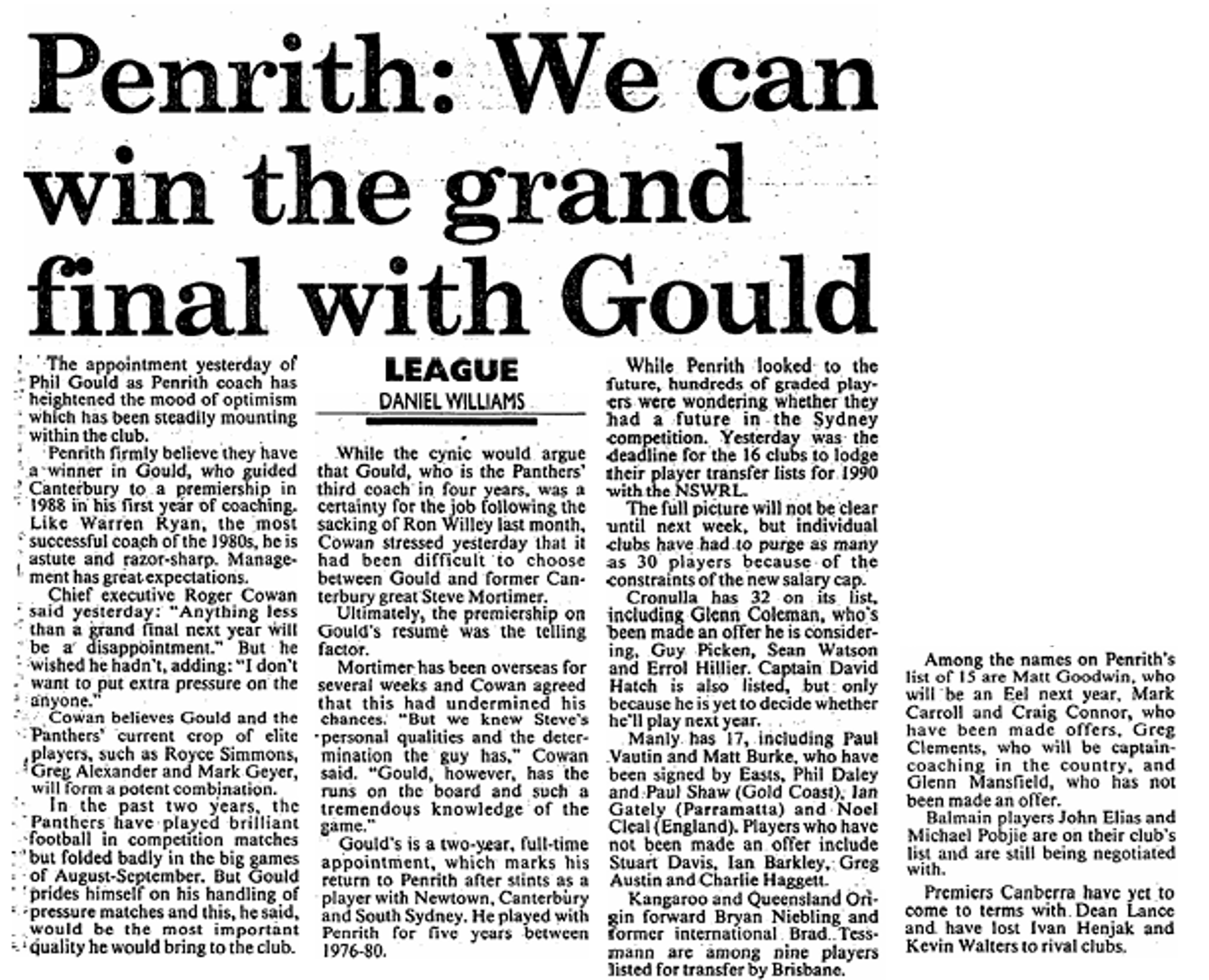
For Penrith, one of those defining moments was the appointment of Phil “Gus” Gould as first-grade coach in late 1989.
The most common version of this story is simple. Ron Willey departs, Gould returns, and within two seasons the Panthers are premiers.
A simple story that rings truth when told — but, really, the story is only partly told. And, so, does not hold the whole truth
The return of Phil Gould to Penrith, as coach, was undoubtedly one of the most significant decisions in the Club’s history. His influence on standards, preparation, selection and tactical innovation would prove decisive. Yet his appointment was not the beginning of Penrith’s rise. Rather, it was the culmination of a long organisational journey that had transformed the club over more than two decades but most dramatically during the seven years preceding his appointment.
Understanding why Gould succeeded at Penrith requires understanding the club he inherited.
Building a club capable of winning
When Roger Cowan became General Manager in 1965, Penrith was little more than an ambitious newcomer attempting to survive in Sydney’s fiercely competitive rugby league landscape.
The years that followed were devoted to building foundations — foundations of financial stability, sound governance, operational capability and an increasingly professional culture.
The club established administrative systems where few had previously existed. It strengthened its financial position, developed licensed club operations, invested in junior rugby league and gradually created an organisation capable of supporting elite football.
Many of these changes attracted little public attention — and some internal pain and conflict — yet each became another piece of the structure upon which future success would rest.
At the same time, a remarkable generation of local footballers was emerging.
From hopefuls to contenders
Tim Sheens deserves enormous credit for changing the direction of Penrith football.
His young side reached the club’s first semi-final in 1985 and, perhaps more importantly, changed what players and supporters believed was possible.
For the first time, Penrith expected to compete rather than merely participate.
When Ron Willey succeeded Sheens in 1987, he inherited a talented but still developing football team. Over the following three seasons he consolidated much of the progress already achieved — he also instilled a harder competitive edge — what many describe as ‘mongrel’ — that had previously been missing.
The Panthers’ consistency ramped up a couple of pegs, reaching the semi-finals again in 1988 before finishing second on the ladder in 1989, only to bow out in “straight sets” — a loss to Balmain (12-24) in Major Preliminary Semi-Final followed by a loss to Canberra (18-27) in the Minor Semi-final. Canberra went on to win the Grand Final over Balmain.
Willey’s contribution is often overshadowed by what followed, but history should remember that he coached Penrith through an important stage of its development. He inherited an emerging football side and left behind a genuine premiership contender.
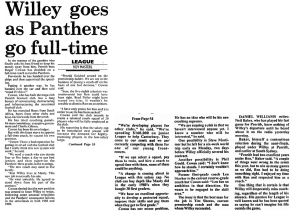
By the end of 1989, however, there was a sense that the club had reached an important crossroads. Penrith’s next coach would need to be fully devoted to the Panthers and build upon the foundations already laid. In this late 1989 article Roger Cowan tells Roy Masters:
We need a coach who can devote four or five hours a day to our best juniors and then supervise the Panthers’ three grades in the evenings.
Sydney Morning Herald 28 Sep 1989 — click image to enlarge and read
While the club had become more competitive, the question was whether it could become the best.
The right coach at the right time
Phil Gould did not arrive to rescue a struggling football club.
He arrived at a club already pounding on the door. Today, you’ll often hear the expression “premiership window” — well, Gus joined when that window was wide open.
Sydney Morning Herald Headline 14 Oct 1989 — click image to read full article.
His coaching philosophy was uncompromising. Fitness standards rose. Preparation became more meticulous.
Selection became ruthless when necessary. Reputation alone offered no protection. Gould was prepared to make difficult decisions if he believed they improved the team, even when they involved respected senior players.
The controversial decisions surrounding Royce Simmons during both 1990 and 1991 illustrated both the personal cost and Gould’s willingness to place team performance ahead of sentiment. Those decisions were fiercely debated at the time but reflected the standards he expected throughout the organisation. Bound for Glory recounts Gould’s insistence that difficult decisions were necessary if Penrith was to push through that premiership window and transform from contenders to champions.
His greatest contribution may not have been introducing entirely new ideas, but demanding that every aspect of the football operation meet a higher standard.
Royce Simmons, in Hooked on League, describes some of the changes in 1990:
With Phil Gould at the helm … Weight coaches came to the club for the first time, there was a bit more money in the game and you were able to get away from work a little earlier and get fitter. The game was becoming semi-professional. … Phil was much more structured in his approach with not as much emphasis on skills but certainly a lot more education on how to play a more structured game.
Importantly, he inherited players capable of responding to those demands.
Greg Alexander, Royce Simmons, Mark Geyer, John Cartwright, Brad Izzard, Brad Fittler, Colin van der Voort, Col Bentley and others had largely developed together through Penrith’s football system. Gould refined them into a premiership side.
Just as importantly, he inherited a club capable of supporting elite football.
Behind the scenes, Penrith’s administration continued to expand sponsorship, strengthen finances, modernise marketing and deepen its connection with the wider district. As Bound for Glory records, the Club’s transformation extended well beyond the playing field, with new sponsorships, a new black playing strip for 1991, a rapidly growing marketing operation and increasing community engagement all reinforcing the confidence of an organisation entering the 1990s with growing belief.
The football team was improving because the club itself was improving.
More than one architect
It is tempting to view premierships through the lens of individuals.
Roger Cowan, Tim Sheens, Ron Willey, Phil Gould. Greg Alexander, Royce Simmons — each individually occupies an important place in the history of the Penrith Panthers that led to the 1991 Winfield Cup heading west to Penrith.
Yet focusing too heavily on any one figure risks missing the broader story.
Successful organisations rarely emerge because of one appointment or one season. They are built through hundreds of decisions, made by countless people over many years.
Roger Cowan with successive boards and countless staff built the organisation.
Tim Sheens rebuilt belief.
Ron Willey consolidated competitiveness.
Phil Gould delivered the final refinement.
Each stage depended upon the one before it.
The Final Piece
Looking back on those days, Gould’s appointment appears inevitable.
It was anything but.
It is now well-known that Steve Mortimer was a very strong contender for the Panthers role — and had he not been on a world trip at the crucial time discussions were being held, he may have landed the job. Sliding doors.
Had the Board chosen differently at the end of 1989, Penrith may still have remained one of the competition’s strongest clubs. Whether it would have climbed the final step can never be known.
What history can say with confidence is that Gould arrived at precisely the moment when Penrith was ready for him.
The Panthers did not become premiers simply because they appointed Phil Gould.
They became premiers because, after twenty-five years of organisational development, administrative reform, financial strengthening, football rebuilding and cultural change, the club had finally become capable of making the most of a coach of his calibre.
That is the story. It is a more complete story than the “Gould arrives — Panthers become premiers — Gould is the hero” popular narrative.
Phil Gould’s return was not the beginning of Penrith’s rise — it was the moment when years of patient preparation found their final catalyst.
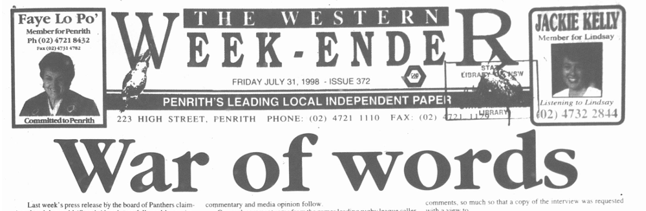
Contemporary newspaper coverage from the Western Weekender, July- September 1998
Editors Note: The articles selected for this Beyond the Book entry are those that best illustrate the major stages in the public debate as it evolved between July and September 1998.
The following newspaper articles are presented in chronological order. Together they allow readers to follow one of the most significant episodes in Panthers’ history as it unfolded during 1998. Rather than viewing events with the benefit of hindsight, they invite readers to experience the uncertainty, competing arguments and rapidly changing public debate that surrounded the proposed merger discussions.
These articles illustrate how the debate gradually expanded — from Board deliberations, to community campaigns, to local government, to the wider media — before eventually reaching the public information meeting that proved to be a turning point in the story
24 July 1998 — Stand Alone
Commentary
This was one of the first major reports after discussion of a possible merger became widely known. The article captures the immediate emotional response within the Penrith community and reflects the strength of the emerging “Stand Alone” campaign.
At the same time, it provides readers with Roger Cowan’s explanation of why management believed every contingency needed to be examined if Panthers was to maximise its chances of remaining in the National Rugby League.
Reading the article today, one feature stands out. The emotional and practical arguments were already beginning to diverge. While much of the public discussion centred on loyalty and identity, management continued to focus on risk, planning and the long-term survival of the club.
Despite Cowan and his management team being as passionate and loyal — as emotionally invested — as the most fervent supporter, these qualities were already being overshadowed by the emerging public narrative.
31 July 1998 — War of Words
Commentary
Within a week the debate had expanded well beyond Penrith itself. Sydney’s leading radio commentator, Ray Hadley, had broadcast damaging misinformation about Panthers prompting the Club to respond with an open letter published in the Sydney Morning Herald and the Western Weekender.
This exchange illustrates how quickly the discussion moved from private Board deliberations to public debate. Importantly, it also demonstrates that Roger Cowan’s explanation of the club’s position was being expressed publicly at the time. The account presented throughout Parts 29–35 is therefore not a reconstruction created years later, but reflects the position being articulated as events unfolded.
Readers may wish to compare this article with the discussion in Part 33 of The Series — A Good Story Trumps Truth — where the relationship between public perception and documented fact is explored in greater detail.
7 August 1998 — Merger Decision Deferred
Commentary
This article is significant because it records Panthers’ management describing its decision-making process while events were still unfolding. It’s headline — Damned if you do … — echoes the difficulties being encountered by those responsible for the Club. Roger Cowan repeatedly emphasises that the Board was analysing the risks, considering several possible scenarios and attempting to avoid making decisions based purely on emotion.
It is also a reminder that the future remained highly uncertain. Today it is easy to assume that Panthers’ eventual survival was inevitable. In August 1998 it was anything but certain — indeed, the uncertainty persisted until North Sydney and Manly announced their merger more than a year after the events chronicled here.
21 August 1998 — Council Enters the Debate
Commentary
By late August the merger debate had expanded well beyond Panthers’ Boardroom. Penrith City Council formally resolved to urge the club to remain a stand-alone participant in the National Rugby League, arguing that the Panthers name had become an important part of the city’s identity and economic development.
The article is of particular significance because it captures the complex position occupied by Deputy Mayor John Bateman, who was both a Panthers director and a councillor. Speaking in his capacity as a councillor, Bateman publicly praised the professionalism of Panthers’ management, confirmed that no merger agreement had been reached and acknowledged that the economic case being examined by management was a strong one. At the same time, he explained why he personally believed the socio-economic arguments for retaining an independent Penrith team were ultimately more compelling.
With hindsight, the article demonstrates that the debate had become far more sophisticated than a simple contest between “for” and “against”. Competing economic, governance and community considerations were all being weighed, even by people who ultimately reached different conclusions.
The public information meeting marked an important turning point in the merger debate. As described in Part 34, Roger Cowan later recalled the meeting as having become an “ambush”, while many supporters regarded it as the defining moment in the campaign to remain a stand-alone club.
The reporting that followed is interesting for another reason. Rather than simply recording the arguments presented, the article framed the debate as one of “Passion” versus “Practical”. Ron Mulock’s position appeared under the heading The Passion, while Roger Cowan’s appeared under …the Practical.
Whether intentional or not, this framing invites an interesting question. Was the debate really between passion and practicality, or were both men expressing different forms of commitment to the same objective — the long-term future of Panthers?
Readers who have followed Parts 29–35 may notice a striking irony. Throughout those chapters, management’s practical approach — risk analysis, contingency planning and exploring every available option — was itself driven by a determination to preserve Panthers’ place in the National Rugby League. The practical and the passionate were not necessarily opposing ideas; they were different philosophies for pursuing what each believed was in the club’s best interests.
It is obvious that both sides of this debate were driven by people holding strong loyalty and devotion to the Penrith Panthers.
Looking Back
Reading these articles nearly three decades later, several observations stand out.
The uncertainty of the time is unmistakable. Decisions that now seem obvious were anything but obvious in 1998. Much of the debate took place before supporters had access to the information available today.
The articles also reveal how rapidly public narratives developed. As discussions moved from the Boardroom into newspapers, radio and public meetings, the story acquired a momentum of its own. Perceptions often became as influential as documented facts.
Perhaps most interesting of all is the consistency of Roger Cowan’s public position. Whether speaking through interviews, open letters or Board statements, the central themes remained remarkably consistent: the risks were real, the future uncertain, and management had a responsibility to examine every realistic option before events overtook the club.
These articles go beyond being simple contemporary newspaper clippings. They are historical documents that allow readers to experience events as they unfolded, before hindsight shaped later interpretations.
Readers wishing to explore these articles in full can download the accompanying PDF containing the complete Western Weekender collection reproduced in this Beyond the Book entry.
Editors Note: The tables reproduced in this article are based on Panthers’ internal working papers prepared during 1998 and 1999. They were management documents used to estimate the club’s position under the NRL Selection Criteria and were never intended for publication. While some financial measures necessarily relied on informed estimates, they provide a rare insight into the information available to Panthers’ leadership as critical decisions were being made.
The settlement that ended the Super League war did not guarantee the survival of every club. In fact, it guaranteed the demise of some teams.
Twenty-two teams competed in the 1997 Season — the split competitions season — twelve played in the Australian Rugby League and ten in Super League.
Before the new National Rugby League competition began in 1998, the South Queensland Crushers and the Hunter Mariners were wound up, leaving twenty clubs to compete in the frist season of a unified competition.
The unity was conditional.
The NRL would operate with twenty clubs during 1998 and 1999, but from the 2000 season the competition would be reduced to just fourteen. The peace agreement had ended one conflict while immediately beginning another — a contest for survival.
To determine which clubs would be admitted to the new fourteen-team competition, the NRL introduced a formal assessment process known simply as the Criteria. (Download PDF: Admission Criteria National Rugby League Competition )
The NRL described the Criteria as a “fair and reasonable” method of selecting the clubs that would comprise the future competition. They consisted of three separate components.
The Basic Criteria required clubs to demonstrate that they met, or had plans to meet, minimum standards relating to playing facilities, administration, solvency and development.
The Qualifying Criteria examined financial capacity, including minimum revenue requirements of $8 million together with five-year business plans demonstrating the ability to sustain those revenues.
It was the third component — the Selection Criteria — that attracted the greatest attention from Panthers and most other clubs.
Selection points were awarded across six categories:
Home crowd numbers
Away crowd numbers
Competition’s points
Home game receipts
Sponsorship and other income
Profitability
Not every club was required to compete under these Selection Criteria.
Brisbane, Newcastle and Auckland were given exemption, leaving seventeen clubs competing for the remaining eleven places.
There were two further provisos that influenced the process.
Firstly, any club created through the merger of two or more existing clubs would also receive automatic admission to the fourteen-team competition. The deadline for merger submissions was 31 July 1999— a date that becomes critically important later in this story.
Secondly, there was to be a minimum of six Sydney-based clubs. Of the seventeen clubs still subject to the Selection Criteria, twelve were Sydney clubs. While there was no predetermined list of clubs to disappear, it was obvious that the greatest competition for survival would occur within Sydney.
After studying the Selection Criteria, Panthers pursued two parallel strategies.
The first was to prepare submissions challenging aspects of the Criteria that the club believed were flawed or unfair.
The second was to construct an internal model to estimate where Panthers ranked against the other clubs.
The Modelling
Of the six measured categories, three could be obtained directly from publicly available information – home crowds, away crowds and competition points. A fourth category, home gate receipts, could be estimated with reasonable confidence because it was closely related to attendance figures. The remaining two categories – sponsorship and other income, and profitability – required informed estimates based on the information available.
Points were then allocated according to each club’s ranking in every category, with bonus points applying in some areas.
Although the NRL never published progressive rankings, Panthers developed its own working model using the published Selection Criteria and the best information available at the time.
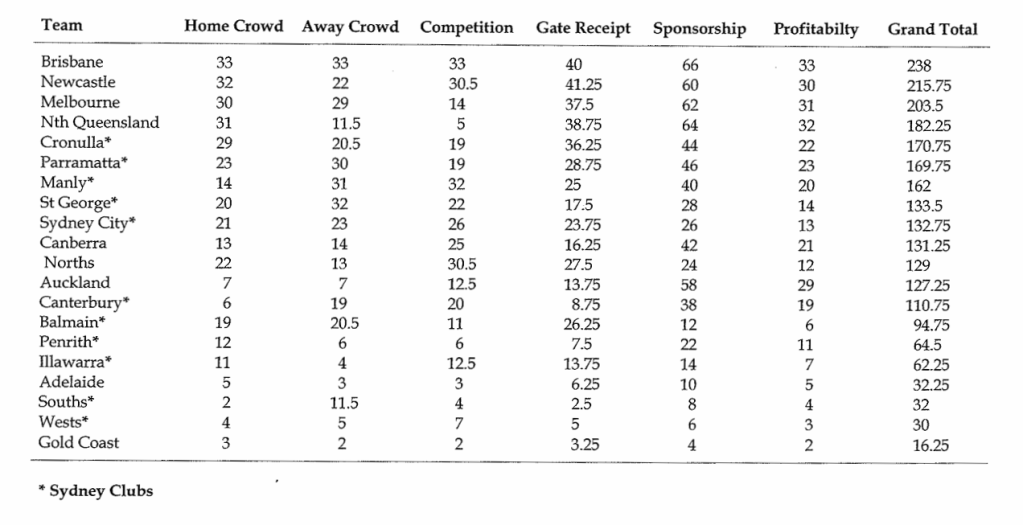
The following table is reproduced from a report for Panthers management explaining the modelling and its results — it shows the estimated rankings at the end of Season 1998. (Download PDF: Working Paper on NRL Selection Criteria – this is the Panthers working paper produced at the end of Season 1998)
Panthers internal estimate of club criteria rankings at the end of Season 1998
The purpose of the modelling was not to predict the future with certainty. It was more to provide information that might guide decision-making and strategy development leading into the final declaration of the 2000 NRL line-up … the merger deadline of 31 July, 1998 was another critical point in the calendar for which this information could prove useful.
Where did Panthers appear to rank? What categories could Panthers take action to improve? Could those areas realistically be improved?
If no potential improvement could be seen or planned, what strategic options needed to be examined before the 31 July 1999 merger deadline expired?
Despite relying on estimated figures in three categories, the analysis painted a concerning picture.
Panthers appeared to be ranked fifteenth — just below the 14-team cut-off. Significantly significantly the team hold fourteenth position, Balmain, was estimated to be around thirty points ahead. Even allowing for some estimation error, the modelling suggested that Penrith faced the genuine threat of being axed from the top rugby league competition.
The calculations did not stop there.
By the beginning of the 1999 season, the Gold Coast Chargers and Adelaide Rams had left the competition, while St George and Illawarra had merged to form the St George Illawarra Dragons.
Those changes did little to improve Penrith’s position.
Both the folded clubs had been ranked below Panthers, while the St George–Illawarra merger simply created another club guaranteed admission under the merger provisions.
So, the 1999 season began with seventeen clubs competing, four of them already guaranteed a place in the 2000 competition. That left thirteen clubs — nine from Sydney — competing for the remaining ten places.
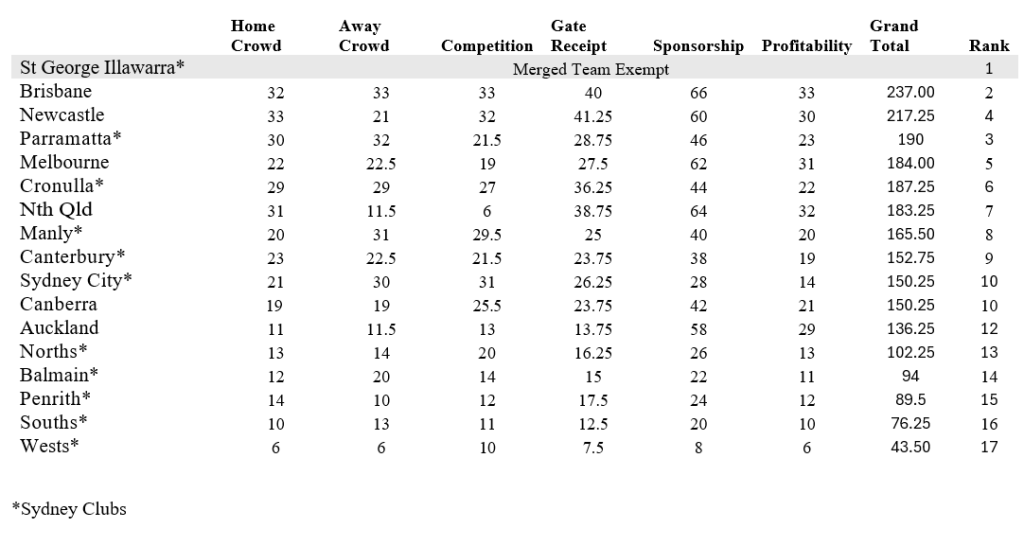
The following table shows the standings as at Monday 26 July 1999 — after Round 21 of Season 1999 — five days before the merger submissions deadline.
Panthers internal estimate of club rankings after Round 21, 1999 Season (26th July 1999)
At this late stage of the process the modelling still had Penrith in fifteenth position.
However, the gap to fourteenth (Balmain) had been narrowed — from 30 points to 4.6 points. And Norths fortunes had them dropping from eleventh position to thirteenth, a reachable (though difficult) 12.75 points ahead of Penrith.
There were still five rounds of the season to be completed.
BUT …
The day after this table was distributed to Panthers management, Balmain and Western Suburbs announced a joint venture — the Wests Tigers were born and another place was taken.
To be sure, throughout 1998 and 1999 there was speculation about potential mergers, so this wasn’t a surprise. So, Penrith now had to close a gap of 12.75 points on North Sydney — given their slide and Penrith’s gathering momentum, there was hope.
However, no internal analysis could predict the final outcome. Some financial measures remained estimates and therefore likely had errors, more mergers could change the landscape and the NRL still retained discretion in applying the Criteria.
Nevertheless, the modelling consistently pointed to the same conclusion.
The Penrith Panthers were vulnerable.
The significance of the Panthers modelling and their companion working documents is not with their accuracy.
Their importance is that they demonstrate commitment by Panthers management to ensuring information was available to maintain their evidence-based approach to decision-making. It was not reacting to to rumours or speculation despite the fact that some influential people were.
Panthers had constructed a detailed assessment of its position using the published Selection Criteria and the best information available at the time. No other club had taken this approach.
That assessment suggested Panthers was outside the projected fourteen-team competition.
Whether the analysis ultimately proved right or wrong is almost secondary.
It explains why management believed the threat was real, why alternative strategies had to be considered before the merger deadline expired, and why simply waiting for the NRL’s final decision was never regarded as a responsible option.
When the Super League war finally ended, it was conditional.
Twenty clubs would compete in the National Rugby League during 1998 and 1999 before the competition contracted to just fourteen teams for the 2000 season. Which clubs survived would not be determined by tradition, supporter loyalty or even on-field performance.
There was an attempt to determine the clubs that would compete from Season 2000 onwards by more objective means. So, a detailed set of selection criteria was created to decide who’d be eliminated.
Although Panthers’ management was pleased the NRL had tried to apply some science to the process, there was great concern that it was compromised right from the start.
The criteria relied upon historical information that could not easily be audited. For example, attendance figures formed an important part of the assessment, yet clubs reported their own crowds and there appeared to be no independent verification.
In fact, Panthers was encouraged, by the game’s governing body during Season 1997, to “boost” the attendances. They resisted but believed the practice was widespread.
Panthers repeatedly challenged aspects of the criteria, arguing that several measures lacked transparency. Panthers raised its concerns privately and directly with the NRL rather than through the media.
The attitude within Panthers was to formally advise the authorities of the Club’s concerns about serious flaws in the criteria, alerting them that they could easily be challenged. The internal emphasis on evidence, analysis and measurement was applied to this problem — and although there was no solution in sight, the management and Board at least had a solid understanding of the challenges.
That philosophy gave birth to one of the more unusual projects undertaken during the fight for survival.
A War of Words
The immediate catalyst arrived in early May 1998.
Sydney City (The Roosters) chairman Nick Politis publicly criticised Penrith — labelling the Panthers, and Canterbury, “basket cases”. The restrained approach consciously adopted by Cowan had been interpreted as weakness.
Not wanting to exchange insults in the public arena, a decision was made to present evidence that would serve as a “return shot” at the Roosters while alerting Panthers fans that the Club’s public silence did not mean they were sitting on their hands.
Importantly, it also would send a message to the NRL, the other clubs and the general public about the fragility of the measures that were being used to cull clubs.
This was an opportunity for Cowan and the Panthers to go public with evidence demonstrating one of the significant flaws in the criteria.
Cameras Instead of Opinions
The Roosters were scheduled to play the Auckland Warriors at the Sydney Football Stadium on Saturday 2 May. Panthers management team knew the crowd would be relatively small and also had a strong suspicion that their official crowd would be inflated.
So, photographer Neil Billington was dispatched to the Sydney Football Stadium with the task of photographing every section of the stadium. Neil’s media accreditation allowed him to take the photos from the field area and his instruction was to take the photos 5 minutes into the second half when attendees would have returned to their seats.
The resulting enlarged photographs allowed individual seating bays to be examined and the spectators counted manually. The counting was done by members of the Panthers management and marketing teams — sometimes with magnifying glasses deployed. Each count was verified against the others.
The conclusion was clear, the official attendance announced by the Roosters significantly overstated the number of spectators actually present.
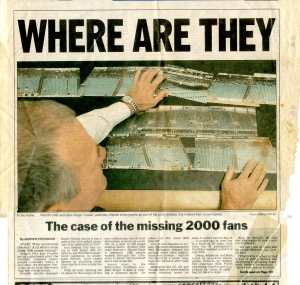
The photographs became the basis of a dramatic Daily Telegraph back-page story under the headline “Where Are They?”, accompanied by enlarged photographs of the stadium and detailed comparisons between the official crowd and Panthers’ own calculations.
Daily Telegraph — click image to read article. The article continues here.
What began as an off-the-cuff comment aimed at belittling the Penrith Panthers, became a public debate about the integrity of the selection criteria.
The Project Expands
Encouraged by the clarity of the photographic evidence, Panthers broadened the exercise. Panthers Media & Communications Manager, Rob Weaver, directed Neil Billington’s work.
Contrary to later recollections that suggested almost every match was photographed, the research concentrated on two or three Sydney-based games each round, particularly those involving clubs competing with Penrith for the final places under the criteria. The process was painstaking. Every photograph had to be examined manually and individual spectators counted section by section.
The objective was not to embarrass rival clubs.
It was to determine whether attendance figures—the very figures helping decide which clubs lived and which disappeared—were reliable. In fact Cowan also required at least one Panthers home game to be given the same attention.
According to Roger Cowan, the accumulated material may eventually have supported a legal challenge if Panthers found themselves excluded from the competition. He never regarded it as a particularly attractive strategy, but believed the circumstances justified examining every possible option.
Roger and Nick Declare Peace
Within days, the public dispute subsided.
Correspondence between Roger Cowan and Nick Politis helped calm tensions, and both clubs publicly agreed to move on. There was nothing personal about the exchange — both men were doing what they saw as necessary for their clubs.
The underlying issue, however, remained unresolved.
Whether official attendance figures accurately reflected the crowds attending NRL matches was never independently tested.
Daily Telegraph 8 May 1998 — click image to read.
Looking Back
With the benefit of hindsight, the crowd-counting exercise could appear excessive.
Yet it reflected the reality confronting Panthers during 1998.
Management believed the club was sitting outside the fourteen places destined for Season 2000. Every point on the criteria mattered. Every category was scrutinised. While substantial resources were invested in increasing Panthers’ own crowds and commercial performance, management also continued examining the assumptions upon which the criteria rested. At the same time the club quietly but substantially increased the budget for marketing initiatives designed to improve attendances and strengthen its own position.
Ironically, the photographs were never called upon.
When South Sydney later challenged its exclusion from the competition, Panthers’ collection of crowd photographs was not requested. Whether they would ever have carried legal weight remains unknown.
Perhaps that is not their greatest significance.
The Panthers / Roosters “Where Are They” conflict may have been a dispute over attendance figures, but it was evidence of something more important — a management team, led by Roger Cowan, determined and prepared to investigate every possible avenue in the fight to preserve first-grade rugby league in Penrith.
Postscript
Nick Politis added a postscript to the letter he sent Roger Cowan. It said:
I hope all this controversy between our clubs results in a great crowd for you when the Roosters visit the Panthers in Round 18 (July 10-12)!
The attendance at Penrith Stadium for the Rooster’s game was 11,156—around 20 per cent higher than the club’s average home crowd for the 1998 season. Whether the controversy contributed is impossible to know, but the irony was sweet.
Final Note: The fate of the hundreds upon hundreds of photograph prints from those 1998 games? It is said they were burned.
Leaving the ARL and signing with Super League was one of the most difficult decisions in the Club’s history. It was difficult for the Board, Cowan, the management team, the players, and the staff of both the football and licensed clubs.
It was also difficult for the members, fans and the local community. The extreme reaction of some individuals reflected the depth of feeling that existed within parts of the Panthers community. Many saw the decision as a betrayal driven by greed.
The administration building of the Club had faeces smeared across the glass entry, Roger Cowan was sent an envelope filled with nail clippings, and at the next Penrith Panthers home game fans displayed a sign that read “Betrayed”.
More sober reactions included critical letters and phone calls to the club and some staff resigned in protest. A Penrith Press telephone poll also reported overwhelming opposition, with around 90% of respondents opposing the decision.
Cowan’s response to the divisive environment was to schedule a forum in which the reasoning behind Panthers’ decision would be presented to club members and fans who could then seek answers to any questions they may have.
The meeting took place in Reactor 1 — the very popular nightclub downstairs in Panthers World of Entertainment — on 28th May 1995.
It was a Sunday morning. It was game day — the Panthers were scheduled to play the Gold Coast at Penrith Stadium. Reactor was a very dark, enclosed area – large enough to comfortably hold over 500 people. Only a few hours earlier, more than 500 people had probably filled the room. The air and even the carpet still carried the unmistakable signs of a busy Saturday night.
Several hundred people attended to hear why the Board had taken Panthers into Super League after previously declaring its loyalty to the ARL. It was tense, you could feel the anger about the decision and anger that members were not consulted.
Penrith Press Back Page 26 May 1995 – click image to read articles
As I write this, I’m reminded of the Panthers song Go the Mighty Panthers. Its opening line is:
Tension’s running high, it shows on nevery face.
While those attending were overwhelmingly against the Super League decision, the opposition was emotional but not hostile … and there were pockets of support for the Club’s move. The presence of some players perhaps took the edge off the sentiment and those present listened intently to Cowan’s explanation of the Club’s position.
The final word came from Club Captain, John Cartwright who spoke of his own doubts about the move, doubts persisting up until the meeting which had finally convinced him he’d made the right decision and so had the club.
Even the supporters who had displayed the “Betrayed” banner left expressing support for the Club’s position.
The forum did not eliminate disagreement, but it appears to have reduced some of the anger by allowing members to hear directly from those responsible for the decision.
Penrith Press 30 May 1995 — click image to read article
It would, however, be wrong to suggest that the community’s opposition had completely turned to support. Some supporters maintained a deep sense of betrayal by Panthers’ decision, others, after reflecting on the events, reached a different conclusion. One letter published in the Penrith Press in early 1996 acknowledged discomfort with the way Super League had unfolded, yet concluded that Panthers’ administrators had acted out of concern for the club’s future rather than self-interest. Steve Wharton’s letter was published in the Penrith Press on 12 March 1996, in part he said:
I am still not comfortable with what happened. But through it all I saw only concern for what was best for Panthers, when it came to the efforts of our team and administrators.
Steve Wharton’s letter is not evidence that community opinion had swung decisively behind the Board. Rather, it is a reminder that community opinion was more varied and nuanced than later accounts sometimes suggest.
Continue Exploring the Super League Story
These companion Historical Context articles examine different aspects of Panthers’ decision to join Super League:
The Panthers Move — How the Penrith Panthers came to join the new competition.
The Real Money Fight — The corporate battle that lay behind the Super League War.
When Panthers Faced the Community — How Panthers’ decision affected its members, supporters and the wider Penrith community.
For most rugby league supporters, the Super League War is remembered as a bitter struggle between the Australian Rugby League and Rupert Murdoch’s News Limited.
That description is accurate—but it tells only part of the story.
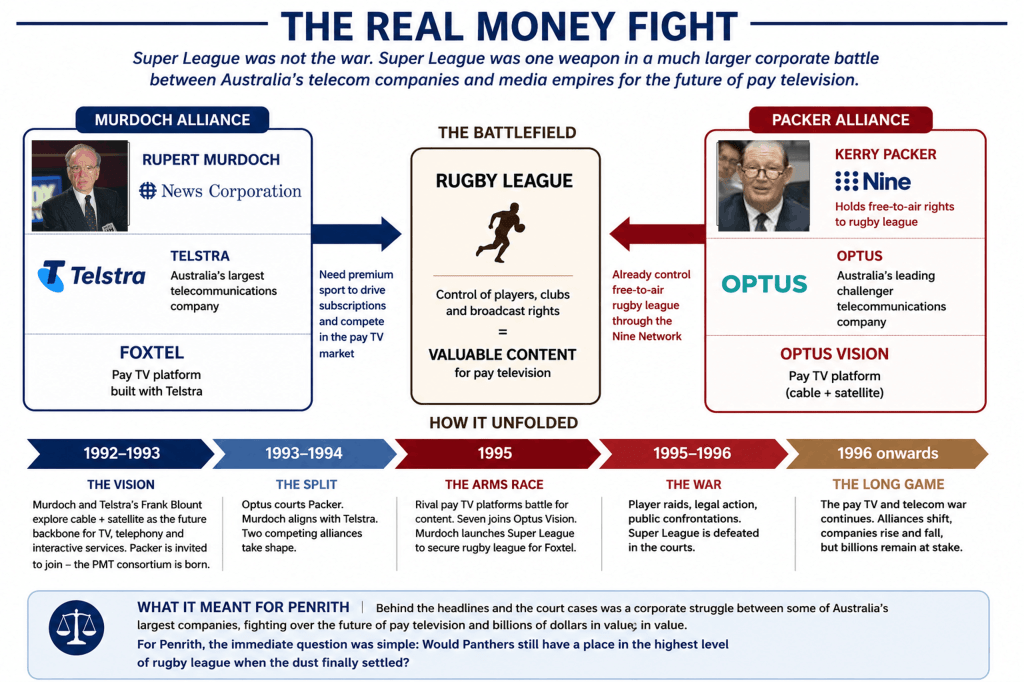
Looking back three decades later, it is easy to view the conflict simply as a battle over the control of rugby league. At the time, however, respected financial journalist Robert Gottliebsen argued that the game itself was not the real prize. In an article published in the Australian Financial Review in April 1996, he described Super League as just one front in a much larger corporate struggle involving Australia’s emerging pay television industry, the nation’s two largest telecommunications companies, and two of its most powerful media empires.
In Gottliebsen’s view, rugby league had become one of the weapons in “the real money fight.”
A Bigger Vision
The origins of that conflict can be traced back several years before the first Super League contracts were signed.
Around 1992, Rupert Murdoch and Frank Blount, the Managing Director of Telstra, began discussing the enormous potential of cable and satellite technology. Their vision extended well beyond television. They believed that broadband networks would eventually carry not only entertainment but also telephone services, banking, retailing, medical services, gambling and countless other forms of communication.
To pursue that vision, Murdoch suggested bringing Kerry Packer into the venture. The proposal became known as the PMT consortium—Packer, Murdoch and Telecom.
For a brief period, Australia’s two most influential media families appeared to be working towards a common future.
It did not last.
The Alliance Breaks Apart
As Australia’s telecommunications industry prepared for competition, Optus recognised the strategic value of Kerry Packer’s media interests and encouraged him to align with its own plans.
Murdoch, meanwhile, ultimately partnered with Telstra.
What had begun as a shared vision quickly evolved into competing alliances.
Telstra and Murdoch established Foxtel.
Optus assembled its own powerful consortium, supported by Kerry Packer and eventually the Seven Network.
Suddenly, the emerging pay television market had become a battleground between rival telecommunications companies, rival media organisations and rival strategic visions for Australia’s communications future.
Billions of dollars were now at stake.
Gottliebsen reported that Telstra’s own internal modelling suggested as much as $7–8 billion of corporate value could be affected depending on which side prevailed.
Why Rugby League Suddenly Mattered
Pay television needed something that could persuade Australians to subscribe.
Movies were important.
News was important.
But live sport was essential.
Existing broadcasting arrangements meant Kerry Packer’s Nine Network already held the free-to-air rights to rugby league. When Murdoch’s executives struggled to secure premium sporting content for Foxtel, creating a new national rugby league competition became a commercially attractive option.
From this perspective, Super League was far more than a football competition.
It became part of a much larger contest over subscribers, broadcasting rights, market share and ultimately the future of Australia’s communications industry.
This does not diminish the genuine rugby league issues that also existed. Questions about the game’s administration, its national expansion, club structures and commercial future were all real and important. However, Gottliebsen argued that these football issues had become intertwined with a much broader corporate struggle that most supporters could neither see nor fully appreciate while it was unfolding.
What It Meant For Penrith
None of these corporate manoeuvres were visible to most Panthers members or supporters.
They saw clubs changing sides.
Players signing confidential contracts.
Court battles.
Television cameras.
Public accusations of betrayal.
Behind those events, however, some of Australia’s largest corporations were fighting over far more than rugby league.
Understanding that broader context helps explain why events moved so quickly during 1995 and why the decisions confronting clubs became so significant.
For Penrith, the immediate question was never which media company would ultimately prevail.
Would Panthers still have a place in the highest level of rugby league when the dust finally settled?
That was the question management sought to answer in Part 29.
Continue Exploring the Super League Story
These companion Historical Context articles examine different aspects of Panthers’ decision to join Super League:
The Panthers Move — How the Penrith Panthers came to join the new competition.
Part 29 — Joining Super League begins with a deceptively simple statement:
“In May 1995 Panthers had resolved to leave the Australian Rugby League to join Super League…”
Read in isolation, it almost sounds like an ordinary administrative decision. In reality it followed months of uncertainty, strategic analysis and one of the most turbulent periods in rugby league history.
It would be easy for a reader to miss the nuance and significance behind that statement — it sounds almost as simple as resolving to change the club’s soft drink supplier.
The opening phrase is followed up with a hint that this was, in fact, a major decision and noting that Super League was a new competition established by News Limited.
Many simplify the establishment of this new competition as an attempt by Murdoch to attain the broadcast rights of rugby league for his pay television platform, Foxtel. This was true. Kerry Packer’s Consolidated Press held those rights but they were not being used — and it was commonly believed that the Packer deal did not represent the true value of the game.
It’s worth briefly doing a quick history — to take us up to that point in May 1995 when the Penrith Panthers made their resolution to join Super League.
Just over a year before Penrith’s resolution, in April 1994, John Ribot (Chief Executive Officer, Brisbane Broncos) sent Ken Cowley (Chief Executive, News Ltd) a report outlining the concept of a new structure for rugby league in Australia. This was followed up in May 1994 with discussions of the concept with some leading players.
By August 1994 News Ltd had moved well beyond an idea. It had developed an outline for an entirely new national competition. The main points of this outline were:
To establish an elite national competition (including New Zealand) between 12 privately owned teams. Up to 4 of these teams to be owned by News Ltd.
Superleague Ltd would get revenue from sponsorship, free-to-air and pay television rights, gate receipts and merchandising. New Ltd would receive a 15% management fee and the profit shared amongst the 12 clubs.
The 12 clubs would be:
4 based in Sydney
4 continuing teams — Brisbane, Canberra, Newcastle and Auckland
New teams in Perth, Adelaide and Melbourne
The greatest challenge was reducing eleven Sydney clubs (plus Illawarra) to four Sydney franchises. News Ltd proposed grouping clubs into sets of three and inviting them to jointly own a single Super League franchise.
For example: Wests, Parramatta, and Penrith could be grouped together and offered a franchise. Ownership would be split evenly between those clubs taking up the offer. The owner of the old club eg Penrith Rugby League Club Ltd would be entitled to 50% of its share of the new club, the other 50% would be offered directly to members.
Over the remaining months of 1994 there was considerable media speculation and News Ltd and ARFL Ltd executives held private discussions.
Following those discussions, Ken Arthurson (ARFL Ltd Chairman) and John Quayle (ARFL CEO) issued agreements to each of the 20 existing club aimed at securing their loyalty to the ARL for the 5 season starting 1995. All 20 clubs signed these agreements by November 1994.
On 6th February 1995 News Ltd presented their proposal to the ARL — offering the ARL positions on the Super League Board as well as the ongoing rights to administer various rugby league programs.
On that same day Kerry Packer addressed the 20 clubs declaring his ownership of the broadcasting rights (free-to-air and pay television) until the year 2000. Part of this address was a threat to sue any club that joined a Super League competition. A short time later in February 1995 all 20 club signed another agreement — the so-called Loyalty Agreements — reinforcing those signed 4 months earlier.
Packer’s declaration made one thing abundantly clear. The dispute was no longer simply about rugby league administration. Rugby league had become the battleground in a much larger corporate struggle over broadcasting, telecommunications and pay television. Robert Gottliebson in an Australian Financial review article in April 1996 suggested this was a battle where $7 billion dollars was at stake.
Packer’s declaration made one thing abundantly clear. The dispute was no longer simply about rugby league administration. Rugby league had become the battleground in a much larger corporate struggle over broadcasting, telecommunications and pay television. Robert Gottliebson in an Australian Financial review article in April 1996 suggested this was a battle where $7 billion dollars was at stake.
By late March 1995, after having their momentum slowed by the reaction of Packer, the ARL and the club, News Ltd resolved to press on. In their eyes they had three strategic choices as shown in the table from Super League Case Study a 2003 research paper for Victoria University written by Robert D, McDonald.
News Ltd elected to take the third approach and start a “rebel competition”.
Their attack was on two fronts:
In late March, early April News Ltd launched an aggressive and clandestine campaign — a ”blitzkrieg” — to sign players and coaches for the rebel league.
Legal action commenced challenging the validity of the two agreements clubs had signed in November 1994 and February 1995.
The early targets for Super League were Brisbane, Canberra, Auckland and Canterbury. When news broke that players and coaches from these four clubs had signed with Super League, there was a flurry of signing activity from both Super League and the ARL.
Neither side approached the Penrith Panthers.
Here’s how the Super League clubs fell:
29 March— Canterbury-Bankstown Bulldogs. Key players signed contracts. Two day later an 1st April, Bulldogs CEO Peter Moore resigned his position on the Board of the NSWRL after aligning the club with Super League.
1 April — Brisbane Broncos. This is the date the Broncos defection broke publicly. Broncos CEO, John Ribot, left the Broncos to become CEO of Super League at around the same time.
1-2 April — Cronulla- Sutherland Sharks. The Sharks’ players were signed after playing the Western Reds in Perth on 31st March.
2 April — Auckland Warriors. The players signed on this date. Coach John Monie had signed late in March. The Board signed the club to Super League on 20th April.
2-3 April — Canberra Raiders. Following the news breaking on April Fool’s day, most of Canberra’s high profile roster signed.
Early April — Western Reds and North Queensland Cowboys.
During all this activity and publicity there were no communications, offers or invitations for teh Penrith Panthers — from either the ARL or Super League.
The management team at Panthers was very concerned by the silence and paid close attention to every piece of information that could be found about what was happening on both sides of the battle. A comprehensive critical analysis of the situation facing Panthers was undertaken — despite the fact reliable information was scant.
The analysis process was steered by Outcomes Thinking. Rather than beginning with today’s problems, Outcomes Thinking began by defining what success would look like several years into the future. (See Beyond the Book: Education by Experience.)
The highest-level outcome was simply:
“In the year 2000 Panthers is competing in the highest-level rugby league competition.”
Our first step towards survival was to ensure that at least one of the two sides were interested in having Panthers in their competition.
Super League represented the best opportunity to create that interest — among the reasons for this conclusion was that their team list, to date, only included two Sydney-based clubs, Canterbury-Bankstown and Cronulla-Sutherland.
There was also a strong belief Panthers had a compelling case that News Ltd had not yet fully appreciated — while the ARL had had many years to understand the strengths of the Penrith club.
Cowan requested a meeting with Ken Cowley and John Ribot. At that meeting he let them know Panthers hadn’t made any decisions about its future and that we’d be an important club to either Super League or the ARL. In particular, rugby league in Penrith had strong financial backing from the largest licensed club and it also ran junior rugby league with the strongest participation anywhere in the country.
The meeting achieved its immediate objective. Super League, which until then had shown no interest in Penrith, quickly reassessed the club’s strategic value. Negotiations followed and an agreement was reached within days.
That brings us back to the opening of Part 29, where the Penrith Panthers formally resolved to become the eighth club to join Super League.
Continue Exploring the Super League Story
These companion Historical Context articles examine different aspects of Panthers’ decision to join Super League:
The Real Money Fight — The corporate battle that lay behind the Super League War.
The poker-machine transaction examined in Part 24 did not disappear when the NSW investigation ended. Four years later, the same transaction surfaced in the Queensland Criminal Justice Commission’s 1990 report on gaming machines, where Cowan believed the facts were misstated and the implications left uncorrected.
Somehow the Queensland Justice Commission accepted the false proposition, from an undisclosed source, that Panthers had paid $7,000 per machine when the list price was only $5,300. Every piece of documentation Howe had seen had clearly shown that the club paid only $5,300.
The poker machine purchase from Len Ainsworth’s company, Aristocrat, was mentioned in the Commission’s 1990 report on gaming machines. The QCJC used the purchase to illustrate what it called the ‘Byzantine transactions’ that it said were common in the club industry at the time.
‘Various manufacturers are alleged to have engaged in the offer of inducements of one sort or another to buy gaming machines’, said the report. It continues, ‘There is room in such contorted transactions for any number of corrupt arrangements.’
It quotes the same information that was in the original NSW police allegations, including the listing of only 90 machines. It provides all the figures, and mentions Ainsworth’s subsidisation of the interest, without providing any explanation of the circumstances. The report emphasised the payment by Panthers of an inflated price of $7,000.
After the report was released, Cowan had a solicitor write to the Commission asking that the report be amended to reflect the true facts of the transaction – that Panthers paid $5,300, not $7000, and that the list price was $7000, not $5300. The request was ignored. A subsequent approach was also ignored. No response was ever received, and the false representation still stands in the records.
Although Panthers had been cleared of all the original charges, with no action taken by the NSW police or the Liquor Administration Board, here was the very same information finding its way into the QCJC report. Cowan is mentioned specifically in the same report, saying he ‘has come to the notice of NSW police on a number of occasions and had been unsuccessfully prosecuted once’. No evidence was ever recorded of any specific occasions on which Cowan had ‘come to the notice of police’.
Phil Bennett also read the report, and, knowing the real facts of the transaction, sent a personal response to the QCJC, explaining his own knowledge of the sale. He told the Commission: ‘It was clearly established that there was nothing illegal or improper about this transaction and no action was taken, nor was the matter raised as an objection in Ainsworth’s licence application.
The Commission’s suggestion that this transaction was an example of an inducement paid to people in exchange for their club buying machines is clearly not sustainable.
Bennett also noted in his response that the prices of poker machines quoted in the QCJC report were ‘a nonsense’.
The QCJC did nothing to rectify its erroneous report. The blatant untruth still stands in its records.
In the winter of 1973, Penrith found itself searching for answers.
The club had entered the first-grade competition only six years earlier and was struggling badly. Results were poor, confidence was low and the future looked uncertain. The low point came when Manly-Warringah inflicted a humiliating 70–7 defeat on the Panthers. The result became part of club folklore and reinforced the belief that dramatic action was needed.
Penrith’s response was bold. Rather than look only within Australia, the club turned its attention to England.
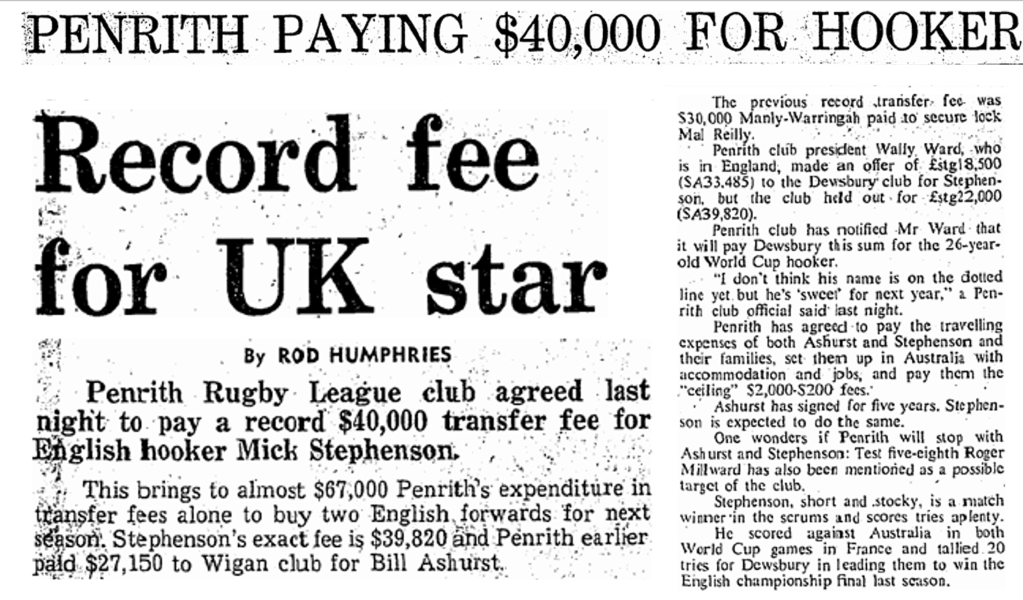
Club president Wally Ward and director Bruce Welladsen travelled to England with a clear objective: find experienced players who could strengthen the team and help establish a culture of professionalism. Their first target was Bill Ashurst, one of Britain’s leading second-row forwards. Negotiations were successful and Penrith secured his signature for what was reported at the time as a record rugby league transfer fee. Contemporary reports noted that Penrith had committed more than $27,000 to secure Ashurst’s services.
But Penrith wanted more than a forward. They also wanted leadership.
While in England, Ward and Welladsen turned their attention to Mike Stephenson, captain of the English champions, Dewsbury. Stephenson later recalled receiving an unexpected approach while working on a building site in Yorkshire. A workmate shouted up a ladder asking whether he was Mike Stephenson. When he answered yes, he was told that visitors from Australia wanted to speak with him.
The meeting that followed would change the course of Stephenson’s career.
Ward and Welladsen outlined their vision for Penrith and offered Stephenson a long-term contract. At first he was uncertain. Penrith sat at the bottom of the premiership table and had just suffered one of the heaviest defeats in its history. Yet the honesty of the approach impressed him. Rather than paint an unrealistic picture, the Penrith representatives openly explained the club’s position and their plans for the future.
Stephenson later said that this honesty was one of the decisive factors in his decision. The club was struggling, but it had ambition. Just as importantly, it had a strong junior base and a growing district. He believed there was an opportunity to help build something meaningful rather than simply join an established powerhouse.
Penrith eventually secured Stephenson’s release after complex negotiations with Dewsbury. The reported transfer fee of almost $40,000 established a new benchmark and attracted national attention. The press described the signing as a record-breaking deal and evidence of Penrith’s determination to improve its fortunes.
The arrival of Ashurst and Stephenson generated enormous excitement. Two of Britain’s finest players were heading to Penrith. Expectations rose accordingly.
The results, however, were mixed. Despite the quality and commitment of both men, rugby league success remained elusive. Penrith finished with the wooden spoon in 1973 and continued to struggle for consistency. Yet the significance of the signings went beyond wins and losses. They demonstrated that Penrith was prepared to think differently, act boldly and invest in its future.
Those qualities would become recurring themes throughout the Roger Cowan years.