Charlie Gibson and the Culture Clash

This article forms part of the serialised republication of Panthers, Passion & Politics – The Roger Cowan Years.

Start · Reader’s Guide · All Parts


Although the new structure fell short of the model Cowan had long advocated, it was seen at the time as a significant step forward.

Both Cowan and the board were pleased with the appointment of Charlie Gibson. He was part of rugby league’s inner circle1, a close friend of Kevin Humphreys, and the man recommended by Mackie and the Super Six for the role of rugby league secretary at Penrith.
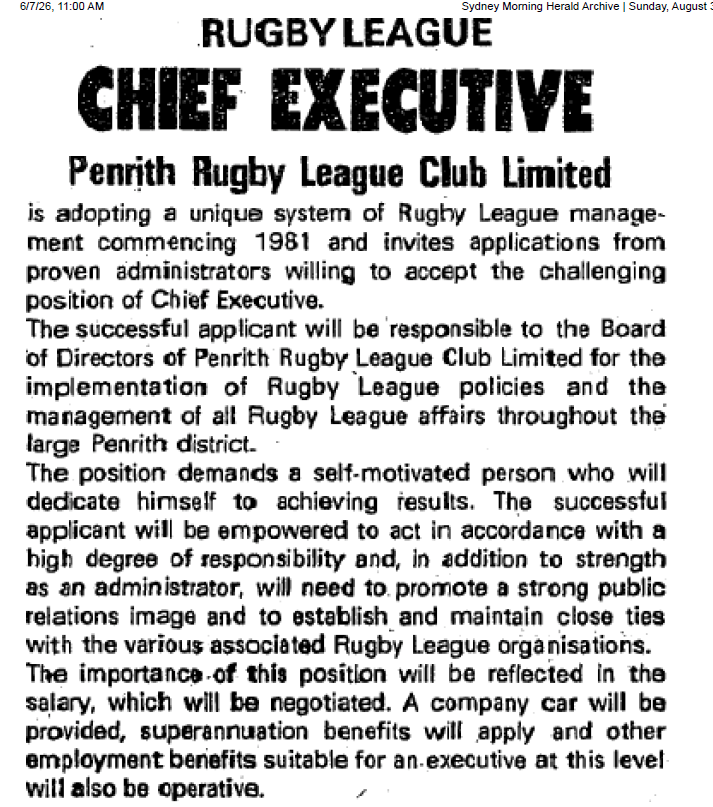
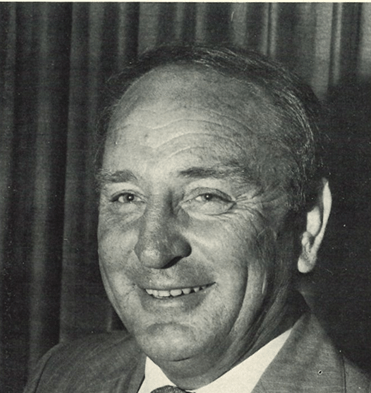
Gibson came with excellent credentials. He had been secretary of the South Sydney club for ten years and was there during the club’s winning streak of four premierships between 1967 and 1971. While the structure fell far short of the ultimate solution Cowan had been fighting to achieve for more than ten years, it was a huge step in the right direction. The Board and Cowan made an agreement that he would concentrate on the licensed club and take no further part in rugby league management. Cowan recalls;

We all thought – great! Charlie really knows his way around the rugby league world and that is what we need. We thought it could be the turning point in our rugby league fortunes.

I thought the board was making a mistake by having him report direct to the board, but I was willing to give it a go. I even agreed to have my contract changed to reflect that rugby league was no longer part of my responsibilities.

Charlie’s role was going to involve a lot of co-operation with the licensed club management in areas of accounting, ground maintenance, and in football-related marketing and promotions.

My vision for the club had always been a structure that united all the expertise available. For example, the club’s catering manager was far better qualified to manage rugby league functions than honorary committees or a rugby league manager. The club’s maintenance and cleaning managers could look after the ground. Financial management could come under the club’s finance manager.  Making rugby league successful would require a united effort and a high degree of co-operation.

Problems began to emerge quite early.. They were used to working as a team with overlapping needs, and they felt there was a lack of co-operation that was making their jobs difficult.

The fact is that we were not ready for such a radical departure from the way football was managed in those days.

Although no one realised it at the time, we were again seeing culture at work. This time it was a clash of cultures. Charlie was new to the organisation and we probably should have done more to talk through the tensions that were building. Culture can be a building force but it can also be destructive.

Keith Rhind says that Charlie Gibson was very much a part of the old rugby league ethos. Penrith was developing a culture that was unique, and Gibson often found it hard to adapt. It started out well enough, but eventually the cracks began to appear as the management culture developing at Penrith came into conflict with the rugby league culture that had helped Gibson achieve success at South Sydney.

Tension between the club and rugby league was growing. But that was only the tip of the iceberg. The Gibson appointment would also create a bitter division within the board and ultimately destroy a long-standing friendship between the chairman and Cowan. It would also light the slow-burning fuse that culminated in Detective Sergeant Mick Howe’s raid on the club a few years later.

When the election was held in 1980 for the first joint board, John Hewett became chairman. He had held that position on the licensed club board for the previous ten years, and he and Cowan had become good friends and built a strong working relationship.

Rhind says that Gibson also developed a close relationship with Hewett, taking him to events and functions to meet the high-profile people in his rugby league circles. Hewett was enjoying the attention. Another director from those days describes him as ‘basking in the reflected glory’.

When a Kangaroo tour was coming up, Hewett told others on the board that Gibson was going to use his influence to take him on the tour. It seems likely that Hewett was pushing for this favour and Gibson was doing his best to accommodate him. But there was disquiet among other members of the board, and Gibson himself also appeared unhappy about it.

Looking back, it was a relatively minor issue. Yet it became one of those moments where personality, disappointment and misunderstanding combined to produce consequences far beyond the original dispute.

Hewett believed that he was about to be invited to join league heavyweights on a Kangaroo Tour2, but that belief was against the designs of the heavyweights themselves. When it didn’t happen, Hewett was devastated and the conflict within the Board intensified. His disappointment, and the atmosphere of conflict on the board, caused him to resign as chairman in 1982. But his bitterness remained.

Deputy chairman Barry Hubbard, who was Hewett’s close friend, also resigned, leaving two vacancies on the board executive. Both men remained on the board. Keith Rhind, then deputy chairman, moved into the chairman’s role, which he held until the following AGM. At that meeting, Leo Armstrong was elected unopposed, and would become the club’s longest serving chairman.

Few could have known it at the time, but Armstrong would go on to become the longest-serving chairman in Panthers history and preside over some of the most significant years in the Club’s development.

Nevertheless the tensions that had been building were far from resolved — and the consequences were only just beginning to emerge.


To receive new Parts and occasional project updates by email, you may subscribe below.

Readers who hold recollections, documents, or material relevant to this history are welcome to contribute via the Commentary & Contributions page.

Project Updates

Receive updates when new parts are published.


  1. For more on Cowan’s experiences within the NSW Rugby League hierarchy, Removed Section in Beyond the Book – Rugby League’s Inner Circle. ↩︎
  2. A Kangaroo Tour was regarded as a high honour and a prestigious experience for rugby league administrators during this era. ↩︎
Part 19 · All Parts · Part 21

Commentary and Contributions

Why One Board, One CEO?

Readers of Parts 19–21 may wonder why Roger Cowan spent more than sixteen years arguing for what appeared to be a relatively simple administrative reform. Why did the issue matter so much to him? Why did he keep returning to it despite repeated setbacks, opposition and criticism?

The answer lies in a question that had troubled Panthers almost from the beginning:

The issue was not new.

Readers familiar with the events of 1971 may recognise some familiar themes. The removal of football club secretary Merv Cartwright and treasurer Ron Partridge arose from concerns about the administration of rugby league affairs and accountability for financial decisions. Although the circumstances were different, the disputes that emerged again in the late 1970s centred on many of the same questions. Who should make decisions? Who should be accountable for those decisions? And what happened when agreements were not honoured?

From the time Penrith entered first grade rugby league in 1967, the football club and licensed club operated under separate governance structures. The arrangement was common in rugby league, but Roger increasingly came to believe it created problems that could never be fully resolved.

It would be easy to assume the conflict was simply about money. Certainly finances played a part. Rugby league required increasing investment, while the licensed club was trying to strengthen its financial position and pursue long-term development projects. Yet Roger’s frustration was not that football sought resources. In his view, the licensed club had repeatedly demonstrated a willingness to support rugby league and invest heavily in its future.

The real problem arose after decisions had been made.

Budgets would be negotiated. Agreements would be reached. Plans would be approved. Yet time and again, football expenditure exceeded agreed limits or new commitments were entered into without the knowledge or approval of those responsible for managing the Club’s overall finances.

From Roger’s perspective, this was not simply a financial problem. It made long-term planning almost impossible.

A licensed club board could approve a football budget, commit to major development projects and make decisions based upon expected cash flows. If those assumptions later proved incorrect because spending commitments had changed, the consequences extended well beyond rugby league. The entire organisation could be affected.

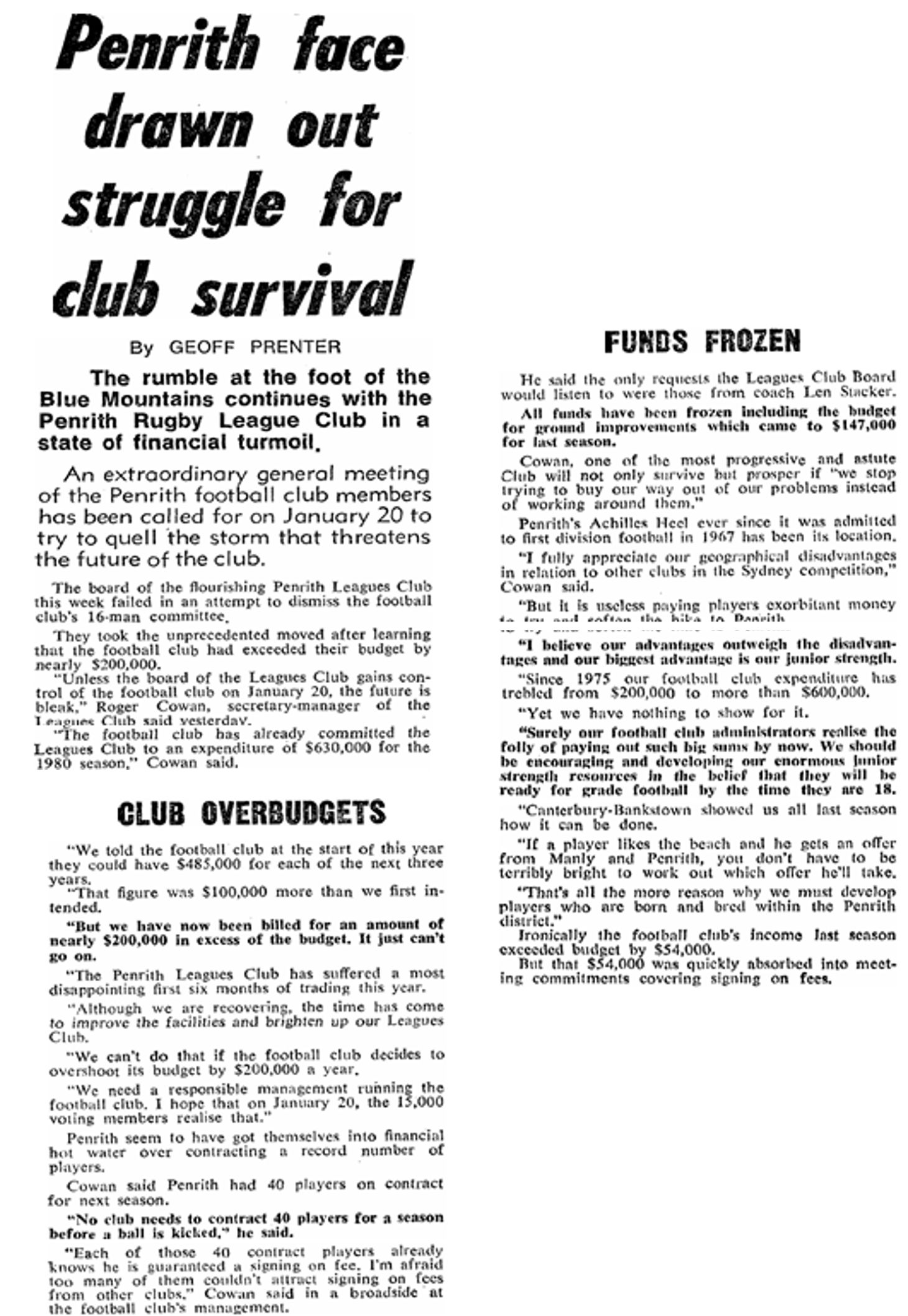
By the late 1970s, these tensions had become increasingly public. In December 1979, the Sydney Morning Herald reported on financial difficulties and disagreements between the football and licensed club administrations. Around the same time, Panthers was preparing for the enormous financial challenge of constructing its new Mulgoa Road complex.

SMH 1979 Dec 9 – click image for full article.

Reports to members in 1980 revealed the extent of the concern. Directors reported that the football club had exceeded an agreed annual budget of $485,000 by more than $100,000 during 1979, while additional commitments had already been entered into for the following season. To the licensed club board, the issue was not simply the amount involved. It was that decisions affecting the future of the entire organisation had been made outside the framework that had previously been agreed.

These events helped bring the governance debate to a head, but they do not fully explain Roger’s determination.

For him, the issue was ultimately one of organisational unity.

He believed Panthers would never achieve its potential while parts of the organisation operated according to different priorities, different assumptions and different lines of accountability. A football club and licensed club could share the same colours, the same members and the same ambitions, yet still find themselves working against each other.

His solution was straightforward.

One board would determine policy and direction for the entire organisation. Management would then be responsible for implementing those decisions. Everyone would work towards the same agreed objectives and everyone would be accountable to the same governing body.

Not everyone agreed.

Some viewed Roger’s campaign as an attempt to centralise power. The perception is understandable. After all, he was advocating a structure that would eventually place responsibility for football and licensed club operations under a single administration. His persistence over sixteen years inevitably raised questions about motive.

Yet there is another interpretation.

Roger was not arguing that football should receive less support. Nor was he arguing that rugby league was less important than the licensed club. Rather, he believed the entire organisation should operate according to a common plan and that all parts of Panthers should be accountable to that plan.

Many years later, Panthers would use concepts such as “twin citizenship” to describe the idea that people belonged not only to their immediate team but also to the wider organisation. While that language did not exist in the 1970s, the philosophy behind it helps explain Roger’s thinking. He wanted rugby league, club management, directors and staff to see themselves as contributors to a single enterprise rather than separate interests competing for influence.

The first major breakthrough came in 1980 when a single board was finally established. Yet even then, the model remained incomplete. Rugby league and the licensed club continued under separate chief executives. As described in Parts 20 and 21, the compromise produced its own difficulties and did not resolve the underlying tensions.

It was not until the end of 1983 that the structure Roger had advocated for so long was fully implemented. One board and one chief executive became responsible for the entire organisation.

Whether that decision alone explains the improvements that followed is impossible to know. Organisations are rarely transformed by a single reform. Nevertheless, the years that followed saw a stronger emphasis on cooperation, planning and shared ownership. The workshops that led to the Five by Five program, closer relationships throughout the rugby league district and a more integrated approach to football and club operations all emerged during this period.

Reasonable people may still disagree about whether Roger was right. They may also disagree about the extent to which later successes flowed from the governance reforms he championed.

What is difficult to dispute is that he regarded the issue as fundamental. For more than sixteen years he returned to the same argument, often in the face of resistance and disappointment.

Ironically, that persistence contributed to one of the enduring myths about Roger Cowan — that he was somehow anti-rugby league.

The evidence suggests a more complex reality.

His long campaign for “One Board, One CEO” was not driven by a desire to diminish rugby league, but by a belief that Panthers could only achieve lasting success when every part of the organisation was working towards the same goals and operating under the same commitments.

Whether one agrees with that belief or not, it became one of the defining ideas in the history of Panthers.


Source Material*

The following documents are extracts of the relevant sections of larger reports:


Related Topics


Related Themes

Financial Management · Governance · Board Decisions · Culture · Club Structure


* Resource material courtesy of The Ausburn Collection


To receive new Parts and occasional project updates by email, you may subscribe below.

Readers who hold recollections, documents, or material relevant to this history are welcome to contribute via the Commentary & Contributions page.

Project Updates

Receive updates when new parts are published.


The Iconic Panthers Scoreboard

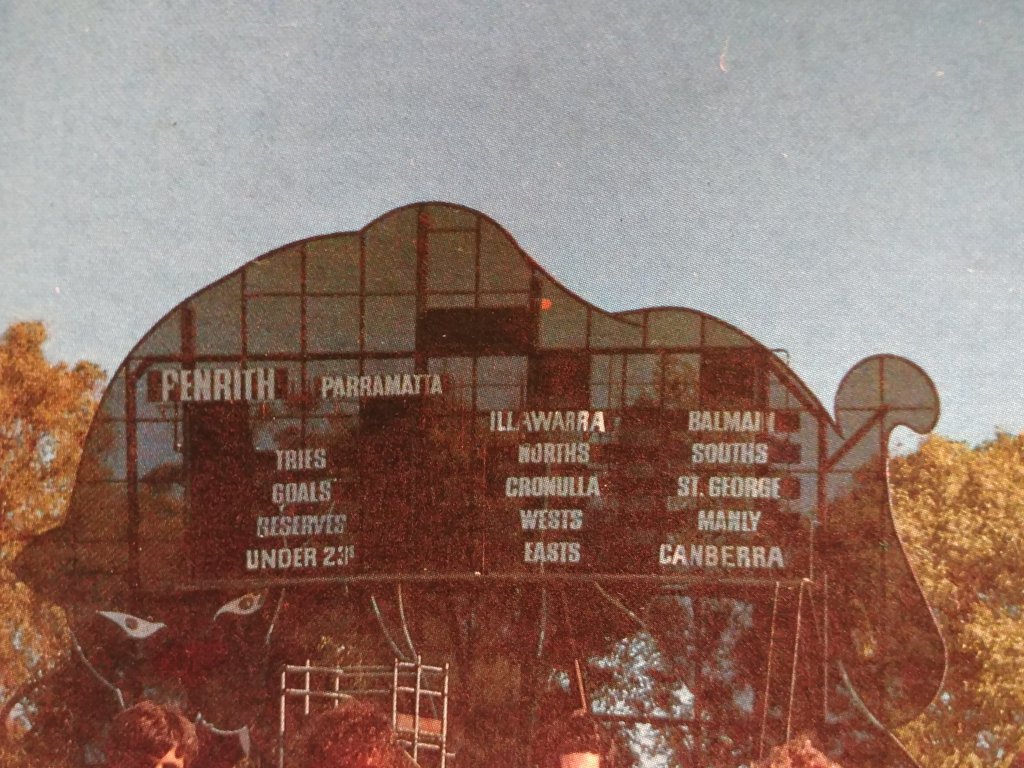
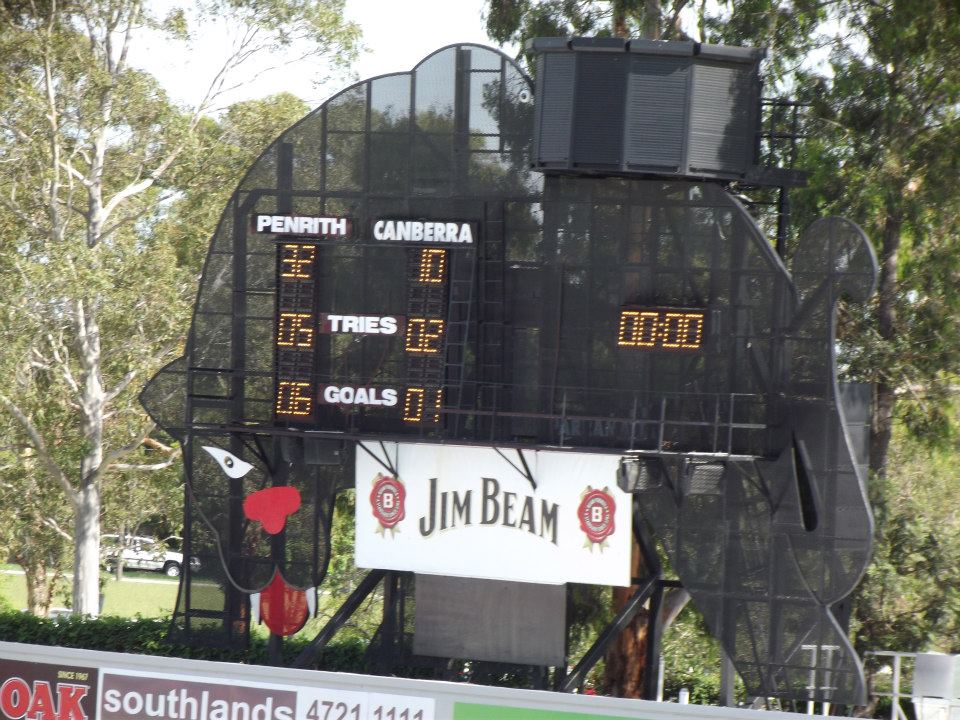
The Panthers scoreboard became one of the most distinctive features of Penrith Stadium — or any rugby league ground at the time. Its origins can be traced to the club’s early think-tank culture.

In the early days of Penrith Rugby League Club, Roger Cowan used think-tanks to encourage participation and generate ideas for the club’s development.

According to Kevin McGrath, the unique scoreboard installed at Penrith Park in 1979-80 had its origins in one of those sessions.

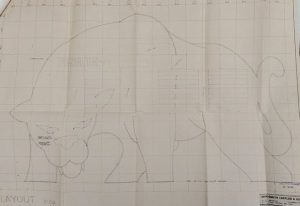
An idea for creating a Luna Park style feature for the club entry was eventually re-imagined as a football scoreboard. The concept was developed further by the architects Dick-Smith Leffler & Gill, who drafted the concept.

Finally, that original idea was brought to life at the southern end of Penrith Park as an innovative scoreboard.

The scoreboard displayed the score of the Panthers game, as well as progress scores from other matches being played on the day. A score by the home team triggered a response from the structure — flashing eyes and a Panther’s roar marking the moment.

Over time, modifications were made as the structure aged and operational demands changed.

The iconic scoreboard had its operational flaws, as it aged there were many breakdowns and failures and eventually could not deliver what was required at a modern sporting stadium … but still it was loved by Panthers fans and visitors alike.

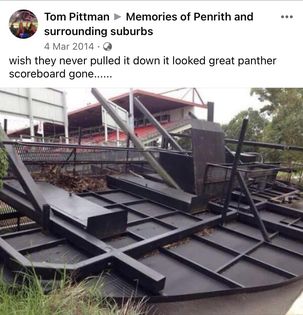
In 2013 it met a fate unbefitting of a trusted, if unreliable, friend:

This Facebook post is dated 4 March 2014, the photo (source unknown) was taken in 2013.

In 2013, the scoreboard was removed.

At the time, it was suggested that the structure had been carefully dismantled and placed into storage, with the possibility of future restoration. Other accounts indicated that it had instead been destroyed during the removal process.

Regardless of the circumstances, its disappearance marked the end of one of the most recognisable symbols of the Panthers experience.


Related Topics


Related Themes

Culture · Growth · Innovation


To receive new Parts and occasional project updates by email, you may subscribe below.

Readers who hold recollections, documents, or material relevant to this history are welcome to contribute via the Commentary & Contributions page.

Project Updates

Receive updates when new parts are published.

The Think Tank Culture

This article forms part of the serialised republication of Panthers, Passion & Politics – The Roger Cowan Years.

Start · Reader’s Guide · All Parts


Focus groups — later formalised as Strategic Planning Groups — became a part of everyday life at Panthers. Glenn Matthews says the involvement of staff remains essential when Panthers considers major changes or redevelopment

Back in the early 70s, with a full-time staff numbering only 30, it already worked the same way. Kevin McGrath who started at Penrith Leagues a little after Roger Cowan, describes how it was then.

We used to have what they called think-ins or think-tanks. They started out once or twice a year, but pretty soon they were every three months. They would get groups of employees – someone from the bars, poker machines, a cleaner, an office person, one of the catering staff, and one of the directors – and put us all in a room together for a day. We had to sit there and come up with ideas that we thought could benefit the club. The ideas could be as weird and wonderful as we liked. Roger used to tell us the more way out, the better.

We had to work as a group, write the ideas down, throw them around, and come up with a list of a final few. Then they would pass the lists on to another similar group, to be discussed and modified again.

That’s an interesting comment, but is it true?

McGrath once jokingly told Cowan he was the biggest plagiarist of all time, because many of those ideas helped make the place what it is today. ‘But he was able to take those ideas and make them become reality.’

For example, one of McGrath’s suggestions was to make the front doors of the club a big open panther mouth – a la Luna Park. This went through the process and ended up as the scoreboard at Penrith Stadium.1

Penrith Stadium’s iconic “Panther” Scoreboard – this was a later modified version.

Keith Rhind says,

Roger was always working on ways to stay ahead of what other clubs were doing. I’m sure he used to stay awake at night thinking up new ideas. He once bet me that one of the groups could come up with more than 200 suggestions in a day. I didn’t believe it was possible, but I lost the bet.

Cowan used to take people out of their comfort zones, Rhind says,

The main purpose of the think-tanks was to give the staff confidence in themselves. When Roger first started, there were a lot of problems, and staff morale was very low. We had a lot of internal pilfering and other bad practices, and there was no real structure or systems. These groups got the staff involved, they began to work as a team, and feel they were a part of something when they came to work. And we were getting all these ideas as well.

Kevin McGrath says it made him feel good to be part of those groups. ‘I was only a cellarman, but in those think-ins, I was equal to any of those blokes.’

In the 70s, Random Breath Testing was introduced to NSW. There was great apprehension about the effects it would have on businesses selling alcohol.

At Panthers, however, the legislation had positive effects. The Club’s “think tank” culture enabled it to come up with strategies that would take it to another level of growth.

Two managers went to Victoria, where RBT had been introduced five years earlier. They researched its effects in Victoria and what hotels had done about it. On their returned a think tank involving a number of key staff. It lasted several hours, and about 150 suggestions were listed. Once the list was complete, the more crazy ones were eliminated. The remainder were grouped and analysed.

Because of this one piece of legislation, the seeds were sown for Panthers to broaden its marketing focus. Now it would include family activities, tourism, and greater emphasis on food. The session was probably one of the two most valuable think tanks ever held by the Club.

The other, in 1983, drove the transformation of rugby league in Penrith from its lowest point to an era of success.

What began as informal ‘think-ins’ had become one of the defining engines of Panthers’ growth.


To receive new Parts and occasional project updates by email, you may subscribe below.

Readers who hold recollections, documents, or material relevant to this history are welcome to contribute via the Commentary & Contributions page.

Project Updates

Receive updates when new parts are published.


  1. The scoreboard became an iconic and much-loved feature of Penrith Stadium. It was removed in the early 2010s. For further context, see: https://pantherspassionpolitics.com/2026/06/02/the-iconic-panthers-scoreboard/. ↩︎

Part 15 · All Parts · Part 17

Commentary and Contributions

Culture — An Early Instance at Panthers

A removed section from the original Chapter 6: Building a Culture — by Accident and Design. This is Roger Cowan’s descirption of the culture of the licensed club in te early days.

The following reflection from Roger Cowan describes how elements of that culture were already taking shape in the early years — often without formal structure.

The importance of managing the culture arose out of the efforts to find better ways of managing Panthers after its rapid growth from 1984 on, and our difficulties coping with it.

Before that, whatever was happening in the culture was happening quite naturally with no thought of planning it. No matter who takes the position of CEO, the culture of the organisation will reflect many of that person’s values, behaviours and beliefs.

The one thing I believed in most strongly was that getting results required hard work and long hours. I think I probably went a little bit overboard, and the family paid the price. But I led the way and before long I had a management team prepared to give a lot of time to chasing the club’s goals.

Don Ellks, Leo Trevena and Bob Donaghy were the key drivers of the business in the early days, and they were prepared to put in whatever time was necessary to make sure they got things done. Leo left after a few years, but Don and Bob were linchpins for many years.

An interesting story shows how recruitment plays a part in building culture in a team. It concerns the promotion of Don Ellks. He came to Panthers as a casual barman, and it was not long before his qualities started to shine through. He was promoted to a supervisory position.

At that time Bob Donaghy and Leo Trevena were the club’s two assistant managers. We needed another assistant to help cover the long hours of operation and Don was suggested. But I was not sure whether he was the sort of person who could handle the hours. I did not want anyone on the management team who would crumble if asked to work long hours, sometimes for a seven-day week. We were a small club and there were a lot of demands.

I asked Bob and Leo to give Don a really tough roster for a couple of months to see how he would handle it. He came through with flying colours and was promoted to assistant manager – where he continued to shine for more than 25 years.

This is a good example of how a culture builds. By that time there were four of us leading the way and you might imagine that the expectations and beliefs of staff was that you would not get far in Panthers if you were not prepared to give a bit extra in time and effort. In those years none of us had ever heard of culture in a business sense but we were building one anyway.

There was another thing I learned in those early days. Most people are more comfortable when they know there are good controls in place. There was a lot of dishonesty in the culture before I arrived – people believing the game was to get what you could without getting caught.

As the controls started to take effect, employees would sometimes very privately give me the tip where something was still going wrong. The culture was changing. The honest people were starting to dominate. They knew that what was happening was wrong and wanted to do something about it, wanted to stop others from getting what they could.

Most people were willing to work together to make the club successful. All they needed was someone to show the way.

Later accounts from those who worked within the Club at the time reinforce this description of the early culture — particularly the expectation that staff would contribute beyond defined roles, and that leadership was demonstrated through action rather than hierarchy.


Related Topics


Related Themes

Culture · Growth


To receive new Parts and occasional project updates by email, you may subscribe below.

Readers who hold recollections, documents, or material relevant to this history are welcome to contribute via the Commentary & Contributions page.

Project Updates

Receive updates when new parts are published.

The Thomas Paynter Story

A removed section from the original Chapter 6: Building a Culture — by Accident and Design.

At the time of publication (2006), around 25 CEOs of clubs in NSW had spent their ‘formative’ career years at Panthers.

Thomas Paynter is one of those managers.

Now the CEO of Port Macquarie Panthers1, he started at Penrith in 1987, working in the bars, picking up glasses. As he began to work his way up, he was given a couple of opportunities early in the piece, which he says he ‘stuffed up’.

I was lucky enough to be given another chance, and I think that’s why I am here today.

Bathurst was the first of the Panthers amalgamations to be finalised. Paynter was sent there as caretaker for three months, but ended up staying a couple of years, before taking on the job at Port Panthers.

It was a huge learning curve for me. The culture of Penrith was really open. People did their job and knew what was expected of them. Coming into an organisation where there were no systems or procedures in place was very difficult. Everything at Bathurst had been quite dictatorial. People would come up and say, “Well, what should we do?”, and I would answer: “Well, what do YOU think you should do?”  I persevered, and a lot of those people picked up and ran with it.

Coming from the culture of Panthers — with its teams, and systems, that sense of natural ownership — and then walking into the other clubs was like stepping back in time.

Bathurst was a bit of a baptism of fire, especially once I knew I was staying. I had never dealt with a board before, never dealt with the community, or even outside suppliers.

But Roger puts very big shoes on people, so you wear them. The fact that Panthers, and Roger – believe that you can do it — you believe you can too.

Janette Hyde2 is the marketing manager of Port Macquarie Panthers. She is one of the original Port staff and has worked at the club for more than 20 years. Panthers amalgamated with the club in 2002. In a classic example of the way that a culture filters through an organisation, Hyde speaks about the management style of her boss, Thomas Paynter. Her words are almost an echo of the words he used to describe the Cowan management philosophy.

Thomas gets the best out of all of us, because he gives us autonomy, he allows us to grow and use our own initiative. He believes we can do it. Underneath the business thing, which is a very big part of it all, there’s also a strong sense of caring about people.

Thomas Paynter’s journey from bar staff at Penrith to CEO of Port Macquarie Panthers illustrates how the club’s culture of trust, responsibility and opportunity translated into leadership beyond the organisation.


Related Topics


Related Themes

Culture · Growth


To receive new Parts and occasional project updates by email, you may subscribe below.

Readers who hold recollections, documents, or material relevant to this history are welcome to contribute via the Commentary & Contributions page.

Project Updates

Receive updates when new parts are published.


  1. Thomas left the Panthers organisation in November 2008. He spent a further four years in the club industry before moving into the insurance sector, where he has continued in specialist and leadership roles.
    ↩︎
  2. Janette Hyde retired from Panthers in 2011. She has continued to contribute to the Port Macquarie region through leadership roles in Business Port Macquarie and the Greater Port Macquarie Tourism Association, and was named 2019 Citizen of the Year. ↩︎

Culture — Pivotal to this Story … and the Club

This article forms part of the serialised republication of Panthers, Passion & Politics – The Roger Cowan Years.

Start · Reader’s Guide · All Parts


Evidence given by some of the Footy Five at the Temby Inquiry – and carried through in newspaper stories at the time – suggested that Roger Cowan had a dictatorship mentality. Some Cowan critics interviewed for this book echo that view.

‘Cowan always had yes-men on the boards’, they said. ‘He was used to getting his own way and resented anyone who questioned his proposals or ideas’.

That’s an interesting comment, but is it true?

It was April 1984 when the Club finally moved to its new home. It walked out the doors of Station Street as the Penrith Leagues Club, and into Mulgoa Road as Panthers. It had taken almost thirteen years to create the physical part of the vision, but other foundations of the Panthers world were being laid all the time.

As soon as a new CEO takes over, a transition begins from the old culture to a new one. A lot of the culture of an organisation develops naturally from the interactions between people. Some of it is driven as a part of the strategic planning. Culture is the unique combination of stories, beliefs, myths and experiences within an organisation that influence how people treat each other and how they expect to be treated.

Every organisation has a culture.

By the late 80s the culture of Panthers became a management project as they searched for better ways to manage the dramatic growth that had occurred.

The words “corporate culture” came to many people’s notice in New South Wales at the time of the Police Royal Commission in 1994. Justice James Wood found that the NSW police culture had been carried through from the senior level to new recruits in an ever-spinning wheel over many years. Because of this, it had been almost impossible to wipe it out, though many had tried.

The Panthers story proves that the theory also works on the other side of that equation. Once the basic elements of a strong, positive culture exist, it too spreads through all levels of the organisation – from the board through management to new employees. The culture at Panthers was resilient and protected by everyone — it has also spread into the broader world of club-land with those who left Panthers.

Bryn Miller is now the CEO of Merrylands RSL Club in Sydney’s west. He worked at the Penrith club through the seventies and eighties, moving up through the structure. His responsibilities included poker machine promotions, entertainment, duty management and managing the new water ski park.

After 14 years in the job, he believed he was ready for another opportunity, but still looks back fondly on his experience at Panthers.

At Panthers we had a very strong team culture. In this ongoing environment of team bonding, you start to believe that there’s nothing outside Panthers. Other people who have moved on have said the same. For a long time afterwards, when you’re talking about Panthers, you still say ‘we’.

 There was none of that feeling at other clubs where I worked. You went to work and you collected your pay. If you tried to be creative or do things differently, there was always somebody white-anting you, including the bosses above you. There was none of the structure or discipline that was normal practice at Panthers.

And it wasn’t that Roger went around ranting and raving. He trod quietly. I found some of the situations in those other clubs absolutely abhorrent. But it also taught me a lot.

People who come through Panthers are usually greeted with open arms when they apply for positions with other employers. The discipline that Miller spoke of, the ability to work as part of a team, the creativity, and the leadership skills make them an asset to any organisation.

Panthers’ amalgamations have been an extension of the whole process. Steve Van Zwieten is the General Manager of the Penrith site.1 He said amalgamations have allowed the company to retain many good people they may well have lost.

When top management positions are limited, and people have that drive and ambition, they will move on. Amalgamations allowed us to hang on to those people. We can move them out into our smaller clubs, where they can continue their growth – realise their potential.

‘It worked the other way too. When we went into those new clubs, we found a lot of good people out there, but often they had had no leadership. As we started to work with them and educate them to our systems and culture, we found many that began to flourish. We had stars rising from all over the place.

‘Growing people is certainly one of our strengths’, says Glenn Matthews. ‘You’ve only got to look at the number of club general managers out there that came through this organisation.’

Around 25 CEOs of clubs in NSW spent their ‘formative’ career years at Panthers. One example is Thomas Paynter, who progressed from bar staff at Penrith to CEO of Port Macquarie Panthers. His story is explored in a companion Beyond the Book article.

That culture had its roots in the early days, when employees were encouraged to believe in the importance of their own contribution to success. Some of the earliest examples can be seen in a removed section from the original manuscript, Culture — An Early Instance at Panthers.

Cowan says there was a strong spirit of helping each other, with less emphasis on seniority or status.

Kevin McGrath tells the story of the first big Sunday night show in the auditorium.

‘It was Col Joye, and the staff was just not prepared for the numbers. People came from everywhere. There were no tickets, it was first come, first served, and total chaos. We sent down for more staff, but it was still not enough, so we called Roger. He raced down and said, “OK, what do you want me to do?” We put him behind the bar working the till. We were his boss that night.’

McGrath says he’s worked in a lot of places, and the boss always says to you, ‘My door is always open’. But when it comes to the crunch, he said, it seldom is.

Roger’s door was always open. I had eight kids, and all you got back then was your wages and endowment. I was always getting into financial trouble. Every time I needed bailing out till payday – or help to pay a bill – Roger would help me out.

Glenn Matthews joined the organisation in 1984, and he confirms that the ‘open door’ really always was an open door. And he says as group GM, he continues that policy. ‘Although it’s not really policy’, he says. ’It’s more than that – it’s a culture, a philosophy that seems to have always been there.’

Matthews says not everybody is going to be successful working for Cowan.

If you’re the sort of person who can give yourself your own pats on the back, you’re fine. But if you expected that Roger was going to pat you on the back, well, that just wasn’t going to happen. He supported and encouraged you and showed his faith in you by letting you go off on tangents, and try new things, so you knew you were OK. But that doesn’t work for everybody.

I thrived in that environment anyway; I always knew if I was doing a good job. If I gave something to Roger that he thought needed more work, or wasn’t quite right, he would give it back to me. He was always constructive, never really critical. And I took on board what he said for the next time.

Bryn Miller agrees that there were few actual ‘pats on the back’ from Cowan, but he says they weren’t really needed.

When we started bringing in the big acts, and it was all going so well, he would present the latest figures at a meeting and make the comparisons. We didn’t need him to come out and say, “good job, guys” because we knew. I now have quite a big staff of my own, and I know that some people do need that kind of reinforcement in their work, but it was never really Roger’s style.

Recognition, at Panthers, was often implicit — built into results, trust, and responsibility.


To receive new Parts and occasional project updates by email, you may subscribe below.

Readers who hold recollections, documents, or material relevant to this history are welcome to contribute via the Commentary & Contributions page.

Project Updates

Receive updates when new parts are published.


  1. Steven van Zwieten left Panthers in September 2007. ↩︎

Part 14 · All Parts · Part 16

Commentary and Contributions

The Tin Shed — Myth and Memory

In telling the history of Penrith Rugby League Club, one phrase appears again and again — the “tin shed.”

It is often used to describe the club’s early years: humble, under-resourced, and far removed from the scale of the modern Panthers organisation.

Like many origin stories, the reality is both more specific — and more revealing.

What Was the “Tin Shed”?

As former director Max Connors recalled, the so-called “tin shed” was not a clubhouse in the way the term is now understood. It was, in fact, a kiosk at the showground where the team played.

The tin shed that people talk about was actually a kiosk on the showground where they used to play. It was run by the ladies, and the players used to get three free tickets each, and the supporters could buy three tickets for two shillings.

The structure doubled as a dressing area for players, reflecting the limited facilities available at the time.

Penrith’s “Tin Shed” Mark II

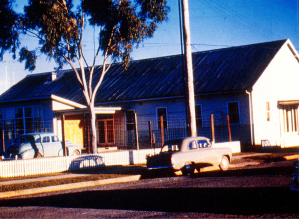
Many would label this building as the “tin shed” of Penrith’s history.

Panthers first clubhouse in Station St, Penrith

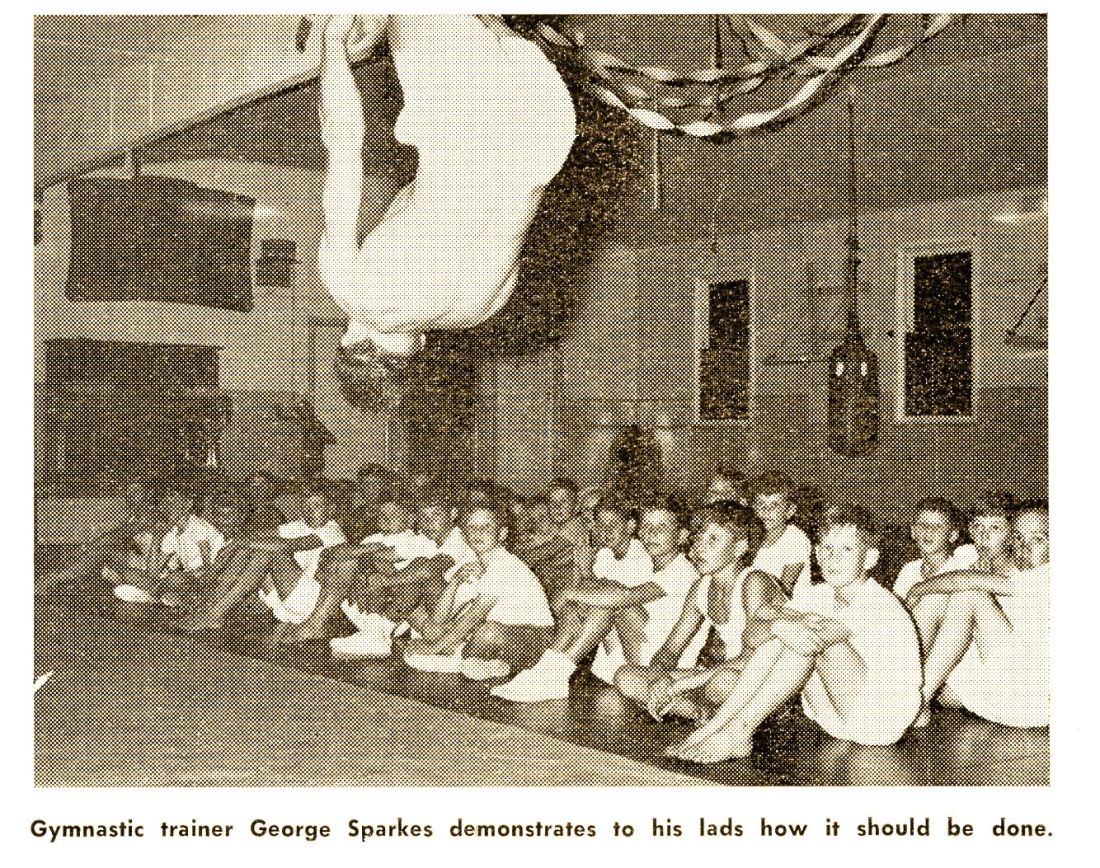
It would be a fair label, for this too is a far cry from the building that, in 1963, opened along side it. But this second “tin shed” was already multi-functional, and efficiently so. Dining room, function room, gymnastics (see feature image), boxing, calisthentics, jiu-jitsu, weights and of course, the club staples of bar and poker machines.

A Familiar Story

The idea of a club beginning in a “tin shed” is not unique to Penrith.

Across New South Wales, the history of registered clubs abounds with stories of “tin shed” origins — always small, improvised buildings, often constructed from basic materials and supported by volunteer labour.

Whether literally accurate or not, the phrase has become a kind of shorthand for humble beginnings and community effort.

In that sense, the “tin shed” is as much a cultural expression as a physical description.

How Myths Take Shape

Over time, the image of the “tin shed” has taken on a broader symbolic meaning — shorthand for:

  • hardship
  • simplicity
  • and the idea of a club built from nothing

This kind of simplification is very common in tales of sporting and community history. The details are simplified, merged, or reshaped into something more easily remembered and retold.

The result is not necessarily inaccurate — but it is selective.

The Penrith Version

At Penrith, the story is slightly more nuanced.

While the original “tin shed” referred to the showground kiosk described by Connors, later early facilities — including the original Station Street club building — were also modest in scale and construction.

In practical terms, they fit very well with the image the phrase now conveys.

The mythology, in that sense, is not entirely misplaced — but it is an interpretation crossing several realities.

Why it Matters

Understanding the reality behind the “tin shed” does not diminish the achievement of those early years.

If anything, it clarifies it.

The club did not begin in abstraction or myth, but in a very real, very practical setting — a showground, a kiosk, and a community effort sustained by volunteers, financiers — lenders and donors — players, and supporters.

That distinction matters, because it grounds the story of Penrith not just in adversity, but in structure, place, and people.

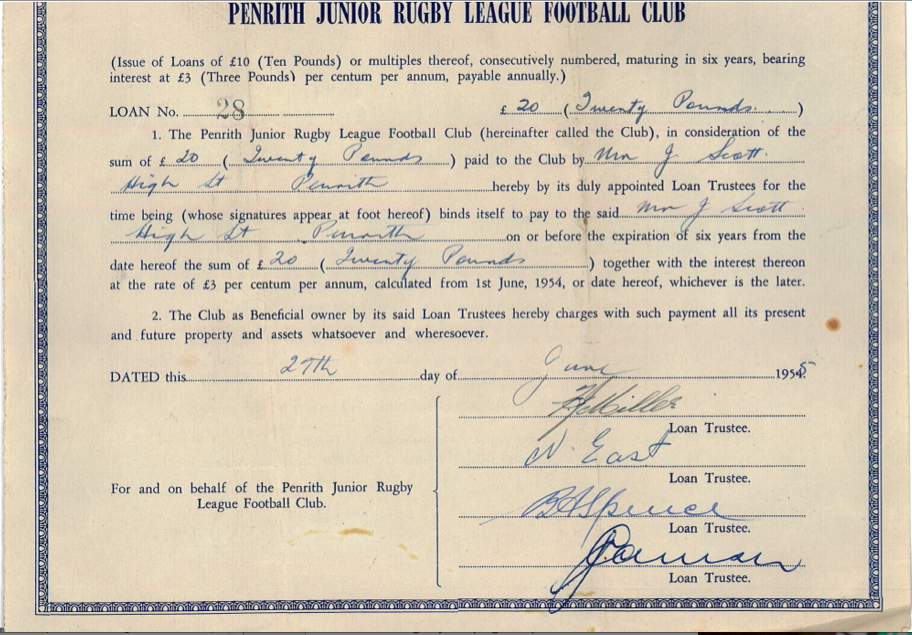
One of the people who helped Penrith Rugby League Club move beyond tin shed was Mr John Scott who provided the Penrith Junior Rugby League with a loan of £20 in 1955. The Scott family have supported the Club from its very beginnings, have seen many changes, great growth, challenges and remain firmly part of the Panthers family today.

In the Narrative

The reference to the “tin shed” appears in Part 4 — From Small Beginnings, where it helps frame the scale of the club’s early operations, and the distance between those beginnings and what would follow.


Related Materials


Related Themes

Growth · Culture


To receive new Parts and occasional project updates by email, you may subscribe below.

Readers who hold recollections, documents, or material relevant to this history are welcome to contribute via the Commentary & Contributions page.

Project Updates

Receive updates when new parts are published.