
Part 16 of 70 — Original Chapter: Chapter 6: Building a Culture — By Accident and Design
This article forms part of the serialised republication of Panthers, Passion & Politics – The Roger Cowan Years.
Focus groups — later formalised as Strategic Planning Groups — became a part of everyday life at Panthers. Glenn Matthews says the involvement of staff remains essential when Panthers considers major changes or redevelopment
Back in the early 70s, with a full-time staff numbering only 30, it already worked the same way. Kevin McGrath who started at Penrith Leagues a little after Roger Cowan, describes how it was then.
We used to have what they called think-ins or think-tanks. They started out once or twice a year, but pretty soon they were every three months. They would get groups of employees – someone from the bars, poker machines, a cleaner, an office person, one of the catering staff, and one of the directors – and put us all in a room together for a day. We had to sit there and come up with ideas that we thought could benefit the club. The ideas could be as weird and wonderful as we liked. Roger used to tell us the more way out, the better.
We had to work as a group, write the ideas down, throw them around, and come up with a list of a final few. Then they would pass the lists on to another similar group, to be discussed and modified again.
That’s an interesting comment, but is it true?
McGrath once jokingly told Cowan he was the biggest plagiarist of all time, because many of those ideas helped make the place what it is today. ‘But he was able to take those ideas and make them become reality.’
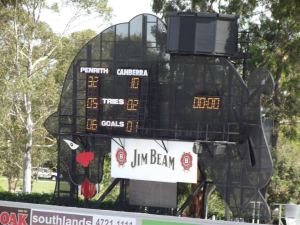
For example, one of McGrath’s suggestions was to make the front doors of the club a big open panther mouth – a la Luna Park. This went through the process and ended up as the scoreboard at Penrith Stadium.1
Keith Rhind says,
Roger was always working on ways to stay ahead of what other clubs were doing. I’m sure he used to stay awake at night thinking up new ideas. He once bet me that one of the groups could come up with more than 200 suggestions in a day. I didn’t believe it was possible, but I lost the bet.
Cowan used to take people out of their comfort zones, Rhind says,
The main purpose of the think-tanks was to give the staff confidence in themselves. When Roger first started, there were a lot of problems, and staff morale was very low. We had a lot of internal pilfering and other bad practices, and there was no real structure or systems. These groups got the staff involved, they began to work as a team, and feel they were a part of something when they came to work. And we were getting all these ideas as well.
Kevin McGrath says it made him feel good to be part of those groups. ‘I was only a cellarman, but in those think-ins, I was equal to any of those blokes.’
In the 70s, Random Breath Testing was introduced to NSW. There was great apprehension about the effects it would have on businesses selling alcohol.
At Panthers, however, the legislation had positive effects. The Club’s “think tank” culture enabled it to come up with strategies that would take it to another level of growth.
Two managers went to Victoria, where RBT had been introduced five years earlier. They researched its effects in Victoria and what hotels had done about it. On their returned a think tank involving a number of key staff. It lasted several hours, and about 150 suggestions were listed. Once the list was complete, the more crazy ones were eliminated. The remainder were grouped and analysed.
Because of this one piece of legislation, the seeds were sown for Panthers to broaden its marketing focus. Now it would include family activities, tourism, and greater emphasis on food. The session was probably one of the two most valuable think tanks ever held by the Club.
The other, in 1983, drove the transformation of rugby league in Penrith from its lowest point to an era of success.
What began as informal ‘think-ins’ had become one of the defining engines of Panthers’ growth.
To receive new Parts and occasional project updates by email, you may subscribe below.
Readers who hold recollections, documents, or material relevant to this history are welcome to contribute via the Commentary & Contributions page.
Project Updates
Receive updates when new parts are published.
- The scoreboard became an iconic and much-loved feature of Penrith Stadium. It was removed in the early 2010s. For further context, see: https://pantherspassionpolitics.com/2026/06/02/the-iconic-panthers-scoreboard/. ↩︎
 Panthers, Passion & Politics - The Roger Cowan Years