The Changing Face — and Culture — of the Panthers Board

This article forms part of the serialised republication of Panthers, Passion & Politics – The Roger Cowan Years.

Start · Reader’s Guide · All Parts

John Bateman, a Penrith solicitor, joined the board in 1995. He had previously stood unsuccessfully for the Board and his patience was rewarded when a vacancy occurred between elections. He was a local councillor. The Board considered he would be a valuable addition to the expertise available on the Board.

Around three years later, another seat became available on the Board, and Greg Evans was also invited to join. He owns a local newspaper, the Western Weekender. He had also served on council. He had stood for the Board two years in a row and had been unsuccessful. He confided in Barry Walsh, then a member of the Board Executive, that he could not afford to fail a third time. Walsh advised him that there was a vacancy coming up and that the Board would probably invite him to fill that. 

So, a solicitor and a local businessman had been invited to fill vacancies on the Board – both experienced in local government – should have strengthened the board. Both were also sponsors of the rugby league team, and so were well known to the club management.

Four of the directors who became the Footy Five were actually invited to join, rather than securing their seats through a members’ vote.  Craig Terry and Dennis Coffey joined In the latter part of 1998 and early 1998. Terry’s credentials were in accountancy and it was thought he would be a suitable replacement for the retiring Leigh Mawhood, also an accountant. Terry, too, had also stood unsuccessfully for the Board a couple of times.

The 90s saw Merv Cartwright back on the board after a hiatus of many years. Some of Cartwright’s history with the club is already documented, including the cancellation of his membership. When his sons began playing for the Panthers, he wrote letters to the Board asking that his membership be reinstated. He gave a written undertaking that he had no interest in becoming a director, and would not take any part in club politics. 

The Board relented, and Cartwright was a member again. Soon after readmission he stood for the Board on a platform that criticised Cowan. When he eventually decided to stand down, he pushed for his son-in-law, Dennis Coffey, as his replacement.

Coffey is an ex-rugby league player for Penrith, and founder of Coffey Engineering, a successful Penrith-based industrial engineering company. He was a popular choice with all board members to fill the vacancy. Cartwright’s son John, one of the players in the 1991 premiership winning team, had married Dennis Coffey’s daughter.

Geoff James had been a director for several years as part of what had been a reasonably cohesive and productive board. James had a friendly relationship with chairman Leo Armstrong. They had been next door neighbours for many years and used to look after each other’s homes if one was away.

When Craig Terry arrived, he and James quickly established a good rapport.  Cowan and the other managers came to believe an alliance was forming between them and Bateman, Coffey, and Evans. From that time, the dynamic on the board totally changed.

The situation in the boardroom began to deteriorate to become what has been described as ‘horrific’.

There is a lot of evidence of Cowan’s efforts – through Board management seminars, recommendations to Board meetings, and the employment of consultants to get the Board to clarify what it wanted from him and the management team.

Greg Evans says that members of the alliance of five were trying to get Cowan to ‘come under the direction of the board, and to work within the parameters that they set’.

He denies there was a hidden agenda, but says,

He’d been the boss for so many years, and things were going OK. Boards got used to going along with him. He always felt that his way was the right way; he just wanted to get things done. Any questioning by the board was just a nuisance, so he used to get impatient.

But Evans does not identify any of the ‘parameters’ that the Board wished to impose. The real problem was that the main protagonists in this drama saw their role – and the others’ – very differently.

It was a clash in values that caused me to walk out of a meeting in June 2000. I was angry that people saw nothing wrong with breaking a contract when it suited them.

I could not understand how they could even consider reneging on the amalgamation deal with Newcastle. It took more than a year to get the Board to make a decision about amalgamations. It is true that I used to get impatient. How can it take 12 months to make a simple decision about amalgamating with another small club? I could see great advantages for Panthers and I wanted to get started.

While we were talking around in circles we failed to take advantage of an opportunity to amalgamate with Kingswood Bowling Club and Eastern Suburbs snapped it up. Panthers’ management could see some big potential for that club but it was almost impossible to get the Board to look at proposals rationally and objectively.

Management and Board both have an important job to do. If I do a bad job, then the Board has to step in, but there has to be a line between Board and management, and that applies in any business.

 I always insisted from the moment I started on that three month trial in 1965 that I would be totally in charge of all staff matters, all the hiring, firing, and all the discipline. It would be my responsibility. The Board was not to interfere in any of it. And they agreed with that.

It ultimately evolved into a strong part of the Panthers culture.  As long as staff matters were my responsibility, I was able to oversee the day-to-day running of the place. I do know of some other clubs where board members interview and employ staff. They are even able to fire them.

In that kind of environment, the sailors are not taking their orders from the captain of the ship. They’re being told what to do by the owners of the shipping line.

Roger Cowan says the culture of an organisation is what sets it apart, and to be effective, it must be strong at all levels – from the chairman, all the way through to casual employees.

People have to know where they stand and feel good about the contribution they are making. He and most of the other managers were disappointed that the strong culture that had been built over many years was being eroded.

The problems in Panthers’ boardroom were exacerbated by the rugby league merger issue. Rumour had abounded about Cowan’s alleged plan to merge with Parramatta. Claims in Ray Hadley’s radio show that it was a ‘done deal’ added to the tension. Alliances that were initially tenuous now became solid.

The time was now right, says Cowan, and the group – Bateman, Coffey, Evans and Terry – made their move to unseat the chairman, Leo Armstrong.

Leo had been chairman for 14 years and was generally acknowledged as a fine figurehead for Panthers. He was respected and admired by the other directors and by management and staff. He was popular with the members and the general public, who recognised him from public appearances, and as the person who often presented cheques to community organisations on behalf of the club.

Leo often became quite angry with Bateman in Board meetings. But removing Leo was a problem for the Bateman camp. He had the support of four directors, and with his own vote could hold his position. They would need to shift the balance. 

When Geoff James accepted the dangled carrot of the deputy chairman’s job, the die was cast. 

Somehow the group managed to convince Geoff James to move against the chairman. Once Armstrong was removed from the chair, James moved into the position of Junior Deputy Chairman.1

Becoming a deputy chairman would automatically elevate him to the Board Executive. More importantly, even though many executive matters were supposed to be confidential, his appointment could open new doors for the alliance, and thus give it an added measure of power.

James would later admit faxing confidential executive material to John Bateman –an action questioned by Ian Temby in the Inquiry.

Once they knew that the alliance was solid, Bateman made his move. He first approached Keith Rhind, a deputy chairman at the time, telling him the Leo Armstrong was to be removed as chairman, and asking Rhind to take over the chair.  Rhind refused the offer.

Bateman then went to deputy chairman Barry Walsh, making the same offer. Armstrong was going whatever happened, Bateman said. If Walsh also refused the chairman’s job, Bateman would take it himself.

Walsh, like Rhind, was a loyal Armstrong supporter. It was a terrible decision to have to make. Walsh opted for the lesser of the two evils and agreed to stand.

Preferring to avoid the ignominy of being voted out, Armstrong stood down. Cowan says he was bitterly disappointed to learn that his trusted neighbour had turned against him.

Cowan has some theories as to the motives of the group in putting Walsh in the chair instead of Bateman, who would be the logical choice.

They may have wanted to avoid the impression of a coup if both Armstrong and Walsh were deposed in one hit. Both were well known in the community, and popular with members, supporters, staff and management.

Also, there was the friendship between Barry and Bateman. Barry was godfather to one of Bateman’s children. Maybe Bateman hoped that that friendship would give his faction another supporter. I suspected it was just an interim measure.

Walsh stepped into the chair, but in many ways, he lacked the power of the position. In a very telling comment in the 41X inquiry, he told Department of Gaming & Racing (DGR) counsel Vickie Hartstein, ‘I never had control of the Board’.

The five had the numbers, and they used them.

Panthers’ group CEO Glenn Matthews described the board meetings as dysfunctional.

It often seemed that some of the Footy Five were being deliberately obstructive. They’d ask you for the same information again and again. Meetings usually went on till after midnight. I used to cop personal abuse all the time. Many times, I was called names, frequently a liar, in Board meetings. Often, we had the most trivial things to be approved by the Board, and they questioned every single item. Yet I can remember one night when they voted to spend over $100,000 on a player in some deal. There was no rhyme or reason. It was a nightmare.’

One night Craig Terry’s usual barrage of illogical, petty comments and accusations got the better of me. I became totally frustrated and in anger I hurled the papers I was holding in his direction. Later I was with John Wilson as we waited for the meeting to finish. I was regretful about losing my cool and I said to John, “I’m in for trouble when the boss gets out of the meeting. He is not going to like what I just did.”

One night Craig Terry’s usual barrage of illogical, petty comments and accusations got the better of me. I became totally frustrated and in anger I hurled the papers I was holding in his direction. Later I was with John Wilson as we waited for the meeting to finish. I was regretful about losing my cool and I said to John, “I’m in for trouble when the boss gets out of the meeting. He is not going to like what I just did.”

The meeting broke up and Roger came over to us. He said,

“Glenn, next time you throw something at Craig Terry make sure it is heavier than paper and make sure you aim better.”

We all laughed, and I was off the hook.


To receive new Parts and occasional project updates by email, you may subscribe below.

Readers who hold recollections, documents, or material relevant to this history are welcome to contribute via the Commentary & Contributions page.

Project Updates

Receive updates when new parts are published.


  1. The Temby Inquiry records that in 1999 Leo Armstrong was replaced as Chairman by Barry Walsh and Geoff James became a member of the Board Executive. Temby noted that, according to Roger Cowan, these changes had been engineered by the group Cowan saw as opposed to him and had caused Armstrong “bitter disappointment”. See Ian Temby QC, Penrith Rugby League Club Inquiry: The Report, Chapter 2, “A Power Struggle”, p. 8. ↩︎
Part 49 · All Parts · Part 51→

Commentary and Contributions

When Penrith City Became the Major Sponsor

Beyond the Book — Commentary & Contributions

Phil Morehead remembers an unusual sponsorship idea — and the leadership lesson that followed.

Contributor: Phil Morehead

Phil Morehead was a partner in Thomas Marsden Advertising the advertising agency and design studio that supported Panthers for many years. Phil also was a long-time active member and President of the Penrith Valley Chamber of Commerce. In this contribution he recalls how Penrith P Panther came into existence and became a recognisable community figure.


In 1988, the name across the front of the Penrith Panthers jersey wasn’t a company or a commercial product.

It was PENRITH CITY.

The arrangement lasted for just one season. But the story of how it came about provides an interesting glimpse into the relationship between the Panthers, the business community and the city during a period when all three were growing.

For Phil Morehead, however, the strongest memory isn’t really about sponsorship at all.

It is about Roger Cowan.

Phil was a partner in Thomas Marsden Advertising, the long-time advertising agency for Panthers, and at the time was also President of the Penrith Chamber of Commerce. He remembers Roger approaching him because Panthers had been unable to secure what Roger regarded as a suitable major jersey sponsor.

Roger saw another possibility.

The football team was appearing regularly on television and in newspapers, carrying the Penrith name far beyond the district. If a commercial sponsor couldn’t be found, why not use that exposure to promote Penrith itself?

As Phil recalls:

Roger was big on promoting Penrith and realised the massive media exposure our football team was delivering every time they played. It was Roger’s concept to have PENRITH CITY on the jerseys.

Phil was wearing what he describes as his “two hats” — advertising man and Chamber President — and the two began developing a plan around the idea.

A city gets behind its team

The proposal went well beyond simply putting PENRITH CITY on a football jersey.

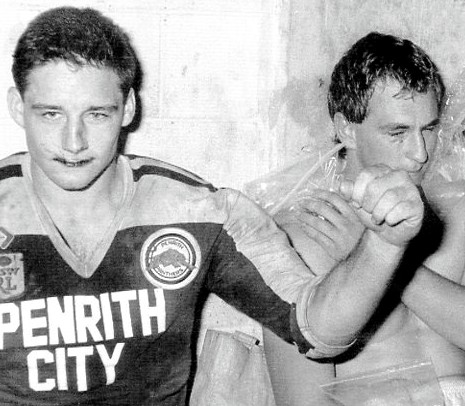
Bloodied and busted — Mark “MG” Geyer & John “Hoss” Cartwright bringing victory to their city. (Photo from Bound for Glory)

An Art Union was planned. Local motor dealers came on board with a new car as first prize. Other businesses would provide additional prizes, while the Chamber’s extensive business network would help sell and promote the tickets.

Responsibilities were allocated among the various people involved and another meeting was scheduled to check progress.

By then, Roger had acted — the jerseys had been ordered.

Phil had acted too. Retailers were prepared and the posters, tickets and other promotional material had been produced.

Then came the follow-up meeting.

In Phil’s recollection, almost nobody else had completed what they had undertaken to do. He particularly remembers a young Royce Simmons, then working with the junior clubs, apologising because he hadn’t had time to complete his part.

The original plan was in trouble.

“We will have to put this aside”

Roger looked at the situation and made the decision.

The jerseys could no longer be altered. Thousands of dollars had already been spent on promotional material. But without the other elements in place, the broader campaign could not achieve what had originally been intended.

Phil remembers Roger saying:

Well, the jerseys cannot be altered, we’ve already spent thousands of dollars on promotional material and I don’t think we can achieve our goal. We will have to put this aside and go back to the drawing board.

What impressed Phil was not simply the decision. It was the absence of everything that might easily have accompanied it.

No anger. No criticism. No ‘what are we going to do now’?

The plan had not come together. People had failed to deliver what they had agreed to do. Roger was undoubtedly disappointed.

But, as Phil remembers it, there was no attempt to embarrass anyone, allocate blame or prolong the failure.

A decision was made and everyone was allowed to move on.

For Phil, it became an enduring example of Roger’s leadership — particularly his capacity to make a hard decision without condemning the people whose actions had helped make that decision necessary.

The unexpected result

The original promotional scheme may not have proceeded as intended, but something significant remained.

The jerseys had already been produced.

So, throughout the 1988 season, the Penrith Panthers ran onto the field carrying PENRITH CITY across their jerseys.

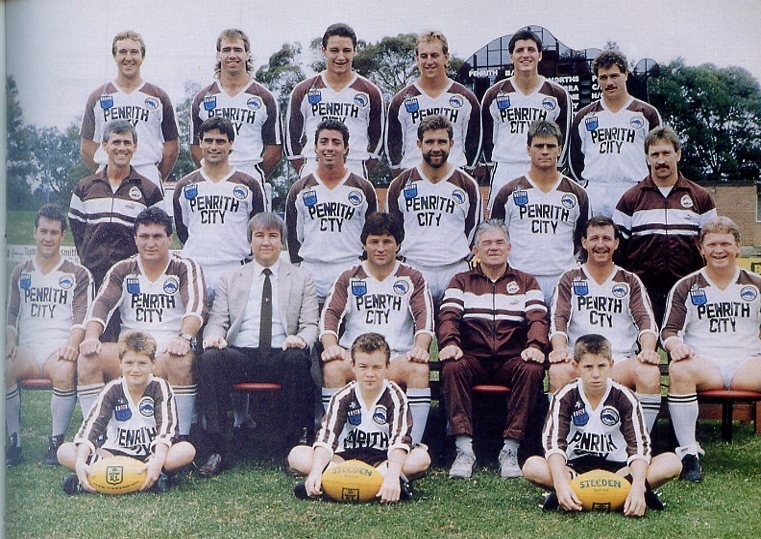
The 1988 Penrith City Panthers (photo: Bound for Glory)
BACK (l to r): Rod McNeil, Matt Goodwin, Mark Geyer, John Cartwright, Graeme Bradley, Cal Van Der Voort.
MIDDLE(l to r): Bryan Hider, Neil Baker, Greg Alexander, Geoff Gerard, Chris Mortimer, Steve Colman.
FRONT (l to r): Greg Clements, Peter Kelly, Steve Robinson, Royce Simmons (c), Ron Willey (coach), David Greene, Brad Izzard.
Ballboys (l to r): Tim Bailey, Paul Bicknell, Brad Bateup.

For Phil, wearing his Chamber of Commerce hat, there was a considerable consolation. Panthers honoured the costs already incurred in producing the promotional material, while the Chamber could tell the local business community that its football team would be promoting Penrith City throughout the season without cost to the Chamber.

It was, in Phil’s words, one of the “win win” experiences of his time as Chamber President.

And the unusual arrangement proved short-lived.

In 1989, Calphos became the Panthers’ major jersey sponsor. In 1990, DahDah took over the major sponsorship, apppeared in a grand final, then a major change in colours, and a premiership win — impeccable timing. DahDah remained on the jersey through to 1993.

Phil wonders whether that prominent PENRITH CITY branding across the Panthers jersey helped open the door for the commercial sponsorships that followed.

Perhaps it did. But his recollection leaves another legacy.

A plan had failed. Money had already been spent. Commitments hadn’t been met. Roger had every reason to be frustrated.

Yet the thing Phil Morehead remembers almost four decades later isn’t the frustration.

It is the way Roger treated the people around the table.


Related Topics


Related Themes

Culture · Innovation · Football Club · Leadership


To receive new Parts and occasional project updates by email, you may subscribe below.

Readers who hold recollections, documents, or material relevant to this history are welcome to contribute via the Commentary & Contributions page.

Project Updates

Receive updates when new parts are published.

What Makes a Good Club Director

This article forms part of the serialised republication of Panthers, Passion & Politics – The Roger Cowan Years.

Start · Reader’s Guide · All Parts

The club industry in NSW occupies a unique position — strongly regulated by the state government, but still very much a part of its individual communities. Most clubs are heavily involved in sport and recreational groups in their areas, and provide donations, facilities, and other benefits. Many also support local charities and organisations. By 2003, the total cash donations from NSW clubs amounted to around $102 million. The main recipients were health and social services programs, education (cash, scholarships, library support), emergency services and disaster relief, and of course local sport, at both professional and non-professional levels.

The situation of club directors is also unique. The shareholders who elect boards of major corporations have a ‘hip pocket’ interest in who is overseeing the running of the company. The directors are usually there because they bring some skill or expertise that qualifies them to do a good job.

In most club elections, a 1% turnout of members would be classed as good. This changes only slightly where there is a major issue being played out, as at Panthers in 2002. Even then, the 3000 people who voted still only represented a small percentage of the club’s 130,000 members at the time.1

People pay to become shareholders in a company, whereas people become members of a club to enjoy the facilities it offers and the geographical convenience. Few of them have any interest in the politics unless they become aware of major problems that are likely to impact on the amenities they enjoy.2

Craig Fantom3 is now the CEO of a well-known Irish pub on the western outskirts of Sydney. Before moving into hotels a couple of years ago, he had spent 25 years in the club industry, 20 of them dealing with boards. It was the three years he spent as CEO of the Rooty Hill RSL Club that became the catalyst for a change in his career direction.

 ‘Club directors have the same fiduciary duties as any other director, and often have control of a multi million dollar organisation’, says Fantom, who believes that one of the industry’s major weaknesses is the quality of the directors it attracts. 

Roger Cowan says he was aware of the difficulties at Rooty Hill, but his experience at Panthers has been quite different and he doesn’t share Fantom’s view on club directors. Cowan says that some of the directors that have caused the most problems for Panthers over the years appeared to be the best qualified.

Look at the group that set themselves up as the Footy Five.4 There was a solicitor, an accountant, two successful businessmen and a private investigator. They should have been the best directors we ever had but the reader of this tale might have some doubts about that.

There are a lot of directors in the club industry who are volunteering their time because of a genuine interest in their club. If they lack formal qualifications they make up for it with common sense, loyalty to the cause and the willingness to listen to expert opinions when they are needed. 

One [Panthers] director who stands out in my memory was Lou Brown, a truck driver and a rough diamond if you ever saw one. Another was Poker Ausburn. He was a boilermaker and was chairman of the club for several of our most successful years. I could name a lot more very good directors and they all had one thing in common – a genuine unselfish desire to see the Club succeed. An uneducated director with a genuine sense of ownership and sound common sense will be an infinitely better director than a Rhodes scholar whose heart isn’t in it.

To the allegation that he worked with boards of ‘yes-men’, Cowan says,

It really is quite ridiculous to think that directors would volunteer their time to represent the members who elected them and then turn up to meetings to be told what to do. Human nature does not work like that.

Keith Rhind remembers one amusing example of the myth.

Before Vern Mychael was elected to the board, he would be at every general meeting asking the most probing questions. He made it well known that if he ever got onto the Board, he “was going to put Cowan in his place”.  He was elected and became one of Cowan’s strongest supporters and friends.

Rhind recalls that years later Mychael related how different was the reality of the board from the myth.

Nobody in their wildest dreams could imagine Vern as a yes-man. He was a very strong character.

Rhind also points out that nobody could say Barry Walsh was a yes-man, and yet on most issues, he supported Cowan to the hilt.

The fact is that they shared the same vision for Panthers and they agreed on most things. They were both passionate about succeeding. Barry’s greatest passion is rugby league, but he knows the future of rugby league depends on the success of the club in every other way. When they did disagree, they were able to discuss it rationally and with respect for each other. The “yes-men” theory is really quite ludicrous when you think about it.

Another claim was that Cowan could choose who he wanted on the board. Boards are elected – as October 2002 proved. All the campaigning and the tickets made no difference. The members decide who they want.

It was the vagaries of directors that had seen Cowan in court facing charges in 1986.5 It had also taken him ten years to convince a board to implement a change to the way the rugby league club was administered.6


To receive new Parts and occasional project updates by email, you may subscribe below.

Readers who hold recollections, documents, or material relevant to this history are welcome to contribute via the Commentary & Contributions page.

Project Updates

Receive updates when new parts are published.


  1. A total of 3273 ballot papers were retruned in the March 2002 election. 110 of these were informal. See: Temby Report page 39. ↩︎
  2. Rugby League Clubs may be slightly different. If the team is performing badly, members appear to take great interest. The 1971 Extraordinary General meeting that saw Merv Cartwright and Ron Partridge resign had an attendance of 1000, when there was only 6000 members. See: Part 8 — Divided Control: The Club and Football ↩︎
  3. Craig Fantom held this role at the time of publication. ↩︎
  4. The origins and later use of the term “Footy Five” are examined in Beyond the Book — The Footy Five — A Name that Rewrote the Story. ↩︎
  5. This story begins at Part 22 — An Investigation Starts . Also relevant is Beyond the Book — The End of Season Drinks That Weren’t So Cordial ↩︎
  6. See Part 21 — The Right Structure. Finally! ↩︎

Part 48 · All Parts · Part 50

Commentary and Contributions

Unexpected Bonuses

This article forms part of the serialised republication of Panthers, Passion & Politics – The Roger Cowan Years.

Start · Reader’s Guide · All Parts

An example of the unexpected bonuses emerging from Panthers’ amalgamations comes from Port Macquarie. When Panthers amalgamated with Port Macquarie RSL1, it also picked up a small bowling club out of town that had already amalgamated with the RSL Club. This little club may end up being one of the jewels in the Panthers crown.2 The Hibbard Bowling Club is on 12 acres of land, with its own sports complex in a residential area. In 2005 council approved a new development of 3000 homes. The new estate backs onto the club’s playing fields, and the area is not far from the Port Macquarie airport. Locals believe Hibbard will become a major satellite suburb of the city, and its Panthers club will be an important part of that new community.

Amalgamations have helped to pump life back into communities that might otherwise have lost their club — along with its sporting amenities, inexpensive meeting rooms and the donations that are part of the club ethos.

Even where amalgamation offered a struggling club a way forward, change was not always readily accepted. Newcastle Panthers former CEO, Bob Adamson, spoke of the way that Panthers’ systems were implemented into each amalgamated club. There were manuals and documented procedures covering every facet of the business, designed to make the operational transition as seamless as possible. But bringing in the Panthers culture was not always so straightforward.

Thomas Paynter had spent some time at Bathurst Panthers before he took on the job of CEO at Port Panthers. He says that the amalgamation in Port was not as smooth as it had been in Bathurst.

There are still some people – members, and a few staff – that do not accept it. They don’t realise that without other clubs coming in, they will fold. There are still people here that believe that clubs should be the same as they were 20 years ago. It’s not just us – another local club is in the process of an amalgamation at the moment, and it’s copping the same sort of flack. People are leaving the club, saying they will never come back. They’re very set in their ways around here.

Growth from one site to 14 was inevitably going to be punctuated by mistakes. Making mistakes is not as bad as being too slow to correct them.

The first general manager appointed by Panthers to the Port Macquarie club proved unpopular with local staff, and his management style appeared at odds with the Panthers culture they had been promised.To staff, he was the antithesis of everything they had been told of Panthers’ philosophy.

Janette Hyde, marketing manager of the Port Macquarie club, had been there many years. She immediately clashed with the new CEO.

He could be very charming, but he had this other side. We were pretty confused. This wasn’t what we expected at all. But we all thought, “Well, this must be what Panthers wants”, so we weren’t saying anything.

We’d heard so much about the Panthers culture …we really cared about the club. And we cared about Panthers. We wanted to be loyal to the new Panthers brand.

When she approached the manager about the way he was treating staff, she was given a formal warning.

Hyde, who said she has seldom taken sick leave, was placed on stress leave. Word soon got out in the community.

Port Macquarie News editor Janine Graham said it was a major topic of conversation.

Janette was the face of the club. She was involved in the community to an enormous extent. The town was very protective of her. You’ve got all these old guys that have been coming in, sitting on their same stools for the past ten years, and they hear that Janette’s off on stress leave!

The whole Panthers culture thing sounded great but this guy was certainly not what we’d been told about the way Panthers does things.

“To give them credit’, says Graham, ‘as soon as they found out about him, they reacted”.

Hyde says that word got through to Penrith that she was on stress leave.

Glenn [Matthews] rang me and asked what was wrong. I said, “I’m going to tell you, even if it costs me my job”.

She says Panthers investigated, talked to others in the club, and found out what was going on. The general manager left, and long-time Panthers manager Don Ellks was appointed as caretaker until Thomas Paynter was able to step into the role.

Hyde said much of the good work that had been done to convince Port Macquarie that Panthers was the best option had been undone.

Another incident was to help overcome these early negative impressions.

Before the Panthers amalgamation, the club had found that its food operation was not financially viable and had contracted a chef to run that side of the business. All the catering staff were transferred to the contractor’s books. Hyde says that while he turned the club’s food operation around, he ultimately went under himself.

He’d kept all the staff, and some of them were not what you’d call good workers. In the two years he was here, he only sacked one person – and he should’ve sacked about 12.

Hyde says that the contractor was in danger of losing everything, including his house. Panthers management heard of his predicament and guaranteed some of the debt. It gave him time to sort things out, and he was able to hang on to his house. When the business folded, all employees were transferred back to Panthers with their entitlements intact, although she adds that some of the more unproductive ones were paid out.

This particular episode would also stand Panthers in good stead with another potential amalgamating club. Gary Kennedy was a board member of ClubNova in Newcastle when discussions came up about a merger with Panthers. Kennedy was also secretary of the Newcastle Trades Hall,3 the seat of union power in that city.

The experience at Port Macquarie suggests that a takeover-style amalgamation would have faced formidable opposition. The evidence from Newcastle also suggests that ClubNova may not have come on board under such a model. Without those two important additions to the group, the attraction of a property trust4 would have been considerably reduced in the marketplace.

For Panthers it had proved an extraordinarily successful strategy — one that was embarked upon with consensus between Board and management. Why then was it the basis of some of the most costly and bitter disagreements?


To receive new Parts and occasional project updates by email, you may subscribe below.

Readers who hold recollections, documents, or material relevant to this history are welcome to contribute via the Commentary & Contributions page.

Project Updates

Receive updates when new parts are published.


  1. The Port Macquarie amalgamation became one of the most controversial undertaken by Panthers. The fuller story, removed from the original narrative for this edition, is available in Beyond the Book: Not Your Everyday Amalgamations — Shenanigans in Port.
    ↩︎
  2. This assessment reflects expectations at the time the original manuscript was written in 2007. In 2014, Hibbard Sports Club de-amalgamated from the Panthers Group, with the club and property returning to local control. The club subsequently experienced financial difficulties and entered liquidation in 2024. It is now permanently closed, with the 12-acre (4.8-hectare) property offered for sale.
    ↩︎
  3. Gary Kennedy resigned his position as Secretary of Newcastle Trades Hall in July 2014.
    ↩︎
  4. The idea of a property trust had been introduced by Panthers’ then Financial Controller, Glenn Matthews, as Panthers began its amalgamation strategy. See Part 28 — The System is the Solution. ↩︎

Part 47 · All Parts · Part 49

Commentary and Contributions

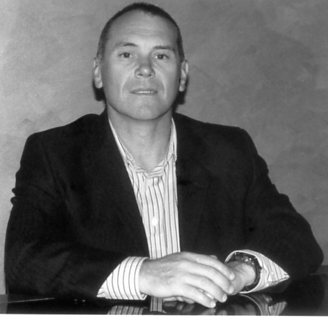
Major Player: Glenn Matthews

Glenn Matthews
Image Source: The Panthers: Men in Black

Glenn Matthews

Accountant, Chief Financial Officer and Chief Executive Officer

Few people contributed to—and witnessed—the modern development of Penrith Panthers as closely as Glenn Matthews.

Joining Panthers in March 1984, on the very day the club’s administration moved into its new Mulgoa Road premises, Matthews would spend the next twenty-six years helping guide the organisation through one of the most significant periods in its history. During that time he progressed from accountant to Chief Financial Officer and ultimately succeeded Roger Cowan as Chief Executive Officer in 2005.

His career spanned the club’s transformation from a rapidly expanding regional licensed club into one of Australia’s leading community organisations, providing a unique perspective on both its growth and the challenges that accompanied that success.

Role in the Narrative

Glenn Matthews appears throughout the middle and later pages of the Panthers, Passion & Politics narrative.

Unlike many figures whose involvement centred primarily on football or board administration, Matthews worked across almost every aspect of the organisation. His responsibilities evolved well beyond finance to include commercial development, strategic planning, football administration and executive leadership.

He was directly involved in many of the defining events covered throughout this series, including:

  • the move into the Mulgoa Road premises;
  • Panthers’ commercial expansion during the 1980s;
  • development of the organisation’s management culture;
  • the organisational restructure of the early 90s;
  • football administration;
  • the Temby Inquiry, the conflict preceding it and its aftermath;
  • Roger Cowan’s retirement;
  • the Global Financial Crisis;
  • development of Panthers Property Trust;
  • Panthers’ transition into a new phase of executive leadership.

Because his career bridged both Roger Cowan’s administration and the years immediately following, Matthews provides an important perspective on the continuity—and eventual evolution—of the Panthers organisation.

Background

Born: 17 September

Raised in Campbelltown before later settling in Western Sydney, Matthews developed an early interest in mathematics and accounting while simultaneously pursuing competitive barefoot water skiing, eventually becoming an Australian representative coach.

He also developed a lifelong passion for endurance sport. A long-time member of the Panthers Triathlon Club, Matthews completed eighteen Ironman-distance events, including the Ironman World Championship at Kona, Hawaii. His achievements earned recognition as an Ironman Legend — an accomplishment reflecting the discipline, persistence and resilience that also characterised his professional career.

He joined Panthers in March 1984 as an accountant – at the very momemnt Panthers was moving from Station Street to Mulgoa Rd.

from Western Weekender Podcast: On the Record 26 February 2024

That spirit of shared responsibility and willingness to step beyond formal job descriptions would become one of the defining characteristics of Panthers during Matthews’ career—and one of the organisational strengths he most admired.

Panthers Roles

  • Accountant
  • Chief Financial Officer
  • Reserve Grade Trainer
  • Senior Executive
  • Group General Manager
  • Chief Executive Officer (2005-2010)

Throughout his career Matthews accepted responsibilities well beyond traditional financial management, becoming involved in commercial ventures, organisational development, football administration and strategic planning across the wider Panthers Group.

Leadership and Culture

Matthews has consistently acknowledged Roger Cowan as the greatest influence on his development as a leader.

Working alongside Cowan during Panthers’ formative years exposed him to a management philosophy built upon trust, accountability and personal responsibility. Matthews has often recalled the lessons he learnt about treating people with respect, empowering staff to make decisions and responding to mistakes with honesty rather than blame.

One incident early in his career, when he admitted to a significant financial forecasting error, became a defining leadership lesson. Rather than reacting with anger, Cowan focused on solving the problem—an approach Matthews later identified as fundamental in shaping his own leadership style.

Those experiences would later influence Matthews’ own approach to leadership as he assumed increasingly senior responsibilities within the organisation.

Contribution to Panthers

Matthews’ contribution extended well beyond finance.

Throughout the 1980s and 1990s he became closely involved in commercial development, organisational planning, tourism initiatives, football administration and strategic projects across the Panthers Group.

Among those projects was the development of the Panthers Cable Ski Park, where Matthews became actively involved in both management and promotion, later overseeing its redevelopment through new accommodation and tourism initiatives. His willingness to move beyond the traditional boundaries of accounting reflected the increasingly integrated management culture that characterised Panthers during this period.

Cheif Executive Officer

Matthews succeeded Roger Cowan as Chief Executive Officer in 2005 during one of the most challenging periods in Panthers’ history.

Rather than inheriting an era of rapid expansion, he assumed leadership as the organisation confronted increasing complexity, significant football decisions, the Global Financial Crisis and growing regulatory pressures affecting licensed clubs, and a Board grappling with the fallout from a major, public and damaging Inquiry.

Matthews has reflected that while Cowan’s strengths lay in innovation and growth, his own strengths were better suited to leading organisations through periods of operational and financial challenge.

Relevance to Events Described

Many of the major events described throughout this series either involved Matthews directly or occurred while he occupied senior executive positions.

His experience provides valuable insight into the reasoning behind many of the decisions discussed elsewhere in the narrative, particularly those involving organisational development, commercial strategy, football administration and executive leadership.

His experience provides valuable insight into the reasoning behind many of the decisions discussed elsewhere in the narrative, particularly those involving organisational development, commercial strategy, football administration and executive leadership.

Legacy

Glenn Matthews occupies a distinctive place in Panthers’ history.

He experienced the organisation as a young accountant during the move to Mulgoa Road, helped shape many of its commercial and organisational developments, and ultimately became the executive entrusted with leading the club following Roger Cowan’s retirement.

His career spans one of the most significant periods of change in Panthers’ history and provides an important link between the organisation’s formative vision and its emergence as one of Australia’s leading licensed club organisations.

Although remembered as a senior executive, Matthews’ influence extended well beyond management. His commitment to developing people, embracing new challenges and serving the organisation across multiple disciplines reflected a culture in which leadership was earned through contribution rather than position.

Related Topics


Related Themes:

Financial Management · Governance · Growth · Culture


To receive new Parts and occasional project updates by email, you may subscribe below.

Readers who hold recollections, documents, or material relevant to this history are welcome to contribute via the Commentary & Contributions page.

Project Updates

Receive updates when new parts are published.


Editorial Note

This profile is presented as contextual background.
Additional material may be introduced as the narrative progresses.


Politics, Business and Two Different Visions of Panthers

A removed section from the original Chapter 13: Amalgamations Not Takeovers. This section originally during the discussion of the growing disagreement over Panthers’ amalgamation strategy. It was removed from the main narrative because it moves beyond the events themselves into Roger Cowan’s interpretation of why he and Ron Mulock — and, more broadly, management and some directors — appeared to see the future of Panthers so differently.

It is retained here because that interpretation offers another perspective on a conflict that would become increasingly important in the chapters that followed.

Ron Mulock had been critical about Panthers getting ‘too big’ even before the amalgamations strategy surfaced. This was also the strongly held view of the Treasurer, Michael Egan, and many in the NSW Labor Party.

Cowan used a particularly vivid analogy to describe what he saw as Mulock’s inflexibility. When a shark swims into a net, it is unable to change direction or reverse out of it. It will keep swimming in the same direction; nose into the net, until it drowns.

A number of observations and experiences added to my feeling that Mulock suffered from a similar inflexibility in his thought processes. Once he had made up his mind to go in a certain direction, once he believed he was right, there was no turning. No amount of new information could convince him to reconsider his position. On one particular occasion, when the rugby league merger saga was at it nastiest, I arranged to meet Mulock to see if we could sort out our problems on a man-to-man basis.  At the finish of that meeting, I was left with the impression that he had not heard a word I said.

Cowan believes that this type of inflexibility would be a fatal flaw in the CEO of an organisation with close to a thousand employees. But Mulock’s experience was in a law office and a seat in politics – places where inflexibility may even be advantageous.

Cowan saw an important difference between the pressures operating on business leaders and politicians. A CEO, in his view, had to respond continually to changing business data, technology, expert opinion, personnel and economic circumstances. A decision that worked yesterday might fail tomorrow. Flexibility was therefore essential.

The Panthers belief in teams, participation, flexibility, leadership, Twin Citizenship1, creativity and other management values was philosophically in conflict with what Cowan believes to be the narrow world view taken by Mulock.

But the argument of what is important to a politician has to be raised here too. Cowan thought in big pictures where there were no limits. His vision of Panthers was always bigger, better and more beautiful than it had achieved so far. He was thinking like that when he took over management of the tiny club with 26 poker machines and was still thinking the same way when he could see Panthers as a state-wide organisation with many successful branches – an organisation that now has such a solid backing of assets that it would be able to survive the worst downturns.

Supporting rugby league to Cowan was a long-term challenge that would be met by all round growth and success rather than an annual drive to outdo the extravagances of the previous year. His vision for Panthers was always long term rather than short term, looking at possibilities way into the future and always seeking ways of taking advantage.

That vision included rugby league supporters all over the state driving TV audiences when Panthers was competing. The possibility that one day supporters may have to pay to watch some rugby league games on television was a consideration in establishing Panther clubs in other areas. If it never happened, it would make no difference.

Politicians probably need to be more focused on tomorrow’s headlines and the elections next year. CEOs know that the decisions they make tomorrow can have an impact on outcomes years into the future.

It was little wonder the two were in conflict. From Cowan’s point of view:

I always had a strong feeling that the real conflict between Mulock and me was the conflict between the big picture view of a long-term future and a narrow short-term view centred on a football team. Perhaps my frustration with this narrow approach was shared by Neville Wran. Mulock briefly served as his deputy around 1984.

Graham Richardson, in his book Whatever it Takes, quotes the Labor elder describing Mulock in extremely disparaging terms. I choose not to repeat his words, but Wran’s description demonstrates very clearly that I am not the only person who was ever reduced to sheer frustration when dealing with Ron Mulock.

Mulock always seemed to me to be narrowly focused on Penrith and the here and now. His attitude as the Club grew seemed to indicate a belief that a medium sized club supporting the Penrith rugby league team was the be all and end all. The growth of the Club and its expansion into other parts of the state were way outside his range of vision, even had he the benefit of the world’s most powerful telescope. Of course, he would probably have never held himself accountable if he had been successful in influencing strategy that terminated growth to the point where the Club proved to be too small to be competitive in an increasingly professional rugby league competition.

Now I come to think of it, the shark analogy also fitted most of the Five. In hindsight, it occurs to me that my conflict with them might have had the same roots – and I failed to see it at the time. I was dealing with some directors holding a narrow and limited vision for Panthers. It seemed to me that most of the conflict in the boardroom was about strategy for elections. The long-term success of Panthers seemed a secondary consideration.2

Barrister Terrence Lynch has observed the opposition of two views when he attended the 2005 AGM.

Roger gave his address, and he was speaking of the club, its growth, its amenities and the new sites. Later, Ron Mulock and some others spoke, strongly criticising the amalgamations.

Each group had an entirely different perception. The Mulock group – was speaking of a Penrith identity. It was about geography and their football team. , and I don’t think that was Roger’s conception at all. Neither party ever seemed to recognise that they were proceeding from entirely different premises, so all they could do was snarl at each other.

They were early joiners, the club was small, Penrith was much more remote and they all knew each other. So there’s all the history and networks and personal associations.

It’s resistance to change, it’s hanging on to the past and what you know. It’s what many older people tend to do. They identify with the institutions that are part of their lives, be it the suburb, city, country where they live – or the customs and culture of their society, or their club. If you try to change that, it feels like an attack on them.

And though they’d never admit it, to an extent, his success in building the club and the brand outside Penrith fed their pride about the city, and in fact, even reinforced their sense of their special connection to it. To them, Penrith is a very discrete notion, and they could never conceive it in the way that Roger did.

Seen this way, the disagreement was about more than amalgamations. It reflected two different conceptions of Panthers itself. One began with Penrith — its history, its football team and its local identity. The other increasingly saw Panthers as an organisation capable of carrying that identity far beyond Penrith.

Neither perspective made conflict inevitable. But if Lynch was right that the two sides were arguing from different premises without fully recognising it, it helps explain why agreement became increasingly difficult to find.


Related Topics


Related Themes

Conflict · Growth · Culture


To receive new Parts and occasional project updates by email, you may subscribe below.

Readers who hold recollections, documents, or material relevant to this history are welcome to contribute via the Commentary & Contributions page.

Project Updates

Receive updates when new parts are published.

  1. The concept of “Twin Citizenship” comes Charles Handy’s book, The Empty Raincoat. This book had a powerful influence over the Panthers management team through the 1990s. The concept illustrated the fact that a team member can simultaneously hold strong loyalties, sense of belonging and responsibilities to multiple distinct groups. This was an extraordinarily important concept when it came to the amalgamation philosophies with venue management and staff having a strong sense of ownership of their local operational and strategic efforts while also understanding, supporting and owning the needs of the entire Panthers Group.
    ↩︎
  2. The reference to “the Five” reflects terminology used retrospectively in the original manuscript. The group later became publicly known as the “Footy Five”; that label and its effect on interpretation are discussed in Beyond the Book: The Footy Five — The Name That Rewrote the Story. ↩︎

The Mental Game — Roger, Gus and an Idea Ahead of its Time

Today, the mental side of elite sport is taken for granted. Professional teams employ sports psychologists and mental skills coaches. Visualisation, relaxation techniques, controlled breathing and the management of anxiety and confidence have become familiar parts of preparing athletes to perform under pressure.

It was rather different in 1978.

More than four decades later, Phil Gould recalled one of his earliest encounters with those ideas — at Penrith, through Roger Cowan.

Gould told the story during an episode of Six Tackles with Gus in September 2021. The discussion had turned to Parramatta’s use of a mental skills coach during the NRL finals and to the relative importance of the physical and mental sides of elite sport.

For Gould, there was little doubt. At the highest level, he suggested, the mental component accounted for perhaps 95 per cent of performance. Players needed to learn how to control their thinking under pressure, he said, and that was a skill that took time to develop.

Then he remembered Roger.

An Experiment at Penrith

Gould described Cowan as the man who ran the Leagues Club and someone who read widely about self-improvement. Roger had long been particularly interested in hypnosis and in techniques, he believed could help people get the best out of themselves.

In May 1978, he decided to try some of those ideas with the Penrith first-grade team.

Gould’s memory of the occasion, 43 years later, compressed the chronology a little. He recalled the match as only his second game in first grade. In fact, he had debuted for Penrith in 1976.

But the match was a significant first for the young Gould.

It was his first game as captain of the Penrith Panthers.

The previous Sunday, 30 April, club captain Mick Stephenson had played his final match. Mounting injuries had finally brought his career to an end, but he went out with a remarkable performance. Penrith had lost its first five matches of the 1978 season; against North Sydney, Stephenson scored two tries as the Panthers recorded their first win, 17–16.

The following week, the captaincy passed to Gould.

He was just 19.

Penrith’s opponents on Sunday, 7 May were Eastern Suburbs. Gould recalls Bob Fulton being captain-coach of Easts that year but it was Arthur Beetson However, for this game at the Sydney Sports Ground Beetson did not play and Fulton was the captain.

Gould remembers the young Panthers being given virtually no chance.

Roger decided to try something different.

Shoes Off, Lie on the Floor

Before the game, Gould recalls, the Penrith players walked from the Sports Ground to a nearby hotel. Pubs were closed on Sundays in those days, but Roger knew someone who allowed the team inside.

The players removed their shoes and lay on the floor.

Roger began what Gould describes as a relaxation and hypnotherapy session.

He asked the players to relax, control their breathing and then visualise the match ahead. Gould remembers Roger asking them to imagine themselves playing the perfect game — making tackles, kicking well, scoring tries and seeing everything they did producing a positive result.

Gould, reflecting on this in 43 yers later, could see parallels with techniques that had become commonplace in professional sport.

At the time, however, this was something very different.

As the players lay quietly imagining their perfect performances, one of Penrith’s front-rowers1 suddenly cried out:

“Oh No!”

Everyone sat up.

As Gould remembered it, that rather killed the mood.

Then they beat Easts.

Whatever contribution Roger’s experiment made, something went right that afternoon.

Penrith beat Eastern Suburbs 15–13.

Inevitably, Gould recalled, everyone credited the victory to Roger having hypnotised the team.

So they did it again.

Before the following match against St George at Kogarah on Saturday, 13 May, Roger arranged another session. This time, however, there was a practical problem.

At the Sports Ground the previous week, the hotel had been only a short walk away. Roger didn’t know the St George area nearly as well. The venue he found was down towards Blakehurst — much further from the ground than he had appreciated.

The players walked there, went through another session and then had to walk all the way back to Kogarah. They arrived late, rushed their preparation and St George beat them 26–9.

Gould’s conclusion was succinct:

That was the end of the hypnotherapy.

HEAR PHIL GOULD TELL THE STORY

In this 12-minute extract from Six Tackles with Gus (September 2012), Phil Gould recalls Roger Cowan’s experiments with hypnotherapy and visualisation at Penrith in 1978 — and explains the lasting influence the experience had on his own interest in sports psychology.

Excerpt from Six Tackles with Gus courtesy of Nine Network Australia

It would be easy to leave the story there — an entertaining glimpse of a very different era of rugby league.

But Gould didn’t.

Something Stayed With Gus.

Despite the scepticism of some of the players, and despite the somewhat chaotic end to Roger’s experiment, Gould says he personally got something from it.

More importantly, he says:

“It piqued my interest in sports psychology.”

That interest stayed with him.

When Gould eventually moved into coaching, he became, in his words, “a very strong believer” in the psychological side of preparation and incorporated it into his coaching programs. He sought out sports psychologists, learned from them, and developed ways of helping players understand their own thought processes, motivation, preparation and performance.

Gould’s approach was not about a few minutes of emotional motivation before a match. His 2021 explanation is much broader: self-appraisal, goal setting, preparation, communication, trust, relationships between players and understanding how an individual’s role affects those around him.

And he traced the beginning of his interest back to those early experiences at Penrith.

“That Sort of Stuff Was Unheard of Back Then”

There is an interesting echo to Gould’s recollection.

Many years later, Ivan Cleary encountered Gould as a young player at the Sydney Roosters.

In his book Not Everything Counts … But Everything Matters, Cleary recall being struck by the way Gould thought about football:

From the very start, I was blown away by the way Gus saw the game.

Cleary remembers Gould’s tactics and strategy, but specifically mentions “the mental side of the footy”.

On one occasion Gould brought a psychologist in to speak to the players.

Cleary’s recollection is telling:

That sort of stuff was unheard of back then.

Perhaps it was to Cleary.

But it wasn’t to Gould.

Nearly two decades earlier, a teenage Phil Gould had been lying on the floor of a closed Sydney hotel while Roger Cowan asked him to relax, control his breathing and visualise himself playing the perfect game.

More Than an Eccentric Experiment

In Part 43 of Panthers, Passion & Politics, Roger talks about his longstanding fascination with what he called “the power of the unconscious to affect performance”.

He explored meditation, hypnosis, NLP and other approaches to changing patterns of thought. At various times he worked directly with Panthers players who were struggling with confidence or performance.

Read in isolation, Roger’s recollections might sound like the unusual interests of an unconventional chief executive.

Gould’s story adds something important.

It independently confirms that Roger was actually experimenting with these ideas in the Panthers football environment as early as 1978.

Care needs to be taken about claiming any more than that. There may have been others in rugby league experimenting with psychological preparation at the time, and there is no need to claim that Roger Cowan invented or pioneered sports psychology in the game.

But it is interesting enough that Roger was exploring the mental dimensions of sporting performance at a time when such ideas were far from commonplace in rugby league.

Intersting enough because he had plenty on his plate with the entire Panthers enterprise. Interesting enough given the label “anti-rugby-league” tat had been applied by some.

The first experiment produced a memorable win.

The second produced a long walk and a 26–9 defeat.

And the hypnotherapy sessions stopped for then.

But for one 19-year-old player, something remained.

More than forty years later, Phil Gould could still trace his interest in sports psychology back to those unusual afternoons at Penrith — an interest he would eventually carry into his own highly successful coaching career.

Perhaps Roger’s experiment achieved something after all.


Related Topics


Related Themes

Innovation · Culture · Football Club


To receive new Parts and occasional project updates by email, you may subscribe below.

Readers who hold recollections, documents, or material relevant to this history are welcome to contribute via the Commentary & Contributions page.

Project Updates

Receive updates when new parts are published.


  1. Unfortunately Gould does not name the player. The front-rowers on the day were John Farragher and Ross Cale. In the second row were Paul Merlo and Tas Batieri. ↩︎

Major Player: Royce Simmons

Royce Simmons OAM

Royce Michael Simmons OAM

Rugby League Player, Coach, Mentor, Ambassador

Over more than forty years Royce Simmons has beome one of the most enduring figures in Penrith Panthers history, as player, captain, premiership winner, coach, mentor, ambassador and community leader. His player and coaching statistics alone can’t paint his true portrait or explain why generations of Panthers supporters speak of him with such affection and respect.

Royce represents something beyond football. His determination, humility, loyalty and connection with the community reflects the culture Panthers spent decades trying to build. As the club evolved from perennial battlers into premiers and one of Australia’s leading sporting organisations, Royce Simmons became its most recognisable human face.

Few individuals have become so closely woven into the identity of a sporting club.

Role in the Narrative

Royce Simmons occupies a unique place within Panthers Passion & Politics because his involvement spans many of the defining periods of the club’s history.

He first appears as one of the emerging players who would become central to the football transformation initiated during the 1983 Strategic Reset. As captain, he became the on-field leader of a club that was consciously reshaping its culture, systems and expectations. The success of those reforms ultimately culminated in Penrith’s first premiership in 1991, with Royce scoring two tries in his farewell match.

His importance to the narrative does not end there.

Returning as head coach, Royce led the football club through one of the most turbulent periods in rugby league history. The Super League conflict, the introduction of competition criteria, financial pressures and the difficult rebuilding years all form major themes within this series. Throughout those challenges, Royce provided continuity, stability and leadership at a time when the organisation faced extraordinary uncertainty.

Royce through leadership, example and an unwavering commitment to the club became one of the constants in the Panthers story.

More broadly, Royce represents one of the central themes running throughout Panthers Passion & Politics: that lasting organisational success depends as much upon culture and character as it does upon talent or strategy. Repeatedly, teammates, coaches and commentators describe him not simply as a champion footballer but as the embodiment of what it meant to be a Panther.

Country Beginnings

Born on 2 May 1959 in the small central western New South Wales town of Gooloogong, Royce grew up immersed in country sport and the values that accompanied it — hard work, resilience, mateship and community. Rugby Union initially occupied much of his attention and he represented NSW Country at under-16 level before turning his focus to Rugby League. After playing senior football for Cowra and Canowindra, he travelled to Sydney seeking an opportunity in first grade.

Trials with St George and South Sydney failed to produce a contract, but the Panthers coach, Len Stacker, got a tip about Simmons from former Parramatta teammate Barry Rushworth. It was a good tip – and would prove to be one of signings in the club’s history.

Growing with the Club

Royce arrived at Penrith in 1980 when the club was still searching for both consistency and identity. Success remained elusive and Panthers were still regarded by many as one of the competition’s easy-beats.

As Panthers undertook the organisational reforms that occurred in late 1983, Royce emerged as one of the players who best reflected those changes — in fact he played an influential role in developing those reforms, and in ensuring Tim Sheens changed his plans and stayed to coach the Panthers.

Initially playing at lock before establishing himself as the club’s first-choice hooker, he became captain in 1983 and quickly developed a reputation for leading through actions rather than words. While representative honours followed—including ten State of Origin appearances for New South Wales and ten Test matches for Australia—his greatest contribution was arguably the standards he set within the club itself.

Phil Gould would later declare:

That description has been echoed repeatedly by teammates, coaches, journalists and supporters.

The Embodiment of Panthers Culture

Within the story told throughout Panthers Passion & Politics, Royce Simmons represents something more significant than an outstanding football career.

The Panthers of the 1980s were intent on turning the club around through building a new organisational culture. The cultural values were being developed throughout the club, from the Board and administration to coaches, staff and players.

His leadership displayed the standards the club’s administrators and coaches were working to establish throughout the organisation.

John Cartwright later reflected:

Greg Alexander described him as:

Mark Geyer perhaps captured his influence most simply:

Those comments describe a footballer and, more importantly, a cultural leader.

Two leaders – both knock-about blokes — photo: Craig Golding (SMH)

A Fitting Farewell

Royce captained Penrith through 1980s during the Club’s transformation, an played in its first Finals Series appearance, first Grand Final appearance and first Premiership.

His two tries in the 1991 Grand Final helped secure Penrith’s first premiership and provided one of the most memorable farewells in Australian rugby league history. He retired immediately afterwards, having helped transform the club from competition battlers into premiers.

Royce’s celebration after scoring his second try in that grand final win is one of the most iconic images in Panthers’ history … and perhaps in Rugby League history.

Returning to Lead

Retirement from playing did not end Royce’s service to Panthers.

When Royce returned to coach Penrith in 1994, he inherited a club coming out of a very unstable era where club culture had drifted badly. As well, the Club was entering another period that would prove difficult to navigate.

His coaching tenure coincided with one of the most turbulent periods in rugby league history. Super League divided the game, the salary cap reshaped recruitment, and Panthers entered another rebuilding phase.

Despite those challenges, Royce guided the club to finals appearances in both the 1997 Super League competition and the 2000 NRL season. He remained fiercely loyal to his players during difficult years and was reluctant to publicly criticise individuals when results deteriorated.

At the end of the 2001 Season his tenure as Panthers coach finished but the impact he had on the Club had not. Following the 2003 premiership victory John Lang, Panthers premiership-wining coach, credited Royce Simmons with some of that victory praising the work he’d done creating the core of that winning team.

Simmons’ value as a leader during his coaching tenure should not be measured by win-loss statistics but through the stability, integrity and belief be inspired.

Beyond Football

Despite having some successful coaching stints away from Penrith — Hull (1992-94), Wests-Tigers (2003-10), as Assistant to Tim Sheens, and St Helens (2011-12) — he never lost touch with Penrith.

He has remained one of the Club’s most respected ambassadors, supporting a stack of community initiatives and continues to show the younger Panthers what it means to be a Panther.

Following his diagnosis with Alzheimer’s disease in 2021, Royce transformed personal adversityinto public advocacy. Through fundraising walks and awareness campaigns, he has helped raise both funds and understanding for dementia research while continuing to inspire the broader community.

His appointment as Brand Ambassador for The Royce retirement communicty reflects the qualities that have endeared him with Panthers supporters and the wider rugby league community — down-to-earth honesty, humour and humility.

Perhaps his greatest achievement has been the initiation and development of the Royce Simmons Foundation which is dedicated finding a cure to dementia and supporting those wh are affected by it. His Big Walks have very quickly eastablished themselves as legendary, just like the man hwo has choreographed them You can get involved through donation or participation — for more see https://www.roycesimmonsfoundation.com.au/.

Background

Born: 2 May 1959, Gooloogong, New South Wales

Profession: Rugby League player, coach. Ambassador.

Panthers Involvement
• First Grade Player (1980-1991)
• Club Captain (1983-1990)
• Head Coach (1994-2001)
• Club Ambassador

Representative Honours
• New South Wales (10 State of Origin matches)
• Australia (10 Tests)

Honours
• Penrith Panthers Player of the Year — 1981, 84, 86, 87 (renamed Merv Cartwright Medal in 2006)
• John Farragher Award for Courage & Determination — 1982, 85 (shared with Matt Goodwin), 89.
• 1991 NSWRL Premiership
• Panthers Life Member (1992)
• Panthers Team of Legends (2006)
• Panthers Hall of Fame (2016)
• Australian Sports Medal (2000)
• Centenary Medal (2001)
• Medal of the Order of Australia (OAM) (2025

Relevance to Events Described

Royce Simmons presence throughout the Panthers, Passion & Politics series is significant. He features in:

  • As captain during the Club’s 1983 transformation and strategic reset.
  • Evolution of the Club’s culture — especially as Coach when his leadership positively impacted the connection between licensed club and football club teams.
  • Simmons was instrumental in the development of the “Five-by-Five” focus on local talent and leadership.
  • Super League – helped guide the Panthers through this tumultuous era, including the rationalisation trauma.

Related Topics


Related Themes:

Football Club · Leadership · Culture


To receive new Parts and occasional project updates by email, you may subscribe below.

Readers who hold recollections, documents, or material relevant to this history are welcome to contribute via the Commentary & Contributions page.

Project Updates

Receive updates when new parts are published.


Editorial Note

This profile is presented as contextual background.
Additional material may be introduced as the narrative progresses.


Education by Experience

A removed section from the original Chapter 9: An Urgent Need for Research and Change.

IN THE COURSE of more than a year and a half of research and writing for this book, I conducted a large number of interviews. For obvious reasons, more than one of those was with Roger Cowan. Many of our discussions focused on the way things were done at Panthers.

On one occasion, I asked a very specific question. How did that little club evolve into the half billion dollar enterprise that is Panthers today? What made the difference, what did he see as the most important parts of the management philosophy during his 40 years at the helm?

It was an important question, and he wanted plenty of time to consider. Eventually, we decided that it would work better if Roger answered it in his own words.

It is difficult to answer this question because 40 years is such a long time. Many changes have occurred along the way — in knowledge, attitudes, technology, even the way the industry is regulated. In the earlier days  I used a calculator for payroll.

To multiply by seven, for example, we turned a handle seven times. Accounting and stock control were all done manually. The management tools available today demand a much different approach to the use of management time and the expectations of administrative productivity. In many ways, management change has been driven by the changing environment.

The other difficulty I have in answering the question is that I was always inclined to try something new if it looked good. Some things were effective for a while, and made a significant difference at the time, but failed to see the long distance. Some became permanent influences and some failed completely. Some seem too small to mention, yet they held a lot of significance for me.

Applying a very strong filter, I came up with what I considered to be the three most important influences. I am sure it would be an interest­ing debate if members of our management teams were asked the same question. But there is a common thread that runs through the three I have chosen. Each one has quite a lot to do with the need to manage evolu­tionary change rather than merely cope with it. We tend to cope with the results of evolution in our private lives, but business requires a different level of thinking.

Thinking in Outcomes. The success of the human race has depended on the ability to take in information and make rapid decisions. Imagine if our hunter and gatherer forefathers had held meetings to evaluate the knowledge they had gleaned from their observations and then debated what action should be taken. They would have died of starvation or been eaten, and we would not be here to write about it. The natural decision making process for humans is still the same. Our senses collect informa­tion, feed it into our brains in an amazingly short time, and this central processor quickly decides on the options and tells us what to do. Just as well we have that power. You see a car hurtling towards you, out of control, and there is no time to hold a brain storming session to work out how to survive.

Quick thinking is important to us as individuals. My theory, though, is that when it becomes the predominant thinking style used in business, it is often inappropriate and can be downright dangerous. Looking back, I think I harped and nagged about this principle more than anything else in management meetings and training sessions. I was never better than partially successful. It is actually quite difficult to break out of the natural thinking style. It requires discipline and technique. And as soon as you relax the discipline, the natural way of thinking takes over again.

The difference between quick thinking and thinking in outcomes is demonstrated in the following example. The Security Manager puts a proposal to a meeting: there has been an increase in behaviour problems in the club, and the security staff should be increased to deal with the situation. Others in the meeting, respecting the expertise of the Security Manager and seeing the logic of his suggestion, support the proposal. The Finance Manager agrees that the extra cost is affordable. A quick vote and it is all done.

But someone skilled in Outcome Thinking says, “Hold up there. Let’s first agree on what we are trying to achieve. Is it just to cope with increased behaviour problems, or is there more to it?”

The best way to answer that question is by imagining another meeting, some point in the future -say three months ahead. You sit in that meeting, and ask, “What evidence can we find today that proves we made a great decision three months ago? Not just a good decision, but a great one?”

One person might say there are more people visiting the club now than there were three months ago. That proves it was a good decision. Another might suggest that the cost of security has decreased. Others might add that there are fewer incidents of bad behaviour now, the people causing the problems three months ago have gone, there have been no negative stories in the newspapers, and so on.

The challenge is now much different. It is no longer about coping with increased behaviour problems by increasing costs. A great decision would achieve fewer problems, less cost and increased patronage.

The most important debate is about what outcomes the group is willing to support, and what it believes it can achieve. They will usually be much more challenging than expected. When there is an agreed set of outcomes, the next challenge is to find every possible idea for achieving them. That then brings out the creativity in management and usually achieves a better result.

The number -and quality-of ideas might be surprising. In this case it might mean changing the entertainment mix, increasing public relations, zero tolerance in some issues, a different marketing approach, or any number of bright ideas that would never be raised in the quick decision scenario.

The point is that the natural process of quick decision making is the killer of creativity, and often provides solutions to the wrong problems.

Thinking in outcomes ensures that the best goals are set and that they will be creatively pursued. It also encourages creative opposition, and avoids the dangers of ‘groupthink’, where people tend to go along with each other because of respect for expertise or position.

In this situation, you are able to manage the thinking processes, rather than going along with nature.

Values, Beliefs and Culture. Our deep-seated beliefs and values are mostly developed in the very early years. Culture develops from experi­ences, and dictates how people treat each other and expect to be treated. The behaviour in an organisation is a reflection of its culture. The combined beliefs and values of the staff, managers, board, and custom­ers form a rich cultural soup that has to meet the needs of everybody. We see examples every day, and in every part of the world, of the enormous problems caused by clashes of culture, most of which can be traced back to differences in beliefs and values.

Beliefs and values are not impossible to manage. We cannot ask people to change what they believe or how they feel, but we can structure an organisation around the differences. Being aware of the differences allows us to manage them, and achieve a positive culture without the clashes.

Recognition and understanding of values was one of the topics of man­agement training at Panthers. There are many ways of finding out what drives people. When there is better understanding, people work together more harmoniously. There are some good programs and tests available, and most of them are interesting and non-threatening.

One important advantage of setting agreed outcomes is that they define what the group wants to own and achieve in working together. Where there are opposite values, the list will be more limited, but there will still be common purpose.

There is another element in play in the club industry – one that is much less likely to affect other businesses of similar sizes. There is a much stronger board influence on culture, varying significantly from one club to another. Some directors in some clubs enjoy socialising with staff, talking to them during breaks and even – in ways ranging from very subtle to quite demanding – interfering in the way they work. The impact on culture can be profound. Even worse, the influence can be difficult to see until it is entrenched and starts to show up in behaviour.

That is one of the good reasons for clearly separating the responsibili­ties of management from those of directors. A good culture is built on consistency —what is said and done has to be within consistent patterns and plans, and everyone has to be singing the same tune. A good management plan can easily be undermined, quite unknowingly, by directors getting too close to staff and not knowing what the tune is.

The cultures and sub-cultures throughout an organisation will affect the behaviour of people, their satisfaction and productivity. One important subculture is the relationship between board and management. It is the one most difficult to manage. Some of the chapters in this book spell out the type of problems that can arise when it is not well managed.

Panthers workshops involving both management and board always centred on strategic issues. If I had the time over, I would try to interest the directors in joining other workshops that focused on values and culture. In learning to recognise values and understand their impact, everyone could work together to build a shared vision about the cultural objectives of the business. It would not be an easy task, considering that directors often have many other commitments, and the difficulties in getting all the key players together for the time required, but it would be worthwhile.

Evolution and Revolution. Larry Greiner wrote of his theory in 1971, and it was almost 20 years before I discovered it. I wish I had studied it much earlier. It would have helped my understanding of periods of stag­nation and other difficulties.

When a business only has a few employees, the style of management is not as important. The entrepreneurial manager with one assistant and lots of subcontractors can be autocratic and successful. As a business grows and matures, it requires adjustment. Autocracy will not be as effec­tive in a business employing 3,000 people, where the best results come from communication, delegation, participation and good controls. That is not to deny that some successful larger companies are run in a very autocratic fashion. It simply says that Greiner’s research influenced his theory that growth should be handled differently.

There are several stages in the path from small to large, and from young to mature. The needs change through the range of creativity, direction, delegation,  co-ordination and collaboration, each one building on the previous phase. As the business evolves naturally through one stage, pressures start to build almost to bursting point. This causes its own crisis. It is a case of success creating its own problems.

Had I understood the principles much earlier, it would have allowed a smoother transition between the Club’s evolutionary phases. It would probably also have meant a quicker and more effective pathway to what I eventually hoped to achieve — on the democratic ideals of an organisation driven by principles of collaboration. In our case, it was probably more spectacularly noticeable because of the rapid growth of the business over a relatively short period.


Those three principles stand out in my mind because of the impact they had on my thinking. I was influenced about outcomes by reading a great little book on outcomes and performances in my first few years at the Club. I read a lot about culture and did some courses on values and beliefs. In everything you read, you will probably find some gem of wisdom that can improve how you do things. A chance meeting, a brief conversation, a quick word of advice – can plant the tiny seeds that grow into the ideas and concepts that become part of your life.

In my first year at the club I met a director of the City Tattersalls Club in Sydney. One of the things he said that struck a chord in me was that each of us is a totally different person in the eyes of every person who knows us. This had quite an impact on me. It changed not only the way I saw others, but also how I saw myself. We are many, many people living inside the same skin.

In my first year at the Club, I also received some advice from a man named Ken Charlton.

Ken had been a big name in rugby league in the 50s. Around the same time that I started with the Club, he was, if I remember correctly, working as a representative for one of the breweries. He seemed genuinely inter­ested in seeing me make a success of my radical move from teaching to club management. I came to respect him, and when we talked I listened carefully. He told me one day that it is much more effective to ask ques­tions than to make statements. It was simple advice that sounds no more than good common sense. I don’t think that either of us knew just how profound it was at the time. I had an amusing example of its power some years later.

The Club was in the middle of one if its extensions, and I was walking through the work area. We had employed a very clever air conditioning expert, and I wandered up and stood beside him – basically just for a chat. I had no idea at all of what he was doing. I have never been mechanically or technically intelligent. He was explaining some of the work, and I said, purely to show him that I was interested in what he was saying, “Why do we do it like that?”

He stopped for a minute, looked back at the job, and looked at me again. After a pause he said, “You know what? You’re right. That’s not the best way to do it. It would be better if I …

I had asked a dumb question, he mistakenly thought it was an intelligent observation and took it as a challenge to find a better way. Meanwhile, I stood there trying to look as if I really was intelligent. His final disillusionment might come if he reads this book.

But over the years I found that asking questions was important to culture as well as results. Imagine an assistant in the marketing depart­ment prepares a corporate design and presents it to the CEO for approval. The CEO could say, ‘No, I don’t like that. Change the red to purple and make the yellow stronger. Use upper case in the title.’ After the time and effort that has been put into that design, how does the assistant feel about that reaction?

What if the CEO asked questions instead? “Do YOU think the red sends out the message WE want? What if WE tried a bit of purple? How do YOU think that would go?” Plenty of YOU clarifies who still owns the project. Plenty of WE says we are here to work together and help each other.

Questions involving YOU and WE raise the odds in favour of a more motivated assistant, a higher degree of ownership of the design job – and a better design. It is the cultural difference between the organisation being driven autocratically from the top and people collaborating for a better result.

The three main issues I chose are closely linked. They are all about people. Setting outcomes before deciding what to do smooths out values and cultural differences. Some of the essential components of a good, productive culture are well constructed forward plans, logical decisions, and ownership of the plans by all who participated in their making. Outcomes thinking is an important tool.

In some ways the three concepts are a little idealistic. Despite the efforts of a committed management team, we never really reached our own measure of satisfactory. Some sections at Panthers were always closer than others, but we never stopped having to remind people to think in Outcomes. Culture was constantly on the agenda for testing, meas­uring and improvement. And having an organisation fully embrace the Greiner concept of Collaboration is a really challenging dream. Culture and decision-making work in a similar way to systems in a business. Without constant review and discipline, they gradually revert to chaos. What is certain, though, is that we were much closer to those ideals than we would have been had we not been conscious of them, and committed as a team to their pursuit.


Related Topics


Related Themes

Club Structure · Culture


To receive new Parts and occasional project updates by email, you may subscribe below.

Readers who hold recollections, documents, or material relevant to this history are welcome to contribute via the Commentary & Contributions page.

Project Updates

Receive updates when new parts are published.

1991 — Shadows Behind the Story

The text [in Part 27 – From Left Field] simply says that Roger contacted his long-time friend Norm Bowers looking for two people who could help research management theory, distil complex ideas and assist with communicating organisational change. Norm suggested two tutors from his coaching college. One of them was me.

That summary is accurate enough, but it leaves out a much bigger story.

For as long as I can remember Roger held a firm principle that close family members should not work together at Panthers. Unlike many family businesses, he believed employment should never depend upon bloodlines. It protected the organisation from accusations of favouritism and, just as importantly, protected the family from the pressures and complications that inevitably arise when work and home become entangled.

My brothers and I experienced that principle long before employment was ever contemplated.

As children we watched children from families of Roger’s Panther colleagues enjoy privileges that were simply unavailable to us. The children and grandchilren of some Panthers’ officials could wander into dressing rooms. Other children became ball boys or travelled with teams. We remained outside those circles. At the time it felt unfair. Looking back, I understand that Roger was drawing a line he was determined not to cross.

So why did he cross it in 1991?

The simple answer is that he believed Panthers had reached a point unlike anything it had previously faced.

The move to Mulgoa Road had been spectacularly successful in one sense. Sales had exploded. The club had become one of the largest in the country. But behind those impressive numbers Roger could see problems that few others recognised. The organisation had outgrown the management systems that had served it so well in earlier years. The challenge was no longer simply managing a licensed club. It was understanding how organisations evolve, why they stall, and how they successfully reinvent themselves.

He needed people who could immerse themselves in ideas, research widely, challenge assumptions and then translate abstract concepts into practical language that managers throughout the organisation could understand and use. Club management experience was almost beside the point. In some respects, it was an advantage not to have it.

By 1991 Roger was carrying burdens — some were widely visible, others were not so obvious.

The public could see the club’s growth and football success. The long hours were seen by the Panthers staff — especially the management team who shared the search for answers to the dilemmas faced by the Club. This commitment was hidden from the wider public.

Hidden from all but those closest to him was the stress of discovering that he had serious underlying health issues. The most serious of these was polycythemia, an incurable blood disorder in which the bone marrow manufactures too many red blood cells.

The combined challenges of the Club’s financial stress and the newly diagnosed health issues are sufficient to drive unhealthy levels of stress. But, by mid-year 1991 a huge shadow was cast across this picture — Peter, the third of the four Cowan boys, was dying.

Through the second half of the eighties, Peter was diagnosed HIV/AIDS. Remember, by 1987 big budgets were directed towards advertising that elevated concerns about the spread of AIDS – lifting the feeling from concern to horror and fear.

Imagine being the parent of someone with the virus, imagine thinking about their future while watching their physique reduce to the skeletal, imagine seeing the grim reaper repeatedly visiting your living room.

By the early part of 1991, Peter’s withering physique made his destiny clear. Roger & Mum were regularly taking trips between Penrith and Sydney, spending time with Peter.

On July 15, we gathered at St Vincent’s Hospice for what we suspected would be his last hours. Our time with him was one-on-one, holding and stroking his skeletal hand, listening as he ranted against some imaginary barman who would not serve him a drink, or some incompetent cabbie taking the wrong route.

We laughed with him, crying inside at what we were about to lose.

He couldn’t hear us; he couldn’t see us; but I’m damned sure he felt us.

He left us just before the sun went down that day.

Three months later, Panthers took their first premiership lap. Peter would have loved that.

I started at Panthers a month after Peter left us.

Beneath this shadow and amidst all the turmoil and stress swirling around Roger’s worklife, his focus on the future health of Panthers didn’t falter – in fact his dedication and commitment to this ambition may well have increased.

It would be wrong to suggest these private events somehow caused my appointment. They did not.

But they formed part of the context in which Roger found himself confronting perhaps the greatest organisational challenge of his career while carrying some of the heaviest personal burdens of his life. For someone who had always preferred solving problems himself, this was one of the few occasions where he openly acknowledged that he needed help.

Even then, abandoning his principle about family employment was not a decision he made lightly. Before I joined Panthers he took the proposal to the Board. Approval was unanimous.

Looking back, I don’t think this episode says very much about me.

It says far more about Roger.

He had principles, and he took them seriously. They were not ornaments. They were not things to be put on display when convenient and packed away when awkward. But he also understood that a principle should serve a purpose. It should not become a cage.

In 1991, Panthers needed something different. Roger needed something different too.

I think he knew both things.


Related Material


Related Themes

Culture


To receive new Parts and occasional project updates by email, you may subscribe below.

Readers who hold recollections, documents, or material relevant to this history are welcome to contribute via the Commentary & Contributions page.

Project Updates

Receive updates when new parts are published.