
Part 14 of 70 — Original Chapter: Chapter 5: Building the Basics – Business Principles and Property
This article forms part of the serialised republication of Panthers, Passion & Politics – The Roger Cowan Years.
With Mulgoa Road established, the focus shifted to sustaining momentum and extending Panthers’ presence beyond the club itself.
After the blaze of publicity that followed the 1984 opening of the Mulgoa Road premises, Cowan and the management team were looking for ways to keep up the momentum of the Panthers brand.
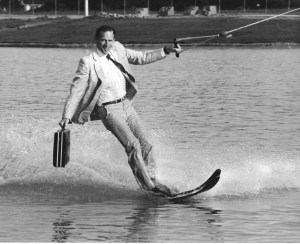
Around the same time as Mulgoa Road opened its doors, a new water-ski concept had been developed in a Perth suburb. A man-made lake had been created for water-skiing with a novel twist. There was no need for boats. Water skiers queued and were given instructions as they waited their turn. As they neared the top of the queue, they were handed a ski rope. The operator would pull a lever, the rope would become attached to the moving cable and the skier would take off for two or three circuits of the lake.
When the managers of the Perth enterprise heard of Panthers, they made contact. They approached the Club to explore whether such a park might be feasible for Penrith. Representatives of the Club inspected the WA operation and carried out studies to determine whether it could be a worthwhile investment.
Here was a unique and interesting way to build the Panthers brand and generate publicity.
Further, there was a large area of land that had been earmarked for future use, but it was too low-lying for any development – it needed to be filled. Excavating two large lakes would provide the hundreds of thousands of cubic metres of fill for this low area. They would not be paying to dump the excavated fill, nor would they need to buy any to raise the land.
One important point was overlooked in assessing the financial feasibility of this venture – the climates of Perth and Penrith are similar, except that Perth gets most of its rainfall in winter, whereas Penrith is wettest in summer.
In 1987-88, its first year, the park – named Cable’s Ski Park -made a profit, generated enormous publicity and provided all the fill needed for the lower areas of property. It was a win all round.
In the second year, it started to rain in December and continued through most of January – the summer school holiday period, and the most important revenue generating part of the year. The following year the weather pattern was repeated.
It turned out that a dry December-January period was the difference between profit and loss for the entire year. When the novelty died away after a few years, so did the publicity, and the park struggled to break even. For a while it was a great attraction, helping to raise the city’s profile, along with Panthers. Eventually repeated losses could not be justified, and Cable’s was closed in 2002.1
The ski park decision has been criticised by some, but Cowan later reflected that factoring in the fill requirements for other parts of the property meant the real cost of building the park was quite low. He says:.
On the one hand, the fact that it had to be closed down says very clearly that it was a failure. There is another perspective. If we were able to go back and I was faced with the same situation, I would have no hesitation in making the same decision. The gains far exceeded the losses. The ski park did more to boost the Panthers name throughout Australia than anything else we did, apart from moving to Mulgoa Road.
Another ‘outside the square’ decision for Panthers was the purchase, in 1993, of Nepean Shores. It was an upmarket mobile home village located close to the Nepean River. It had more than 80 cabins, all fully occupied, and several function rooms. The developers had overspent on it and been forced to appoint an administrator, so it came on the market for much less than its cost.
Management inspected the site. They discovered that the current income was less than the holding costs of interest, rates and maintenance – but not much less.
The conference rooms were a strong attraction. They had been tastefully constructed and were practical and functional. The Club’s conference market was growing, and business was often limited by availability of rooms. Nepean Shores could open up new opportunities.
Cowan says Nepean Shores had been finished to a high standard, in fact it was probably overdone for the income it could generate. The infrastructure, although a bit run-down, could be revitalised at a relatively small cost. The purchase price was $3 million. To the Board and management, it seemed an excellent investment with the potential to be further developed for a good cash flow.
Nepean Shores enhanced the status of Panthers as a provider of a range of conference facilities. It became a venue of choice for Panthers’ management and Board conferences. It remained part of the Panthers portfolio for many years and proved to be one of the Club’s most successful commercial investments.
Roger Cowan believes that the physical side of building a business – the buildings, infrastructure, equipment and systems – make up only a very small part of the whole when compared with the other side – the people.
It’s the people who make it work, the relationships and networks, the supporters and the critics. The culture of a company develops automatically as the various influences take dominance for periods. The philosophies, values, beliefs, tall stories and historical landmarks combine to affect decision making and strategy in a dramatic way.
Strange to say, culture was an important concept at Panthers even before the word became a recognised part of the management language.
Behind each of these decisions was a consistent thread — the belief that while buildings and assets matter, it is people, relationships and culture that ultimately determine success – a theme that would continue to shape the Club in years ahead.
To receive new Parts and occasional project updates by email, you may subscribe below.
Readers who hold recollections, documents, or material relevant to this history are welcome to contribute via the Commentary & Contributions page.
Project Updates
Receive updates when new parts are published.
- Cables reopened in 2009 as Cables Wake Park and continues operate under a lease from Penrith Rugby League Club Ltd. ↩︎

