
Part 13 of 70 — Original Chapter: Chapter 5: Building the Basics – Business Principles and Property
This article forms part of the serialised republication of Panthers, Passion & Politics – The Roger Cowan Years.
Long before Mulgoa Road, the Club had already begun to adopt a deliberate approach to property.
From the time that Cowan took on the job, the Club’s philosophy was to invest in property that could support future development – even if it meant increasing debt.
In 1965 the Penrith Rugby League Club was boxed in on all sides. The main parking area for its customers was the Council Swimming Pool on the opposite side of Station Street, or on the streets nearby. The old clubhouse had been built in 1955 and provided facilities for a Boy’s Club. In 1963, a new clubhouse was completed next door, and the old building was dedicated to Boys Club Facilities.
By 1970, the Club needed a major extension, and the Boys Club building had to be demolished. It was replaced by the Police Youth Club, further North on Station Street, in a project funded, uniquely at the time, jointly by the Club and Penrith City Council.
From the time the Club had overcome its financial problems and secured a position in the first division rugby league competition, Cowan and the committee looked for solutions to a parking problem that could only become worse as business grew. The Club quietly began to buy the houses surrounding the site. When the strategy became known, two of the closest residents decided to dig their heels in and hold out for some absolutely extraordinary prices.
As the Club’s fortunes improved, management increasingly found itself paying premium prices for properties it wished to acquire. One five-acre property on the opposite side of Reserve Street would make an ideal car parking area. This and an adjacent property were on the market, but the owners were adamant they would not sell to the Club.
By this time Cowan had established the private family company, Phyro Holdings Pty Ltd.1 When that company made a lower — but still very reasonable — offer to the owners they happily accepted. After settlement, the properties were transferred to the Club at the same cost. Gradually, the Club acquired all the properties around it and on both sides of Reserve Street. Some houses along Station Street were also purchased and rented out until the land would be needed.2
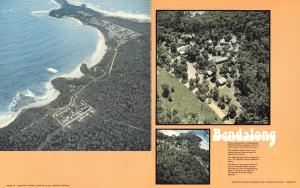
In the late 60s, the Club had also purchased some holiday cabins at Bendalong, south of Nowra, for $25,000. The club sponsored an active fishing club at that time, and it was a popular venue for members looking for a subsidised holiday. A ballot was held each year to see who the lucky tenants over the Christmas holidays would be. That property was sold in the 1990s for $900,000.
Mulgoa Road was added to the property portfolio in 1971.
Even with the properties it had purchased, the Club was still boxed in and very limited in its potential for growth. Parking would always be a nightmare on this site and the use of the swimming pool carpark by the Club’s customers was causing conflict. It was in the middle of a residential area and noise complaints were building momentum. Long-term planning for this site would be difficult.
However, if all the properties were consolidated, it would be an ideal site for a shopping centre, and around 1978 there was interest from a developer. A price of $3.25 million was negotiated subject to council approval of a shopping centre and the consolidation of all the properties including some roads.3 That caused difficulties, lengthy delays, unforeseen charges and a lot of bitterness but it was finally achieved. At that time, the book value of the properties was less than $1 million and it was a good profit for the club.
But it all hinged on Council approval of a shopping centre. Cowan says the first response was an almost blunt: “no chance”.
More work, feasibilities, and growth forecasts eventually led to agreement for a major retailer — but no specialty shops.
However, shopping centres depend on specialty shops. Further negotiations led to a revised proposal, but the permitted mix remained too limited to be viable, and time was passing.
In the meantime, the developer was spending more money on buying neighbouring properties and updating plans and information for Council.Finally, the development application was approved, and the Club was paid. Within a few days the developer sold the site to another developer for $7 million. The other properties purchased by the developer would allow for a shopping centre quite a bit better than the one we had approved. Nearly four years had elapsed from the time the deal had been agreed. A relatively small annual appreciation would have added well over a million to the value of the Club’s portion. Long delays cost money. And we did not have the experience of developers who could see other ways of doing things for a better result.
The first developer certainly made a nice profit and, eventually, so did Panthers. However, the sequence of events gave rise to one of the enduring myths surrounding Cowan and later became one of the matters that prompted a police investigation.4
This willingness to think beyond conventional boundaries would continue to shape decisions — not just in land, but in how the Panthers brand evolved.
To receive new Parts and occasional project updates by email, you may subscribe below.
Readers who hold recollections, documents, or material relevant to this history are welcome to contribute via the Commentary & Contributions page.
Project Updates
Receive updates when new parts are published.
- Phyro Holdings Pty Ltd becomes very important in this narrative. Phyro is derived from the names Phyllis and Roger.
↩︎ - One of these houses was 138 Station St, where the Cowan family lived from 1968-1972.
↩︎ - See Beyond the Book — Negotiation with Council — The Station St Road Closures.
↩︎ - The allegations arising frm these transactions are examined in Parts 22-25. ↩︎

