
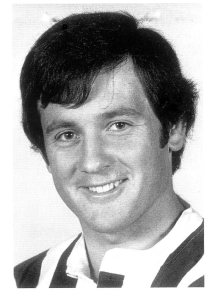
Image Source: The Panthers: Men in Black
Tim Sheens
Player, Coach, Administrator.
Tim Sheens occupies a unique place in Panthers history.
Many people remember him as the coach who guided Penrith to its first finals appearance. Yet his most important contribution may have come before a ball was kicked in 1984.
At a time when questions were being asked about Penrith’s future in first grade, Sheens chose to stay and help rebuild the club.
Unlike many coaches who arrive from elsewhere, Sheens understood Penrith from the inside. He had played more than a decade of first-grade football for the club and his family’s involvement in district rugby league stretched back generations.
Role in the Narrative
Although Sheens’ appearance in Panthers, Passion & Politics is brief, it acknowledges him as one of the key figures in the football club’s revival following the introduction of the unified “One Board, One CEO” structure in 1980.
By 1983 the football club faced significant challenges. Player retention had become a major problem, results remained poor, and concerns existed both within Penrith and within the NSWRL about the club’s long-term competitiveness.
Following a series of community workshops organised to identify a path forward, Sheens emerged as a central figure in the proposed football rebuilding program.
His appointment as coach in 1984 represented one of the most important football decisions made during the Roger Cowan era.
The Risk
When Penrith approached Sheens about coaching the club, his future appeared to lie elsewhere.
Sheens had already accepted a player-coach position in Queensland and was preparing to leave Sydney when Panthers approached him. The opportunity offered greater certainty than a struggling Penrith side that had won only six matches in 1983 and faced serious questions about its future.
Before making a decision on the Panthers role, Sheens spent several days discussing the decision with his wife Rhonda – whose family were in Queensland. Remaining at Penrith meant abandoning established plans and taking responsibility for rebuilding one of the competition’s most troubled football clubs.
From a football perspective, accepting the Penrith role carried considerable risk.
The Panthers had won only six matches in 1983. Experienced players were leaving. Recruiting power was limited. Media commentary frequently questioned Penrith’s ability to compete with the stronger Sydney clubs.
For an aspiring young coach, failure at Penrith could easily have damaged future opportunities.
Roger Cowan later recalled being impressed by Sheens’ contribution during the community workshops and believed he possessed both the football knowledge and commitment needed to help implement the club’s new direction.
Sheens agreed to stay.
Building From Within
Rather than rely heavily on expensive recruitment, Sheens embraced the philosophy emerging from the workshops.
The focus shifted towards local talent, player development and creating stronger pathways from junior football to first grade.
This approach aligned with the club’s Five by Five objective: producing five representative players from Penrith’s junior system within five years.
Under Sheens, young local players were given opportunities and expectations began to change. For the first time, many within the club started to believe that Penrith’s greatest resource was not money but its own district.
Sheens did more than advocate for local development. He actively worked to retain and recruit players he believed could form the nucleus of the club’s future, including Mark Geyer, Greg Alexander, Colin Van Der Voort and future champion Brad Fittler. His approach reflected a belief that Penrith’s long-term success would be built from within the district rather than purchased from outside it.
Intermediate Results
The improvement was rapid.
In his first season as coach, Penrith narrowly missed the finals and recorded its best performance since entering first grade.
The turnaround was so significant that Sheens was awarded Coach of the Year by his fellow Sydney first-grade coaches.
The following season Penrith qualified for its first finals series.
The achievement provided tangible evidence that the governance reforms, strategic planning and renewed focus on junior development were working.
Background
Born: 30 October 1950
Playing Career
• Penrith Panthers Player #62 (1970-1982)
• Club record-holder for most first grade appearances at time of retirment (174).
Coaching Career
• Penrith Panthers (1984-1987)
• Canberra Raiders (1988-1996)
• North Queensland Cowboys (1997-2001)
• Australian Kangaroos
• NSW — State of Origin
• NSW — Super League Tri-Series
Recognition by Panthers
• Life Membership, Penrith Panthers (1990)
• Inducted into the Panthers Hall of Fame (2026)
Relevance to Events Described
The significance of Tim Sheens within this story extends beyond coaching results.
The introduction of a unified governance structure provided Penrith with a framework for success. Sheens helped translate that framework into football outcomes.
His willingness to remain at Penrith during one of the club’s most uncertain periods, and his commitment to developing local talent, played a major role in establishing the pathway that eventually led to the club’s emergence as a genuine first-grade force.
For Panthers, Tim Sheens was not simply a successful coach. He was one of the people prepared to stake his future on the club when many others doubted it had one. In helping to change the club’s future, he changed the course of his own.
Related Topics
Related Themes:
To receive new Parts and occasional project updates by email, you may subscribe below.
Readers who hold recollections, documents, or material relevant to this history are welcome to contribute via the Commentary & Contributions page.
Project Updates
Receive updates when new parts are published.
Editorial Note
This profile is presented as contextual background.
Additional material may be introduced as the narrative progresses.

