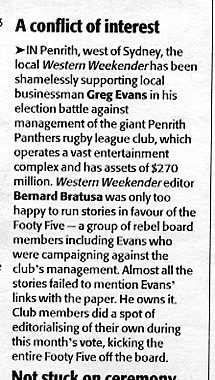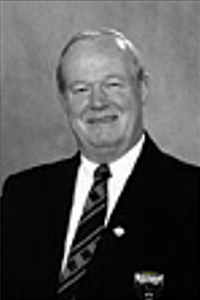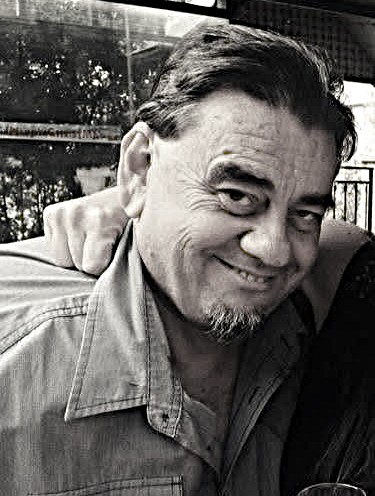
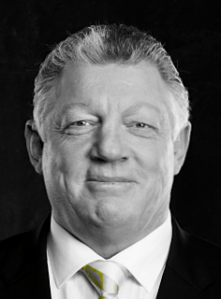
Major Player: Greg Evans

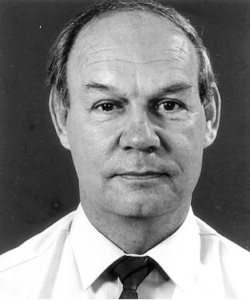
Greg Evans
Image Source: Nepean News Facebook Page

Greg Evans

Businessman, entrepreneur, newspaper proprietor, councillor, Panthers’ director.

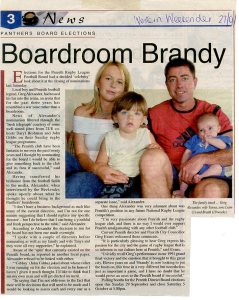
Greg Evans was a prominent Penrith businessman, newspaper proprietor, local councillor and Panthers director who became one of the central figures in the Board conflicts of the late 1990s and early 2000s.

Already well known within the Penrith community when he joined the Panthers Board in 1997, Evans became increasingly involved in disagreements over the future of the football club, the respective roles of the Board and management, and the exercise of authority within Panthers. On these and other issues, he increasingly found himself in opposition to Roger Cowan and eventually became one of the five directors who were known as the “Footy Five”.

His significance to the story, however, extends beyond that label. Evans’ business and civic standing, his ownership of The Western Weekender, and his strongly held views about the respective authority of the Board and management gave him an unusually influential position during one of the most divisive periods in Panthers history.

Role in the Narrative

Greg Evans enters the narrative during a period of considerable change on the Panthers Board.

Greg Evans joined the Panthers Board in 1997 after having previously stood unsuccessfully for election. His arrival was part of a period of unusual turnover on the Panthers Board, during which Craig Terry and Denis Coffey also joined.

Evans, Terry and Coffey subsequently became aligned with existing directors Geoff James and John Bateman. Ian Temby later described the emerging group as being determined to make management accountable. From Roger’s perspective, they increasingly represented an opposition to management.

Evans was instrumental in developing division.

He features prominently in the debate surrounding Panthers’ survival as a stand-alone NRL club in 1999, in the later disputes over the respective authority of the Board and management, the cancelled 2002 election and in the events that ultimately developed into the Board wars.

He was subsequently identified as one of the “Footy Five”, alongside John Bateman, Craig Terry, Geoff James and Denis Coffey.

Background

Evans had established a substantial business and community profile well before joining the Panthers Board.

Beginning his career as an analyst programmer, he moved into business management and became involved in computer distribution. After purchasing and operating a computer company, he took over the distribution business of a failed multinational supplier at the invitation of Apple Computer Inc. A later account of his career records that within two years the business had become Apple Australia’s largest distributor.

In 1991 he founded The Western Weekender.

Evans believed Penrith was often unfairly portrayed by the metropolitan media and saw an opportunity to establish a newspaper presenting the district from a local perspective. Under his ownership the Weekender developed into a significant independent local newspaper. Evans remained its owner and Chairman until 2008.

His media interests later extended to other publications and, briefly, local radio through Kick FM. He also owned the Sydney Spirit basketball team.

Evans was also active in civic and economic affairs. He served for nine years as a Penrith City Councillor, chaired the Penrith Economic Development Board for many years and served on a number of other local and regional bodies, including the University of Western Sydney and Western Sydney Institute of TAFE. He was also appointed to the Greater Western Sydney Economic Development Board.

By the time he joined Panthers, therefore, Evans was already a substantial figure within the Penrith community, with business, political, economic development and media experience.

Leadership and Culture

Matthews has consistently acknowledged Roger Cowan as the greatest influence on his development as a leader.

Working alongside Cowan during Panthers’ formative years exposed him to a management philosophy built upon trust, accountability and personal responsibility. Matthews has often recalled the lessons he learnt about treating people with respect, empowering staff to make decisions and responding to mistakes with honesty rather than blame.

One incident early in his career, when he admitted to a significant financial forecasting error, became a defining leadership lesson. Rather than reacting with anger, Cowan focused on solving the problem—an approach Matthews later identified as fundamental in shaping his own leadership style.

Those experiences would later influence Matthews’ own approach to leadership as he assumed increasingly senior responsibilities within the organisation.

Relevance to Events Described

One of Evans’ most important appearances in Panthers, Passion & Politics comes during the debate over Panthers’ future in the rapidly contracting NRL competition.

On 31 July 1999, the Board considered whether to sign a non-binding letter indicating that Panthers was prepared to investigate a possible joint venture with Parramatta. The proposal was intended to preserve an alternative while Panthers continued its efforts to survive as a stand-alone club.

Evans strongly opposed signing it.

He later explained his reasoning:

I really believed that signing that letter was signing to merge with Parramatta.

Despite the document being expressly non-binding, Evans believed that once Panthers entered the process the pressures being applied by the NRL would make amalgamation inevitable.

His position provides an important insight into the disagreement.

All of the directors wanted Panthers to survive as a stand-alone club. The division was over whether prudent planning required investigating alternatives in case that objective could not be achieved.

Evans genuinely appears to have believed that investigating the Parramatta option was itself an unacceptable risk. Others, including Roger, believed refusing even to investigate alternatives could place Panthers’ survival at greater risk.

The disagreement between Evans and Cowan, however, extended well beyond the merger question.

A deeper difference concerned the relationship between the Board and management and where operational authority should reside.

That difference became particularly evident during the crisis surrounding coach Royce Simmons in 2001. When Roger proposed returning responsibility for appointing and dismissing the football coach to management, Evans was vehemently opposed. The Board ultimately authorised Roger to deal with the matter, Simmons was dismissed and Evans resigned from the Board. He subsequently returned.

Evans later described the broader disagreement as an attempt by the group of five directors to get Roger to:

… come under the direction of the board, and to work within the parameters that they set.

Roger saw the governance issue differently. He believed the Board had an essential oversight role but that management needed sufficient authority to manage the organisation and remain accountable for the results.

The distinction was fundamental.

Both sides could argue for accountability and good governance while holding substantially different views about how those principles should operate in practice.

By 2002 Evans was firmly associated with the group that became known publicly as the “Footy Five”. The label would become an important feature of the Board election and subsequently of the way the conflict was remembered.

As explored elsewhere in this project, however, the name simplified a considerably more complicated history. The five directors did not begin as a formal group bearing that name, nor were they necessarily united on every issue. John Bateman later maintained that any real unison among the five developed much later, particularly during the licensed club amalgamation disputes of 2002.

The Publisher and the Director

Evans occupied another position that distinguished him from the other protagonists in the Board conflict: he was simultaneously a Panthers director and proprietor of one of Penrith’s most influential local newspapers.

The Western Weekender reported extensively on Panthers during a period when internal Board disputes were increasingly becoming public.

Roger became deeply concerned about confidential Board information finding its way into the media and believed the Weekender sometimes appeared to know of internal developments before management.

Evans’ dual roles inevitably complicated perceptions surrounding both the Board conflict and its public reporting.

The available material establishes Evans’ ownership of the newspaper and his role in setting its policy direction. It does not, by itself, establish the extent to which he personally influenced individual stories concerning Panthers.1

Nevertheless, the combination was unusual. Evans was simultaneously participating in an increasingly bitter governance dispute inside one of Penrith’s most important institutions while owning an influential newspaper reporting those events to the wider community.

Legacy

Greg Evans died in July 2025.

The tributes published following his death reflected a life and career extending well beyond the Panthers Board wars. He was remembered as a businessman, newspaper founder, councillor, community contributor and a significant figure in the civic and commercial life of Penrith.

The Western Weekender, which he founded in 1991, remains perhaps his most visible contribution to the district.

The tributes also demonstrated how strongly one interpretation of the Panthers conflict had become embedded in local memory.

Evans was remembered as one of the Footy Five who had prevented Panthers from being amalgamated with Parramatta. One obituary described him as a key figure in ensuring Panthers remained a stand-alone NRL club, while another tribute credited him with helping block a concerted drive for merger.

The events described in Panthers, Passion & Politics reveal a more complicated picture.

There was no Board proposal in July 1999 to amalgamate Panthers with Parramatta. There was a proposal to investigate an alternative while continuing the fight to remain independent. Evans sincerely believed taking that step would ultimately lead to merger. Others believed keeping the alternative available was prudent protection against the possibility that Panthers might otherwise be excluded from the NRL.

That distinction does not diminish Evans’ commitment to the football club. Rather, it helps explain the strength of his position.

Nor does the merger debate alone define his importance to this story.

Greg Evans was an independently successful businessman, publisher and civic figure who became a significant participant in the divisions that developed within the Panthers Board. His approach to the future of the football club, the respective roles of the Board and management, and the exercise of authority within Panthers increasingly brought him into conflict with Roger Cowan.

His role is therefore important not simply because he became one of the Footy Five, but because understanding Evans helps explain the very different perspectives from which the Panthers Board Wars developed.

Related Topics


Related Themes:

Board Decisions · Governance · Conflict · Football Club


To receive new Parts and occasional project updates by email, you may subscribe below.

Readers who hold recollections, documents, or material relevant to this history are welcome to contribute via the Commentary & Contributions page.

Project Updates

Receive updates when new parts are published.


Editorial Note

This profile is presented as contextual background.
Additional material may be introduced as the narrative progresses.


  1. The fact that the managing editor of the Western Weekender remians unamed throughout Panthers, Passion & Politics, demonstrates Jennie Bentley’s view of who was driving editorial policy on the Panthers issues during the Panthers conflict and throughout the Temby Inquiry. ↩︎

When Penrith City Became the Major Sponsor

Beyond the Book — Commentary & Contributions

Phil Morehead remembers an unusual sponsorship idea — and the leadership lesson that followed.

Contributor: Phil Morehead

Phil Morehead was a partner in Thomas Marsden Advertising the advertising agency and design studio that supported Panthers for many years. Phil also was a long-time active member and President of the Penrith Valley Chamber of Commerce. In this contribution he recalls how Penrith P Panther came into existence and became a recognisable community figure.


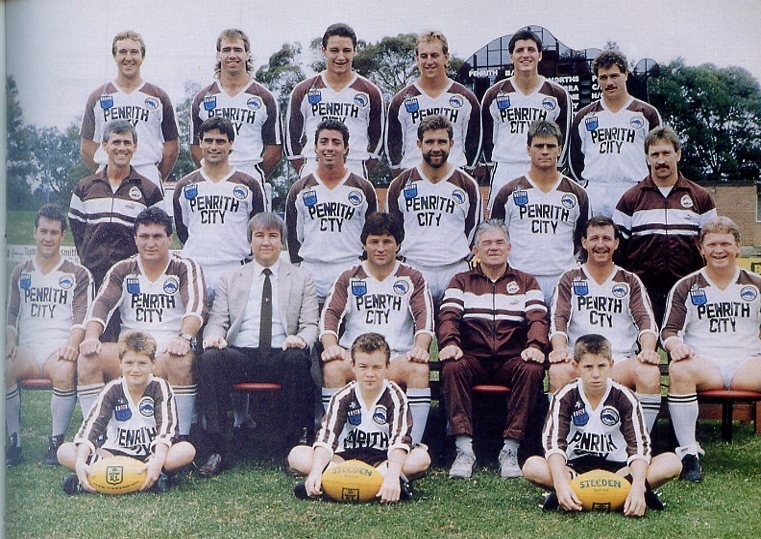
In 1988, the name across the front of the Penrith Panthers jersey wasn’t a company or a commercial product.

It was PENRITH CITY.

The arrangement lasted for just one season. But the story of how it came about provides an interesting glimpse into the relationship between the Panthers, the business community and the city during a period when all three were growing.

For Phil Morehead, however, the strongest memory isn’t really about sponsorship at all.

It is about Roger Cowan.

Phil was a partner in Thomas Marsden Advertising, the long-time advertising agency for Panthers, and at the time was also President of the Penrith Chamber of Commerce. He remembers Roger approaching him because Panthers had been unable to secure what Roger regarded as a suitable major jersey sponsor.

Roger saw another possibility.

The football team was appearing regularly on television and in newspapers, carrying the Penrith name far beyond the district. If a commercial sponsor couldn’t be found, why not use that exposure to promote Penrith itself?

As Phil recalls:

Roger was big on promoting Penrith and realised the massive media exposure our football team was delivering every time they played. It was Roger’s concept to have PENRITH CITY on the jerseys.

Phil was wearing what he describes as his “two hats” — advertising man and Chamber President — and the two began developing a plan around the idea.

A city gets behind its team

The proposal went well beyond simply putting PENRITH CITY on a football jersey.

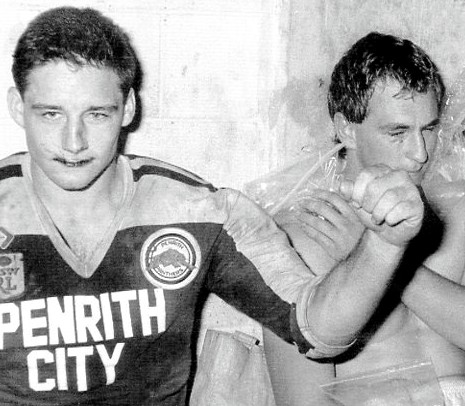
Bloodied and busted — Mark “MG” Geyer & John “Hoss” Cartwright bringing victory to their city. (Photo from Bound for Glory)

An Art Union was planned. Local motor dealers came on board with a new car as first prize. Other businesses would provide additional prizes, while the Chamber’s extensive business network would help sell and promote the tickets.

Responsibilities were allocated among the various people involved and another meeting was scheduled to check progress.

By then, Roger had acted — the jerseys had been ordered.

Phil had acted too. Retailers were prepared and the posters, tickets and other promotional material had been produced.

Then came the follow-up meeting.

In Phil’s recollection, almost nobody else had completed what they had undertaken to do. He particularly remembers a young Royce Simmons, then working with the junior clubs, apologising because he hadn’t had time to complete his part.

The original plan was in trouble.

“We will have to put this aside”

Roger looked at the situation and made the decision.

The jerseys could no longer be altered. Thousands of dollars had already been spent on promotional material. But without the other elements in place, the broader campaign could not achieve what had originally been intended.

Phil remembers Roger saying:

Well, the jerseys cannot be altered, we’ve already spent thousands of dollars on promotional material and I don’t think we can achieve our goal. We will have to put this aside and go back to the drawing board.

What impressed Phil was not simply the decision. It was the absence of everything that might easily have accompanied it.

No anger. No criticism. No ‘what are we going to do now’?

The plan had not come together. People had failed to deliver what they had agreed to do. Roger was undoubtedly disappointed.

But, as Phil remembers it, there was no attempt to embarrass anyone, allocate blame or prolong the failure.

A decision was made and everyone was allowed to move on.

For Phil, it became an enduring example of Roger’s leadership — particularly his capacity to make a hard decision without condemning the people whose actions had helped make that decision necessary.

The unexpected result

The original promotional scheme may not have proceeded as intended, but something significant remained.

The jerseys had already been produced.

So, throughout the 1988 season, the Penrith Panthers ran onto the field carrying PENRITH CITY across their jerseys.

The 1988 Penrith City Panthers (photo: Bound for Glory)
BACK (l to r): Rod McNeil, Matt Goodwin, Mark Geyer, John Cartwright, Graeme Bradley, Cal Van Der Voort.
MIDDLE(l to r): Bryan Hider, Neil Baker, Greg Alexander, Geoff Gerard, Chris Mortimer, Steve Colman.
FRONT (l to r): Greg Clements, Peter Kelly, Steve Robinson, Royce Simmons (c), Ron Willey (coach), David Greene, Brad Izzard.
Ballboys (l to r): Tim Bailey, Paul Bicknell, Brad Bateup.

For Phil, wearing his Chamber of Commerce hat, there was a considerable consolation. Panthers honoured the costs already incurred in producing the promotional material, while the Chamber could tell the local business community that its football team would be promoting Penrith City throughout the season without cost to the Chamber.

It was, in Phil’s words, one of the “win win” experiences of his time as Chamber President.

And the unusual arrangement proved short-lived.

In 1989, Calphos became the Panthers’ major jersey sponsor. In 1990, DahDah took over the major sponsorship, apppeared in a grand final, then a major change in colours, and a premiership win — impeccable timing. DahDah remained on the jersey through to 1993.

Phil wonders whether that prominent PENRITH CITY branding across the Panthers jersey helped open the door for the commercial sponsorships that followed.

Perhaps it did. But his recollection leaves another legacy.

A plan had failed. Money had already been spent. Commitments hadn’t been met. Roger had every reason to be frustrated.

Yet the thing Phil Morehead remembers almost four decades later isn’t the frustration.

It is the way Roger treated the people around the table.


Related Topics


Related Themes

Culture · Innovation · Football Club · Leadership


To receive new Parts and occasional project updates by email, you may subscribe below.

Readers who hold recollections, documents, or material relevant to this history are welcome to contribute via the Commentary & Contributions page.

Project Updates

Receive updates when new parts are published.

The Mental Game — Roger, Gus and an Idea Ahead of its Time

Today, the mental side of elite sport is taken for granted. Professional teams employ sports psychologists and mental skills coaches. Visualisation, relaxation techniques, controlled breathing and the management of anxiety and confidence have become familiar parts of preparing athletes to perform under pressure.

It was rather different in 1978.

More than four decades later, Phil Gould recalled one of his earliest encounters with those ideas — at Penrith, through Roger Cowan.

Gould told the story during an episode of Six Tackles with Gus in September 2021. The discussion had turned to Parramatta’s use of a mental skills coach during the NRL finals and to the relative importance of the physical and mental sides of elite sport.

For Gould, there was little doubt. At the highest level, he suggested, the mental component accounted for perhaps 95 per cent of performance. Players needed to learn how to control their thinking under pressure, he said, and that was a skill that took time to develop.

Then he remembered Roger.

An Experiment at Penrith

Gould described Cowan as the man who ran the Leagues Club and someone who read widely about self-improvement. Roger had long been particularly interested in hypnosis and in techniques, he believed could help people get the best out of themselves.

In May 1978, he decided to try some of those ideas with the Penrith first-grade team.

Gould’s memory of the occasion, 43 years later, compressed the chronology a little. He recalled the match as only his second game in first grade. In fact, he had debuted for Penrith in 1976.

But the match was a significant first for the young Gould.

It was his first game as captain of the Penrith Panthers.

The previous Sunday, 30 April, club captain Mick Stephenson had played his final match. Mounting injuries had finally brought his career to an end, but he went out with a remarkable performance. Penrith had lost its first five matches of the 1978 season; against North Sydney, Stephenson scored two tries as the Panthers recorded their first win, 17–16.

The following week, the captaincy passed to Gould.

He was just 19.

Penrith’s opponents on Sunday, 7 May were Eastern Suburbs. Gould recalls Bob Fulton being captain-coach of Easts that year but it was Arthur Beetson However, for this game at the Sydney Sports Ground Beetson did not play and Fulton was the captain.

Gould remembers the young Panthers being given virtually no chance.

Roger decided to try something different.

Shoes Off, Lie on the Floor

Before the game, Gould recalls, the Penrith players walked from the Sports Ground to a nearby hotel. Pubs were closed on Sundays in those days, but Roger knew someone who allowed the team inside.

The players removed their shoes and lay on the floor.

Roger began what Gould describes as a relaxation and hypnotherapy session.

He asked the players to relax, control their breathing and then visualise the match ahead. Gould remembers Roger asking them to imagine themselves playing the perfect game — making tackles, kicking well, scoring tries and seeing everything they did producing a positive result.

Gould, reflecting on this in 43 yers later, could see parallels with techniques that had become commonplace in professional sport.

At the time, however, this was something very different.

As the players lay quietly imagining their perfect performances, one of Penrith’s front-rowers1 suddenly cried out:

“Oh No!”

Everyone sat up.

As Gould remembered it, that rather killed the mood.

Then they beat Easts.

Whatever contribution Roger’s experiment made, something went right that afternoon.

Penrith beat Eastern Suburbs 15–13.

Inevitably, Gould recalled, everyone credited the victory to Roger having hypnotised the team.

So they did it again.

Before the following match against St George at Kogarah on Saturday, 13 May, Roger arranged another session. This time, however, there was a practical problem.

At the Sports Ground the previous week, the hotel had been only a short walk away. Roger didn’t know the St George area nearly as well. The venue he found was down towards Blakehurst — much further from the ground than he had appreciated.

The players walked there, went through another session and then had to walk all the way back to Kogarah. They arrived late, rushed their preparation and St George beat them 26–9.

Gould’s conclusion was succinct:

That was the end of the hypnotherapy.

HEAR PHIL GOULD TELL THE STORY

In this 12-minute extract from Six Tackles with Gus (September 2012), Phil Gould recalls Roger Cowan’s experiments with hypnotherapy and visualisation at Penrith in 1978 — and explains the lasting influence the experience had on his own interest in sports psychology.

Excerpt from Six Tackles with Gus courtesy of Nine Network Australia

It would be easy to leave the story there — an entertaining glimpse of a very different era of rugby league.

But Gould didn’t.

Something Stayed With Gus.

Despite the scepticism of some of the players, and despite the somewhat chaotic end to Roger’s experiment, Gould says he personally got something from it.

More importantly, he says:

“It piqued my interest in sports psychology.”

That interest stayed with him.

When Gould eventually moved into coaching, he became, in his words, “a very strong believer” in the psychological side of preparation and incorporated it into his coaching programs. He sought out sports psychologists, learned from them, and developed ways of helping players understand their own thought processes, motivation, preparation and performance.

Gould’s approach was not about a few minutes of emotional motivation before a match. His 2021 explanation is much broader: self-appraisal, goal setting, preparation, communication, trust, relationships between players and understanding how an individual’s role affects those around him.

And he traced the beginning of his interest back to those early experiences at Penrith.

“That Sort of Stuff Was Unheard of Back Then”

There is an interesting echo to Gould’s recollection.

Many years later, Ivan Cleary encountered Gould as a young player at the Sydney Roosters.

In his book Not Everything Counts … But Everything Matters, Cleary recall being struck by the way Gould thought about football:

From the very start, I was blown away by the way Gus saw the game.

Cleary remembers Gould’s tactics and strategy, but specifically mentions “the mental side of the footy”.

On one occasion Gould brought a psychologist in to speak to the players.

Cleary’s recollection is telling:

That sort of stuff was unheard of back then.

Perhaps it was to Cleary.

But it wasn’t to Gould.

Nearly two decades earlier, a teenage Phil Gould had been lying on the floor of a closed Sydney hotel while Roger Cowan asked him to relax, control his breathing and visualise himself playing the perfect game.

More Than an Eccentric Experiment

In Part 43 of Panthers, Passion & Politics, Roger talks about his longstanding fascination with what he called “the power of the unconscious to affect performance”.

He explored meditation, hypnosis, NLP and other approaches to changing patterns of thought. At various times he worked directly with Panthers players who were struggling with confidence or performance.

Read in isolation, Roger’s recollections might sound like the unusual interests of an unconventional chief executive.

Gould’s story adds something important.

It independently confirms that Roger was actually experimenting with these ideas in the Panthers football environment as early as 1978.

Care needs to be taken about claiming any more than that. There may have been others in rugby league experimenting with psychological preparation at the time, and there is no need to claim that Roger Cowan invented or pioneered sports psychology in the game.

But it is interesting enough that Roger was exploring the mental dimensions of sporting performance at a time when such ideas were far from commonplace in rugby league.

Intersting enough because he had plenty on his plate with the entire Panthers enterprise. Interesting enough given the label “anti-rugby-league” tat had been applied by some.

The first experiment produced a memorable win.

The second produced a long walk and a 26–9 defeat.

And the hypnotherapy sessions stopped for then.

But for one 19-year-old player, something remained.

More than forty years later, Phil Gould could still trace his interest in sports psychology back to those unusual afternoons at Penrith — an interest he would eventually carry into his own highly successful coaching career.

Perhaps Roger’s experiment achieved something after all.


Related Topics


Related Themes

Innovation · Culture · Football Club


To receive new Parts and occasional project updates by email, you may subscribe below.

Readers who hold recollections, documents, or material relevant to this history are welcome to contribute via the Commentary & Contributions page.

Project Updates

Receive updates when new parts are published.


  1. Unfortunately Gould does not name the player. The front-rowers on the day were John Farragher and Ross Cale. In the second row were Paul Merlo and Tas Batieri. ↩︎

Tapping the Unconcious — Anti-Rugby-League?

This article forms part of the serialised republication of Panthers, Passion & Politics – The Roger Cowan Years.

Start · Reader’s Guide · All Parts

The anti-rugby-league tag is the one that angers Cowan most. It was such a ridiculous claim; he says.

I fought for years to bring about a more streamlined administration of Rugby League despite the conflict, and the criticism that I was bringing down on myself. The results speak for themselves.  I was single minded about the need to run a profitable club. If we had spent all our money on football in the seventies, we would not have grown from that very tiny base to one that continues to compete at the top level. Whenever the football club was in crisis I stepped in and did both jobs.

Panthers’ group chairman Barry Walsh worked with Cowan for most of those forty years. He says that on a number of occasions when the team was going through a series of losses and nothing seemed to be working for the coach, Cowan assisted with player motivation. He adds that only very few people ever knew of Cowan’s involvement at that level.

It involved many hours of preparation and attendance at every game. On many occasions he was providing weekly counselling sessions for individual players who had specific problems affecting their performances.

Cowan recalls:

One of my greatest interests for many years has been the power of the unconscious to affect performance. There are many ways of tapping into that power. Meditation, yoga, hypnosis and NLP (Neuro Linguistic Programming) are all examples and the benefit different people in different ways. I found that a sequence of losses could always be altered by changing patterns of thinking. The majority of athletes, even in losing teams, respond to some of the techniques. I also discovered some of the pitfalls of trying too much.

I only ever offered help after the team had suffered a string of defeats, and on every occasion, there was a turnaround at the very next game. Every time. There was no personal gain – my only motive was to help the team perform better and assist the coach.

My critics say that I would not pay the cost of having a good team. Yet some of them held a majority on the board and made the policy decisions. They never suggested any changes to the budgets for rugby league. When a coach was going through a tough time some of them held secret meetings with players. This brought bad publicity and further demoralised a coach who already had enough problems.

Supporting Rugby League goes far beyond cheering the team from free seats in the grandstand or a private box, rubbing shoulders with the stars of the game, grandstanding at annual meetings, and enjoying spectacular Rugby League events as an invited guest. Directors – and the patron of the club – held that privileged position. It was always disappointing to me that Ron Mulock did not appreciate it to the extent that he would at least accept an invitation from the Chairman to settle his differences quietly and privately in the Boardroom, rather than with very public criticisms.

The reader might be just a little puzzled at this stage about who was really anti-rugby-league – it always puzzled me.

BEYOND THE BOOK
Phil Gould remembers Roger putting these ideas into practice with the Panthers in 1978.
The Mental Game — Roger, Gus and an Idea Ahead of Its Time

If Cowan really had been anti-rugby-league, he could have saved himself a lot of anguish by leaving the hard decisions to others. He could have left the stress that goes with changing coaches and staff, running workshops, writing recommendations and fighting for a united administration to others, and kept right out of it. It is difficult to criticise someone for doing nothing.

It wasn’t as if there weren’t other things to think about. The Club was embarking on a brand-new path – to amalgamate with other clubs. Although totally unrelated to football, this new strategy would be used by some to feed the fires of the anti-rugby-league myth.


To receive new Parts and occasional project updates by email, you may subscribe below.

Readers who hold recollections, documents, or material relevant to this history are welcome to contribute via the Commentary & Contributions page.

Project Updates

Receive updates when new parts are published.


Part 42 · All Parts · Part 44

Commentary and Contributions

Making Hard Decisions — Anti-Rugby-League?

This article forms part of the serialised republication of Panthers, Passion & Politics – The Roger Cowan Years.

Start · Reader’s Guide · All Parts

Early in 2001 the Board approved Mark Levy’s recommendation that Royce Simmons be re-signed for a further two years. The decision ultimately led to his departure in a way that, to Cowan, was both regrettable and unnecessary.

Royce Simmons was an icon in Penrith. He had come from the country as a young player and had shown enormous commitment to the club for close to twenty years. He was – justifiably – looked upon as one of the heroes of the Panthers’ 1991 Grand Final win. He was extremely popular with sponsors and supporters.

Levy approached the board in early 2001, saying that Simmons believed that some high-profile players would not sign new contracts until they knew Simmons’ contract had been extended. Cowan remembers there was mixed reaction from the Board. Significantly, the five directors who so often voted together were themselves divided on the issue.

Cowan believed the mechanisms that had previously allowed for detailed discussion and analysis were no longer operating in the same way, making the situation even more difficult.  Most importantly, it had to be handled carefully. Because of Simmons’ popularity, if word leaked that the board was reluctant to extend his contract, a strong backlash was likely.

He had been quite successful as a coach, which increased the pressure. Although the club had been badly damaged by the Super League wars, Simmons had taken the team to the finals in 1997 and again in 2000. In 2000, the club had also broken records for attendance and sponsorship.

Taking all this into account, the Board agreed with Levy’s proposal and signed the two year contract. Cowan says the 2001 season was a disaster.

The team was not just losing; it was barely competitive in many games. It finished the season in last place. In Royce’s defence, he had been at the club for a very long time compared with the usual coaching careers. A rigid salary cap had prevented the club from adding any new players to the team. However, we still had a good solid base from the previous year, and we had faced the new season with high hopes.

But it does not work that way in rugby league.  Having no new blood served to dampen the morale and enthusiasm of the coach, the staff, and the team. The continual losses hit Royce particularly hard. They sapped his confidence, which didn’t help the situation. By the middle of the season, it was obvious that we were in trouble.

In my own mind I was trying to work out how we could overcome the problem at the end of the year. Royce had a two-year contract, and the decision-making processes of the club were basically in the hands of five directors.

By the second half of the season, Cowan had reached the view that the only way to restore spirit to the team was to replace the coach and several members of the football staff.

He could see no value in making drastic changes halfway through the season. It was his plan to spend the remainder of the season collecting as much information as possible, and to work with some trusted staff to try to analyse the problems and come up with solutions.

Had things been different, part of the process would have been consultations with the Board, but he says that by this time, breaches of confidentiality were a fact of life at that level. The last thing the coach and team needed was to have their problems publicly debated in newspapers, and on television and radio. Cowan adds that it often seemed that Ron Mulock and the Western Weekender knew things before he did.

Around the same time, and unbeknown to the rest of the Board, Dennis Coffey and John Bateman were meeting privately with some senior Panthers players. They later said that players had expressed dissatisfaction with the coach during those meetings.

To Cowan, the meetings presented a serious governance problem. He believed concerns of that significance should have been brought back to the full Board and management rather than pursued independently by individual directors. This was particularly difficult for him to reconcile with Bateman’s frequently expressed concerns about corporate governance.

It was also extremely naïve to think that the meetings would remain secret.1

Soon there was a blaze of publicity. Instead of being handled with discretion and objectivity, Simmons’ future became an emotional public issue that further undermined his position.There were divisions among sponsors and fans. The players, already suffering because of the bad season, were caught in the crossfire.

Cowan says he backed away from making a recommendation but suggested that they consider moving back to the old system, where the responsibility for hiring and firing rested with management. 

Greg Evans was vehemently opposed to handing back this power.  I was equally obstinate, believing that it was the only way to fix the problem without causing more conflict in the community.

Finally, the Board agreed that Cowan should handle the matter, effectively returning responsibility for the coaching decision to management. Royce Simmons was sacked as coach, to be followed soon after by most of the coaching staff.

As a result, Greg Evans resigned from the Board, to be reinstated about six months later.

Substantial changes followed within the rugby league operation. John Lang was appointed coach, and two seasons later Penrith won its second premiership.

Cowan reflects on the problem:

The phenomenon of coaches reaching a year of failure is not unusual.  It is not because a good coach suddenly becomes a bad coach.  Had Royce Simmons left Panthers one year earlier, he would have left on a very high note. He gave much to the club over many years. As a coach he was virtually a workaholic and would probably have cheerfully donated his right arm in return for a successful Panthers team. The way he left was sad and did not do justice to his service with the club. What is even more sad is that it could have been avoided.

Recognition should also be accorded to many others from that era, including Mark Levy and all of Royce’s coaching and support staff. Unfortunately, timing in these matters is all-important – a club full of heroes at the end of 2000 and most of them sacked by the end of 2001.

To receive new Parts and occasional project updates by email, you may subscribe below.

Readers who hold recollections, documents, or material relevant to this history are welcome to contribute via the Commentary & Contributions page.

Project Updates

Receive updates when new parts are published.


  1. Max Cowan recalls speaking to some players about what was happening. “Some were furious that other players were, as they saw it, putting the skids under Royce; others were despondent at the prospect of continuing with him as coach. It seemed clear to me that Bateman and Coffey had unwittingly undermined the coach and added to the instability of the team. ↩︎

Part 41 · All Parts · Part 43

Commentary and Contributions

A Return to Two CEOs?

This article forms part of the serialised republication of Panthers, Passion & Politics – The Roger Cowan Years.

Start · Reader’s Guide · All Parts

Cowan’s ‘hands on’ approach to rugby league saw him step into the role of rugby league CEO a number of times. He was involved in some monumental rugby league decisions in the club’s history, including engaging some very successful coaches.

Strangely though, he says his passion about rugby league resulted in him sometimes being less tolerant of people than he should have been. This brought him into conflict with people,

I should have been able to handle the rugby league issues better than I did. The number of people who think I was anti-rugby-league is an indication that I was not communicating well. There is plenty of evidence to show that I was passionate about having a successful team. But I resented seeing waste arising from irresponsible decisions.

I could also never cope with people who kept prattling on about the Club not putting enough money into rugby league to make it successful. To my way of thinking they were just ratbags who did not have the common sense to see that if we put unlimited money into rugby league it would only last a few years and then there would be none. To me all this was obvious. The most important thing was good management of the resources that we had, rather than having to spend our way out of trouble because of poor management. It frustrated me that some people just couldn’t see it, and there were probably many times I showed how I felt — which is not the way to win friends and influence…

But when people suggested initiatives that presented a chance to build success, I was never opposed to spending the money. On one occasion I had a call from rugby league commentator Frank Hyde, suggesting we consider getting players from South Africa. His rationale seemed very logical, and the idea looked promising. The Board agreed to my recommendation to try it, despite the expense.

FROM THE ARCHIVES
Looking Further Afield — Penrith’s South African Recruitment Mission
In 1972, a four-man Panthers delegation travelled to South Africa looking for players who might strengthen the struggling first-grade team. The venture became a rather more unusual recruitment story than that simple description suggests.
Read the original account

Another time Alan Clarkson told me of a terrific English player who would probably come to Australia if invited. His name was Bill Ashurst. I reached an agreement with Bill, and we agreed to pay a very large transfer fee to his club. When another club tried to get under our guard, we sent two directors to England to make sure we clinched the deal. The two directors rang from England saying that we could also get the English captain, Mick Stephenson, if we were willing to pay another large transfer fee. We paid record money for those players, and I supported it all the way. The success of those two choices is part of Panthers’ folklore.1

The fact is that I cannot recall one occasion when a request for money to fund a well-thought-out rugby league initiative was refused by the board or opposed by me. In addition to that, the criticism that I would not give rugby league enough money shows an ignorance of the procedure. The football club would present a budget to the board of the licensed club at the beginning of each season. On most occasions it was approved. But sometimes – and particularly in the Cartwright era – we would be confronted with a huge deficit at the end of the season, and that’s when I would go off my brain.

After ‘one board, one CEO’ became reality in 1984, Cowan led or participated in most of the important plans and decisions for coaching the Panthers.

The change was followed by a much more deliberate approach to football development. Among the initiatives was the Five-by-Five Plan, which set the ambitious goal of having five locally developed players representing Australia within five years. Within six years of the structural change, Penrith reached its first Grand Final; a year later, the Panthers won their first premiership.2

Those decisions also included included the eventual decision to replace Royce Simmons and the contract Cowan negotiated with John Lang, who would take the club to its second premiership. At this time Cowan had once again taken over responsibility for rugby league after a major restructure that saw most of the club’s rugby football staff depart, including rugby league CEO Mark Levy.

Although there had been a number of dramatic rugby league upheavals over the years, Cowan says that, until the Simmons episode, major changes had generally been made with minimal adverse publicity. He attributed much of that to the club’s participative approach to decision-making.

It all seemed to operate quite smoothly, and a lot of that could be attributed to our participative style of management. Any changes were thoroughly discussed and explored before they were made. For example, the final meeting with Ron Willey was preceded by a meeting of the rugby league chief executive and about six other managers. Their brief was to help me analyse the problem, and decide what should be done about it, and how adverse publicity could be avoided. The Board Executive was also brought in before any action was taken.

Similarly, the decision to join Super League followed months of analysis and discussion involving key staff and the Board.

Cowan strongly rejected claims that he ran the Club as a dictatorship.

He maintained that the five directors who later complained about his management had themselves participated for years in the Club’s consultative decision-making processes. His involvement in the departure of some high-profile rugby league personalities nevertheless provided further ammunition for his critics.

Around 1999, the Board began to become more directly involved in the management of rugby league — a development Cowan regarded as a backward step.

It started with a very simple request from the board that Simmons and Levy should attend the start of every second meeting to deliver a football report.

The Simmons/Levy visits soon moved beyond their rugby league reports. What had begun as a straightforward reporting arrangement gradually altered the decision-making structure. In Cowan’s view, it was a step back towards the arrangement of the Charlie Gibson years: one Board dealing directly with separate executives responsible for the registered club and rugby league.

It was a subtle shift away from the model of discussion and analysis that had operated for about fifteen years, towards more direct decision-making structure by the Board.

Cowan cites an example:

At one meeting, Simmons proposed a payment of $100,000 to a player who was exempted from the salary cap.  It took all of one minute for the Board to agree, despite a couple of strong dissenters.  Previously, something like this would have been analysed carefully by a team. Only then would it have been referred to the board. It was a very poor decision, and fortunately – because of other reasons – it did not happen.

A decision by the Board early in 2001 had massive repercussions.

To receive new Parts and occasional project updates by email, you may subscribe below.

Readers who hold recollections, documents, or material relevant to this history are welcome to contribute via the Commentary & Contributions page.

Project Updates

Receive updates when new parts are published.


  1. More details on the Ashurst and Stephenson signings can be found in Beyond the Book: Looking Abroad — Bringing Stephenson and Ashurst To Penrith. ↩︎
  2. For more details on this see Beyond the Book — The 1983 Strategic Reset and its companiion post The 1983 Strategic Reset — Did it Work? ↩︎

Part 40 · All Parts · Part 42

Commentary and Contributions

Don’t Fix the Decision. Fix the System

Roger Cowan and the Rugby League Judiciary

For Roger Cowan, a problem was rarely just the incident that brought it to attention.

His instinct was to pull it apart. What was actually going wrong? Who was affected? What outcome was required? And, most importantly, could a system be designed that would produce that outcome more consistently?

It was an approach to problem-solving and decision-making he was embedding across the Panthers organisation throughout the 1990s — and one he believed was important to its continuing success.

Few examples illustrate that approach better than his work on rugby league’s judiciary.

The problem had bothered him for decades.

“Sit down, Mr Cowan”

As Roger recalled in Panthers, Passion & Politics, when he served on the NSW Rugby League executive committee in the early 1970s, judiciary decisions regularly created controversy. Penalties appeared inconsistent and clubs sometimes believed others were receiving more favourable treatment.

Eventually he tried to raise the issue at an executive meeting.

“I want to make a suggestion about the judiciary system,” he told chairman Bill Buckley.

“Sit down, Mr Cowan, you’re not here to talk about judiciary.”

Roger tried again.

“Sit down Mr Cowan or leave the meeting. You are out of order.”

That was the end of the discussion.

More than twenty years later, rugby league had changed dramatically — and was in the process of changing even more.

During the planning for Super League, the judiciary came up for discussion. Roger said he had “always had a passion for judiciary” and offered to prepare a paper.

This time the response was different.

“Terrific! Go ahead, do it.”

So he did.

Start with the outcome

The surviving working paper is dated 24 November 1995.

Its opening is revealing.

Roger did not begin by deciding who should sit on the judiciary or what punishment should apply to a high tackle.

He began by identifying what a better judiciary system should achieve. What is the outcome — what evidence will demonstrate the system is a success?

Among a list of outcomes were:  reduced levels of public criticism of judiciary decisions; elimination of the perception that penalties were inconsistent or favoured particular clubs; less involvement of solicitors; reduced number of hearings and shorter duration; and elimination of appeals based simply on the severity of a sentence.

Before designing the machinery, he defined what the machinery was supposed to accomplish.

That changed the nature of the problem.

It wasn’t simply a question of whether an individual judiciary panel made the right or wrong decision. A system could produce perfectly defensible individual decisions and still create inconsistency, expense, delay and a perception of unfairness.

Roger’s proposal therefore attempted to move responsibility for consistency away from the discretion of whichever individuals happened to be sitting on a particular night and place much more of it within the system itself.

Separate guilt from penalty

At the centre of the proposal was a relatively simple distinction.

The judiciary should determine whether a player was guilty and, if so, what offence had been committed.

Ordinarily, it should not then decide the penalty from scratch.

Offences would instead be divided into clearly defined categories carrying predetermined penalties. Discounts and additional penalties could be applied according to defined circumstances.

A player whose guilt was clear could plead guilty, receive the appropriate discount and avoid a hearing altogether. A player maintaining innocence retained the right to have the case heard.

By January 1996, when Roger presented the proposal to Super League, the concept had been distilled into five principal elements:

  • experts should be used where necessary;
  • a Head of Judiciary should control the process;
  • there should be incentives for guilty pleas;
  • penalties should be predetermined, with the judiciary principally deciding guilt rather than sentence; and
  • hearings should generally occur only where a player pleaded not guilty.

The objective was not simply tougher or softer penalties.

It was greater consistency.

Design the process, not just the idea

Roger’s November paper went well beyond the broad concept.

It worked through what should happen from the time an incident occurred.

The Head of Judiciary would identify an appropriate charge and notify the player. Where necessary, expert analysis could be obtained. If that evidence exonerated the player, the matter ended. If it supported the charge, the player had another opportunity to plead guilty. If the player continued to maintain innocence, a judiciary hearing followed.

The proposal dealt with who should pay for expert evidence. It considered appeals and appeal fees. It provided for records of previous offences, discounts for guilty pleas and additional penalties in defined circumstances.

Roger even tried to anticipate the objections to what he was proposing.

Argue against your own idea1

One obvious objection to predetermined penalties was that no two incidents were exactly alike.

Surely a judiciary panel needed discretion to recognise the difference?

Roger’s answer wasn’t to ignore those differences and he produced the principle that offences a more precisely defined and graded.

A high tackle, for example, might be divided into 20 or more categories, each carrying its own penalty.

He also recognised the potential danger in relying upon expert analysis. If a new system placed greater weight on expert evidence and that evidence was subsequently shown to be wrong, confidence in the entire system could be damaged.

One proposed safeguard was a second expert opinion in controversial cases.

Even the media were considered part of the process.

Journalists and editors should have access to the schedules of offences, penalties, discounts and additions. Expert reports should be available and journalists invited to see the video evidence supporting them.

Public understanding wasn’t something to worry about after a decision had been made.

It was part of the system.

From weeks to points

Perhaps one of the most interesting ideas appears under the rather modest heading “Future Considerations.”

Roger had identified another problem.

If suspensions were expressed only in whole weeks, a carefully graded series of offences could still end up producing the same penalty. Several different levels of seriousness might all result in a one-week suspension.

So he considered a points system.

One hundred points could represent a one-week suspension. A penalty of 275 points could produce an immediate two-week suspension, with 75 points carried forward. Discounts and additions could also be expressed as points.

It allowed much finer distinctions between offences and circumstances.

The significance for this story is not simply the points themselves.

The working paper captures Roger’s thought process while it was happening:

If we solve this problem, what new problem might our solution create? And how might we solve that?

Not entirely Roger’s system

The proposal did not simply emerge from Roger’s office and become the Super League judiciary unchanged.

Roger himself was quite clear about that.

Many people became involved in developing the final system and compromises were made. His original submission was not adopted in its entirety, although he believed most of its principles survived.

That distinction becomes particularly important when the story reaches 1998.

By then Super League and the Australian Rugby League had come together in the new National Rugby League, and a decision had to be made about which judiciary system the unified competition would use.

The two systems were fundamentally different.

Roger attended meetings between representatives of the ARL and Super League attempting to reach agreement. According to his later account, those meetings achieved little and the question was eventually referred to the chief executives of the 20 clubs.

They heard submissions supporting both alternatives.

The result, Roger recorded, was 18 votes to two in favour of the Super League system — including support from 10 of the 12 former ARL clubs.

It appeared that the argument had been won.

Roger soon became convinced that something very different had happened.

The system meets the real world

By June 1998, the new NRL judiciary was attracting considerable public criticism.

This was the first season of the unified competition and the clubs had overwhelmingly chosen the Super League judiciary model. Yet some early decisions were already raising questions about whether the system being implemented was actually operating according to the principles the clubs had endorsed.

Two cases involving prominent players became particularly contentious.

Glenn Lazarus, playing for the Melbourne Storm on the eve of a State of Origin match, had received 130 points for a high tackle. With 100 points producing an automatic one-match suspension, the penalty would have ruled him out of State of Origin. The penalty was reduced to 99 points — allowing Lazarus to play Origin, leaving the 99 points to be carried forward.

Geoff Toovey’s circumstances were different. Due to his past judicial recorded any offences attracted a loading on a standard penalty. He — again enough for an automatic one-match suspension. Toovey’s points were reduced back to 75 Concerned that suspending a prominent and respected captain for such a minor offence would appear unreasonable, the authorities reduced his points to 75.2

Whatever the merits of either decision, both exposed a problem at the heart of a system intended to produce consistency.

If Lazarus’s circumstances justified reducing 130 points to 99, what would happen when the next player accumulated 130 points but did not have a State of Origin match approaching?

If Toovey’s standing in the game, or the relatively minor nature of the offence that triggered his suspension, justified reducing his accumulated points, would the same consideration be available to a less prominent player?

These were among the controversies being discussed publicly by radio broadcaster Ray Hadley.

Roger had been listening.

On 15 June 1998, he wrote Hadley a five-page letter. He agreed that a number of decisions during the season appeared “absurd from the public’s point of view”.

But Roger believed the controversy was being blamed on the wrong thing.

The problem, as he saw it, was not that the principles developed for the Super League judiciary had failed. It was that the NRL judiciary had departed from what he regarded as the most fundamental of those principles.

The difference came down to a deceptively simple question:

Who was responsible for consistency?

Under the old system, that responsibility rested substantially with the judiciary panel. Change the people and the interpretation — and potentially the outcomes — could change with them.

The Super League philosophy put much greater responsibility upon the administrators of the game.

The judiciary determined guilt. The rules and schedules provided consistency in penalty.

Those rules could be changed.

But when they changed, they changed for everyone.

Learn from the bad decision

This is where the Hadley letter perhaps reveals more about Roger’s thinking than the original proposal.

He did not suggest that his system would prevent every bad or controversial outcome.

Quite the opposite:

“No judiciary system will ever be perfect.”

What mattered was what happened when an imperfection became apparent.

A good system, he wrote, should produce greater consistency and generate its own improvements.

If a particular case exposed an unfair penalty, the administrators could change the schedule.

The next player committing the same or a closely comparable offence would then receive the new penalty.

The lesson from the controversial decision had been captured by the system.

That was fundamentally different from allowing a panel to produce a different result next time simply because its members regarded the circumstances differently.

The first approach changed the rule for everyone.

The second changed the decision for one person.

Lazarus, Toovey — and the next player

Roger’s response to the Lazarus and Toovey controversies was revealing.

He was not necessarily arguing that the concessions made to either player were wrong.

His concern was what happened the next time.

If there was a legitimate reason why Lazarus’s 130-point penalty should be reduced to 99, that reason should be identified and incorporated into the rules. Every future player satisfying the same conditions should then receive the same treatment.

The same principle applied to Toovey. If there was a legitimate reason why his circumstances warranted reducing the points that would otherwise have resulted in suspension, define that circumstance and make the concession available to every player who subsequently qualified for it.

The individual decision therefore became evidence.

If it revealed something wrong with the existing rules, fix the rules.

If it revealed a legitimate circumstance that had not previously been anticipated, incorporate that circumstance into the rules.

Either way, the system became better.

But not a system without judgement

Roger was not arguing for a completely mechanical judiciary.

His letter makes that clear.

Under the Super League system, the judiciary retained discretion to alter a penalty where it considered the circumstances of a particular case genuinely unusual. As far as Roger knew, that discretion had not been used during the Super League season.

The distinction is important.

His objective was not to eliminate judgement.

It was to prevent routine decisions from depending unnecessarily upon individual judgement — while retaining discretion for the genuinely exceptional case.

Consistency was the default.

Departure from it needed a reason.

Who cares what the system is?

Another surviving set of Roger’s notes from 1998 approaches the same issue from a different direction.

At the top of the page he posed a simple question:

Players cared. They wanted less time spent travelling to and attending hearings, equal treatment and a safer game.

Coaches cared. Judiciary appearances interfered with training; they wanted their players treated fairly and protected from dangerous play.

Chief executives cared about the time consumed by judiciary matters and the treatment of their players.

Financial managers cared about the cost of solicitors, witnesses and travel.

Supporters wanted confidence that their team was being treated equally. They also wanted the game’s best players playing rather than injured or suspended.

And the media?

Roger’s assessment was characteristically dry:

“As many opportunities as possible to create controversy.”

There is humour in the line, but the exercise itself is revealing.

Before judging whether a system was working, Roger was asking what the different people affected by it actually required from it.

Don’t fix the decision. Fix the system.

The surviving judiciary papers stretch from the original Super League proposal in November 1995, through its presentation and development in 1996, to Roger’s defence of its underlying principles in 1998.

Together they provide something more interesting than a claim about who devised rugby league’s judiciary.

They provide a small window into how Roger Cowan approached a problem.

Start by defining what you are trying to achieve.

Identify who is affected.

Separate the problem from the personalities involved.

Design a process rather than relying upon good intentions.

Build incentives into that process.

Anticipate objections.

Allow for exceptional circumstances.

And when the system produces an outcome that exposes a weakness, don’t simply correct the outcome.

Learn from it.

Change the system.

Then apply the improvement consistently to everyone who comes next.

It was an approach Roger applied repeatedly during his years at Panthers — to organisational structures, financial controls, strategic planning and football administration.

The judiciary happens to leave behind an unusually clear documentary trail showing that approach at work.

There is also a certain symmetry to the story.

In the early 1970s, Roger tried to suggest there might be a better way to administer rugby league’s judiciary.

He was told to sit down.

More than twenty years later, he was finally invited to develop the idea.

And when the new National Rugby League had to choose between two fundamentally different approaches, 18 of its 20 clubs voted for the system that had grown from that proposal.

For Roger, however, winning that argument was never quite the point.

The system still had to work.

And if it didn’t, the answer was not to abandon the principles behind it.

It was to find out why — and make the system better.


From the Panthers Passion Politics Digital Archives

The surviving documents behind this story provide an unusual opportunity to follow the development of Roger Cowan’s thinking about the rugby league judiciary — from his original proposal, through its presentation to Super League, to his response when he believed the principles behind the system were being compromised.

November 1995 — The Original Judiciary Proposal

Roger Cowan, 24 November 1995

Roger’s original working paper setting out the objectives of a proposed Super League judiciary system, its procedures and safeguards, and the problems it was intended to overcome. The document also includes his early consideration of replacing suspensions expressed solely in weeks with a points-based system.

View the original document.

January 1996 — Presentation to Super League

Roger Cowan, 8 January 1996

The presentation prepared from the earlier working paper, distilling the proposal into its principal elements for consideration by Super League. It shows how the more detailed November proposal was developed into a practical model for discussion and implementation.

View the original document.

January 1998 — Who Cares What the System Is?

Roger Cowan, 18 January 1998

These working notes approach the judiciary from another direction: who is affected by the system, and what does each group need from it? Roger considers the interests of players, coaches, chief executives, financial managers, supporters, administrators and the media.

View the original document.

June 1998 — Letter to Ray Hadley

Roger Cowan to Ray Hadley, 15 June 1998

Written during controversy surrounding the judiciary in the first NRL season, this five-page letter explains Roger’s concern that the system being implemented had departed from a fundamental principle of the Super League model: consistency should reside principally in the rules and procedures rather than depend upon individual decisions. The letter discusses the Glenn Lazarus and Geoff Toovey cases and explains how Roger believed apparent anomalies should be used to improve the system.

View the original document.


Related Topics


Related Themes

Innovation · Governance · Football Club


To receive new Parts and occasional project updates by email, you may subscribe below.

Readers who hold recollections, documents, or material relevant to this history are welcome to contribute via the Commentary & Contributions page.

Project Updates

Receive updates when new parts are published.


  1. This was another technique Roger encouraged in the decision-making process throughout Panthers — this took various forms and names depending on the specific circumstance. One was use deBono’s “Six Hat Thinking” where the Black Hat was engaged to argue against the idea. Using the process developed by Mike Basch of Federal Express, there was a section title “Things We Must Overcome” where the challenges were listed and anything that “killed” the diea identified.
    ↩︎
  2. In Round 1 of the 1998 unified season Brisbane played Manly in Brisbane. Bill Harrigan was the referee. Early in the match Harrigan sent Toovey to the sin-bin for dissent about a decision. In the last 30 seconds of the game John Hopoate was sent of for referee abuse. Wtin seconds Toovey was also sent and the charge was also abuse. ↩︎

Anti-Football — Joke or Paradox

This article forms part of the serialised republication of Panthers, Passion & Politics – The Roger Cowan Years.

Start · Reader’s Guide · All Parts

People who worked with Cowan, or dealt with him through rugby league administration over the years, saw the anti-rugby league tag very differently.

Greg Mitchell, rugby league general manager at Parramatta,1 was a contemporary of Cowan during the NSWRL days. They attended many meetings together.

If there was some issue facing the game at the time, Roger always had a paper to present to provide a new perspective. He was certainly always current and relevant in terms of rugby league issues.

David Gallop says the fact that Cowan was on the Board of Super League is evidence of his reputation as a leader among football club CEOs.

I’ve always found him to be a deep thinker about rugby league and how to improve the game. For instance, his role in the judiciary concept and the amount of written material that he put together in relation to that – shows that he was very interested in the future of rugby league.

Roger Cowan was the original architect of the judiciary system introduced by Super League in 1997 and subsequently adopted by the NRL. In a 2003 paper, academics Ian Dobinson and David Thorpe described the system as a “benchmark or exemplar for how sports … should deal with on-field violence”.

Cowan says the way the rugby league judiciary worked had long been a problem in his mind.

Even back in the early seventies, when I was on the NSWRL executive committee, there was always controversy about the way the judiciary worked. Often there seemed to be no rhyme or reason to the decisions, and some teams appeared to be getting more favourable treatment than others. One night I decided to suggest an improvement to the system.

Bill Buckley was the chairman at the time. I waited till general business, then stood up and said,

“I want to make a suggestion about the judiciary system”.

Buckley said,

“Sit down, Mr Cowan, you’re not here to talk about judiciary”.

“But I just want to suggest an improvement.”

“Sit down, Mr Cowan or leave the meeting. You are out of order”.

That was it. He was going to throw me out of the meeting rather than listen to a suggestion. The culture of rugby league was always pretty closed in its early days. There was that inner circle, and they were fixed in their ways. It was very much a closed environment for ideas. It was an “If it ain’t broke, don’t fix it” kind of atmosphere. “We’ve been doing it this way since nineteen hundred and nothing …”.’ It took around twenty years for it to change.

At a Super League meeting one night, we started talking about judiciary, and I said, “I’ve always had a passion for judiciary, I’d like to write a paper on it.” They said, “Terrific! Go ahead, do it”. It was such an open and participative environment. Everyone worked together in a great spirit of cooperation to get things done.

I wrote a proposal, and we worked on it as a team. There were a number of modifications, and it came into operation in time for the commencement of the Super League competition. When the NRL competition started there was great debate about which system to use for judiciary – the Super League or the ARL system. They agreed to use the Super League system, but to my horror and frustration they started to use it incorrectly. It was going back to being more like the ARL system. Fortunately, someone must have seen what a mess they were making of it and made the necessary changes.

Cowan says his original system was refined by the input of others on the Super League planning group, and since then there have been some minor modifications but the basic principles remain the same. Thorpe and Dobinson agree that the previous NSWRL judiciary procedure was viewed as arbitrary and inconsistent. Their research also found that it ‘was not written down anywhere and varied from chairman to chairman’.

The NRL system was also adopted by the Australian Football League at the beginning of the 2005 season. In an article in a sports law journal, The Commentator, Andrew Stops, a partner in Piper Alderman’s Dispute Resolution Group, Melbourne, made the following comment:

 The tribunal system is a great credit to the AFL. It is transparent, predictable and flexible enough to deal with a wide variety of incidents that can and do occur in our national game.

Beyond the Book: Roger’s original judiciary papers survive, providing an unusual opportunity to follow the way he approached the problem — from defining the desired outcomes to designing the system and later defending its principles. Read: Don’t Fix the Decision. Fix the System.

At the time he was interviewed for the book, David Costello was CEO of ClubsNSW, having previously held the same role with the Leagues Club Association. He had a long association with Roger Cowan. He laughs at the suggestion that Cowan was “not a rugby league man”.

I don’t believe that myth. Roger is an absolute supporter of rugby league, I’ve seen it personally, in the support that he extends to junior rugby league and so many other areas.

I think more than anything else, he’s encouraged better professionalism on the football club side of things – as opposed to the leagues clubs side. I don’t believe that Roger ever had anything but absolute regard for rugby league, and the need to promote it and propagate it. But he was also very mindful of the costs associated with supporting a professional rugby league team. He would have liked the football club to be able to fully fund rugby league at some stage, given the pressures that we’re now seeing with government taxation levels.

So, to suggest that he’s not passionate about it – that’s a joke.

Roy Masters says Roger Cowan’s ‘anti-rugby league’ tag is paradoxical.

There were many times that he had to pull himself away from rugby league, because people were saying he was too hands-on. He played rugby league. He’s always been fascinated by the game and quite a few times he was involved at the administration level.


To receive new Parts and occasional project updates by email, you may subscribe below.

Readers who hold recollections, documents, or material relevant to this history are welcome to contribute via the Commentary & Contributions page.

Project Updates

Receive updates when new parts are published.


  1. Greg Mitchell left Parramatta Eels in 2005 and joined the NSW Rugby League Western Academy. ↩︎

Part 39 · All Parts · Part 41

Commentary and Contributions

The Not-Enough-Money-For-Football Myth

This article forms part of the serialised republication of Panthers, Passion & Politics – The Roger Cowan Years.

Start · Reader’s Guide · All Parts

The perception that Roger Cowan was against rugby league was built up through the seventies, as he battled to bring the registered club and the football club under one administration.

Barry Hubbard was on the executive of the registered club through those years.

There was the football committee and our board, and there was very little liaison between them. The football committee called the board the “kings in their castles”. Roger was always up against it because everybody knew he was determined to get hold of football. He once told the board executive, “We should cut the head off rugby league”.

It was a remark that would come back to haunt Cowan. He did not remember the particular occasion, but acknowledged that, when particularly frustrated by the divided administration, it was quite possible he had said something like it.

I used to say that if we were not careful, rugby league would send us broke.

They [the football committee] would give us a budget, and when it came time to pay the bills at the end of the year, the amount would be double. To them there was no limit – they would just spend, didn’t care where it was coming from.

The other thing that I always said – and I’ve never backed away from it – is that the number one priority is to make the registered club successful. Rugby league has to run second. If you reverse the priorities you end up with nothing, not even a team. Western Suburbs came close, and Norths failed to take their place in the fourteen team competition. The Newtown club – with all its traditions – died completely.

Expressed that way, Cowan’s priorities could easily be interpreted as placing rugby league at the margins. His argument was almost the reverse. If the registered club was to provide continuing support for football, its own financial strength had to come first. In his view, weakening the source of the funding would ultimately weaken rugby league itself.

The vote taken in July 1999 was not a vote on whether to merge, but on whether to sign and send the letter to the NRL.

In 1983, Newtown1, one of the original rugby league clubs, with a debt of $1 million and no money to pay its players, was forced to fold. In a similar financial position, Western Suburbs — also one of the rugby league’s foundation clubs — was only saved by legal action. It struggled for many years before amalgamating with Balmain in the late 90s.

Cowan’s own memories of the days when the Penrith club was unable to pay its players had steeled his convictions.

The dispute always made me think of the fable of the goose that laid the eggs of gold. If the goose is treated badly there are no more eggs.

Yet the belief that not enough money was put into rugby league is a big part of the anti-rugby league tag. Merv Cartwright took what he needed for football, because he believed he could, but he was not the only person who saw things that way. In their evidence at the Inquiry, both Greg Evans and Dennis Coffey said that Cowan was not as supportive of football as they would have liked. Both spoke of their passion for football and their love of the team.

There was, however, an important distinction between Cowan’s influence as chief executive and the authority of the Board. Cowan could advise and recommend, but decisions about the level of financial support provided to football ultimately rested with the directors.

That raises a question not explored in evidence presented to the Inquiry. If directors believed football required greater financial support, they had the capacity to propose it and, if they commanded a majority on the Board, to approve it.

When Ian Temby suggested to Coffey that he ‘reckoned the leagues club was mostly there to support the football club and the football team’, Coffey agreed. He said that it would not surprise him if management was prepared to collude in a reverse takeover by amalgamating with clubs that would take control of rugby league out of Penrith’s hands.

Roy Masters does not agree that Roger Cowan could have secured more premierships by providing more money.

Rugby league premierships are extremely hard to win. Look at Cronulla.2 They came in the same year as Penrith, and they’re still waiting for their first one.

Putting more money in does not necessarily help. Penrith put more money in in 98, when Royce Simmons was coach, and didn’t win. They didn’t in 2003, with John Lang, and that year they won. There are many elements to winning a premiership.

Being the type of person that he [Cowan] is, he probably took the view that if you build a tremendously successful licensed club, you are always going to have a cash cow that can support a football club.

Dennis Fitzgerald, who was the long-time CEO of the Parramatta Eels, has faced the same problems with funding;

If you put all the money into the game – and so many clubs have done that – their leagues clubs either have to close or they run into all sorts of financial problems. Newtown is a classic example.

Roger is a rugby league person, but at the end of the day, he is a visionary, a business person who realised that unless you’ve got something funding rugby league, you won’t have anything. He had a massive junior league to fund, as well as an NRL team – as we all have. You need a good profitable facility to generate the dollars to keep everything else running.


To receive new Parts and occasional project updates by email, you may subscribe below.

Readers who hold recollections, documents, or material relevant to this history are welcome to contribute via the Commentary & Contributions page.

Project Updates

Receive updates when new parts are published.


  1. Only tw years earlier, Newtown had played Parramatta in the 1981 Grand Final, leading 7-6 at half-time before losing 20-11. Few watching that game could have imagined that Newtown had only two season leftc in the first-grade competition. ↩︎
  2. Masters was speaking well before Cronulla won its first premiership in 2016. ↩︎

Part 38 · All Parts · Part 40

Commentary and Contributions

The Foundations of Myth

This article forms part of the serialised republication of Panthers, Passion & Politics – The Roger Cowan Years.

Start · Reader’s Guide · All Parts

In the aftermath of Mulock’s advertisement1, a mythology built around a distorted version of events began to take hold in Penrith. It was strongest perhaps among readers of the Western Weekender, but by word of mouth it spread widely. People came to believe that four of the nine Panthers directors had voted for a merger with Parramatta, even though no such vote had been taken.

One of the four was Barry Walsh who says:

I made it clear from the start that there was no way I would ever vote for a merger with Parramatta. But we had to investigate it. We were in trouble; we could have lost our team completely. We had a duty as directors to look at the position and investigate the options and the opportunities.

In 2002, the five directors who had opposed signing the letter placed another full-page ad in the Weekender. Again, it referred to the merger, and the ‘vote’ on it. In part it reads:

On 31 July 1999 a special board meeting was held at Roger Cowan’s request at which he tabled a written submission by the Penrith and Parramatta clubs to the NRL requesting the NRL’s approval for a joint venture of the two clubs for participation in the NRL competition from 2000.

It notes that the document had been signed by the Parramatta CEO.

The vote taken in July 1999 was not a vote on whether to merge, but on whether to sign and send the letter to the NRL.

The assertion was that the document was a submission for a joint venture between the two clubs — a description that did not accurately reflect what the letter said. The letter sought the NRL’s approval for Penrith and Parramatta to continue discussions about a possible joint venture, while expressly stating that neither club was under any obligation to proceed.

The ad did not mention that the letter clearly spelled out that there was no obligation to merge.

The ad was run as part of the Five’s campaign for the October 2002 election for the Board of Directors2. Cowan says it followed their controversial “Board Wars” front page headline in the newspaper a week earlier.

For Cowan, the advertisement was more than simply an inaccurate account of what had occurred. He saw it as part of a deliberate attempt to portray him and the other three directors as being prepared to sacrifice Penrith’s independence:

By this time, I had seen plenty of behaviour from these directors that should have prepared me for this, but it still surprised me a bit. Here in print was the evidence that they were prepared to stretch the facts in order to take over the Board of the Club3. If the ticket they ran at that election had been successful, the Board would have contained the so-called Footy Five, and two other affiliates of Greg Evans.

Ron Mulock ran his own separate ad at the time of that election. What surprised me most was that a well-known local solicitor, a prominent local newspaper owner and businessman, and a high-profile Labor politician – who was also the club patron – would put their name to ads that were obviously designed to mislead the Club’s members and the public. The participation of the other three did not surprise me.

Particularly damaging were some misleading statements in the Footy Five ad.

Readers would be left with the impression that I had signed away the club and that they had saved it. Also untrue was that four directors had voted to merge with Parramatta.

The belief that Roger Cowan signed a document to merge, and that without the actions of these five people and Ron Mulock, there would be a team called the Parramatta Panthers in the competition – remains with many in the Penrith community to this day. A number of long-time Panthers supporters interviewed for this book were definitely under this belief.

Roger Cowan says that the merger saga solidified the anti-football perceptions that he believes started many years earlier.

In the mid-1960s, Penrith won a place in the first division competition, but Cowan was continually frustrated by the football committee’s inability to stay within budget. The tensions between the two administrations eventually contributed to the removal of district club secretary Merv Cartwright4.

As a player I had been quite friendly with Merv and supported him.

Once we were both in administrative positions, we came into conflict. We did not work well together as secretary and treasurer.

He was on the registered club committee when I offered to manage the Club on the three-month trial. He spoke against it. The committee accepted the offer and Cartwright was furious.

After the meeting I went down to help behind the bar and he followed me, abusing me all the way.

“What a hide I had to take on such a role without previous club management experience”, he said. “What would a schoolteacher know about running a club?”

When promotion to first division was raised, I supported it totally. The bad blood that existed between Cartwright and me was never a factor. I was excited by the prospect.

Penrith 1st Grade circa 1959 — Cartwright and Cowan are teammates. (photo courtesy of David Ellks)
Back row: Gordon Roberts (2nd from left), Don Ellks (centre), Merv Cartwright (4th from right), Noel ‘Doc’ East (far right).
Middle row: Roger Cowan (far left), Leo Trevena (centre)
If you can help identify any others please contact admin@pantherspassionpolitics.com

Cowan had realised that promotion to the top level would be made much more difficult while it was struggling financially. He and some of his team were working seven days a week to turn the registered club around.

The rugby league competition was very different in the 60s. It was Sydney-based, most players were employed in other jobs, and it did not require the kind of money it does today to participate. A small club could aspire to do it – provided it was run efficiently. But Penrith was by far the smallest, by every measure — licensed club turnover, profitability, membership, football operations, financial resources and assets. Even Newtown was larger. St George, Norths, Easts, Balmain were all giants in comparison. Cowan realised it was going to be difficult to compete with them in rugby league without significant financial gains.

Up until that time I doubt if anyone could have said that I was anything other than a committed rugby league supporter for Penrith. However, reputations are often built on rumour rather than fact, and I had made a ferocious enemy.

Cartwright was well known in the district and had built his own reputation as a rugby league man through and through. Considering our conflict, it is unlikely that he would have been singing my praises around the junior league and other league circles.


To receive new Parts and occasional project updates by email, you may subscribe below.

Readers who hold recollections, documents, or material relevant to this history are welcome to contribute via the Commentary & Contributions page.

Project Updates

Receive updates when new parts are published.


  1. This refers to the advertisment run in the Western Weekender in 1999. You can read it in full in A Campaign of Letters, a PDF archive of public dispute of late 1999.
    ↩︎
  2. By this time the Penrith Panthers had already competed in three NRL seasons — the prospect of being excluded no longer existed, there was no danger, no prospect, no thought of mergers.
    ↩︎
  3. The five directors signing this ad would contend their aim was to protect the Penrith club.
    ↩︎
  4. The treasurer at the time, Ron Partridge, also lost his position. See Beyond the Book — Removing the Football Club and Treasurer ↩︎

Part 37 · All Parts · Part 39

Commentary and Contributions