
Image: The Panthers: Men in Black
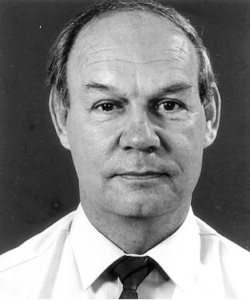
Donald George Feltis
Police Inspector, CEO Penrith Junior League, CEO PDRLFC, Director
Few people had an association with rugby league in Penrith that stretched as far across its history as Don Feltis.
As a young man, Feltis was there when volunteers began laying the foundations of the original Penrith Leagues Club in Station Street. Decades later, after serving as a player, coach, Junior League administrator, football executive and director, he became Chairman of Panthers.
That span alone makes Feltis an important figure in the Panthers story. The significance of his contribution lies less in the number of positions he occupied and more in the different eras of Penrith rugby league those positions allowed him to influence.
His most enduring and constructive contribution was probably made at the grassroots level — in the administration of the Penrith & Districts Junior Rugby League.
Later he moved into senior football administration as the football club CEO — he was in charge for the breakthrough 1991 premiership. He also had to guide the football club through the tragedy of Ben Alexander’s death and the years that followed, culminating in the mid-season departure of Phil Gould.
Feltis was elected to the Panthers Board in that controversial October 2002 election and, in 2009 took the chairmanship of the organisation. He remained in that chair until 2015 and faced some of the most difficult financial circumstances in its history.
It was a long contribution, and an important one. It was also more complicated than a simple record of positions held and honours received might suggest.
Role in the Narrative
Don Feltis appears at several quite different points in Panthers, Passion & Politics.
In the early history, he is a direct connection with the people who physically built the first licensed club. During the 1980s, he became an important part of the team recruited by Roger Cowan for the specific task of transforming Penrith’s approach to developing footballers. By 1991, he had moved into senior football administration as Penrith won its first premiership.
A decade later, Feltis appears again in very different circumstances.
In 2002 he was elected to the Football Club Board during the bitter struggle between Roger Cowan and the directors who became known as the Footy Five. The Temby Inquiry subsequently examined that election and the role played by Panthers management in attempting to influence its outcome. Feltis was among those elected.
His later career extended beyond the period covered by the original book. He became Panthers Chairman in 2009, held the position during the Group’s subsequent financial difficulties and restructuring, and was Chairman when Phil Gould returned to Penrith in 2011.
Feltis therefore connects several of the central themes running through the Panthers story: junior development, professionalisation, football success, organisational politics, governance, and financial pressure.
Background
A 2012 NSW Legislative Council tribute recorded that he began playing rugby league at age 14 and subsequently played for Penrith, St Marys and Richmond. His involvement expanded into coaching, including junior teams at Penrith, St Marys, Richmond and Emu Plains and district representative teams.
Rugby league initially ran alongside another long career.
Feltis joined the NSW Police Force in 1955 and served for more than three decades, eventually retiring at the rank of Inspector in 1986. His police postings included Penrith and other parts of western Sydney as well as country NSW. When he retired from the Police Force in 1986, rugby league became his full-time occupation.
Throughout those years in the Police Force, his involvement with Penrith rugby league continued.
One of his recollections preserved in the original manuscript reaches back to the construction of the first Penrith Leagues Club in Station Street. Feltis remembered joining other volunteers to help lay the foundations and recalled a character known as “Nobby” Hunter pre-empting a planned drawing of straws to determine who would break the ground by simply digging the first hole himself.
It is a small story, but an evocative one. Feltis’s Panthers involvement began in an era when the club was being built quite literally by its members and volunteers.
Feltis’s administrative involvement with the Penrith District Junior Rugby League eventually became one of the defining parts of his career.
The scale of that task can easily be underestimated. The Junior League was not simply an adjunct to the Panthers first-grade club or a mechanism for identifying talented young footballers. It administered rugby league across one of the largest junior districts in the game, extending from Blacktown in the east to Katoomba in the west and from the Hawkesbury in the north to Wallacia in the south.
Its responsibilities extended from the youngest children’s competitions through the various junior age divisions and into senior district football. Behind every season sat the less visible work of administering clubs, teams, registrations, competitions, rules, disputes, representative programs and the large volunteer network required to make community rugby league function.
From the 1980s he occupied a succession of senior positions within the Penrith Junior League, including president, vice-president, secretary-administrator and chief executive. Even after periods working in senior football administration, he returned to the Junior League and remained closely involved with its administration for many years. A 2014 parliamentary tribute described him as a “driving force” behind the Penrith Junior Rugby League since 1985.
It was a form of administration very different from running an NRL football operation. Its success was measured not primarily by premierships but by whether thousands of players could participate each week in properly organised competitions spread across a huge geographical area.
Feltis proved exceptionally capable at it.
Recognition & Awards
• Life Membership, Penrith & Districts Junior Rugby League Football Club (1994)
• Life Membership, Penrith Panthers (1995)
• City of Penrith, Wall of Achievement (1999)
• Australian Sports Medal (2000)
• Life Membership, New South Wales Rugby League (2006)
• Medal of the Order of Australia (2014)
• Don Feltis Cup — Penrith Junior League Sunday Division 1 Competitions. (2022)
Relevance to Events Described
Perhaps the most important part of Feltis’s contribution came during the transformation of Penrith’s football development program in the 1980s.
After years in which Penrith struggled to convert the enormous potential of its junior district into sustained first-grade success, Panthers began looking much more deliberately at how talented young players were identified, coached and retained.
One expression of that new thinking was the Five-by-Five program.
The objective was deliberately ambitious: within five years, Penrith wanted five locally developed players capable of representing Australia.
Feltis was one of the people involved in developing the strategies intended to make that possible.
Five-by-Five was not simply a prediction that Penrith’s enormous junior nursery would eventually produce outstanding players. It represented an attempt to create a system capable of turning that potential into elite footballers.
Feltis believed the exercise made Penrith considerably more professional and provided a platform for its future football operations.
The results that followed gave considerable weight to that assessment.
A generation containing players such as Greg Alexander, Mark Geyer, Brad Fittler and others emerged from the Penrith system. The club reached its first Grand Final in 1990 and won its first premiership in 1991.
Feltis had by then moved into senior football administration by then. Contemporary accounts variously describe his roles as coaching and development manager, Rugby League Manager and Chief Executive. The distinction is worth preserving: these were football administration roles rather than leadership of the much larger Panthers licensed-club group.
The NSW Parliament’s 2012 account describes Feltis as Panthers’ Rugby League Manager when the club won the 1991 Winfield Cup.
For Feltis, who had spent so much of his life working within Penrith’s junior system, that premiership represented something more than first-grade success. Many of the players had emerged through precisely the development environment he had helped create.
From administration to the Board
Feltis later returned to the Junior League, an organisation with which he maintained an exceptionally long association.
His next important appearance in the narrative of Panthers, Passion & Politics came in 2002.
By then Panthers had become engulfed in the internal struggle between senior management and the group of directors who became known as the Footy Five.
Feltis stood in the October 2002 Football Club election.
The result was significant. Feltis received 1,072 votes and was elected, followed by Keith Rhind with 1,058 and Kerry Lowe with 954. Immediately behind them were the five directors whose return Roger Cowan and other members of senior management had publicly opposed.
The election later received considerable attention from Ian Temby during his inquiry into Panthers.
The election marked a transition for Feltis. His influence had previously been exercised predominantly through football and junior league administration, it was now part of the governance of the wider Panthers organisation.
The post-Cowan Era — Difficult Years.
Feltis replaced Barry Walsh as Chairman of Panthers in 2009.
The organisation Feltis chaired was substantially different from the one he had first joined. It was also substantially different from the Junior League where his administrative skills were suited.
Panthers had become a large multi-club group, but it was also carrying substantial debt and would soon face serious financial pressures. The Board itself formally carried responsibility for oversight of the Group’s financial management, viability and performance.
The difficulties did not originate during Feltis’s chairmanship, nor can responsibility for them reasonably be assigned to one individual. Some of the warning signs, and proposals for addressing them, predated his elevation to Chairman.
In 2007 Panthers engaged hospitality consultants Australian Leisure to review the operations of the Panthers Entertainment Group. After visiting the Group’s sites, the consultants presented their findings in early 2008. An off-site workshop involving Australian Leisure, Panthers management, ING and another external adviser was then convened to develop an action plan. The resulting recommendations were presented to the Board, but consideration of them was repeatedly deferred.
Glenn Matthews, who was Group Chief Executive at the time, recalls later raising the debt-reduction strategies again with Feltis after he became Chairman. According to Matthews, Feltis told him the Board did not want to pursue them at that time because “it is an election year”.
After leaving Panthers in June 2010, Matthews says he identified a further opportunity through which the ING debt could have been discharged for substantially less than its face value. He offered to assist Panthers with the negotiations, but says the Board declined the offer and chose to handle the matter itself. Matthews later maintained that the financial crisis should never have been allowed to become as serious as it did.
It is Matthews’s account, and he attributed the decision to the Board rather than specifically to Feltis. Nevertheless, it provides an important perspective on the governance of Panthers during the early period of Feltis’s chairmanship.
What is beyond dispute is that the organisation subsequently required substantial change.
Two of the most consequential decisions made during Feltis’s chairmanship was the return of Phil Gould to Penrith in 2011 and the appointment of Warren Wilson in March 2012 as Group CEO.
Gould was given wide responsibility for the football operation and became central to a long-term restructuring of Panthers’ football program. Feltis and the Board supported that process, and Gould later publicly thanked Feltis and his directors for their continuing support of the rugby league program.
Following Warren Wilson’s appointment as Group CEO in March 2012, Panthers embarked on substantial debt reduction, divestment and restructuring. The principal measures adopted reflected strategies that participants in the 2007 management workshop recall having recommended five years earlier.
Feltis therefore occupied the chair through both sides of a difficult period: the financial pressures confronting Panthers and the beginning of the restructuring from which the organisation subsequently emerged in a much stronger position.
He resigned as Chairman in July 2015, bringing to an end an association with Panthers administration that had extended across much of his adult life.
Legacy
Feltis made important contributions to Panthers’ elite football development, particularly during the Five-by-Five period, but that should not be confused with his broader contribution to the Penrith District Junior Rugby League.
The Junior League may ultimately provide the strongest measure of his administrative legacy. For decades, Feltis helped run an organisation responsible for providing rugby league to thousands of players across an enormous part of western Sydney and the Blue Mountains. Most would never become professional footballers. That was not the point. The competition existed for the children, teenagers and adults who played for their local clubs every weekend, and for the families and volunteers who sustained those clubs.
Administering an organisation of that nature required skills quite different from those involved in running an elite football team or governing a large licensed-club group. It was an area in which Feltis demonstrated considerable ability.
His record at those senior levels of Panthers was more complicated.
Yet two decisions made during Feltis’s chairmanship — bringing Phil Gould back to Penrith and appointing Warren Wilson as Group CEO — would have consequences extending well beyond his own time in the chair and stamp his legacy on Panthers.
Those consequences belong to the post-Cowan history of Panthers and fall beyond the scope of Panthers, Passion & Politics. Their full assessment is a story for another Panthers historian.
Related Topics
- Beyond the Book — The 1983 Strategic Reset
- Beyond the Book — The 1983 Strategic Reset — Did it Work?
- Beyond the Book — Why One Board, One CEO?
- Beyond the Book — The Footy Five — A Name That Rewrote the Story
Related Themes:
Governance · Growth · Financial Management · Football Club
To receive new Parts and occasional project updates by email, you may subscribe below.
Readers who hold recollections, documents, or material relevant to this history are welcome to contribute via the Commentary & Contributions page.
Project Updates
Receive updates when new parts are published.
Editorial Note
This profile is presented as contextual background.
Additional material may be introduced as the narrative progresses.

