Part 65 of 70 — Original Chapter: Chapter 18: The Footy Five Make Their Play
This article forms part of the serialised republication of Panthers, Passion & Politics – The Roger Cowan Years.
Leading up to the election, Cowan was on holiday in Malaysia, but he was in contact with senior management and the non-aligned board members. Matthews was acting CEO. When the Western Weekender story hit, there were some urgent changes in strategy at the Club.
The Board conflict had also taken a toll on senior management. John Wilson was among those whose morale had suffered, while Glenn Matthews had begun applying for positions elsewhere. Matthews, who had risen through the Panthers organisation and had been identified as Cowan’s eventual successor, could see little future in remaining if the conflict continued.
Cowan had become increasingly concerned for the future of the Club if the Five retained their Board majority. And once the Weekender published the ‘Board Wars’ story, Barry Walsh was ready to pull out all stops. Cowan and Walsh discovered they had different ideas on strategy during a phone conversation from Malaysia. Cowan recalls,
My feeling was that we only had to remove two of the Five to remove their domination. Barry had already released a ticket with Bateman and Coffey, and I thought we could soften our attitude towards Geoff James. He had been a director a long time, and he was going through some personal crises. I even felt some sympathy for him at the time but I soon learned how easy it is to misplace such a valuable emotion.
I said to Barry,
“Maybe you are biting off too much here? It would be a lot easier to have two voted off than five”.
But they decided to go for the lot. It proved to be a wise move.
Until the Board Wars article, the extent of the Board conflict had not been widely known among Club staff. Now it seemed there was an attack on the management and on some directors who were quite popular with the staff. And now, for the first time, staff had an opportunity to vote
Ian Temby investigated the proposition that staff were pressured into voting against the Five. Glenn Matthews told the Inquiry that after the Weekender came out on Wednesday he had been inundated with requests from staff asking him what was going on.
I even had union delegates asking what’s happening. I could see how important it was for the majority of the 800 or 900 employees of that site.
Matthews headed up a regular team leaders’ meeting on the Friday after the Board Wars story hit.
I had a couple of outcomes I wanted to achieve at that meeting. Roger was away and the place was chaotic. First of all, I wanted to answer any questions about the article itself. I think I actually mentioned a no-confidence motion in the CEO. I was also being asked whether staff could vote.
Matthews says he held up the article, and that he told those at the meeting,
If you want to get rid of management, here is your chance.
He says he answered questions about the content of the article and explained that staff could vote. He told them that if they felt strongly about what was happening, they might exercise their right to vote.
He admits that he told the managers at the meeting that those calling themselves the Footy Five were in direct conflict with Cowan but says that was merely confirmation of what had been printed in the Weekender. He categorically denies that he told those at the meeting either to vote, or how to vote, although that particular allegation was put to him many times.
Evans and Bateman maintained that they had information, even affidavits, from staff members who said they had been pressured or intimidated. No affidavits were produced at the Inquiry, although one staff member appeared saying she felt intimidated. The DGR had been given a contact list of 40 Panthers employees. Terrence Lynch questioned opposing counsel as to why only three of those were called to give evidence.
What about the rest? If you’re not prepared to tell us what they said, then the inference is that they had nothing bad to say.
Matthews says there were two how-to-vote cards at the meeting – the one that had appeared in the Weekender, and the one that Temby took to calling the ‘management ticket’. Matthew says,
Members obviously made their own decisions about voting. They must have consciously decided how they voted. There were not following asterisks this time. Some people have said the fact that Greg was running, and had spoken out convinced them to go out and vote. But his ticket was not followed fully, or Bateman and Coffey would have got up. Also, staff voting the ‘management ticket’ could not have tipped the balance if the majority of other members had gone for Greg’s ticket without changes.
With any football team there is a group of diehard supporters who live and breathe their club. These are the people who make the massive coloured flags that fly at games all over the country. They are there through wind, rain and in freezing conditions. They travel on overnight buses to Melbourne or Brisbane to support their team. They are also a very strong network, with some very vocal leaders.
Some long time Panthers fans interviewed for this book said they were shocked when the Weekender story appeared, especially when it suggested that four of the directors were too old and should therefore go. Walsh, Rhind, Heidtmann and Armstrong were well known among supporters. For many years they had seen them, spoken to them, at Penrith and when they travelled to away games. A full-page ad, endorsed by Mulock and Cartwright supported the Footy Five and suggested the other four directors did not care about League.
The supporters said none of it rang true, and word went out. Up till then most had been casual about board elections but that was about to change. Alexander was certainly a factor but, if the members were just following his ticket, two of the Five would have been re-elected.
Matthews says that everyone at the inquiry seemed to assume that all the staff voted the one way and that that was what swung the election. ‘I know for a fact that’s not the case’.
Our employees have always been encouraged to think for themselves. They’re not sheep, or brainwashed, they can make up their own minds. And as for dragging people to polling booths – even if that had happened, which it certainly didn’t, once they’re there – how do I know what they put on their ballot papers?
And there was so much stuff going on anyway. Newspaper ads, all kinds of tickets flying around. Geoff James had people sitting in the foyer watching everything – including who was voting, and that was far more intimidating than anything management could have done. People were handing out Footy Five electioneering material at the railway station to passengers coming off trains, or standing like pizza boys at the lights giving voting cards to drivers.
Roger Cowan says that the end of voting was approached with excitement and apprehension.
The counting of the votes commenced at 6:00 pm on Saturday 5 October. By 7:00 pm, it was becoming obvious that the Five were in trouble. The only one that even appeared to be in the running was John Bateman. Dennis Coffey was also polling reasonably well, no doubt because both were on the tickets of Alexander and Walsh.
A few days after the election, I had no problem convincing Glenn Matthews and John Wilson they should drop any plans for leaving. On the other hand, the election result was greeted with anger and disbelief by some of the Footy Five.
Barry Walsh says the Five ‘kept shooting themselves in the foot’. The election result, he says, could never have happened without their ‘comedy of errors’.
The first change in the constitution drew the attention of prospective directors in Newcastle and Port to the fact that they could stand. Maybe they would never have even thought of it. But then the Five aborted the election, when all of them would have been returned.
Then they pushed and pushed for the second lot of changes to the constitution, which meant staff could vote. I’m not sure if even that would have been enough to change the result. But the craziest thing they did was that ‘Board Wars’ thing. They underestimated the power of the people, and that was really stupid.
John Bateman told the Inquiry that it was staff voting that made the difference.
There is no doubt we created the instrument of our own demise in terms of the amendments to the constitution in September 2002, because those amendments brought into play staff voting.
In a 2006 interview for this book Greg Evans said that he didn’t expect that ‘management would turn against them’.
According to Cowan, management had an inkling that the Five had a plan to lull management into a false sense of security. Suspicions were raised at a meeting in the weeks leading up to the election when Bateman congratulated management for keeping the conflict out of the media. Cowan warned his team to be alert. He speculated that a media attack was probably in their plan and would happen at the latest possible time to prevent a good response. The Western Weekender’s Board Wars story reinforced Cowan’s belief that his suspicions had been justified.
‘Staff voting was a big factor but so was Greg Alexander, I accept that,’ says Evans. ‘Greg was always going to get people’s votes.’
Evans also says he heard that ballot boxes had been tampered with, but everyone involved in the election, including the independent company engaged by Panthers to run it, says this is not possible. The DGR, during their initial investigation of the claims by the Five, viewed video footage of the voting and found nothing to substantiate claims of tampering.
Another point made by Evans in the interview was that management involvement in the election was inappropriate. He also denied that he used his newspaper to campaign during the election. Evans’ ownership had been the subject of questioning by Ian Temby at the end of his evidence, but Evans said that he did not have editorial control. However, in the election coverage and material reviewed for this book, his connection with the paper was not disclosed.
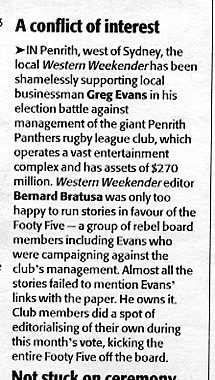
Questions about Greg Evans’ ownership of the Western Weekender and the newspaper’s coverage of the Board election also attracted attention outside Penrith. This item appeared in The Australian shortly after the election.
Publication: The Australian 17th October 2002
Column: The Diary (media)
Journalist: Stephen Brook.
This clipping courtesy of Rob Weaver.
Note: A broader archive of contemporary media coverage of the October 2002 Board election is currently being curated and will be added to Panthers Passion & Politics.
Throughout the Inquiry and since, Evans has made interesting statements. He claims there was a planned takeover of Panthers by the unions and says he could produce affidavits from employees intimidated during the October 2002 election. None of these allegations was ever substantiated.
It would have been in the interests of the Footy Five if such evidence had been produced. It was exactly what the Inquiry wanted. There was nothing presented that gave any support to the statements by Evans. There was nothing supporting his claims in CCTV real-time footage of the election, evidence from Newcastle directors, the investigation by the DGR or in any evidence of other witnesses.
In September 2003, one year after the defeat of the Five in the election, Geoff James revealed on Ray Hadley program on Radio 2GB:
We wrote a letter of complaint [to the DGR] in August of last year, and again in June of this year.
The 2002 elections formed part of the directors’ complaints and were part of the allegations listed in Ian Temby’s Instrument of Appointment for the Section 41X inquiry.
Cowan later expressed frustration that members of the Five received relatively little cross-examination from the Club’s legal team. He believed the approach was intended to avoid damaging the standing of the Board as a whole by exposing inconsistencies in directors’ evidence. In his view, a number of claims — particularly those made by Evans — could therefore have been tested more thoroughly.
To receive new Parts and occasional project updates by email, you may subscribe below.
Readers who hold recollections, documents, or material relevant to this history are welcome to contribute via the Commentary & Contributions page.
Project Updates
Receive updates when new parts are published.

