The longest walks I ever made in my life were down Elizabeth Street1, and turning the corner to face all those journalists and cameras outside the court.
Panthers chairman Barry Walsh made that walk a number of times in 2004.
In May 2004, Cowan and Panthers were called to appear before the first inquiry conducted under the NSW government’s Section 41X legislation.2 This new section of the NSW Registered Clubs Act had appeared at the end of the previous year, around the time of major demonstrations against new taxes on clubs.
In late September 2003, the NSW government was in a spot over tax increases on clubs, and a major protest was imminent. A story broke in The Sydney Morning Herald about the dealings of Roger Cowan, his family company, Phyro Holdings, and Panthers. And the state Labor Government was breaking legislative ground by preparing to introduce legislation that would give it Royal Commission-style powers to investigate allegations concerning clubs.
In the aftermath of the second election — the October 2002, election — some members of the Five made allegations to the Department of Gaming and Racing (DGR).3
Darryl Freeman, from the DGR’s legal section, was contacted several times to request copies of the complaints, but he maintains that the DGR protects its informants, and that he would never approve a Freedom of Information request for the letter. He did, however, confirm the existence of a long letter with at least two signatures and possibly more. Later, a formal application under Freedom of Information was also rejected.
So, neither Cowan nor Panthers’ legal representatives have ever seen the allegations in those letters. Subsequent events indicate that they concerned the election itself, Roger Cowan and his family company, and accusations that Cowan misled both the Board and members of amalgamating clubs.
Allegations of this type would subsequently form part of the government’s action against Cowan and Panthers.
Some in the group [the Five] admitted contacting The Sydney Morning Herald at the same time.
Ron Mulock had strongly supported the Five. In 1998, without any discussion or negotiation, he embarked on a campaign to discredit Cowan.
When the dust settled after the election in October 2002, things seemed to go back to normal at Panthers. The new board — nine from Penrith and five from the amalgamated clubs — came together well. Cowan and the management team breathed a sigh of relief, happy to return their full focus to running the business.
Throughout the election campaign, and indeed even earlier, the DGR had a presence at the Club. The aborted board election of the previous March had gained DGR attention, and if — as Geoff James claimed — a letter had been sent by the Five in August, there was even more reason for them to be there.
Dennis Coffey had complained to journalist Roy Masters at a Melbourne Cup day function in November 2002 that a letter had also been sent to The Sydney Morning Herald but there had been no response. Coffey said the group had sent complaints to the DGR, and to the Herald. At the time Masters shrugged it off. He later told Cowan that nobody at the newspaper saw any reason to follow it up — or to mention it to anyone at Panthers. It was seen as bravado – or sour grapes — from a group of embittered men. It would be another year before the newspaper would see any news value in the allegations.
Quite soon after the second election, the DGR activity increased. Nobody was particularly concerned. The new board and management believed they had nothing to hide, and nothing to answer.
From around Christmas 2002 until well into 2003, the DGR officers spent a great deal of time at the club. According to Glenn Matthews, then financial controller, they were extremely thorough, and appeared to be satisfied with their findings in each of the areas of complaint. No action was taken against Panthers throughout this period.
To receive new Parts and occasional project updates by email, you may subscribe below.
Readers who hold recollections, documents, or material relevant to this history are welcome to contribute via the Commentary & Contributions page.
Project Updates
Receive updates when new parts are published.
Barry was headed toward the St James Centre at 111 Elizabeth St, Sydney. On the third floor of that building was the hearing room used by the Police Integrity Commission (now called Law Enforcement Conduct Commission). This room was used for the Inquiry conducted by Ian Temby for the Department of Gaming and Racing. ↩︎
Section 41X of the Registered Clubs Act gave the Director of Liquor and Gaming power to appoint an investigator to inquire into specified matters concerning a registered club, with extensive powers to obtain evidence and require the production of documents. Panthers was the first club investigated under the provision. A second Section 41X inquiry, concerning Paddington Bowling Club, was conducted in 2007. The provision was repealed in 2011. ↩︎
The Department of Gaming and Racing (DGR) was then the NSW government agency responsible for the regulation of registered clubs, liquor and gaming. ↩︎
Leading up to the election, Cowan was on holiday in Malaysia, but he was in contact with senior management and the non-aligned board members. Matthews was acting CEO. When the Western Weekender story hit, there were some urgent changes in strategy at the Club.
The Board conflict had also taken a toll on senior management. John Wilson was among those whose morale had suffered, while Glenn Matthews had begun applying for positions elsewhere. Matthews, who had risen through the Panthers organisation and had been identified as Cowan’s eventual successor, could see little future in remaining if the conflict continued.
Cowan had become increasingly concerned for the future of the Club if the Five retained their Board majority. And once the Weekender published the ‘Board Wars’ story, Barry Walsh was ready to pull out all stops. Cowan and Walsh discovered they had different ideas on strategy during a phone conversation from Malaysia. Cowan recalls,
My feeling was that we only had to remove two of the Five to remove their domination. Barry had already released a ticket with Bateman and Coffey, and I thought we could soften our attitude towards Geoff James. He had been a director a long time, and he was going through some personal crises. I even felt some sympathy for him at the time but I soon learned how easy it is to misplace such a valuable emotion.
I said to Barry,
“Maybe you are biting off too much here? It would be a lot easier to have two voted off than five”.
But they decided to go for the lot. It proved to be a wise move.
Until the Board Wars article, the extent of the Board conflict had not been widely known among Club staff. Now it seemed there was an attack on the management and on some directors who were quite popular with the staff. And now, for the first time, staff had an opportunity to vote
Ian Temby investigated the proposition that staff were pressured into voting against the Five. Glenn Matthews told the Inquiry that after the Weekender came out on Wednesday he had been inundated with requests from staff asking him what was going on.
I even had union delegates asking what’s happening. I could see how important it was for the majority of the 800 or 900 employees of that site.
Matthews headed up a regular team leaders’ meeting on the Friday after the Board Wars story hit.
I had a couple of outcomes I wanted to achieve at that meeting. Roger was away and the place was chaotic. First of all, I wanted to answer any questions about the article itself. I think I actually mentioned a no-confidence motion in the CEO. I was also being asked whether staff could vote.
Matthews says he held up the article, and that he told those at the meeting,
If you want to get rid of management, here is your chance.
He says he answered questions about the content of the article and explained that staff could vote. He told them that if they felt strongly about what was happening, they might exercise their right to vote.
He admits that he told the managers at the meeting that those calling themselves the Footy Five were in direct conflict with Cowan but says that was merely confirmation of what had been printed in the Weekender. He categorically denies that he told those at the meeting either to vote, or how to vote, although that particular allegation was put to him many times.
Evans and Bateman maintained that they had information, even affidavits, from staff members who said they had been pressured or intimidated. No affidavits were produced at the Inquiry, although one staff member appeared saying she felt intimidated. The DGR had been given a contact list of 40 Panthers employees. Terrence Lynch questioned opposing counsel as to why only three of those were called to give evidence.
What about the rest? If you’re not prepared to tell us what they said, then the inference is that they had nothing bad to say.
Matthews says there were two how-to-vote cards at the meeting – the one that had appeared in the Weekender, and the one that Temby took to calling the ‘management ticket’. Matthew says,
Members obviously made their own decisions about voting. They must have consciously decided how they voted. There were not following asterisks this time. Some people have said the fact that Greg was running, and had spoken out convinced them to go out and vote. But his ticket was not followed fully, or Bateman and Coffey would have got up. Also, staff voting the ‘management ticket’ could not have tipped the balance if the majority of other members had gone for Greg’s ticket without changes.
With any football team there is a group of diehard supporters who live and breathe their club. These are the people who make the massive coloured flags that fly at games all over the country. They are there through wind, rain and in freezing conditions. They travel on overnight buses to Melbourne or Brisbane to support their team. They are also a very strong network, with some very vocal leaders.
Some long time Panthers fans interviewed for this book said they were shocked when the Weekender story appeared, especially when it suggested that four of the directors were too old and should therefore go. Walsh, Rhind, Heidtmann and Armstrong were well known among supporters. For many years they had seen them, spoken to them, at Penrith and when they travelled to away games. A full-page ad, endorsed by Mulock and Cartwright supported the Footy Five and suggested the other four directors did not care about League.
The supporters said none of it rang true, and word went out. Up till then most had been casual about board elections but that was about to change. Alexander was certainly a factor but, if the members were just following his ticket, two of the Five would have been re-elected.
Matthews says that everyone at the inquiry seemed to assume that all the staff voted the one way and that that was what swung the election. ‘I know for a fact that’s not the case’.
Our employees have always been encouraged to think for themselves. They’re not sheep, or brainwashed, they can make up their own minds. And as for dragging people to polling booths – even if that had happened, which it certainly didn’t, once they’re there – how do I know what they put on their ballot papers?
And there was so much stuff going on anyway. Newspaper ads, all kinds of tickets flying around. Geoff James had people sitting in the foyer watching everything – including who was voting, and that was far more intimidating than anything management could have done. People were handing out Footy Five electioneering material at the railway station to passengers coming off trains, or standing like pizza boys at the lights giving voting cards to drivers.
Roger Cowan says that the end of voting was approached with excitement and apprehension.
The counting of the votes commenced at 6:00 pm on Saturday 5 October. By 7:00 pm, it was becoming obvious that the Five were in trouble. The only one that even appeared to be in the running was John Bateman. Dennis Coffey was also polling reasonably well, no doubt because both were on the tickets of Alexander and Walsh.
A few days after the election, I had no problem convincing Glenn Matthews and John Wilson they should drop any plans for leaving. On the other hand, the election result was greeted with anger and disbelief by some of the Footy Five.
Barry Walsh says the Five ‘kept shooting themselves in the foot’. The election result, he says, could never have happened without their ‘comedy of errors’.
The first change in the constitution drew the attention of prospective directors in Newcastle and Port to the fact that they could stand. Maybe they would never have even thought of it. But then the Five aborted the election, when all of them would have been returned.
Then they pushed and pushed for the second lot of changes to the constitution, which meant staff could vote. I’m not sure if even that would have been enough to change the result. But the craziest thing they did was that ‘Board Wars’ thing. They underestimated the power of the people, and that was really stupid.
John Bateman told the Inquiry that it was staff voting that made the difference.
There is no doubt we created the instrument of our own demise in terms of the amendments to the constitution in September 2002, because those amendments brought into play staff voting.
In a 2006 interview for this book Greg Evans said that he didn’t expect that ‘management would turn against them’.
According to Cowan, management had an inkling that the Five had a plan to lull management into a false sense of security. Suspicions were raised at a meeting in the weeks leading up to the election when Bateman congratulated management for keeping the conflict out of the media. Cowan warned his team to be alert. He speculated that a media attack was probably in their plan and would happen at the latest possible time to prevent a good response. The Western Weekender’s Board Wars story reinforced Cowan’s belief that his suspicions had been justified.
‘Staff voting was a big factor but so was Greg Alexander, I accept that,’ says Evans. ‘Greg was always going to get people’s votes.’
Evans also says he heard that ballot boxes had been tampered with, but everyone involved in the election, including the independent company engaged by Panthers to run it, says this is not possible. The DGR, during their initial investigation of the claims by the Five, viewed video footage of the voting and found nothing to substantiate claims of tampering.
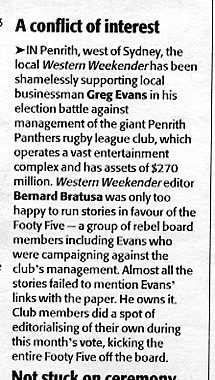
Another point made by Evans in the interview was that management involvement in the election was inappropriate. He also denied that he used his newspaper to campaign during the election. Evans’ ownership had been the subject of questioning by Ian Temby at the end of his evidence, but Evans said that he did not have editorial control. However, in the election coverage and material reviewed for this book, his connection with the paper was not disclosed.
Questions about Greg Evans’ ownership of the Western Weekender and the newspaper’s coverage of the Board election also attracted attention outside Penrith. This item appeared in The Australian shortly after the election.
Publication: The Australian 17th October 2002 Column: The Diary (media) Journalist: Stephen Brook.
This clipping courtesy of Rob Weaver.
Note: A broader archive of contemporary media coverage of the October 2002 Board election is currently being curated and will be added to Panthers Passion & Politics.
Throughout the Inquiry and since, Evans has made interesting statements. He claims there was a planned takeover of Panthers by the unions and says he could produce affidavits from employees intimidated during the October 2002 election. None of these allegations was ever substantiated.
It would have been in the interests of the Footy Five if such evidence had been produced. It was exactly what the Inquiry wanted. There was nothing presented that gave any support to the statements by Evans. There was nothing supporting his claims in CCTV real-time footage of the election, evidence from Newcastle directors, the investigation by the DGR or in any evidence of other witnesses.
In September 2003, one year after the defeat of the Five in the election, Geoff James revealed on Ray Hadley program on Radio 2GB:
We wrote a letter of complaint [to the DGR] in August of last year, and again in June of this year.
The 2002 elections formed part of the directors’ complaints and were part of the allegations listed in Ian Temby’s Instrument of Appointment for the Section 41X inquiry.
Cowan later expressed frustration that members of the Five received relatively little cross-examination from the Club’s legal team. He believed the approach was intended to avoid damaging the standing of the Board as a whole by exposing inconsistencies in directors’ evidence. In his view, a number of claims — particularly those made by Evans — could therefore have been tested more thoroughly.
To receive new Parts and occasional project updates by email, you may subscribe below.
Readers who hold recollections, documents, or material relevant to this history are welcome to contribute via the Commentary & Contributions page.
The proposed changes to the constitutions of both Penrith District Rugby League Football Club (PDRLFC, the district club) and Penrith Rugby League Club Ltd (PRLC, the licensed club) were put to the Penrith members on 15 September, approved, and implemented. The sitting Board was in the box seat to be re-elected. Traditionally, sitting directors were all returned in a Panthers’ election. The system of placing an asterisk beside the name of each current director, and the apathy with which board elections were viewed by members, had seen few incumbents removed over the years.
The Five needed to retain at least five positions to maintain their majority on the nine-person Penrith Football Club Board. Those directors would then automatically take positions on the newly constituted Group Board.
But five seats would no longer constitute a majority at Group level. On the 14-person Board, additional support would be needed to command a majority.
They needed more than five on their team.
In changing the constitution, Brett Boon and the Board appeared to have missed one vital point.
Boon told the Inquiry that if persons who were members of the football club voted, there would be no breach of either the letter or the spirit of the Act. But, he said, he had no idea that hundreds of club employees were members of the Club.1
During September, another unexpected element came into play. It arrived in the form of Greg Alexander.
Alexander was one of Penrith’s most prominent rugby league figures. In an exemplary career, he captained the Club’s 1991 premiership-winning side and represented Australia on numerous occasions. He was also a good friend of Glenn Matthews, who for the previous couple of years had been encouraging him to stand for the Board.
When it became known that he intended to stand, those close to the situation said that the Five felt confident of building a good relationship with him.
Alexander announced his candidature in the Penrith Press on Tuesday 24 September. In the accompanying interview he referred to the vote of no confidence in Cowan and said the CEO had his support.
That was a blow to the Footy Five.
Their preferred election ticket would have almost certainly included Alexander, the Five and two associates of Greg Evans. Had Alexander supported them — and had they secured the votes — it would have given them eight of the nine seats on the Penrith Board and eight on the 14-person group board. But now, Alexander had come out publicly with a statement of support for Cowan.
It was on the night of 24–25 September — immediately after the Alexander story appeared in the Penrith Press — that the mysterious envelope described at the beginning of this chapter (Part 61) was reportedly delivered to the Western Weekender.
The battle lines were now drawn.
Despite Alexander’s profile and popularity, his name was not among the eight candidates identified on the Weekender’s election ticket. Candidates numbered one to eight were listed, while beside number nine appeared the words ‘YOUR CHOICE’.2
It was another mistake. The ‘YOUR CHOICE’ instruction left “Footy Five” supporters following the ticket to select a ninth candidate for themselves — the option to vote for some of the people the Footy Five wanted to defeat.
Only six months earlier, some members of the Five had complained that the distribution of how-to-vote tickets in Port Macquarie and Newcastle breached the Club’s constitution. By September 2002, how-to-vote material was being used by them in support of candidates in the Penrith election.
In the two weeks leading up to the election, Weekender readers were bombarded with headlines, articles and photos relating to the election, along with advertisements and letters endorsed by Ron Mulock and Merv Cartwright. Many stories featured allegations and insinuations against other directors and Cowan.
Their supporters were handing out voting advice at many locations including the railway stations and the traffic lights outside the Penrith club.
The Footy Five’s election strategy was obvious — discredit Cowan and make it appear it was them, and only them, who had the Club’s interest at heart. Cowan and the four other directors — Cowan’s Four Kinsmen, as they were called in Mulock’s advertisement — were thwarting the Five in their effort to do the best for Panthers.
The Weekender continued to carry extensive election material through the end of the election. The result, however, was precisely the opposite to what it was pushing — perhaps sending an unfavourable signal to potential advertisers.
To receive new Parts and occasional project updates by email, you may subscribe below.
Readers who hold recollections, documents, or material relevant to this history are welcome to contribute via the Commentary & Contributions page.
Project Updates
Receive updates when new parts are published.
At the time of the Panthers constitutional amendment, s 30(1)(h) of the Registered Clubs Act 1976 provided: An employee of the club shall not vote at any meeting of the club or of the governing body of the club, or at any election of the governing body of the club or hold office as a member of the governing body of the club. In November 2006, the section was amended to add a further restriction: An employee of the club must not vote at any election of the governing body of another club or association if any member of that governing body would, as the result of that election, be entitled or qualified to be appointed (or be nominated for appointment) to the governing body of the registered club. The later amendment therefore expressly extended the prohibition to the type of indirect election arrangement created by the remodelled Panthers constitution. ↩︎
The ticket needed to provide for a ninth preference because voters were required to number all nine boxes. A ballot numbered only from 1 to 8 would have been informal. ↩︎
Accepting that the Board was set on the path of another constitutional change, Cowan continued to advocate a federalist model, presenting numerous variations.
Craig Terry told the inquiry,
The general manager refused to accept that the board did not wish to accept his federalist model. He repeatedly presented papers on the concept to the board.
Former director Max Connors spoke of Cowan’s methods in the boardroom.
Roger would bring things to the board, sometimes we’d say yes. Sometimes we’d say no, so he’d go away and change it and bring it back again.
Cowan says that in previous years, with previous boards, it was always a bit of a joke.
If I took what I thought was a good idea to the board and it was defeated, I would often think I had failed to present it convincingly enough. So I’d go away and do some more work on it, and then go back and re-present it. I did it for 14 years trying to convince boards we had to have a united effort to run Rugby League. I did it for several months before the Board was convinced to buy the Mulgoa Road property.
Sometimes the failure to bring about change is caused by inadequate information in the presentation of the idea. Sometimes it is caused by the inability of directors to think outside the square. Sometimes irrational argument or incorrect information becomes dominant. At other times the debate in the boardroom raises good reasons for rejection and that’s the end of it.
The culture we had developed over the years encouraged thinking laterally and arguing a point of view strongly no matter who disagreed. One very good example is the amalgamation concept. John Wilson did not take no for an answer. It took him a few meetings to convince us.
It was like that when I presented that first group board model. It was defeated out of hand. I still thought that a board with wider representation was the appropriate way to go, so I looked for modifications that might suit everyone. I really thought it was amusing that making suggestions for change would be greeted with hostility.
Imagine if I had responded that way to John Wilson when he brought up amalgamations. If I had adopted what I saw Craig Terry’s approach, I might have said:
“John, stop wasting our time with that stupid bloody idea. We told you we were not interested, so why do you keep bringing it up.”
We would have missed out on a strategy that will go down in Panther history as one of the best we ever adopted.
It probably demonstrates one of the problems we had at the time. There was a significant gap between the management culture we had developed and the way Craig Terry and other members of the Footy Five believed the Board should operate.
Our team concepts encouraged people to participate and raise ideas without fear of crashing. Listening to the ideas of others and building on them was something we often practiced through brainstorming workshops.
All the board has to do is say yes or no. That’s the easy part.
The Footy Five had the numbers and they could have said no in less than ten seconds. They could do that every time I raised another modification until they found what they wanted.
I considered that it was my responsibility to come to the Board with every suggestion I could raise that might make the Club better in any way.
The Board continued working with Acuiti, receiving further advice through June, July and August. The Registered Clubs Act required a majority of the a registered club’s membership to be entitled to vote in elections for its governing body.1
Panthers’ total membership was now around 130,000. If voting rights were restricted to the approximately 50,000 Penrith members, as one proposal contemplated, the requirement could not be met. Another mechanism was needed.
It was decided to increase board numbers to 14, at the same time introducing a qualification for election to the group board. The Penrith District Rugby League Football Club (PDRLFC) was a separate legal entity, and not covered by The Registered Clubs Act. It also had a board of nine. Under the proposed structure, any director elected to PDRLFC would automatically have a place on the Board of the licensed club. The structure would give the nine directors elected to the PDRLFC Board nine of the 14 positions on the licensed club Board. The other clubs would be guaranteed places on the Board, but there could be no more than two from any one club.2
This proposed change would overcome the problem caused by the 50% requirement.
Brett Boon said he ultimately employed a model similar to those used at some RSL clubs, where board members must have a qualification, such as having served overseas, or being a member of a sub-branch.
Temby and counsel questioned whether the proposed structure amounted to a device for circumventing requirements of the Act.
Craig Terry felt that,
The mechanics of it may, in a tenuous way, still comply with the legal requirements in the Registered Clubs Act.
We were reminded [by Boon] and it was really self-evident, that there were many other models out there employed by other clubs which had the same notion of qualification of directors before they could form part of the board.
At the Inquiry he, and others of the Five, stressed continuously that they had been taking advice from Acuiti as to the model’s legality. Craig Terry said,
I would fully expect Mr. Boon to have been fully knowledgeable on these sections and if he thought the model we were proposing incorrect that he would have highlighted that to us.
Boon, on the other hand, stressed that he was under instruction from the Board.
The proposed change would overcome the 50% problem, and remove some other restrictions covered by the Act. This decision, to transfer the election of nine directors from the licensed club members to the members of the district football club, had some unforeseen repercussions.
It was another little tile in the mosaic that was forming in September 2002.
To receive new Parts and occasional project updates by email, you may subscribe below.
Readers who hold recollections, documents, or material relevant to this history are welcome to contribute via the Commentary & Contributions page.
Project Updates
Receive updates when new parts are published.
The requirement that a majority of members be entitled to vote in Board elections is discussed more fully in Part 51 — A Simple Change, Made So Difficult. Section 30(9)(a) of the Registered Clubs Act required a majority of a club’s full members to be entitled to vote in elections for the governing body. Social Members were legally a subclass of Ordinary Members and were therefore included as full members. In 2006, the required proportion was reduced to 25%, provided the change was approved by a majority of full members. ↩︎
The Panthers organisation comprised two separate legal entities: Penrith District Rugby League Football Club (PDRLFC — the Football Club) and Penrith Rugby League Club Ltd (PRLC — the licensed club). In 1980, the two Boards were brought together. This did not merge the two legal entities or create a single Board governing both. Each entity retained its own Board, but the same people served on both, helping ensure that the two organisations operated with a common direction. See Part 19 — A Solution — Of Sorts. ↩︎
Acuiti delivered its report on Panthers’ amalgamation processes to the Board in May 2002.
Walsh said that although the exercise cost the Club a lot of money it was carried out with no input from him. Not one of the managers involved in formulating or carrying through the amalgamation process was consulted.
It appears that the only people from Panthers who contributed to the preparation of this report were from the Five directors. The report contained 42 separate criticisms of the way Panthers had undertaken its amalgamations, many of them directed at management.
Those involved in the amalgamation process attended a series of meetings, spending around 50 hours dealing with the issues raised. A detailed response addressing each point was prepared and tabled for the Board. It was never discussed at a Board meeting.
On 31 July 2003, more than a year later, Roger Cowan received a letter from Boon. Boon explained that his report had been prepared as ‘essentially a discussion paper for the forthcoming board meeting’. He said his company had envisaged the report would facilitate discussion, and that further information would be provided to clarify the issues raised. Acuiti would then, taking everything into account, make its final comments and recommendations.
Boon’s letter continued that unfortunately neither management nor Acuiti itself was given an opportunity to discuss the report in any detail at any meeting. It acknowledged management’s responses to the 2002 report. It also concluded that Cowan and management had nothing to answer.
Barry Walsh estimated that the Acuiti exercise ultimately cost the Club far more than $400,000. He included the management time spent preparing a response, the diversion of managers from other Club responsibilities and other incidental costs that could not be accurately assessed.
A new election had to be scheduled. But by mid-2002 the Board had decided that the new nine-seat structure, which guaranteed five seats to Penrith, was not satisfactory. Craig Terry told the Inquiry that the simple majority model of five out of nine was not very ‘robust’, because it did not necessarily ensure that Penrith members retained ‘decent control of the organisation’.
There was a logical explanation for why a simple majority might not have been considered sufficiently ‘robust’. The model allowed up to four directors from non-Penrith sites to be elected. Even the election of one non-Penrith director would necessarily displace a sitting board member. If that person were a member of the Footy Five, their five-four majority would disappear.
By now, members from the clubs outside Penrith had been confirmed as Panthers members and, as such, had the right to vote – and stand for the Board. The distinction between Penrith members and members of the amalgamated clubs was evident in Terry’s explanation. He said that ‘the Penrith members were pre-eminent in our minds because they were the ones where we had a duty’.
Cowan took a different view. He argued that the memoranda of understanding had promised members of the amalgamating clubs particular rights in return for the transfer of substantial assets to Panthers, and that those commitments also had to be honoured.
The memoranda of understanding promising certain rights in return for the transfer of millions of dollars in assets to Panthers apparently had no effect on Terry’s sense of duty, according to Cowan.
After the cancelled election, Cowan continued trying to find a solution that would preserve the rights promised to members of the amalgamating clubs. The Board majority, however, had placed greater weight on ensuring continuing Penrith control.
Dennis Coffey was asked in the Inquiry if it concerned him that promises that had been made by Cowan would be broken by the constitutional changes, and that those members would be denied the rights they had been promised.
When I realised the problems that it could have caused our club, it didn’t concern me at all.
He agreed with counsel’s statement that he saw his duties as protecting the interests of Penrith members.
Ian Temby responded,
And if promises were broken, too bad?
Temby asked if Coffey knew that Cowan had been given authority by the Club Board to enter into negotiations for amalgamations. He said yes and then denied that he knew the amalgamating members would receive full voting rights. He had however been being a director on the Board that helped to devise – and approve – the amalgamation criteria, and entered into a memorandum of understanding setting out the rights of amalgamating members for each amalgamation.
All the directors of that time agree that Cowan strongly opposed the changes that would lessen the rights of the new members. John Bateman confirmed that Cowan repeatedly objected to both the cancellation of the election and later constitutional amendments on the basis that they were both unnecessary and meant that promises would be broken.
Temby asked Bateman,
Why shouldn’t it be thought that the Club behaved dishonourably in effecting that change?
Bateman replied,
Dishonourably is a strong word.
Temby:
I am not mincing my words and it is right that I shouldn’t.
To receive new Parts and occasional project updates by email, you may subscribe below.
Readers who hold recollections, documents, or material relevant to this history are welcome to contribute via the Commentary & Contributions page.
It is sometime between midnight and dawn on Wednesday 25 September 2002. A shadowy figure approaches the offices of The Western Weekender newspaper in Abel Street, Penrith. He wears dark clothes and a hat pulled down over his eyes. He carries something in his hand.
A car cruises slowly past, and he jumps back into the doorway of the neighbouring building. Safe once again, he steps out onto the lonely street. After a quick glance each way, he climbs the few stairs to the door of the office. The arc of the streetlight now reveals what he is carrying. He reaches out and places a large envelope on the doorstep of the building.
His mission is accomplished. Visibly relieved, he walks briskly away from the scene, not once looking back.
The scenario above is a dramatised version of a purported incident that would have a significant bearing on the campaign leading to the replacement election in October 2002.
According to the Western Weekender editor, when he arrived on the morning of 25 September, he discovered an envelope on the doorstep. The envelope, he said, contained what appeared to be ‘authentic documents’ relating to Panthers, some dating back to 1998. The documents became the basis of a front-page story in the newspaper, published that very same day. Although the date on the newspaper is Friday, 27 September, numerous people report seeing it late on the Wednesday, 25 September.
On that account, in the space of only a few hours the anonymously delivered material had apparently been assessed, sources confirmed, interviews conducted, the story written, and the newspaper laid out and printed by Wednesday afternoon.
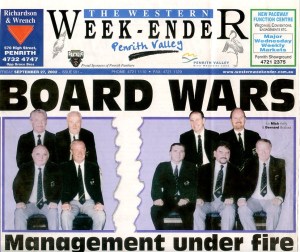
The banner headline screamed ‘Board Wars’, and a full-width photograph show the Panthers Board of Directors, but the image was ripped down the middle.
Western Weekender 27 September 2002. Front Page. Clipping from the Weaver Collection
The story underneath spoke of a split in the Board, revisited in detail the proposed Parramatta merger, the stand-alone committee, and spoke of the ‘now famous FOOTY FIVE’. The story quoted John Bateman as a member of the Five, but failed to mention that Greg Evans, the owner of the newspaper, was also a member of the group. It also contained criticisms of Cowan and the remaining four directors, labelling them Cowan’s ‘Four Kinsmen’.1 It exhorted Panthers’ members to get rid of this ‘old guard’.
Until that week nobody, few people outside Panthers’ directors, senior managers and their families, were aware of the extent of the rift and tension in the Board. There had been a concerted effort by everyone to keep the conflict quiet and try to get on with business.
At management meetings, serious consideration had been given to calling an extraordinary meeting to make members aware of the degree of dysfunction at Board and management level.
The management team always reached the same conclusion. Such a radical move would harm the Club and make the bank nervous. In hindsight many believe it would not have been such a bad idea. Keeping the problems under wraps had not prevented serious damage. What followed included aborted elections, substantial legal expenses, a crippling inquiry, damaged management morale, loss of market share and other flow-on effects.
The Weekender story was a declaration of open war. It made the people of Penrith aware there was a serious problem at Board level. And the Club’s staff also became aware of the situation.
Long-time director Keith Rhind says the months following the aborted election of March 2002 were a terrible time. He would leave his home in the Blue Mountains to drive to a board meeting, hoping all the way that his car would break down so he would not have to go.
Board meetings would go till midnight or later. Matthews calls the behaviour of some of the Five ‘disgraceful’.
I just can’t believe that intelligent people can get in a room and they just want to play the man and not the ball. Some of the board meetings were really dysfunctional. They’d ask you for some information again and again. A couple of times one of them attended the meeting after having far too much alcohol. Bateman and Evans would often pass notes to each other.
According to Matthews one meeting almost ended in physical violence. Evans was screaming abuse at Cowan and Wilson, accusing them of being liars. Matthews himself was also accused of lying. Finally, chairman Barry Walsh exploded. His efforts to call the meeting to order had been ignored, leapt out of his chair and headed for the director who appeared to be drunk and was disrupting the meeting. Cowan intercepted Walsh, slowed things down and helped restore order.
Brett Boon said the situation was a nightmare. He told the Temby Inquiry,
There was a very long period, with board meeting after board meeting which lasted five, six, sometimes seven hours. They were very hostile, aggressive meetings, a lot of politics going on with different factions of the Board.
During questioning by DGR counsel Vicki Hartstein about the constitutional changes, Walsh said the Board had given Acuiti full control to take the Club to the next point.
She asked him about a letter of complaint from the Port Macquarie club asking for an explanation of the constitutional changes. She says,
… you were the chairman of the board of this club and it seems from this letter that complaints about the integrity of the club are being made. Didn’t you regard that with some concern?
Walsh replied,
The scene was changing. Acuiti had the reins, and they were being directed by Mr Terry and Mr Bateman and the Footy Five. Of course I was concerned, but our legal people were handling it and I was not privy to what Mr Boon was doing.
Not once did they contact me to give an opinion. Not about anything. For a better word, the Footy Five had control of the Board and they had the ear of Acuiti..
Hartstein asked, ‘You didn’t follow it up?’
Walsh answered,
It’s not that I didn’t follow it up. I never had control of the Board.
To receive new Parts and occasional project updates by email, you may subscribe below.
Readers who hold recollections, documents, or material relevant to this history are welcome to contribute via the Commentary & Contributions page.
Project Updates
Receive updates when new parts are published.
The front page story doesn’t refer to the “Cowan’s Four Kinsmen” quip. That appears later in the same issue of The Western Weekender. The issue carried a number of stories related to the imminent election of the Penrith District Rugby League Club Board. ↩︎
Throughout Panthers, Passion & Politics, five Panthers directors — John Bateman, Greg Evans, Craig Terry, Geoff James and Denis Coffey — are frequently referred to as the Footy Five.
It is a useful description — maybe too useful.
The five directors became linked during a period of increasing disagreement within the Panthers Board. The first public indication of a division came with Ron Mulock’s press release of 6 September 1999.1Even then, however, neither the directors involved nor any particular grouping of them was publicly identified.
The name Footy Five would not be applied until more than two years later.
The position was more complicated.
The stand-alone issue placed these five directors on the same side of an important disagreement. All directors wanted Panthers to remain independently represented in the highest level of rugby league.
The different “sides” developed well after the 1998 Information Night.2 The division was about whether Panthers should continue investigating possible amalgamation arrangements as protection against the possibility that remaining independent might ultimately prove impossible.
But the five agreeing on that issue did not mean agreement on everything else, nor necessarily the existence of the later faction.
As John Bateman recalled in his January 2007 correspondence with Jennie Bentley:
Any real unison between ourselves [the group eventually labelled “Footy Five”] emerged much later during the period March-September 2002 when the Board was facing major problems associated with licenced club amalgamations.
By then, the differences within the Board had become much more visible.3
And the name that emerged was extraordinarily effective.
More Than a Name
At its simplest, Footy Five identified five directors and reflected their particular concern for the interests of the football club.
Political labels are rarely quite that simple.
To start, calling one group the Footy Five inevitably also labelled the other four directors. If these five directors represented football, where did that leave the other directors?
It helped reduce complicated disagreements over governance and the future direction of Panthers to a simple binary proposition:
one side was for football; the other side was not
That distinction was powerful.
It was also an oversimplification.
Perhaps that should not be surprising. The term was created by Ron Mulock, someone with considerable experience in politics and political campaigning, and it framed the approaching board election with considerable effectiveness.
Yet the issues then dividing the Board were complex. They involved club amalgamations, governance, members’ rights and benefits, commitments made to members of amalgamating clubs and, ultimately, competing views about the direction Panthers was taking.
For some of the Footy Five, however, these issues were connected to football.
Their fear was that the club amalgamations might eventually produce a “reverse takeover” of Panthers. A changed membership and governance structure, they believed, could reopen the possibility of a football merger. Some went further, suspecting that management itself might be orchestrating such an outcome.
Whether those fears were justified belongs to the later story. What matters here is that, by the time the Footy Five name emerged, trust between management and the majority of the Board had substantially eroded.
The disagreements were real. So too were differences in philosophy and priorities.
But the suggestion that one group cared about football while the other did not was precisely the characterisation challenged throughout Jennie Bentley’s original manuscript.
All wanted Panthers to survive as a stand-alone club.
One view was that the organisation should concentrate its resources and energy on achieving the stand-alone objective. The other was that prudent management also required investigation and preparation of alternatives that everyone hoped would never be needed.
That is a much more subtle proposition than pro-football versus anti-football.
Looking Back Through a Later Label
There is another consequence of the effectiveness of the Footy Five name.
It stuck!
Once the five directors became identified in that way, the term was a convenient shorthand for describing them — including when looking backwards at events that had occurred before the name existed.
Panthers, Passion & Politics does this too.
The original manuscript regularly refers to the Footy Five while describing earlier events. This can create the impression that the grouping, the name and the political division it came to represent already existed in their later form.
It is an impression needing some qualification.
The five directors were there. They sometimes shared positions on important issues. And their relationships and influence upon one another were developing. Those earlier disagreements became part of the history that eventually produced the later Board division.
But they were not yet publicly — or privately — defined as the Footy Five.
Describing the five directors in an earlier dispute as the Footy Five makes it very tempting to interpret that dispute through the lens of what came later: football against business, football supporters against their opponents, or ultimately the Footy Five against people supposedly less committed to the game.
It is also easy to fall into the trap of believing there was a dispute over standing alone — there was not!
The contemporary story was more complicated.
The Power of Retrospect
This is one of the difficulties of telling history.
Later events give names and meanings to things that may have appeared quite differently to those experiencing them at the time.
A memorable label makes a complicated story easier to tell. Eventually it can become so familiar that it seems always to have existed.
And The Footy Five is undoubtedly a memorable label.
Its effectiveness can perhaps be measured by the fact that the terminology was eventually adopted retrospectively in the original account of these events — and subsequently in this project.
For Panthers, Passion & Politics, that requires a small but important editorial correction.
Where the term Footy Five is used in connection with events preceding the later Board conflict and election, it should generally be understood as retrospective shorthand for the five directors who later became known as the Footy Five.
It simply avoids allowing a highly effective later political label to define an earlier debate more neatly than the evidence warrants.
And in a story so often concerned with the power of perception, language and public narrative, that distinction seems particularly worth making.
Roger Cowan believed the faction — later labelled Footy Five — was well defined by late 1999 when they forced Leo Armstrong to relinquish his long-held position as chairman. ↩︎
By the end of July 1999, many believed the public debate over a possible joint venture between Penrith and Parramatta had finally run its course.
On 31 July, the Panthers Board rejected the National Rugby League’s invitation to lodge a non-binding joint venture submission. Although such a submission would not have committed Panthers to a merger, it would have extended the deadline and preserved Panthers’ access to the substantial financial incentives being offered by the NRL. By declining the invitation, the Board effectively closed that avenue.
This decision did not remove the uncertainty surrounding Panthers’ future. At that stage the club still faced the possibility of exclusion from the reduced national competition. Questions about the club’s long-term future therefore remained unresolved, even though the merger proposal itself appeared to have been settled.
Five weeks later, the issue unexpectedly returned to the public arena.
On 6 September 1999, former Panthers Patron Ron Mulock issued a press release predicting that another attempt would soon be made to pursue a merger with Parramatta. The statement prompted General Manager Roger Cowan to write directly to Panthers sponsors, responding to a number of Mulock’s claims and explaining both the Board’s position and the reasons behind his earlier recommendation that merger options should be investigated.
The exchange did not end there. Ron Mulock subsequently published a full-page paid advertisement in the Western Weekender and later circulated a detailed response to Roger Cowan’s letter. Together, these documents provide a revealing insight into how the debate was conducted during one of the final stages of the merger controversy.
More importantly, they demonstrate that although the Board had made its decision, there remained a significant difference in management philosophy. While the objective of remaining a stand-alone club was widely shared, opinion differed over whether responsible governance required contingency planning for adverse outcomes or an exclusive focus on achieving the preferred result.
The community’s favoured position was well-known but the atmosphere had quieted after the July 31st confirmation.
Rather than allowing the issue to fade from public view, the correspondence starting with the Mulock Press Release of 6th Spetember reignited debate at a time when the club’s future was still uncertain.
The accompanyingDigital Archive — A Campaign of Letters reproduces these documents in chronological order as contemporary source material. They are presented without alteration, allowing readers to examine the original correspondence and advertisements and draw their own conclusions.
Few Board decisions carried greater significance than the one made late in July 1999. Panthers’ place in the national competition may have depended upon it. It was life or death in rugby league, says Cowan
Panthers losing its place in the NRL competition would have been a disaster, yet here we have a board refusing to talk about it, and refusing to sign something that would have given the club more time.
Sometimes I would have daydreams about the Footy Five attitude1. I imagined them deciding to dive into a pool from the high tower. They would climb to the top, look down and discover that all the water had drained out of the pool. This was new information. But they had already made a decision, and why would they change it just because of new information? So they had dived anyway. As they plummeted downwards, they were studying a book entitled Corporate Governance. It was open at the chapter about considering all the available information and making decisions in the best interests of the organisation.
There was only one downside to signing that letter. Extending the deadline would have allowed the media to continue its speculations, and this, in turn, would have continued to foster divisions in community attitude.
If it had been signed, it is certain that the subject would have been raised again in Penrith Council, perhaps with some questions to Bateman and aspiring councillor Evans, who had previously served and was known to many on council.2
If it had been signed, there would have been no Footy Five campaign, no full-page ads from Ron Mulock attacking Cowan and the other four directors. And there would never have been what Cowan regarded as the biggest myth of all — that the Footy Five and Mulock had saved the Panthers.
There would never have been a ‘Board Wars’ story on the front-page of the Western Weekender. And the Footy Five may never have lost their seats on the Board.
Panthers Board, management, and staff – including the Five themselves – would have avoided much pain.
It is also likely that Panthers would have been spared the enormous costs – in money, time, spirit and lost business – of the Temby inquiry. The NSW government might have been spared a useless exercise which cost it millions of dollars, and the respect of the club industry.
It never occurred to Cowan that there could have been any misunderstanding about the non-binding nature of the document.
Despite all the encouragement I had given the management team trying to have open minds and think creatively, and my own understanding of the powerful impact paradigms can have, it never entered my mind that anyone could fail to understand. I tried so hard to explain it. The document itself seemed so plain.
In September 1999, Ron Mulock sought to publish a full-page advertisement in two local newspapers. It supported his position on the merger situation and was highly critical of Cowan. The Penrith Press declined to run the ad, saying they considered it defamatory. The Western Weekender ran it.
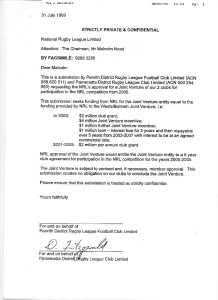
The ad described a document that had ‘fallen off the back of a truck’ to come into his hands. It was a copy of the letter to NRL chairman Malcolm Noad, signed by Denis Fitzgerald – and with a space for Roger Cowan’s signature. The Mulock ad quotes from the document:
‘This submission creates no obligation on our clubs to conclude the joint venture’.
The ad also noted the document to be confidential.
Editor’s Note:Following the Board’s July 1999 decision, the merger issue unexpectedly returned to public debate — the full-page advertisment mentioned here was not what sparked the return, three weeks earlier a press release lit the fire. The Historical Context article — Resurrecting the Merger Debate— examines the exchange of letters and public statements between Roger Cowan and Ron Mulock and links to the Digital Archive containing the original documents.
So, how did this confidential document get from the Panthers boardroom into his hands?
Greg Evans told the Inquiry there had been a split in the Board between those who didn’t want to merge at any cost, and those that were willing to accept the merger. Ian Temby asked if ‘the former group would have rather seen the Panthers cease to compete in the top competition than merge?’
Evans answers: ‘I can’t speak for them, but I probably would have.’
Yet the theme that resounds through Evans’ evidence is his passion for rugby league. This, he claims, first prompted him to stand for the board, and to lobby board members when vacancies became available. Yet his evidence appears difficult to reconcile with that passion. He told the Inquiry he would probably have preferred Panthers to leave the competition rather than merge to ensure top grade games continues to be played by a Panthers team at Penrith Stadium.
Mulock’s attack in the Weekender initiated the myth of the Footy Five, as Cowan explains:
He divided the Board into two groups and labelled one group the Footy Five. He was claiming the high ground for them, saying it was they who would save the club. He denigrated the three directors who had voted in favour of signing the non-binding letter.
So the very concept of a Footy Five, from the first day it was invented, was a total misconception. I call it Mulock’s myth.
As for his other claims, there was no split on the Board about retaining our identity in rugby league. Chairman Barry Walsh has said many times, there was no vote on a merger. The only vote was about signing a non-binding letter.
What did Evans have in mind when he told the inquiry that there were some directors willing to accept a merger? Did he really believe something for which there is no evidence anywhere, or was he just having difficulty in breaking out of his paradigms?
A myth that Cowan had signed the letter grew in the wake of Mulock’s attack, linked to claims he wanted a merger and that Cowan was anti-rugby-league.
Roy Masters disagrees.
I saw that letter, and it was signed by one person, and it was not Roger Cowan. I don’t know how hard he pushed it, but he didn’t push it so far that he signed that document.
The claims by Mick Kelly and others that Ron Mulock and/or the Footy Five had saved the Panthers from extinction are not borne out by the events of the time. The dogmatic stance taken by the Five could easily have spelled the end for the Panthers team.
North Sydney’s misfortunes during 1999 ultimately played a decisive role in saving Penrith. Norths’ stadium on the Central Coast was supposed to open for the 1999 season, but it rained in Gosford almost non-stop for months. The club had vacated its home ground at North Sydney oval, so all its home games had to be played as away games. What should have been a bumper season became a financial disaster for them.
It had been a well-kept secret that North Sydney had financial problems. Towards the end of the 1999 Season, they announced they were going into receivership, and thus had no chance of competing in the NRL on their own. The club formed a joint venture with Manly, and Penrith moved into 14th position. That day, for the first time, Penrith became assured of its place. For some months Cowan had been aware that Norths’ misfortune was helping to close the gap for Penrith. It was a tight tussle on the criteria ladder.
Cowan remained apprehensive right up until the final decision that ensured Panthers’ place in the fourteen-team competition. Three possibilities worried him. Firstly, Norths could – and probably would – finish in front of Penrith on the criteria score. Secondly, even if Penrith was only slightly ahead, grants of $20 million by two governments — given the political push to have a team at Gosford – might have somehow been included in the formula to push the advantage back to Norths. Finally, if Norths merged with Souths it would create an entirely new entity to take the 14th spot.
Each of those possibilities would have been the end of Panthers.
Cowan finally breathed a sigh of relief when Norths chose Manly as its partner. Manly had long been assured of a place, and Norths’ place became vacant for Penrith.
Panthers had survived — but only because events entirely outside the club’s control had unexpectedly changed the criteria race.
To receive new Parts and occasional project updates by email, you may subscribe below.
Readers who hold recollections, documents, or material relevant to this history are welcome to contribute via the Commentary & Contributions page.
Project Updates
Receive updates when new parts are published.
Editorial note:Footy Five is used here — and elsewhere — as retrospective shorthand. The name became associated with these five directors during the later Board conflict and election, rather than during the events being described here. See Beyond the Book — The Footy Five: A Name That Rewrote the Story. ↩︎
This paragraph refers to John Bateman and Greg Evans two of the Panthers Board who were included, by Ron Mulock, in a group he called the Footy Five. ↩︎
With only days remaining before the deadline for NRL amalgamations, the club appeared destined to miss the cut for the new fourteen-team competition. Then, unexpectedly, a possible lifeline arrived.
It required nothing more than the signing of a non-binding letter.
The Board rejected it.
Through the first half of 1999, Penrith continued to sit at number fifteen in the NRL criteria. The deadline for amalgamations was midnight on 31 July.1
Commentators had labelled a merger between Parramatta and Penrith was a ‘done deal’. Community concern was mounting. Two Panthers directors with ambitions in local politics, John Bateman and Greg Evans, were sitting between a rock and a hard place.2
Late in July, Cowan received a call from rugby league headquarters concerning the deadline.
Penrith was still highly regarded in the Super League circles,3and they were trying to do anything possible to assist us. It was obvious to everyone that we were in dire trouble. We sat solidly at number fifteen, and that didn’t look like changing. Nobody knew what was happening at Norths.
The call suggested that we could at least maintain a fallback position if we were prepared to sign a letter saying that we were still considering a merger with Parramatta and requesting more time. The letter would very clearly state that it was not to be taken as any commitment to a merger. It would be a non-binding document, aimed solely at keeping our options alive.
In his evidence to the Inquiry, John Bateman spoke of the events of July 1999. He said that when Cowan presented this offer to the board on 31 July, the Board resolved not to sign the letter. Bateman also spoke of his frustration concerning a paper that Cowan presented to the Board on 20 July, with the latest information on joint ventures.
Bateman said:
In the previous September we had resolved to stand alone. That was our view, and then Roger tabled this paper giving us more information and basically telling us that we were in a risky position standing alone.
From a corporate governance perspective, directors are expected to receive and consider information that may materially affect the organisation. Why, then, would the presentation of updated information about such an important issue become a source of frustration? A CEO who withheld such vital information would be guilty of poor corporate governance.4
On 31 July Cowan called a special meeting to advise the Board that there had been an offer that would overcome the need to comply with the 31 July deadline. Panthers would simply need to sign a non-binding letter addressed to NRL Chairman, Malcolm Noad. Cowan suggested to the Board that there was nothing to lose by signing it.
The document at the centre of the 31 July 1999 special Board meeting. Click image to read.
Bateman was not the only one who was angered by the presentation of the non-binding letter. The ex-wife of Greg Evans remembers how very stressed her husband was before leaving for that 31 July meeting.
Why these two directors reacted angrily to a non-binding proposal that would keep the Club’s options open remains a deep mystery. Cowan developed an interesting theory about it, which seems to be borne out by some seemingly unrelated events of the 1990s.
He came to believe that the concern could not have had anything to do with merging because it was a non-binding letter and the Footy Five had the numbers to prevent any merger any time they liked. He started to wonder if the problem was just the publicity.5
Greg Evans shed some unexpected light on the events of July 1999. He was adamant that none of the Five had believed that the document was actually non-binding.
I really believed that signing that letter was signing to merge with Parramatta. So did the others.
I believe if it walks like a duck, and quacks like a duck, then that’s what it is. It might have said non-binding, but once we signed it, we were going to merge. The NRL were putting enormous pressure on everyone, standing over teams, trying to force amalgamations. It was very bad PR for teams to die completely, so it was in their interest to push.
There was debate and discussion that night, but when the letter was discussed by the entire board, the fact that it was non-binding did not come into the discussion. Every member of that board believed it was an agreement to amalgamate.
Another of the Five, Geoff James, agreed with Evans, saying his view was ‘dead right’.
It might seem difficult for some readers to believe that anyone could misread such a letter. It was a simple one-page document. There it is on the opposite page! Leo Armstrong, Barry Walsh, Keith Rhind and Terry Heidtmann had no doubt that it really was a non-binding agreement.
The committee had representation from local councils, and from local community organizations and businesses, as well as people from Panthers management and Board. The purpose of the committee was to devise strategies that would convince the league decision makers that they could not drop Penrith.
The other three members of the Footy Five group were asked in writing if they agreed with Greg Evans’ view. Dennis Coffey did not respond.
Craig Terry says he had a different perspective on the incident. The document said non-binding, he recalls.
But my view was that signing that document would signal that we were prepared to reopen the issue
It was an important document, and we had no legal advice to say what it actually meant. It did say ‘non-binding’, but what it said was not the main issue. We had made policy determinations that said ‘no’.
Later John Bateman wrote that whilst the document was non-binding, he felt that signing it would bring about a merger. Cowan says it would be easy to jump to conclusion about Evans and James when they claimed that the document was a binding agreement, but he believes it is possible they actually believed what they were saying.
If Evans and James genuinely believed the document committed Panthers to a merger, then an obvious question follows. How could intelligent and experienced people read a document that repeatedly described itself as “non-binding” and nevertheless conclude it required a merger?
The contradiction is difficult to ignore. The letter before the Board imposed no immediate legal obligation and expressly preserved Panthers’ ability to make future decisions. Yet some directors clearly believed it represented something much more significant.
Before considering one possible explanation for this apparent contradiction, it is worth pausing to appreciate just how differently the same document was being interpreted.
Cowan suggests an explanation comes from the author Joel Barker whose book The Business of Paradigms, explains that people interpret information through mental frameworks — beliefs and patterns of thinking. These mental frameworks, or paradigms, cause people to fail to see evidence that goes against their beliefs.
Barker says that even experienced scientists sometimes fail to see clear evidence, although it might be right before their eyes, if it is in conflict with what they expected to see, or what they believed.6
According to Cowan if directors came to that special meeting with the firm belief that they were being asked to vote on merging with Parramatta they could have been “trapped by their own paradigms”.
My argument that it was non-binding and that we had nothing to lose would have fallen on deaf ears.
From the Footy Five point of view, a decision not to sign may have had certain advantages, no matter what different reasons each of them had for not signing. Perhaps it was just plain old-fashioned good luck — make a silly mistake and it comes back to reward you.
Had they analysed the situation and concluded there was nothing to lose except some unwanted media speculation, it would have been difficult to justify not signing it. As directors they had a duty to do what was best for the business, and what rational argument could there be against keeping all the options open for as long as possible?
To receive new Parts and occasional project updates by email, you may subscribe below.
Readers who hold recollections, documents, or material relevant to this history are welcome to contribute via the Commentary & Contributions page.
Project Updates
Receive updates when new parts are published.
Only the top 14 ranked teams were to be included, amalgamated entities were guaranteed a spot – so this deadline had great relevance for Penrith. ↩︎
Roger Cowan believed the political ambitions of both John Bateman and Greg Evans may have influenced the way they approached issues surrounding the merger debate. His reasoning is explored further in the accompanying Removed Section — Political Ambition. ↩︎
Although Roger refers to “Super League circles”, he is really referring to senior figures associated with News Limited and the Super League organisation. ↩︎
The Australian Institute of Company Directors identifies keeping directors informed of matters that may materially affect the organisation as one of the CEO’s fundamental governance responsibilities. ↩︎
Roger Cowan eventually developed an alternative explanation for why this apparently harmless document generated such strong opposition. It is explored in the accompanying Removed Section — Political Ambition. ↩︎
“Paradigms” was a subject often covered in training sessions at Panthers thoughout the 1990s. One of the videos consistently used is available on YouTube was Joel Barker’s Discovering the Future: The Business of Paradigms. It runs for about 40 minutes and shows how easy it is for thinking patterns to create perceptions that don’t match the evidence. ↩︎