Part 38 of 70 — Original Chapter: Chapter 12: The Anti-Football Myth
This article forms part of the serialised republication of Panthers, Passion & Politics – The Roger Cowan Years.
In the aftermath of Mulock’s advertisement1, a mythology built around a distorted version of events began to take hold in Penrith. It was strongest perhaps among readers of the Western Weekender, but by word of mouth it spread widely. People came to believe that four of the nine Panthers directors had voted for a merger with Parramatta, even though no such vote had been taken.
One of the four was Barry Walsh who says:
I made it clear from the start that there was no way I would ever vote for a merger with Parramatta. But we had to investigate it. We were in trouble; we could have lost our team completely. We had a duty as directors to look at the position and investigate the options and the opportunities.
In 2002, the five directors who had opposed signing the letter placed another full-page ad in the Weekender. Again, it referred to the merger, and the ‘vote’ on it. In part it reads:
On 31 July 1999 a special board meeting was held at Roger Cowan’s request at which he tabled a written submission by the Penrith and Parramatta clubs to the NRL requesting the NRL’s approval for a joint venture of the two clubs for participation in the NRL competition from 2000.
It notes that the document had been signed by the Parramatta CEO.
The vote taken in July 1999 was not a vote on whether to merge, but on whether to sign and send the letter to the NRL.
The assertion was that the document was a submission for a joint venture between the two clubs — a description that did not accurately reflect what the letter said. The letter sought the NRL’s approval for Penrith and Parramatta to continue discussions about a possible joint venture, while expressly stating that neither club was under any obligation to proceed.
The ad did not mention that the letter clearly spelled out that there was no obligation to merge.
The ad was run as part of the Five’s campaign for the October 2002 election for the Board of Directors2. Cowan says it followed their controversial “Board Wars” front page headline in the newspaper a week earlier.
For Cowan, the advertisement was more than simply an inaccurate account of what had occurred. He saw it as part of a deliberate attempt to portray him and the other three directors as being prepared to sacrifice Penrith’s independence:
By this time, I had seen plenty of behaviour from these directors that should have prepared me for this, but it still surprised me a bit. Here in print was the evidence that they were prepared to stretch the facts in order to take over the Board of the Club3. If the ticket they ran at that election had been successful, the Board would have contained the so-called Footy Five, and two other affiliates of Greg Evans.
Ron Mulock ran his own separate ad at the time of that election. What surprised me most was that a well-known local solicitor, a prominent local newspaper owner and businessman, and a high-profile Labor politician – who was also the club patron – would put their name to ads that were obviously designed to mislead the Club’s members and the public. The participation of the other three did not surprise me.
Particularly damaging were some misleading statements in the Footy Five ad.
Readers would be left with the impression that I had signed away the club and that they had saved it. Also untrue was that four directors had voted to merge with Parramatta.
The belief that Roger Cowan signed a document to merge, and that without the actions of these five people and Ron Mulock, there would be a team called the Parramatta Panthers in the competition – remains with many in the Penrith community to this day. A number of long-time Panthers supporters interviewed for this book were definitely under this belief.
Roger Cowan says that the merger saga solidified the anti-football perceptions that he believes started many years earlier.
In the mid-1960s, Penrith won a place in the first division competition, but Cowan was continually frustrated by the football committee’s inability to stay within budget. The tensions between the two administrations eventually contributed to the removal of district club secretary Merv Cartwright4.
As a player I had been quite friendly with Merv and supported him.
Once we were both in administrative positions, we came into conflict. We did not work well together as secretary and treasurer.
He was on the registered club committee when I offered to manage the Club on the three-month trial. He spoke against it. The committee accepted the offer and Cartwright was furious.
After the meeting I went down to help behind the bar and he followed me, abusing me all the way.
“What a hide I had to take on such a role without previous club management experience”, he said. “What would a schoolteacher know about running a club?”
When promotion to first division was raised, I supported it totally. The bad blood that existed between Cartwright and me was never a factor. I was excited by the prospect.
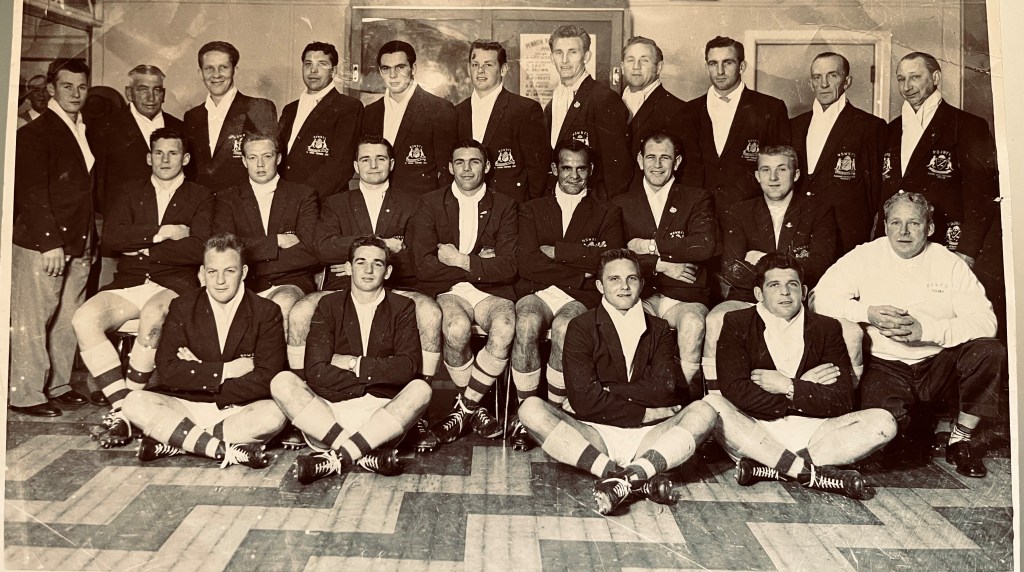
Back row: Gordon Roberts (2nd from left), Don Ellks (centre), Merv Cartwright (4th from right), Noel ‘Doc’ East (far right).
Middle row: Roger Cowan (far left), Leo Trevena (centre)
If you can help identify any others please contact admin@pantherspassionpolitics.com
Cowan had realised that promotion to the top level would be made much more difficult while it was struggling financially. He and some of his team were working seven days a week to turn the registered club around.
The rugby league competition was very different in the 60s. It was Sydney-based, most players were employed in other jobs, and it did not require the kind of money it does today to participate. A small club could aspire to do it – provided it was run efficiently. But Penrith was by far the smallest, by every measure — licensed club turnover, profitability, membership, football operations, financial resources and assets. Even Newtown was larger. St George, Norths, Easts, Balmain were all giants in comparison. Cowan realised it was going to be difficult to compete with them in rugby league without significant financial gains.
Up until that time I doubt if anyone could have said that I was anything other than a committed rugby league supporter for Penrith. However, reputations are often built on rumour rather than fact, and I had made a ferocious enemy.
Cartwright was well known in the district and had built his own reputation as a rugby league man through and through. Considering our conflict, it is unlikely that he would have been singing my praises around the junior league and other league circles.
To receive new Parts and occasional project updates by email, you may subscribe below.
Readers who hold recollections, documents, or material relevant to this history are welcome to contribute via the Commentary & Contributions page.
Project Updates
Receive updates when new parts are published.
- This refers to the advertisment run in the Western Weekender in 1999. You can read it in full in A Campaign of Letters, a PDF archive of public dispute of late 1999.
↩︎ - By this time the Penrith Panthers had already competed in three NRL seasons — the prospect of being excluded no longer existed, there was no danger, no prospect, no thought of mergers.
↩︎ - The five directors signing this ad would contend their aim was to protect the Penrith club.
↩︎ - The treasurer at the time, Ron Partridge, also lost his position. See Beyond the Book — Removing the Football Club and Treasurer ↩︎

