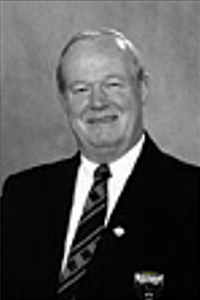
Barry John Walsh
Press Room Manager, Director, Chairman
Barry Walsh’s association with the Penrith Panthers extended across almost four decades and encompassed both sides of an organisation that, for much of its early history, struggled to reconcile the competing interests of football and the licensed club.
A Football Club director from the early 1970s, Walsh became a director of the Licensed Club in the 1980s and ultimately Chairman of Panthers. Along the way he served for decades as a delegate to the NSW Rugby League, managed a NSW representative side, became a Life Member of Panthers in 1987 and a Life Member of the NSW Rugby League in 2002.
His importance to the events described in Panthers, Passion & Politics, however, extends well beyond his longevity.
At several critical points in Panthers’ history, Walsh occupied a position between competing interests.
Around 1980 he helped bridge the deep divide between the Football Club and Licensed Club.
Almost two decades later, he became Chairman as divisions within the Panthers Board were becoming increasingly bitter.
He would occupy the chair through the Parramatta merger controversy, the expansion of the Panthers Group through amalgamations, the Board conflicts of 2002 and the subsequent Temby Inquiry.
Throughout much of that period he was also a longstanding colleague, supporter and friend of Roger Cowan. It was a relationship that placed Walsh close to many of the events that dominate the later chapters of this story, but one that did not always mean agreement.
Role in the Narrative
Barry Walsh first assumes particular significance in the narrative during one of the earliest struggles over how Panthers should be governed.
By the end of the 1970s, relations between the Licensed Club — which generated the money — and the Football Club — which needed much of it — had become increasingly difficult. Roger Cowan believed the answer was to bring both organisations under the control of a single board.
Walsh was then acting secretary (CEO) of the Football Club after replacing Ian Maurice — Walsh’s roots were therefore firmly on the football side of the divide.
According to Walsh’s later recollection, published in Men in Black, Cowan convinced him that the existing arrangement was becoming untenable. Walsh then took the argument back to his fellow Football Club directors. There were 14 directors on the Football Club Board and 12 on the Licensed Club Board and, as Walsh recalled it, the two groups were increasingly pulling in different directions. He urged his colleagues to think about Penrith rather than about themselves.
Eventually both boards agreed to amalgamate.
The decision placed the positions of 14 directors in jeopardy — so there were no guarantees for anyone. When the new Board was elected in December 1980, the Licensed Club directors had the numbers and secured all 12 positions. Not one Football Club director was elected.
Walsh had therefore helped persuade his colleagues to support a structural change that ultimately cost all of them their Board positions.
In December 1983, Walsh was elected to the combined Board until he resigned in 2010.
The episode established a role that would recur during his Panthers career.
Walsh was fundamentally a rugby league man, but this episode demonstrated his willingness to look beyond the immediate interests of the Football Club and towards what he believed were the wider interests of Panthers and its future.
Background
Away from Panthers, Walsh spent his working career with John Fairfax, where he was a press room manager before his retirement.
His involvement with Penrith rugby league began in the early 1970s and developed into what was effectively a second career. By the time he retired from the Panthers Board in December 2010, he had effectively recorded 37 years as a Football Director, and 28 years as a Panthers director. He was highly regarded and was affectionately known as The Football Director by many.
His rugby league involvement extended well beyond the Board room. He managed the NSW Rugby League representative side in 1978, served for some 30 years as a delegate to the NSW Rugby League and was Patron of the Penrith District Junior Rugby League. He was also closely involved with Panthers on the Prowl and served as its Chairman.
Walsh was made a Life Member of Panthers in 1987. In 2002 his contribution to the game was recognised more broadly when he became a Life Member of the NSW Rugby League.
In 2006 the City of Penrith recognized Barry’s contribution to the City by assigning him a position on their Wall of Achievement.
As part of the Queen’s Birthday Honours on 8 June 2009, Barry Walsh was awarded the Medal of the Order of Australia (OAM) for service to Rugby League football through administrative roles in the Penrith district.
These were not incidental associations. Rugby league — and Penrith rugby league in particular—formed the foundation of Walsh’s involvement with Panthers and are important to understanding the positions he subsequently took during some of the organisation’s most contentious periods.
Recognition & Awards
• Life Membership, Penrith Panthers (1987)
• Life Membership, New South Wales Rugby League (2002)
• City of Penrith, Wall of Achievement (2006)
• Medal of the Order of Australia (2009)
Relevance to Events Described
The struggle for Penrith’s survival
By the late 1990s Australian rugby league had emerged from the Super League war into another period of uncertainty. The newly formed National Rugby League intended to reduce the number of teams, and Penrith’s place in the competition could not be assumed.
Cowan wanted the Board to investigate all available options, including a possible merger with Parramatta. The proposal became extraordinarily contentious.
Walsh later drew a clear distinction between investigating the possibility and supporting it. He said he had made it clear from the beginning that he would never vote for a merger with Parramatta, but believed the Board nevertheless had an obligation to investigate the option.
Walsh was a member of the Stand-Alone Committee established to develop and pursue initiatives aimed at advancing the Club’s position on “The Criteria”.
His position therefore reflected something already evident in the Board amalgamation debate almost two decades earlier: a willingness to investigate structural change without necessarily supporting the outcome being investigated.
Becoming Chairman
At about the same time, the composition and culture of the Panthers Board were changing.
Following the death of Deputy Chairman Vern Mychael, Walsh joined the Board Executive. As new directors arrived and began making their mark, the previously stable Board became increasingly divided.
In 1999 Leo Armstrong was replaced as Chairman by Walsh.
Walsh’s elevation occurred in unusual circumstances. He had been a supporter of Armstrong and was not part of the group seeking his removal. John Bateman initially approached Keith Rhind to take the position. When Rhind refused, Bateman approached Walsh. Faced with the reality that Armstrong no longer had the numbers, Walsh accepted the chair.
His subsequent description of his position was telling:
I never had control of the Board.
It was a difficult environment in which to chair an organisation. The Board was becoming divided between directors demanding greater scrutiny of management and others who retained greater confidence in Cowan and the existing management structure. Walsh’s longstanding relationship with Cowan inevitably placed him closer to the latter group, but the events that followed demonstrate that his support was not automatic.
Amalgamation and expansion
As Chairman, Walsh was closely involved when Panthers began pursuing amalgamations with financially troubled clubs elsewhere in New South Wales.
Walsh recalled that management had researched the concept extensively and that it had been discussed for more than a year. He saw potential advantages in expanding the Panthers brand, developing a broader rugby league following and building assets and cash flow. Because many of the clubs being considered were in financial difficulty, he also believed Panthers could acquire substantial assets on favourable terms.
His involvement was therefore more than ceremonial. Walsh understood and supported the strategic rationale behind what became one of the most significant expansions in Panthers’ history.
The expansion would, however, produce unforeseen governance problems — particularly over the voting rights of members joining Panthers through amalgamation.
The aborted election
Those problems came to a head in March 2002.
An election was underway in which members of the newly amalgamated clubs were voting in unexpectedly large numbers. Faced with the possibility of a substantial change in the composition of the Board, the directors unanimously decided to abort the election.
Walsh voted with the other directors to cancel it, despite Cowan strongly opposing that decision.
The episode provides an important qualification to any portrayal of Walsh simply as a dependable Cowan vote.
Walsh subsequently recorded concerns about how the actions of the Board might be viewed by the Department of Gaming and Racing. He stressed that he did not himself believe the directors were improperly manipulating the process, but worried that some recent Board actions might be perceived by the regulator as an attempt to influence the election outcome.
His concern was not merely about what the Board believed it was doing, but about how its actions might appear to an external regulator.
The controversy did not end there. The eventual Football Club election in October 2002 removed five sitting directors. Walsh, Leo Armstrong, Keith Rhind and Terry Heidtmann survived, while Greg Alexander, Greg Chapman, Don Feltis, Kerry Lowe and Col Bentley were elected.
Temby would later describe Walsh, Armstrong and Rhind as strong Cowan supporters. That was Temby’s characterisation, and Walsh’s longstanding friendship and confidence in Cowan certainly formed an important part of his position within the Board. But the cancelled election itself demonstrated that the relationship did not prevent Walsh from supporting a course Cowan strongly opposed.
The Temby Inquiry
As Chairman, Walsh inevitably became an important witness when the NSW Government established the Penrith Rugby League Club Inquiry under Ian Temby QC.
Temby found that significant elements of the information conveyed were incorrect and concluded that Walsh had misled the Board, although he considered this probably resulted from “confusion, rather than mendacity”, on Walsh’s part.
The episode exposed one of the tensions inherent in Walsh’s position. His relationship with Cowan had developed over decades and involved considerable personal trust. But as Chairman and a member of the Executive, Walsh also carried responsibility for independently scrutinising the arrangements surrounding the Chief Executive.
The Inquiry therefore forms an important part of Walsh’s record. It identified shortcomings in governance and oversight for which, as Chairman and an Executive member, he shared responsibility. At the same time, its findings need to be viewed within a much longer Panthers career rather than allowed to define it.
Beyond the Cowan years
Walsh remained Chairman after the Temby Inquiry and after Cowan’s retirement in 2005.
An episode recalled by Glenn Matthews provides an insight into the relationship between Chairman, Board and Chief Executive during this later period.
Matthews had decided to sign Matt Elliott as Penrith’s next first-grade coach before informing the Board. When he approached Walsh at a function and said he needed to speak with him, Walsh immediately asked:
“What have you done?”
On being told that Elliott had already been signed, Walsh responded:
“You what?”
Matthews subsequently prepared a paper explaining his decision for the directors. After considering his reasoning, he recalled that the Board supported him completely.
The episode is revealing. Walsh was plainly surprised that such an important decision had been made before the Board was consulted, but the Board was nevertheless prepared to consider the case Matthews put before it rather than simply react to the way the decision had been made.
Walsh continued as Chairman through much of the decade that followed. He was replaced as Chairman by Don Feltis in 2009.
He resigned from the Board on 22 December 2010, ending an association as a director stretching back almost four decades.
Legacy
Barry Walsh’s contribution to Panthers cannot readily be reduced to a single achievement or controversy.
He was, first and foremost, a rugby league man. His 37 years as a Football Director, decades representing Penrith within the NSW Rugby League, Life Memberships of both Panthers and the NSW Rugby League, and the award of the Medal of the Order of Australia for his service to Rugby League administration attest to that.
But his importance to the Panthers story lies equally in the positions he occupied when the organisation was changing.
Around 1980, he helped persuade Football Club directors to look beyond their own positions and support a governance structure bringing the football and licensed clubs closer together. Nearly two decades later, he became Chairman as another struggle over the organisation’s governance was beginning.
He subsequently presided through the fight to preserve Penrith’s place in the elite competition, the expansion of the Panthers Group, the bitter Board conflicts of 2002 and the searching scrutiny of the Temby Inquiry. He then remained Chairman as Panthers moved into the post-Cowan era.
His longstanding loyalty to Roger Cowan was part of that history, but it does not fully explain Walsh’s actions. At important moments he took positions independently of Cowan, including supporting cancellation of the 2002 election despite Cowan’s opposition.
Their friendship nevertheless survived the conflicts and controversies surrounding the final years of Cowan’s career.
When Cowan was later incapacitated by strokes and living in a nursing home, Walsh was among the relatively small number of former Panthers colleagues who continued to visit him.
Following Cowan’s death in 2017, Walsh reflected on the man with whom he had shared so much of Panthers’ modern history:
Icon is an over-used word, but if ever there was an icon in the licensed club industry it is Roger Cowan.
He added that Cowan was one of those who had “put Penrith on the map”.
Walsh’s own place in that history is different, but substantial.
He began as a representative of the football side of a divided Panthers, helped bridge the gap between its competing arms, and eventually chaired the much larger organisation that emerged. Across almost four decades, he experienced—and at important moments helped shape—the transformation of Penrith from a football club struggling for its place into one of rugby league’s largest and most complex organisations.
Related Topics
- Part 21 — The Right Structure. Finally!
- Part 38 — The Foundations of Myth
- Part 44 — Building a Framework
- Part 50 — The Changing Face — and Culture — of the Panthers Board
- Beyond the Book — The Footy Five — A Name That Rewrote the Story
Related Themes:
Governance · Conflict · Board Decisions · Football Club
To receive new Parts and occasional project updates by email, you may subscribe below.
Readers who hold recollections, documents, or material relevant to this history are welcome to contribute via the Commentary & Contributions page.
Project Updates
Receive updates when new parts are published.
Editorial Note
This profile is presented as contextual background.
Additional material may be introduced as the narrative progresses.


2 thoughts on “Major Player: Barry Walsh OAM”
Comments are closed.