
Part 39 of 70 — Original Chapter: Chapter 12: The Anti-Football Myth
This article forms part of the serialised republication of Panthers, Passion & Politics – The Roger Cowan Years.
The perception that Roger Cowan was against rugby league was built up through the seventies, as he battled to bring the registered club and the football club under one administration.
Barry Hubbard was on the executive of the registered club through those years.
There was the football committee and our board, and there was very little liaison between them. The football committee called the board the “kings in their castles”. Roger was always up against it because everybody knew he was determined to get hold of football. He once told the board executive, “We should cut the head off rugby league”.
It was a remark that would come back to haunt Cowan. He did not remember the particular occasion, but acknowledged that, when particularly frustrated by the divided administration, it was quite possible he had said something like it.
I used to say that if we were not careful, rugby league would send us broke.
They [the football committee] would give us a budget, and when it came time to pay the bills at the end of the year, the amount would be double. To them there was no limit – they would just spend, didn’t care where it was coming from.
The other thing that I always said – and I’ve never backed away from it – is that the number one priority is to make the registered club successful. Rugby league has to run second. If you reverse the priorities you end up with nothing, not even a team. Western Suburbs came close, and Norths failed to take their place in the fourteen team competition. The Newtown club – with all its traditions – died completely.
Expressed that way, Cowan’s priorities could easily be interpreted as placing rugby league at the margins. His argument was almost the reverse. If the registered club was to provide continuing support for football, its own financial strength had to come first. In his view, weakening the source of the funding would ultimately weaken rugby league itself.
The vote taken in July 1999 was not a vote on whether to merge, but on whether to sign and send the letter to the NRL.
In 1983, Newtown1, one of the original rugby league clubs, with a debt of $1 million and no money to pay its players, was forced to fold. In a similar financial position, Western Suburbs — also one of the rugby league’s foundation clubs — was only saved by legal action. It struggled for many years before amalgamating with Balmain in the late 90s.
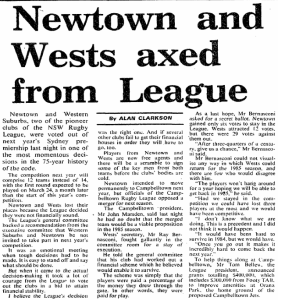
Cowan’s own memories of the days when the Penrith club was unable to pay its players had steeled his convictions.
The dispute always made me think of the fable of the goose that laid the eggs of gold. If the goose is treated badly there are no more eggs.
Yet the belief that not enough money was put into rugby league is a big part of the anti-rugby league tag. Merv Cartwright took what he needed for football, because he believed he could, but he was not the only person who saw things that way. In their evidence at the Inquiry, both Greg Evans and Dennis Coffey said that Cowan was not as supportive of football as they would have liked. Both spoke of their passion for football and their love of the team.
There was, however, an important distinction between Cowan’s influence as chief executive and the authority of the Board. Cowan could advise and recommend, but decisions about the level of financial support provided to football ultimately rested with the directors.
That raises a question not explored in evidence presented to the Inquiry. If directors believed football required greater financial support, they had the capacity to propose it and, if they commanded a majority on the Board, to approve it.
When Ian Temby suggested to Coffey that he ‘reckoned the leagues club was mostly there to support the football club and the football team’, Coffey agreed. He said that it would not surprise him if management was prepared to collude in a reverse takeover by amalgamating with clubs that would take control of rugby league out of Penrith’s hands.
Roy Masters does not agree that Roger Cowan could have secured more premierships by providing more money.
Rugby league premierships are extremely hard to win. Look at Cronulla.2 They came in the same year as Penrith, and they’re still waiting for their first one.
Putting more money in does not necessarily help. Penrith put more money in in 98, when Royce Simmons was coach, and didn’t win. They didn’t in 2003, with John Lang, and that year they won. There are many elements to winning a premiership.
Being the type of person that he [Cowan] is, he probably took the view that if you build a tremendously successful licensed club, you are always going to have a cash cow that can support a football club.
Dennis Fitzgerald, who was the long-time CEO of the Parramatta Eels, has faced the same problems with funding;
If you put all the money into the game – and so many clubs have done that – their leagues clubs either have to close or they run into all sorts of financial problems. Newtown is a classic example.
Roger is a rugby league person, but at the end of the day, he is a visionary, a business person who realised that unless you’ve got something funding rugby league, you won’t have anything. He had a massive junior league to fund, as well as an NRL team – as we all have. You need a good profitable facility to generate the dollars to keep everything else running.
To receive new Parts and occasional project updates by email, you may subscribe below.
Readers who hold recollections, documents, or material relevant to this history are welcome to contribute via the Commentary & Contributions page.
Project Updates
Receive updates when new parts are published.
- Only tw years earlier, Newtown had played Parramatta in the 1981 Grand Final, leading 7-6 at half-time before losing 20-11. Few watching that game could have imagined that Newtown had only two season leftc in the first-grade competition. ↩︎
- Masters was speaking well before Cronulla won its first premiership in 2016. ↩︎

