
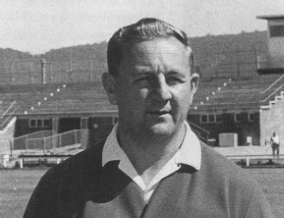
Mervyn Earl Cartwright
Founding figure in Penrith rugby league; Secretary, Penrith District Rugby League Football Club (1967–1970)
Mervyn Earl Cartwright was one of the key figures in the early development of rugby league in Penrith. A local player, administrator, and advocate for the game, he played a central role in the campaign that led to the Penrith Panthers’ admission to the NSWRL competition in 1967.
He served as the club’s inaugural secretary and was widely recognised as a driving force behind rugby league’s establishment in the district.
Role in the Narrative
Merv Cartwright appears in the early phases of the Panthers, Passion and Politics narrative as a key figure in the club’s formation and early direction.
His contribution sits primarily within the “growth” stream of the story — the push to establish Penrith as a first-grade rugby league presence. At the same time, his period of influence overlaps with the emergence of tensions between football ambition and financial governance — a theme that would become increasingly significant as the club developed.
Background
Born: 1927
Died: 2011
Cartwright grew up in the Penrith district and was closely connected to local rugby league from an early age.
• Played junior and senior football in the district
• Became club secretary in the 1950s while still a player
• Continued as Secretary of the Penrith Rugby League Football Club from 1967 to 1970
• Returned to Club governance as a Board Member 1992 – 1998
He was one of the signatories to the formation of the Penrith Rugby League Club Ltd in 1967 .
Recognition by Panthers
• Life Membership, Penrith Panthers (1955)
• Merv Cartwright Medal is awarded to the best player each season (named 2012)
• Named a Panthers Legend (2026)
Relevance to Events Described
Cartwright was a driving force in the campaign to bring Penrith into first-grade competition. He played a visible role in promoting the club, including maintaining a strong media presence during its early years .
During his time as secretary, the club operated in an environment where expectations between football operations and financial governance were not aligned. By the end of the 1960s, these pressures had intensified. Expenditure on football activities exceeded agreed limits, and tensions developed between football operations and the licensed club board over financial oversight and decision-making.
In 1971, Cartwright resigned from his role as Secretary of the Football Club. The circumstances surrounding his resignation were more complex than this summary suggests, particularly in relation to the Club’s financial position and governance arrangements at the time.
This conflict echoes through later sections of the Panthers, Passion and Politics narrative.
Related Material
- Removing the Football Club Secretary and Treasurer
- Part 8 – Divided Control: The Club and Football
- Part 7 – The Bid for First Division
- The Footy Five
Related Themes
Conflict · Football Club · First Division Admission
Editorial Note
This profile is presented as contextual background.
Additional material may be introduced as the narrative progresses.
To receive new Parts and occasional project updates by email, you may subscribe below.
Readers who hold recollections, documents, or material relevant to this history are welcome to contribute via the Commentary & Contributions page.
Project Updates
Receive updates when new parts are published.

