From Left Field

This article forms part of the serialised republication of Panthers, Passion & Politics – The Roger Cowan Years.

Start · Reader’s Guide · All Parts

Norm Bowers1 had been a close friend of Cowan’s for twenty years. He ran a small but extremely successful coaching school in Sydney. The results he has achieved for students in the Higher School Certificate have been extraordinary. He also coached university students.

Cowan phoned him.

Norm, I need help to put some concepts together, research the latest information on management and communicate it to all the key staff so that I can implement change. Do you have two tutors you could lend me for six months? I think I can finish it in that time and you can have them back again. They don’t need to know anything at all about club management. In fact, it would be an advantage if they didn’t. I want fresh minds and fresh approaches. But they have to be quick learners and good, logical thinkers who can analyse concepts.

Norm’s reply was that he had two very good tutors he was prepared to lend. One of his suggestions was Max Cowan, Roger’s son, who was coaching university students in statistics. Cowan had no doubt about Max’s ability to do the job but was reluctant. He had always avoided employing family in the club. But the need was greater than the principle and Max started2 with Joel Dehe, another tutor with academic research experience and a creative bent.

Behind this seemingly straightforward appointment lay a series of private events that profoundly shaped 1991 for Roger Cowan and his family. See: Reflections — Shadows Behind the Story.

The collation of information, theories and ideas propagated by the gurus of the day was one part of the job. Testing the best parts of them against what Cowan believed would fit into the Panthers environment was the more difficult part.

In 1991, he came across The E-Myth by Michael E Gerber. It was primarily aimed at small business, but as it turned out, it was what was needed.

W Edwards Deming, the author of Out of the Crisis, was another big influence on the developing picture. His major focus was on quality, change and the ability to embrace a new philosophy.

Long-term commitment to new learning and new philosophy is required of any management that seeks transformation. The timid and the fainthearted, and the people that expect quick results, are doomed to disappointment.

He said that a business must ‘cease dependence on inspection to achieve quality’. It must be built into the product in the first place. The system of production and service needs to be constantly improved to ensure quality.

Both books talked about systems, but from a different perspective. And both became a part of the Panthers ethos in the early 90s.

The theories of Charles Handy who wrote The Empty Raincoat seemed to be an excellent fit for the next stage of evolution according to Greiner and had a significant influence on modifications to the cultural objectives.

When interviewed, Bob Adamson was the CEO of Panthers ClubNova in Newcastle. In 1991, he arrived at Panthers – newly out of the military – in the midst of a period of great change. The frenzy for seeking change was in full swing, and Adamson says it was a very stimulating environment.

Adamson began with the club in a middle management role as maintenance manager. But he had skills and experience that would be needed in the transformation of the business, and his role would soon grow.

We were doing a lot of work on the evolution, revolution thinking at the time, and what came out of that was that we were not one big business. We were a collection of small businesses, and we had a hierarchical structure that may not have been working for us. It had become too bureaucratic and had lost that fast moving dynamism of small businesses with just a few employees. Greiner talked about finding the solutions to each of those revolutions, and we began to start thinking about having someone to lead each of those sections. The emphasis was on leadership and the leaders would be responsible for their own small business – say, a bar or a restaurant. They would be like a number of little shops in one big shopping centre

Such a dramatic restructure meant the elimination of whole levels of middle management, including Adamson’s own position. He says that this group was largely redeployed into other areas.

Steve Van Zwieten is another Panthers CEO who came up through the ranks. He started in 1988 as what was then a ‘bouncer’, but he came with some innovative ideas about what the role of security personnel should be. Within the nurturing Panthers environment he was quickly able to move into the position of security manager. He is now the chief executive of the Penrith site.3 He recalls the restructuring period:

It was a shock to some people. We certainly had a hierarchy there, and there were too many layers of management. I think that one of Roger’s strengths is that he can see things before others see them. So he was always out in front, looking at the business and saying, “now’s the time for change“.

Panthers Group General Manager, Glenn Matthews, agrees.4 He started as an assistant accountant in 1984 and says that some people thrived under the new flattened structure, while others did not.

Matthews came to Penrith Rugby League Club with a personal belief that an employee shouldn’t stay in the one place for more than five years. ‘That belief hasn’t changed,’ he says. ‘But every time I thought about that, there was another opportunity.’

I’ve been really lucky over the years, seeing the organisation grow, and having the opportunity to venture anywhere that you wanted to have a go at. While I was financial controller, I also managed the ski park for a period. I spent a year in marketing at another time. All this gave me an opportunity to see all the facets of the business. So while I’ve been here a long time, it doesn’t seem that long because the role changed and evolved so much.

The period in marketing was typical of the entrepreneurial spirit in the club at that time. Roger wanted a strong focus on creativity and he selected a team to work together closely and do whatever they thought appropriate to come up with ideas and strategies to grow the business and to make recommendations to the full management team. The team had a good balance. I came from the financial side, Peter Morath had a catering background, and Tony Lackey was a creative thinker.  Max Cowan was a good mathematician and had been involved in all the research for restructure of the business and change implementation. We worked really well together.


To receive new Parts and occasional project updates by email, you may subscribe below.

Readers who hold recollections, documents, or material relevant to this history are welcome to contribute via the Commentary & Contributions page.

Project Updates

Receive updates when new parts are published.


  1. Norm Bowers passed away in 2013, aged 84. He was a unique character – he and Roger were very close. Norm is the father of Steve Bowers who plays a critical role in this history. ↩︎
  2. This engagement was considerably more complex than appears here. One of the complexities came from Cowan’s principle about not employing relations. In an unusual step for an unusual circumstance he sought Board approval for Max’s appointment – approval was unanimous. For more on the events surrounding this move see Beyond the Book — Reflections — Shadows Behind the Story. ↩︎
  3. Steve Van Zwieten left Panthers in 2006. He is now Managing Director of Exact Security, a successful security services company started by him and Roger Cowan in 2009. ↩︎
  4. Glenn Matthews left Panthers in 2010. He is now CEO of the Australian Racing Drivers’ Club. ↩︎
Part 26 · All Parts · Part 28

Commentary and Contributions

Evolution Then Revolution … And Repeat.

This article forms part of the serialised republication of Panthers, Passion & Politics – The Roger Cowan Years.

Start · Reader’s Guide · All Parts

Growth is not always smooth. There are so many roads that must be paved and most of them start as rough tracks. A good management team seeks improvements continually, every day. Some aspects of the business are given priority; others are set aside until there is time. It is never finished, and it is never perfect. 

One of the biggest milestones in the history of the Penrith Leagues Club was the relocation to its new site on Mulgoa Road in 1984. In the years immediately following the move, the club experienced phenomenal growth.

The growth rate had been consistent from the time that Cowan started as manager in 1965. There were some flat spots, and a few years of concern about lower-than-expected profit levels, but they had always been able to overcome them.

In the years after the purchase of the property in 1971, they had spent vast amounts of time planning the transfer from Station St to Mulgoa Rd. When they left the old Station Street premises in April 1984, Panthers had about 200 employees and annual sales income of around $12 million.

The success of the intensive preparation for the move was certainly reflected in the sales. In the first year, sales increased to $16 million, and staff numbers jumped to 300. Most of the systems that had been in place in Station Street
were easily transferred. Despite the issues raised due to Mulgoa Rd being a much bigger building, by and large, the transfer went smoothly.

What they had not anticipated in all the forward planning was the rate of growth.

Within four years, annual sales more than quadrupled, to $65 million. The Club now had 850 staff. Cowan remembers it was an exciting time.

Everyone was highly motivated. It was one of the most enjoyable periods I remember. The new location was successful beyond our hopes. For years we had listened to the knockers saying what a bad move it was, and that our Station Street customers would not follow us that far out of town. 1984 was also a year of significant personal satisfaction. It was the first year of a new administration system for rugby league.1 We narrowly missed the final series that year but made it in ‘85.

Amidst the euphoria there were problems behind the scenes. Apart from a split in the Board and the stress of the misguided police investigation, there was something the matter with the business.

The fact was that while sales were going up, profit was going down. So, something was wrong. It should have been basic maths. Increasing sales, if managed properly, should lead to more profit, but that was just not happening. For more than twenty years we had been managing growth successfully, so what was different now?

In 1990, a chance discussion, a painful back and the Panther’s first grand final combined in a way that would lead to a dramatic change in the management style at Panthers. It would also lay the foundations that have allowed the company to move well beyond what most people ever envisaged.

David O’Keeffe was CEO of the Penrith Lakes Development and a very experienced administrator. He and Cowan were attending a function and their conversation got around to the club. O’Keeffe talked about its growth and asked about the number of employees. When told the staff had grown to 850, he said to Cowan, ‘I’ll bet you are having trouble keeping your thumbs on all of that.’ ‘Unbelievable difficulty’, was Cowan’s response.

‘I’ll send you something that will explain why you are having difficulties’, O’Keeffe promised.

The next day Cowan received an article entitled Evolution and Revolution as Organisations Grow, published by Harvard University and written by Larry E Greiner in 1972.

1990 was our first year in a rugby league grand final. We were to play Canberra on the Sunday afternoon, and coach Phil Gould decided to take the players to Sydney on Saturday and stay overnight. It was one of the times when I was CEO of both organisations and Phil asked me to join them.

For several weeks I had been suffering from a back problem that was giving me pain right down one arm. I had been having physiotherapy, but nothing was working. On Saturday afternoon the pain was driving me crazy. Instead of joining the players for dinner, I decided to go to bed and see if rest would help. I had brought a copy of the Greiner article with me and it was a good chance to read it carefully.

The article explains five evolutionary phases in the growth of an organisation. Greiner says that moving from one phase into the next is never smooth. Each transition is a revolutionary stage with periods of crisis that must be managed and overcome.

Cowan realised that Panthers had already been through some of those evolutionary phases, and had been able to solve some of the revolution crises as they arose. He found himself remembering periods when growth seemed to stall, followed by a struggle to find solutions. Then the feeling that there was a sudden breaking of the chains that were holding the club down, followed by another period of smooth growth.

Somehow the management team had made the right cultural and structural adjustments to get over each hurdle.

Greiner advises that the critical task for management in each revolutionary period is to find a new set of practices. They must then become the basis for managing the next period of evolutionary growth. He warns that many companies fail during the periods of crisis. Companies that are unable to abandon past practices and effect major organisational changes will either level off in their growth rates, or fold.

Reading the article was one of those ‘Aha!’ experiences for Cowan. He was now understanding things that he had never even considered before.

Readers interested in the management theory that produced this moment of insight can explore it further in the accompanying Beyond the Book article, The Article That Changed Panthers’ Thinking.

I suddenly began to see that the Panthers business employing 850 people with sales of $65 million was not a bigger business than the Panthers with 300 employees and sales of $16 million. It was a different business. Systems and management styles that worked for one would not necessarily work for the other. We had to change. We were in one of Greiner’s periods of crisis. Methodologies that had achieved growth in the past had to be re-examined, to see if they would continue to be effective.

That article had more effect on my attitudes towards management than anything else I ever read. It made me realise that I did not know enough to get Panthers through its crisis. I had been operating on the false premise that what we had done in the past would be suitable for the future. It set me off on a discovery path. I read voraciously until I had a picture in my mind of the new direction.

Introducing change is difficult and takes a long time. It causes tension in the organisation. Some find it difficult, even impossible, to adapt. But from that point we were a different organisation, constantly looking for change. We became students of authors on management, and devoted students of a few of them.

It all started with a rugby league grand final and that casual conversation. Strange to say, there was a medical lesson in it for me, too.

We returned to Panthers as losers of our first grand final, but to a heroes’ welcome. The club was packed to the rafters.  The celebrations continued right through the night and I probably had a bit too much to drink. By the time I got to bed, the sun was way up and the pain in my arm and shoulder was gone. It did not return. It seems that I was tensing my back to compensate for the pain, which just made it worse. The total relaxation of that celebration let muscles, tendons, and everything else slip into their rightful places and I was cured. That’s my theory anyway! Had I listened to earlier advice to take painkillers, I might have been fixed much sooner.

The Greiner theory placed Panthers in the revolutionary stage he called “Red Tape”, when bureaucratic needs start to take precedence, dominating decision making and slowing down progress. The next evolutionary stage should be growth through collaboration requiring a high level of democratic management, combining teams across functions, flexibility of teams, frequent conferences of key personnel, educational programs, and more. Moving from one stage to the next was the challenge.

The Greiner article was just the tip of the iceberg for Cowan. Now he was on a mission of discovery.

He had always been a reader of books and articles on management theory, but it was done as an interest without any pressure other than to absorb any good ideas he found. Now he felt it was a matter of urgency. He was missing something, and he had to find it.

At that time, he was President of the Registered Clubs of NSW and Chairman of the Licensed Clubs of Australia. Once a month he had to attend meetings on the mornings of three consecutive days and stayed in a self-contained unit in Sydney. He remembers having books spread all over the floor of the living room, cross referencing notes on what might be applicable in a restructure of Panthers.

As the big picture started to take shape, Cowan saw another obstacle. The ideas had to be compiled into a coherent form, communicated to managers, and then filtered through the staff. Implementing change was no small order, even if the changes themselves had been simple. And the big picture in Cowan’s mind was far from simple. He needed help of an unusual kind.


To receive new Parts and occasional project updates by email, you may subscribe below.

Readers who hold recollections, documents, or material relevant to this history are welcome to contribute via the Commentary & Contributions page.

Project Updates

Receive updates when new parts are published.


  1. The change to rugby league management structure is covered in Part 21 — The Right Structure. Finally! ↩︎

Part 25 · All Parts · Part 27

Commentary and Contributions

Major Player: Tim Sheens

Tim Sheens
Image Source: The Panthers: Men in Black

Tim Sheens

Player, Coach, Administrator.

Tim Sheens occupies a unique place in Panthers history.

Many people remember him as the coach who guided Penrith to its first finals appearance. Yet his most important contribution may have come before a ball was kicked in 1984.

At a time when questions were being asked about Penrith’s future in first grade, Sheens chose to stay and help rebuild the club.

Unlike many coaches who arrive from elsewhere, Sheens understood Penrith from the inside. He had played more than a decade of first-grade football for the club and his family’s involvement in district rugby league stretched back generations.

Role in the Narrative

Although Sheens’ appearance in Panthers, Passion & Politics is brief, it acknowledges him as one of the key figures in the football club’s revival following the introduction of the unified “One Board, One CEO” structure in 1980.

By 1983 the football club faced significant challenges. Player retention had become a major problem, results remained poor, and concerns existed both within Penrith and within the NSWRL about the club’s long-term competitiveness.

Following a series of community workshops organised to identify a path forward, Sheens emerged as a central figure in the proposed football rebuilding program.

His appointment as coach in 1984 represented one of the most important football decisions made during the Roger Cowan era.

The Risk

When Penrith approached Sheens about coaching the club, his future appeared to lie elsewhere.

Sheens had already accepted a player-coach position in Queensland and was preparing to leave Sydney when Panthers approached him. The opportunity offered greater certainty than a struggling Penrith side that had won only six matches in 1983 and faced serious questions about its future.

Before making a decision on the Panthers role, Sheens spent several days discussing the decision with his wife Rhonda – whose family were in Queensland. Remaining at Penrith meant abandoning established plans and taking responsibility for rebuilding one of the competition’s most troubled football clubs.

From a football perspective, accepting the Penrith role carried considerable risk.

The Panthers had won only six matches in 1983. Experienced players were leaving. Recruiting power was limited. Media commentary frequently questioned Penrith’s ability to compete with the stronger Sydney clubs.

For an aspiring young coach, failure at Penrith could easily have damaged future opportunities.

Roger Cowan later recalled being impressed by Sheens’ contribution during the community workshops and believed he possessed both the football knowledge and commitment needed to help implement the club’s new direction.

Sheens agreed to stay.

Building From Within

Rather than rely heavily on expensive recruitment, Sheens embraced the philosophy emerging from the workshops.

The focus shifted towards local talent, player development and creating stronger pathways from junior football to first grade.

This approach aligned with the club’s Five by Five objective: producing five representative players from Penrith’s junior system within five years.

Under Sheens, young local players were given opportunities and expectations began to change. For the first time, many within the club started to believe that Penrith’s greatest resource was not money but its own district.

Sheens did more than advocate for local development. He actively worked to retain and recruit players he believed could form the nucleus of the club’s future, including Mark Geyer, Greg Alexander, Colin Van Der Voort and future champion Brad Fittler. His approach reflected a belief that Penrith’s long-term success would be built from within the district rather than purchased from outside it.

Intermediate Results

The improvement was rapid.

In his first season as coach, Penrith narrowly missed the finals and recorded its best performance since entering first grade.

The turnaround was so significant that Sheens was awarded Coach of the Year by his fellow Sydney first-grade coaches.

The following season Penrith qualified for its first finals series.

The achievement provided tangible evidence that the governance reforms, strategic planning and renewed focus on junior development were working.

Background

Born: 30 October 1950

Playing Career
• Penrith Panthers Player #62 (1970-1982)
• Club record-holder for most first grade appearances at time of retirment (174).

Coaching Career
• Penrith Panthers (1984-1987)
• Canberra Raiders (1988-1996)
• North Queensland Cowboys (1997-2001)
• Australian Kangaroos
• NSW — State of Origin
• NSW — Super League Tri-Series

Recognition by Panthers
• Life Membership, Penrith Panthers (1990)

Relevance to Events Described

The significance of Tim Sheens within this story extends beyond coaching results.

The introduction of a unified governance structure provided Penrith with a framework for success. Sheens helped translate that framework into football outcomes.

His willingness to remain at Penrith during one of the club’s most uncertain periods, and his commitment to developing local talent, played a major role in establishing the pathway that eventually led to the club’s emergence as a genuine first-grade force.

For Panthers, Tim Sheens was not simply a successful coach. He was one of the people prepared to stake his future on the club when many others doubted it had one. In helping to change the club’s future, he changed the course of his own.

Related Topics


Related Themes:

Football Club · Culture


To receive new Parts and occasional project updates by email, you may subscribe below.

Readers who hold recollections, documents, or material relevant to this history are welcome to contribute via the Commentary & Contributions page.

Project Updates

Receive updates when new parts are published.


Editorial Note

This profile is presented as contextual background.
Additional material may be introduced as the narrative progresses.


Major Player: Don Ellks

Don Ellks
Image Source: PRLC Annual Report 1976

Donald Stanley Ellks

Senior Manager/General Manager 1980s–1992

Donald (Don) Ellks was one of the most significant operational managers in Panthers’ history.Beginning as a casual barman carrying a drinks tray, he progressed through the ranks over more than twenty-five years to become General Manager, helping guide the club through its relocation to Mulgoa Road and the rapid growth that followed.

His association with Penrith Rugby League Club began through rugby league, including playing for St Marys and Penrith A Grade and serving as a committeeman.

Role in the Narrative

Don was an Assistant Manager then General Manager for the planning, establishment and ongoing operation of the club’s relocation to Mulgoa Rd and the addition of the hotel and Cables Ski Park.

He was also instrumental in supporting the unified governance model that ultimately transformed the management of Panthers.

Background

Born: 1940
Died: 2025

Recognition by Panthers
• Life Membership, Penrith Panthers (1994)

Relevance to Events Described

Panthers was early to recognise the importance of providing pathways for talent, effort and results to progress through the ranks instead of seniority. Don was a case in point, starting as a bar attendant and progressing to General Manager.

Don’s operational management skills and experience complemented Roger’s leadership. In the first few years after the relocation to Mulgoa Road, the club achieved strong double-digit year-on-year sales growth but remained under significant financial pressure. High interest rates, construction cost overruns and the operational demands of rapid expansion meant that increased turnover did not immediately translate into financial security. Don’s experience working in departments, managing departments and managing managers led to the development of the systems and procedures needed for the effective and efficient operation of all departments and the ultimate success of the relocation.

Don’s long history with rugby league and operations also provided Roger with valuable support in the boardroom and dealing with politics.

Don Ellks’ career reflected many of the qualities that underpinned Panthers’ growth during the Cowan era: loyalty, practical experience, operational discipline and a willingness to take responsibility.

While others often occupied the public spotlight, Don was a key figure responsible for turning vision into day-to-day reality.

Related Topics


Related Themes:

Licensed Club · Culture


To receive new Parts and occasional project updates by email, you may subscribe below.

Readers who hold recollections, documents, or material relevant to this history are welcome to contribute via the Commentary & Contributions page.

Project Updates

Receive updates when new parts are published.


Editorial Note

This profile is presented as contextual background.
Additional material may be introduced as the narrative progresses.


How Penrith P Panther Was Born

Beyond the Book — Commentary & Contributions

Contributor: Phil Morehead

Phil Morehead was a partner in Thomas Marsden Advertising the advertising agency and design studio that supported Panthers for many years. Phil also was a long-time active member and President of the Penrith Valley Chamber of Commerce. In this contribution he recalls how Penrith P Panther came into existence and became a recognisable community figure.

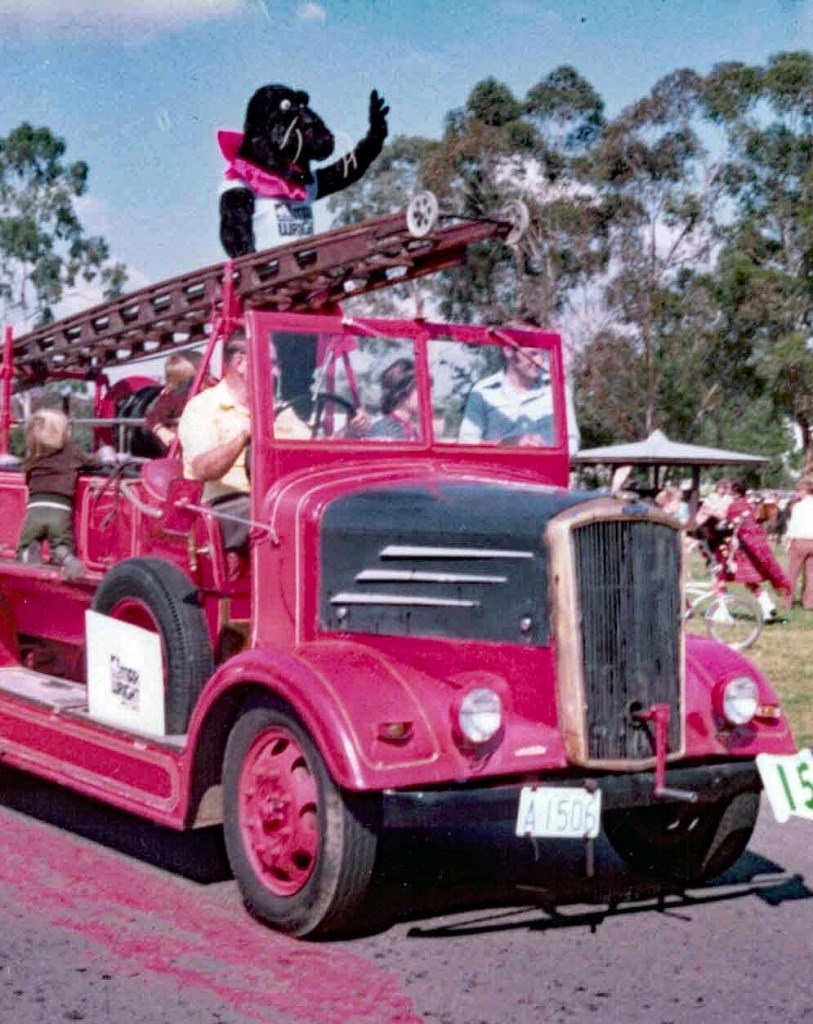
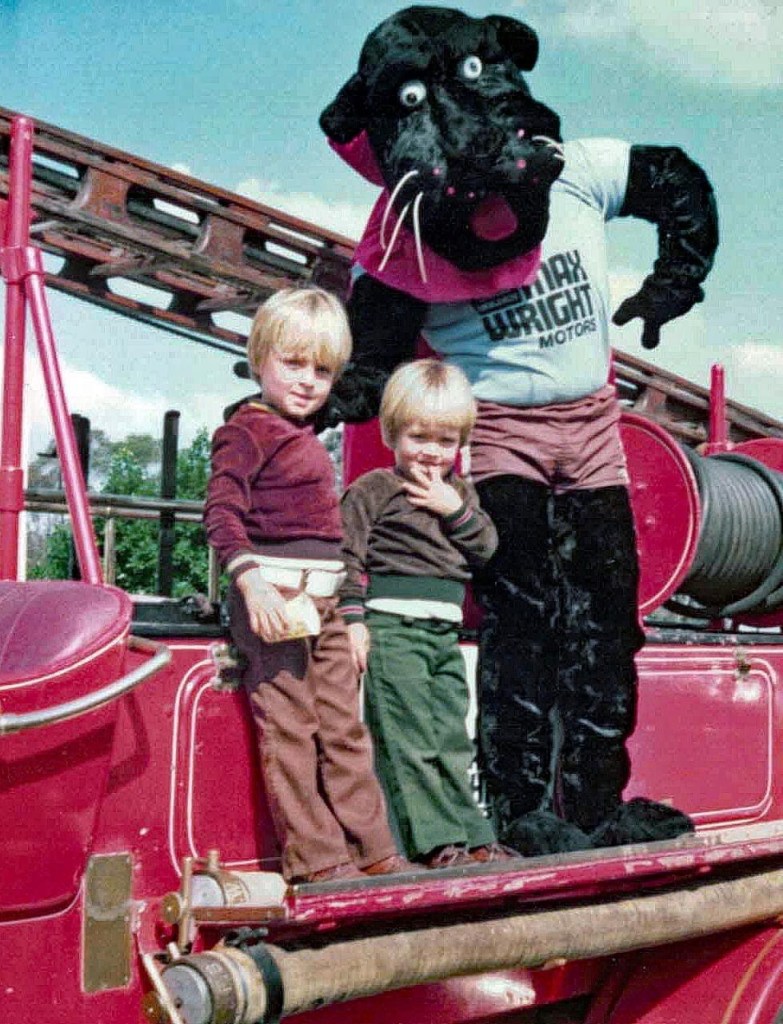
All images courtesy of Phil Morehead and Thomas Marsden Advertising.


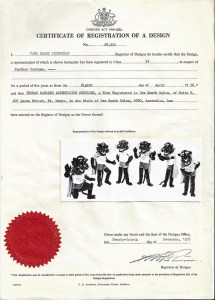
I believe Penrith P. Panther was one of the first mascots to represent a rugby league team in Australia.

I am not sure of the exact year, but I think it was probably in the late 1970s. Ron Workman was the football manager at the time, and he was a little difficult to convince that a mascot would be a good promotional tool.

Years later, at a function, Ron took full credit for Penrith P.’s creation, saying it was an idea he picked up when they went to America on an excursion looking at promotional ideas. I think the cheer girls may have been one idea adapted from America, but Penrith P. was home birthed.

The idea came to me from watching Humphrey B. Bear with my young son

At the time I was doing Max Wright’s Kingswood advertising — new Holdens, used cars and later Viscount Caravans. Max financed the project as part of his advertising.

I negotiated with Stafford Bullen to supply free kids’ passes to Bullen’s Animal World and Warragamba African Lion Safari, which Penrith P. would distribute at home games. Panthers’ contribution was to allow Penrith P. to parade at half-time and give out the tickets.

At the first game, we had Penrith P. distributing the passes from the back of a Max Wright sign-written ute, driving around the inside perimeter of the ground.

It turned into a nightmare.

We also brought 2KA into the partnership and did various pranks at games, with Frank Ley calling them live and promoting Max Wright, Bullens and the others involved.

Most of it was contra. Effectively, all parties were building community goodwill while getting promotional value at the same time.

When Max Wright passed away, 2KA took over ownership of Penrith P., which I think soon came under the control of the football club.

Later, Penrith P. was discarded due to the intellectual property disputes between the ARL and Super League. During the Super League year (1997), Super League came up with Penelope Panther but the suit was too difficult for the person wearing it. When the NRL formed they financed the development of club mascots and Paws and Claws. Claws are still active.

But the O.G. was Penrith P. Panther.


Max’s Note: Reggie Rabbit, with help from TV star Don Lane, debuted for South Sydney at the 1968 Grand Final. Despite Reggie preceding Penrith P. by some years, Penrith P was still one of the first mascots to take the field in Australian Rugbu League.


Related Topics


Related Themes

Culture · Innovation


To receive new Parts and occasional project updates by email, you may subscribe below.

Readers who hold recollections, documents, or material relevant to this history are welcome to contribute via the Commentary & Contributions page.

Project Updates

Receive updates when new parts are published.

Charlie Gibson and the Culture Clash

This article forms part of the serialised republication of Panthers, Passion & Politics – The Roger Cowan Years.

Start · Reader’s Guide · All Parts


Although the new structure fell short of the model Cowan had long advocated, it was seen at the time as a significant step forward.

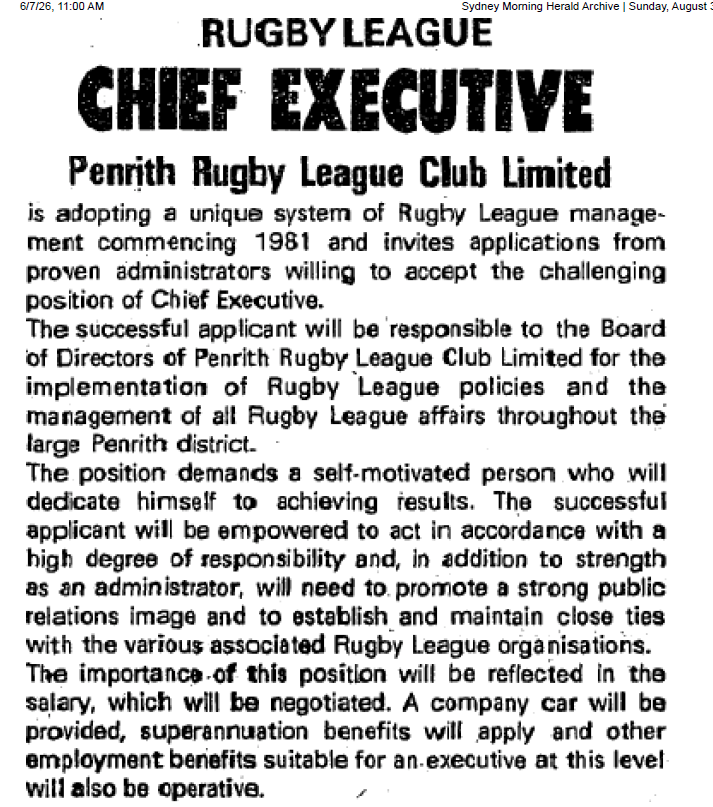
Both Cowan and the board were pleased with the appointment of Charlie Gibson. He was part of rugby league’s inner circle1, a close friend of Kevin Humphreys, and the man recommended by Mackie and the Super Six for the role of rugby league secretary at Penrith.

Gibson came with excellent credentials. He had been secretary of the South Sydney club for ten years and was there during the club’s winning streak of four premierships between 1967 and 1971. While the structure fell far short of the ultimate solution Cowan had been fighting to achieve for more than ten years, it was a huge step in the right direction. The Board and Cowan made an agreement that he would concentrate on the licensed club and take no further part in rugby league management. Cowan recalls;

We all thought – great! Charlie really knows his way around the rugby league world and that is what we need. We thought it could be the turning point in our rugby league fortunes.

I thought the board was making a mistake by having him report direct to the board, but I was willing to give it a go. I even agreed to have my contract changed to reflect that rugby league was no longer part of my responsibilities.

Charlie’s role was going to involve a lot of co-operation with the licensed club management in areas of accounting, ground maintenance, and in football-related marketing and promotions.

My vision for the club had always been a structure that united all the expertise available. For example, the club’s catering manager was far better qualified to manage rugby league functions than honorary committees or a rugby league manager. The club’s maintenance and cleaning managers could look after the ground. Financial management could come under the club’s finance manager.  Making rugby league successful would require a united effort and a high degree of co-operation.

Problems began to emerge quite early.. They were used to working as a team with overlapping needs, and they felt there was a lack of co-operation that was making their jobs difficult.

The fact is that we were not ready for such a radical departure from the way football was managed in those days.

Although no one realised it at the time, we were again seeing culture at work. This time it was a clash of cultures. Charlie was new to the organisation and we probably should have done more to talk through the tensions that were building. Culture can be a building force but it can also be destructive.

Keith Rhind says that Charlie Gibson was very much a part of the old rugby league ethos. Penrith was developing a culture that was unique, and Gibson often found it hard to adapt. It started out well enough, but eventually the cracks began to appear as the management culture developing at Penrith came into conflict with the rugby league culture that had helped Gibson achieve success at South Sydney.

Tension between the club and rugby league was growing. But that was only the tip of the iceberg. The Gibson appointment would also create a bitter division within the board and ultimately destroy a long-standing friendship between the chairman and Cowan. It would also light the slow-burning fuse that culminated in Detective Sergeant Mick Howe’s raid on the club a few years later.

When the election was held in 1980 for the first joint board, John Hewett became chairman. He had held that position on the licensed club board for the previous ten years, and he and Cowan had become good friends and built a strong working relationship.

Rhind says that Gibson also developed a close relationship with Hewett, taking him to events and functions to meet the high-profile people in his rugby league circles. Hewett was enjoying the attention. Another director from those days describes him as ‘basking in the reflected glory’.

When a Kangaroo tour was coming up, Hewett told others on the board that Gibson was going to use his influence to take him on the tour. It seems likely that Hewett was pushing for this favour and Gibson was doing his best to accommodate him. But there was disquiet among other members of the board, and Gibson himself also appeared unhappy about it.

Looking back, it was a relatively minor issue. Yet it became one of those moments where personality, disappointment and misunderstanding combined to produce consequences far beyond the original dispute.

Hewett believed that he was about to be invited to join league heavyweights on a Kangaroo Tour2, but that belief was against the designs of the heavyweights themselves. When it didn’t happen, Hewett was devastated and the conflict within the Board intensified. His disappointment, and the atmosphere of conflict on the board, caused him to resign as chairman in 1982. But his bitterness remained.

Deputy chairman Barry Hubbard, who was Hewett’s close friend, also resigned, leaving two vacancies on the board executive. Both men remained on the board. Keith Rhind, then deputy chairman, moved into the chairman’s role, which he held until the following AGM. At that meeting, Leo Armstrong was elected unopposed, and would become the club’s longest serving chairman.

Few could have known it at the time, but Armstrong would go on to become the longest-serving chairman in Panthers history and preside over some of the most significant years in the Club’s development.

Nevertheless the tensions that had been building were far from resolved — and the consequences were only just beginning to emerge.


To receive new Parts and occasional project updates by email, you may subscribe below.

Readers who hold recollections, documents, or material relevant to this history are welcome to contribute via the Commentary & Contributions page.

Project Updates

Receive updates when new parts are published.


  1. For more on Cowan’s experiences within the NSW Rugby League hierarchy, Removed Section in Beyond the Book – Rugby League’s Inner Circle. ↩︎
  2. A Kangaroo Tour was regarded as a high honour and a prestigious experience for rugby league administrators during this era. ↩︎

Part 19 · All Parts · Part 21

Commentary and Contributions

Why One Board, One CEO?

Readers of Parts 19–21 may wonder why Roger Cowan spent more than sixteen years arguing for what appeared to be a relatively simple administrative reform. Why did the issue matter so much to him? Why did he keep returning to it despite repeated setbacks, opposition and criticism?

The answer lies in a question that had troubled Panthers almost from the beginning:

The issue was not new.

Readers familiar with the events of 1971 may recognise some familiar themes. The removal of football club secretary Merv Cartwright and treasurer Ron Partridge arose from concerns about the administration of rugby league affairs and accountability for financial decisions. Although the circumstances were different, the disputes that emerged again in the late 1970s centred on many of the same questions. Who should make decisions? Who should be accountable for those decisions? And what happened when agreements were not honoured?

From the time Penrith entered first grade rugby league in 1967, the football club and licensed club operated under separate governance structures. The arrangement was common in rugby league, but Roger increasingly came to believe it created problems that could never be fully resolved.

It would be easy to assume the conflict was simply about money. Certainly finances played a part. Rugby league required increasing investment, while the licensed club was trying to strengthen its financial position and pursue long-term development projects. Yet Roger’s frustration was not that football sought resources. In his view, the licensed club had repeatedly demonstrated a willingness to support rugby league and invest heavily in its future.

The real problem arose after decisions had been made.

Budgets would be negotiated. Agreements would be reached. Plans would be approved. Yet time and again, football expenditure exceeded agreed limits or new commitments were entered into without the knowledge or approval of those responsible for managing the Club’s overall finances.

From Roger’s perspective, this was not simply a financial problem. It made long-term planning almost impossible.

A licensed club board could approve a football budget, commit to major development projects and make decisions based upon expected cash flows. If those assumptions later proved incorrect because spending commitments had changed, the consequences extended well beyond rugby league. The entire organisation could be affected.

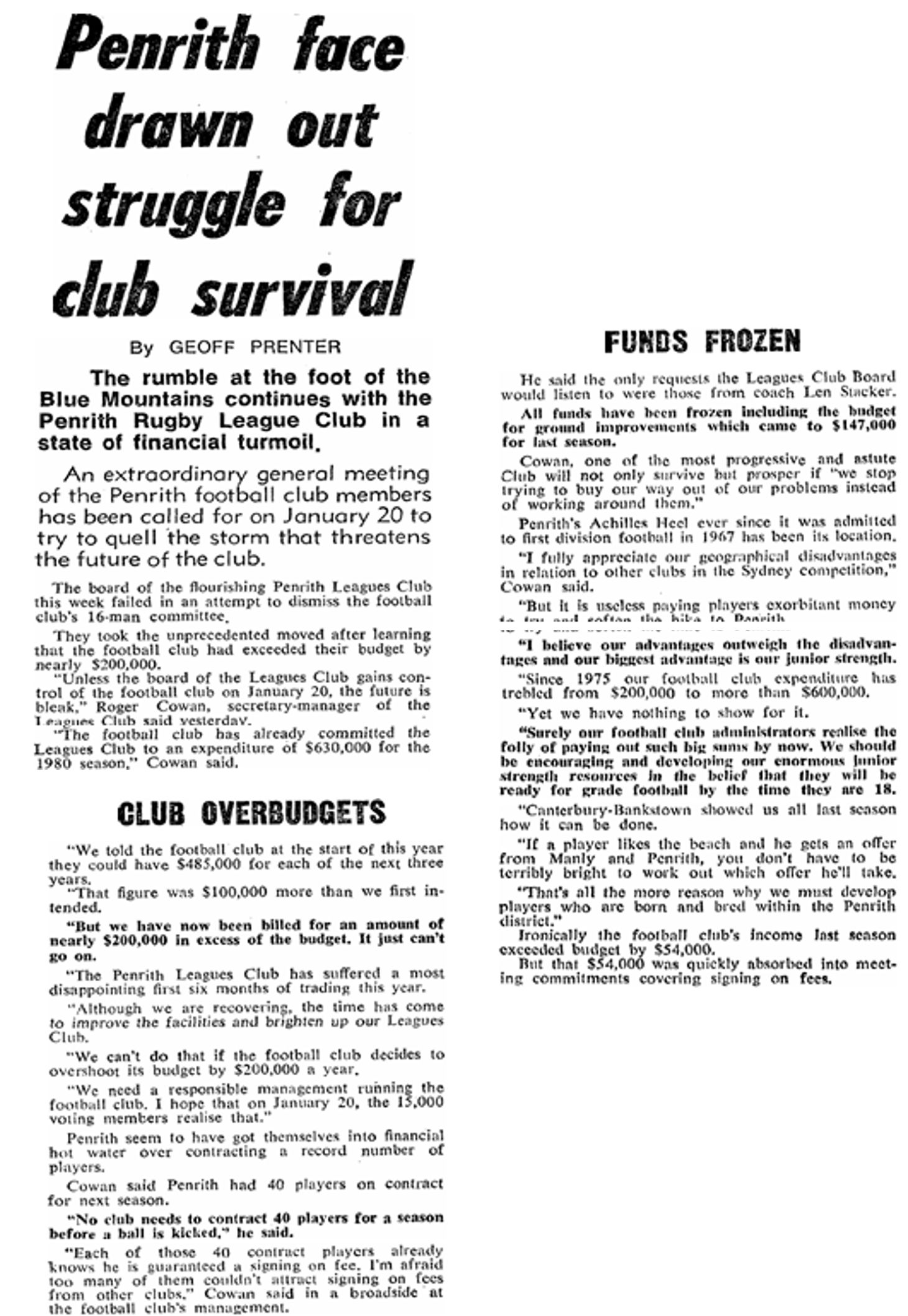
By the late 1970s, these tensions had become increasingly public. In December 1979, the Sydney Morning Herald reported on financial difficulties and disagreements between the football and licensed club administrations. Around the same time, Panthers was preparing for the enormous financial challenge of constructing its new Mulgoa Road complex.

SMH 1979 Dec 9 – click image for full article.

Reports to members in 1980 revealed the extent of the concern. Directors reported that the football club had exceeded an agreed annual budget of $485,000 by more than $100,000 during 1979, while additional commitments had already been entered into for the following season. To the licensed club board, the issue was not simply the amount involved. It was that decisions affecting the future of the entire organisation had been made outside the framework that had previously been agreed.

These events helped bring the governance debate to a head, but they do not fully explain Roger’s determination.

For him, the issue was ultimately one of organisational unity.

He believed Panthers would never achieve its potential while parts of the organisation operated according to different priorities, different assumptions and different lines of accountability. A football club and licensed club could share the same colours, the same members and the same ambitions, yet still find themselves working against each other.

His solution was straightforward.

One board would determine policy and direction for the entire organisation. Management would then be responsible for implementing those decisions. Everyone would work towards the same agreed objectives and everyone would be accountable to the same governing body.

Not everyone agreed.

Some viewed Roger’s campaign as an attempt to centralise power. The perception is understandable. After all, he was advocating a structure that would eventually place responsibility for football and licensed club operations under a single administration. His persistence over sixteen years inevitably raised questions about motive.

Yet there is another interpretation.

Roger was not arguing that football should receive less support. Nor was he arguing that rugby league was less important than the licensed club. Rather, he believed the entire organisation should operate according to a common plan and that all parts of Panthers should be accountable to that plan.

Many years later, Panthers would use concepts such as “twin citizenship” to describe the idea that people belonged not only to their immediate team but also to the wider organisation. While that language did not exist in the 1970s, the philosophy behind it helps explain Roger’s thinking. He wanted rugby league, club management, directors and staff to see themselves as contributors to a single enterprise rather than separate interests competing for influence.

The first major breakthrough came in 1980 when a single board was finally established. Yet even then, the model remained incomplete. Rugby league and the licensed club continued under separate chief executives. As described in Parts 20 and 21, the compromise produced its own difficulties and did not resolve the underlying tensions.

It was not until the end of 1983 that the structure Roger had advocated for so long was fully implemented. One board and one chief executive became responsible for the entire organisation.

Whether that decision alone explains the improvements that followed is impossible to know. Organisations are rarely transformed by a single reform. Nevertheless, the years that followed saw a stronger emphasis on cooperation, planning and shared ownership. The workshops that led to the Five by Five program, closer relationships throughout the rugby league district and a more integrated approach to football and club operations all emerged during this period.

Reasonable people may still disagree about whether Roger was right. They may also disagree about the extent to which later successes flowed from the governance reforms he championed.

What is difficult to dispute is that he regarded the issue as fundamental. For more than sixteen years he returned to the same argument, often in the face of resistance and disappointment.

Ironically, that persistence contributed to one of the enduring myths about Roger Cowan — that he was somehow anti-rugby league.

The evidence suggests a more complex reality.

His long campaign for “One Board, One CEO” was not driven by a desire to diminish rugby league, but by a belief that Panthers could only achieve lasting success when every part of the organisation was working towards the same goals and operating under the same commitments.

Whether one agrees with that belief or not, it became one of the defining ideas in the history of Panthers.


Source Material*

The following documents are extracts of the relevant sections of larger reports:


Related Topics


Related Themes

Financial Management · Governance · Board Decisions · Culture · Club Structure


* Resource material courtesy of The Ausburn Collection


To receive new Parts and occasional project updates by email, you may subscribe below.

Readers who hold recollections, documents, or material relevant to this history are welcome to contribute via the Commentary & Contributions page.

Project Updates

Receive updates when new parts are published.


The Iconic Panthers Scoreboard

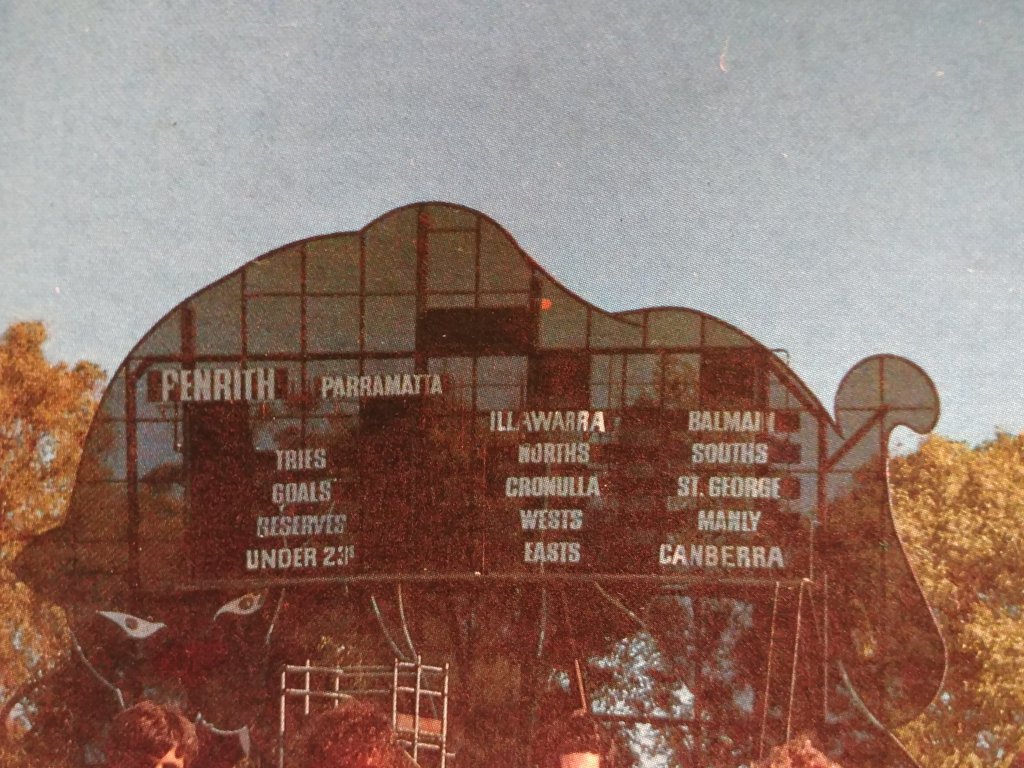
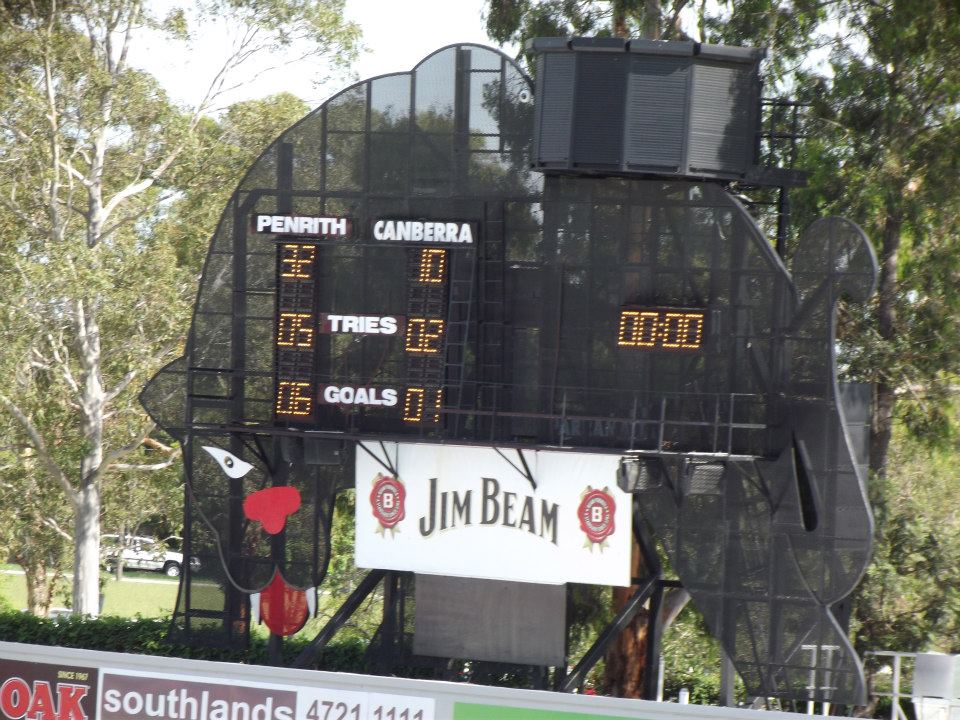
The Panthers scoreboard became one of the most distinctive features of Penrith Stadium — or any rugby league ground at the time. Its origins can be traced to the club’s early think-tank culture.

In the early days of Penrith Rugby League Club, Roger Cowan used think-tanks to encourage participation and generate ideas for the club’s development.

According to Kevin McGrath, the unique scoreboard installed at Penrith Park in 1979-80 had its origins in one of those sessions.

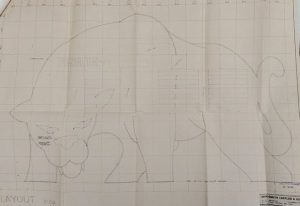
An idea for creating a Luna Park style feature for the club entry was eventually re-imagined as a football scoreboard. The concept was developed further by the architects Dick-Smith Leffler & Gill, who drafted the concept.

Finally, that original idea was brought to life at the southern end of Penrith Park as an innovative scoreboard.

The scoreboard displayed the score of the Panthers game, as well as progress scores from other matches being played on the day. A score by the home team triggered a response from the structure — flashing eyes and a Panther’s roar marking the moment.

Over time, modifications were made as the structure aged and operational demands changed.

The iconic scoreboard had its operational flaws, as it aged there were many breakdowns and failures and eventually could not deliver what was required at a modern sporting stadium … but still it was loved by Panthers fans and visitors alike.

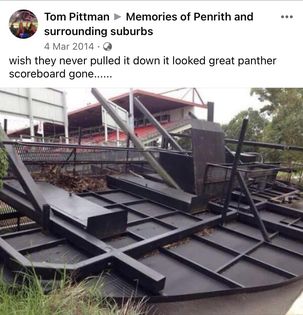
In 2013 it met a fate unbefitting of a trusted, if unreliable, friend:

This Facebook post is dated 4 March 2014, the photo (source unknown) was taken in 2013.

In 2013, the scoreboard was removed.

At the time, it was suggested that the structure had been carefully dismantled and placed into storage, with the possibility of future restoration. Other accounts indicated that it had instead been destroyed during the removal process.

Regardless of the circumstances, its disappearance marked the end of one of the most recognisable symbols of the Panthers experience.


Related Topics


Related Themes

Culture · Innovation


To receive new Parts and occasional project updates by email, you may subscribe below.

Readers who hold recollections, documents, or material relevant to this history are welcome to contribute via the Commentary & Contributions page.

Project Updates

Receive updates when new parts are published.

The Think Tank Culture

This article forms part of the serialised republication of Panthers, Passion & Politics – The Roger Cowan Years.

Start · Reader’s Guide · All Parts


Focus groups — later formalised as Strategic Planning Groups — became a part of everyday life at Panthers. Glenn Matthews says the involvement of staff remains essential when Panthers considers major changes or redevelopment

Back in the early 70s, with a full-time staff numbering only 30, it already worked the same way. Kevin McGrath who started at Penrith Leagues a little after Roger Cowan, describes how it was then.

We used to have what they called think-ins or think-tanks. They started out once or twice a year, but pretty soon they were every three months. They would get groups of employees – someone from the bars, poker machines, a cleaner, an office person, one of the catering staff, and one of the directors – and put us all in a room together for a day. We had to sit there and come up with ideas that we thought could benefit the club. The ideas could be as weird and wonderful as we liked. Roger used to tell us the more way out, the better.

We had to work as a group, write the ideas down, throw them around, and come up with a list of a final few. Then they would pass the lists on to another similar group, to be discussed and modified again.

That’s an interesting comment, but is it true?

McGrath once jokingly told Cowan he was the biggest plagiarist of all time, because many of those ideas helped make the place what it is today. ‘But he was able to take those ideas and make them become reality.’

For example, one of McGrath’s suggestions was to make the front doors of the club a big open panther mouth – a la Luna Park. This went through the process and ended up as the scoreboard at Penrith Stadium.1

Penrith Stadium’s iconic “Panther” Scoreboard – this was a later modified version.

Keith Rhind says,

Roger was always working on ways to stay ahead of what other clubs were doing. I’m sure he used to stay awake at night thinking up new ideas. He once bet me that one of the groups could come up with more than 200 suggestions in a day. I didn’t believe it was possible, but I lost the bet.

Cowan used to take people out of their comfort zones, Rhind says,

The main purpose of the think-tanks was to give the staff confidence in themselves. When Roger first started, there were a lot of problems, and staff morale was very low. We had a lot of internal pilfering and other bad practices, and there was no real structure or systems. These groups got the staff involved, they began to work as a team, and feel they were a part of something when they came to work. And we were getting all these ideas as well.

Kevin McGrath says it made him feel good to be part of those groups. ‘I was only a cellarman, but in those think-ins, I was equal to any of those blokes.’

In the 70s, Random Breath Testing was introduced to NSW. There was great apprehension about the effects it would have on businesses selling alcohol.

At Panthers, however, the legislation had positive effects. The Club’s “think tank” culture enabled it to come up with strategies that would take it to another level of growth.

Two managers went to Victoria, where RBT had been introduced five years earlier. They researched its effects in Victoria and what hotels had done about it. On their returned a think tank involving a number of key staff. It lasted several hours, and about 150 suggestions were listed. Once the list was complete, the more crazy ones were eliminated. The remainder were grouped and analysed.

Because of this one piece of legislation, the seeds were sown for Panthers to broaden its marketing focus. Now it would include family activities, tourism, and greater emphasis on food. The session was probably one of the two most valuable think tanks ever held by the Club.

The other, in 1983, drove the transformation of rugby league in Penrith from its lowest point to an era of success.

What began as informal ‘think-ins’ had become one of the defining engines of Panthers’ growth.


To receive new Parts and occasional project updates by email, you may subscribe below.

Readers who hold recollections, documents, or material relevant to this history are welcome to contribute via the Commentary & Contributions page.

Project Updates

Receive updates when new parts are published.


  1. The scoreboard became an iconic and much-loved feature of Penrith Stadium. It was removed in the early 2010s. For further context, see: https://pantherspassionpolitics.com/2026/06/02/the-iconic-panthers-scoreboard/. ↩︎

Part 15 · All Parts · Part 17

Commentary and Contributions

Culture — An Early Instance at Panthers

A removed section from the original Chapter 6: Building a Culture — by Accident and Design. This is Roger Cowan’s descirption of the culture of the licensed club in te early days.

The following reflection from Roger Cowan describes how elements of that culture were already taking shape in the early years — often without formal structure.

The importance of managing the culture arose out of the efforts to find better ways of managing Panthers after its rapid growth from 1984 on, and our difficulties coping with it.

Before that, whatever was happening in the culture was happening quite naturally with no thought of planning it. No matter who takes the position of CEO, the culture of the organisation will reflect many of that person’s values, behaviours and beliefs.

The one thing I believed in most strongly was that getting results required hard work and long hours. I think I probably went a little bit overboard, and the family paid the price. But I led the way and before long I had a management team prepared to give a lot of time to chasing the club’s goals.

Don Ellks, Leo Trevena and Bob Donaghy were the key drivers of the business in the early days, and they were prepared to put in whatever time was necessary to make sure they got things done. Leo left after a few years, but Don and Bob were linchpins for many years.

An interesting story shows how recruitment plays a part in building culture in a team. It concerns the promotion of Don Ellks. He came to Panthers as a casual barman, and it was not long before his qualities started to shine through. He was promoted to a supervisory position.

At that time Bob Donaghy and Leo Trevena were the club’s two assistant managers. We needed another assistant to help cover the long hours of operation and Don was suggested. But I was not sure whether he was the sort of person who could handle the hours. I did not want anyone on the management team who would crumble if asked to work long hours, sometimes for a seven-day week. We were a small club and there were a lot of demands.

I asked Bob and Leo to give Don a really tough roster for a couple of months to see how he would handle it. He came through with flying colours and was promoted to assistant manager – where he continued to shine for more than 25 years.

This is a good example of how a culture builds. By that time there were four of us leading the way and you might imagine that the expectations and beliefs of staff was that you would not get far in Panthers if you were not prepared to give a bit extra in time and effort. In those years none of us had ever heard of culture in a business sense but we were building one anyway.

There was another thing I learned in those early days. Most people are more comfortable when they know there are good controls in place. There was a lot of dishonesty in the culture before I arrived – people believing the game was to get what you could without getting caught.

As the controls started to take effect, employees would sometimes very privately give me the tip where something was still going wrong. The culture was changing. The honest people were starting to dominate. They knew that what was happening was wrong and wanted to do something about it, wanted to stop others from getting what they could.

Most people were willing to work together to make the club successful. All they needed was someone to show the way.

Later accounts from those who worked within the Club at the time reinforce this description of the early culture — particularly the expectation that staff would contribute beyond defined roles, and that leadership was demonstrated through action rather than hierarchy.


Related Topics


Related Themes

Culture


To receive new Parts and occasional project updates by email, you may subscribe below.

Readers who hold recollections, documents, or material relevant to this history are welcome to contribute via the Commentary & Contributions page.

Project Updates

Receive updates when new parts are published.