
Not Your Everyday Amalgamation — Shenanigans in Port

A removed section from the original Chapter 13: Amalgamations Not Takeovers. It tells the remarkable story of the contest over the future of Port Macquarie RSL Club — a dispute involving competing amalgamation proposals, an intense local campaign, political intervention and even a bomb hoax. It has been removed from the main narrative because the level of detail interrupts the broader account of Panthers’ amalgamation strategy, but the episode provides important context for both the Port Macquarie amalgamation and the political reaction to Panthers’ expansion.

The Port Macquarie Panthers story reads like the script for a Bruce Willis movie. It had secret meetings and bomb threats, vandalism, office bugging, threatening phone calls, 19 faceless men, and, of course, who let the dog out?

But the most important element of all was people power.

In mid-2000, the Board and management of the Port Macquarie RSL agreed to approach Panthers about an amalgamation. The club was in trouble and had been for many years.

The original RSL club was born in 1947 in a corrugated Nissen hut, in the centre of what was then a small beachside town. The local sub-branch owned the site and leased it to the licensed club.

After a failed attempt to buy the property from the sub-branch in 1986, the club bought the land in Bay Street where its new premises would be built. It was a short distance from the centre of town, in what was to become a prime waterfront location.

The club moved into its new premises in August 1993, but due to the recession and a blow-out in the building costs, it started with a $22 million debt. Within a few months, it became clear that the new location had not attracted local members in the numbers anticipated. The locals were staying away in droves.

By early 1994, management knew they were in trouble. The club went into voluntary administration in May of that year and continued to operate that way until Panthers came on the scene.

An agreement was struck very quickly between Panthers and the club’s chief executive, Greg Willcocks, and board chairman Graham Linn. Board and management of both clubs negotiated a memorandum of understanding. Roger Cowan and Glenn Matthews attended a meeting of around 800 members on 26 November 2000. Linn told members that the amalgamation offered members ‘a brighter and more certain option for the future’.

Contemporary reports and parliamentary records relating to the Port Macquarie amalgamation are available in the PPP Digital Archive: The Port Macquarie Amalgamation — A Contemporary Record: “Shenanigans” at Port .

Roger Cowan also spoke, assuring members that the Panthers model would preserve the club’s local identity, retain local management and that staff would have all their benefits honoured.

He told the meeting that Panthers had been able to negotiate with the bank to bring the club’s debt of $44 million dollars down to around $8.8 million. The members voted almost unanimously to proceed with the amalgamation.

Cowan explains,

The club had been in trouble for a long time, and the debt was growing. A lot of the accumulated debt was unpaid interest. The bank had not been able to bring about any improvements in the club’s trading position and wanted to write it off their books. At that point, they knew that there was no chance that they would ever collect the total debt, so it was just a matter of how far they would come down. We worked out a figure that we thought was manageable and negotiated from that angle.

For Panthers, the next phase began. An application to the licensing court was approved, and it appeared that everything was on track for a smooth transition.

Around the middle of 2001, Cowan received word that the club was looking at an alternative proposition. In the next couple of months, details of the new offer were revealed.  A group of 19 local businessmen had put a proposition to the club.

Freely admitting that they were taking advantage of the new, lower debt that had been negotiated by Panthers, they said they had raised $2 million and had finance for the remainder. Their plan was to pay out the debt and take over the ownership of the prime Bay Street site. The club would retain ownership of its bowling club at Hibbard.

The relationship between Panthers and Graham Linn, and to a lesser extent with Willcocks, began to come apart. Unwilling to become embroiled in a local conflict, Panthers decided to back off. To them it seemed that the Port Macquarie club was committing itself to a deal that was almost suicidal, but they could also see there was no point in persisting where they were not wanted.

The nineteen investors were looking at a windfall. They would be buying a prime property for less than $9 million and renting it back to the club.  After ten years, or if the club defaulted, they would have the right to sell or redevelop it. Property values in Port Macquarie were increasing, particularly on such a prime waterfront site, adjacent to the only major shopping centre in town. By 2004, the value of Port Panthers site was already close to 25 million. It had increased even more when development opportunities were explored in 2006.

It was a wonderful deal for the investors, but for the club it was a different prospect.

At the end of the ten years it would need to find a new site, in a suitable position, reasonably close to town, in a property market that was going through the roof. If profits were consistently high over the ten years, it may have accumulated the funds to buy the club back or to secure another site and rebuild. If it didn’t, its only alternative would be to relocate to the Hibbard club a few kilometres out of town and build a new club there. It would take an extremely optimistic view to believe that the club could accumulate, in ten years of trading, sufficient capital to start again in a reasonable way. Taking into account its trading history, and that the investors could do nothing to help in that regard, it was more than optimistic.

The biggest complaint from the locals was the fact that these 19 men, throughout the entire process, refused to reveal their identities. The secrecy, the future security of the club, and the enormous profit potential soon had members thinking and talking.

The ‘19 faceless men’ saga became the biggest story in town. Nine months earlier, there had been an overwhelming vote to go with Panthers, but now there were many who now saying that ‘local ownership’ was a better option than letting the big out-of-town super-club come in to take over the world. Today the club is probably much more a locally-owned club than it would have been had it taken the offer to sell the premises.

The club’s chairman and others were now enthusiastically backing the alternative bid. One of the points they would continue to push during the campaign was that the non-Panthers bid would see the club become ‘debt free’. What they failed to mention, however, was that it would also be free of its greatest asset. Instead of paying interest on its loans, it would be paying rent.

One group of members was particularly concerned about the disappearance of Panthers from the negotiating table. These ten ‘concerned club members’ formed their own little consortium. One of them, Col Munro, made a personal phone call to Roger Cowan. He asked, ‘you’re not dumping us, are you?’

I explained to Col that Panthers was not interested in pushing in where it was not wanted. This was a local issue and the members had to sort it out for themselves. He told me that we had been given the wrong impression. A large majority of members still wanted the Panthers amalgamation and the perception in town was that Panthers was letting them down. I finally agreed to meet his group to see if we should become involved again.

The following morning, a breakfast meeting was held in a Port Macquarie coffee shop. It was attended by Roger Cowan, Barry Walsh, and the ten concerned members. Munro was later elected to Port Macquarie Panthers’ advisory board. Another member of the group was David Meidling, also on the advisory board. David also was elected to Panthers’ group board.

Panthers agreed it would honour its original commitment provided there was sufficient support by the members.

The group mounted a campaign, bombarding the local Port News newspaper with letters to the editor. They also got out amongst the townspeople, talking, rallying members and getting signatures on petitions. This tactic would continue over the next three months, and in the end, was the thing that tipped the balance.

A meeting of members was scheduled for 11 October. Both sides would put their case. A local businessman would speak for the 19. It was here that the high farce began. Greg Wilcocks introduced the parties, and Roger Cowan addressed the large crowd for about 30 minutes. A speaker from the other side had just begun to speak when word came through that there was a bomb in the club.

‘Nobody moved for a while, the reaction was quite hostile,’ says Meidling. ‘There were boos and catcalls and the situation became quite ugly. Nobody at the meeting believed there was a bomb, and most refused to leave.’

The police were called and the meeting broke up, but the high farce continued.

Both sides accused each other of staging the hoax, but it did not stop there. Even the Sydney media got involved. In typical tabloid style, a Daily Telegraph story told of ransacked offices, glue in the locks of someone’s car and house, and anonymous phone threats being made to people on both sides. In a particularly bizarre turn, the story said that a gate had been deliberately opened, ‘allowing the general manager’s beagle to wander off’.

Col Munro shrugs that allegation off. ‘That dog had roamed the North Shore all its life’, says Munro. ‘It didn’t know what a fence was.’

‘We also got accused of bugging the boardroom’, says Munro, ‘though I don’t know how we got past security to do it. We used to meet in a little coffee shop near my place.’

Secret meetings became a way of life, for both sides.

Port News editor Janine Graham says the paranoia in people made the bomb threat seem real. ‘That was what pushed it into wierdsville’, she says.

The bomb did turn out to be a hoax, but it was totally unrelated to amalgamations, faceless men, or either club. A local woman had a little too much to drink and made the call. She received a fine and a suspended sentence.

The meeting galvanised the town. It split down the middle, with a massive media campaign. Full page ads ran in the Port News, and the Holiday Coast Pictorial. The latter publication began full-scale attacks on Panthers and the pro-amalgamation group of members. An ad run by a local businessman called the Panthers’ interest a ‘hostile takeover’. The ad stated that Panthers had never clarified the deal and warned that jobs would be in jeopardy.

He had either not been informed that a detailed memorandum of understanding had been signed by both parties, or he chose to ignore it.

The Hastings Council also got into the act, vocally supporting the local bid. One councillor dismissed concerns about the 19 men. ‘It’s not an issue knowing who is in the consortium,’ he said.

Another full-page ad featured local businesspeople and two local politicians, Rob Oakeshott and John Tingle. Tingle called the consortium ‘white knights’ and said their anonymity should not be seen as anything sinister, and spoke of Panthers’ ‘aggressive takeover program’. Richard Face, became involved and asked the DGR look into the situation.

It could all have been clarified with just one phone call: a copy of the memorandum of understanding would have been available to anyone who asked for it within hours. There was nothing secret about it.

The story moved into the annals of NSW parliamentary history. In state parliament, in answer to a Tingle question, minister for gaming and racing, Richard Face said the happenings in Port Macquarie in October 2001 have ‘strengthened my resolve to reform laws relating to club amalgamations’.

Hansard [27.10.2001] records the minister saying,

The new legislation will require that two clubs that are proposing to amalgamate will have to enter into a deed of amalgamation, clearly setting out key information about the amalgamation. One of the key areas … covered in the deed will be a statement as to what degree the management and staff of the dissolving club are to be retained by the continuing club. The deed will also be required to outline how the local identity of the club is maintained by the continuing club after the amalgamation.

Ironically, each of the legislated gaming reform measures were already part of Panthers’ amalgamation model. They had been resolved and approved by the Club’s management and board in 1999, far in advance of the minister’s announcement of the reform package in July 2001. 

The minister could have discovered, in less than an hour, that Panthers was actually doing more to protect the interests of the amalgamating clubs than anything he was proposing.

The Port Macquarie issue was finally resolved by a postal vote. Around 15,000 ballot papers were sent to members. Col Munro said a disused police cell was hired to keep the votes secure until they were counted. Counting took place at the police station, each side had scrutineers, and a policeman wandered around keeping an eye on things. Of the 6399 members who responded, 4459 voted to amalgamate with Panthers.
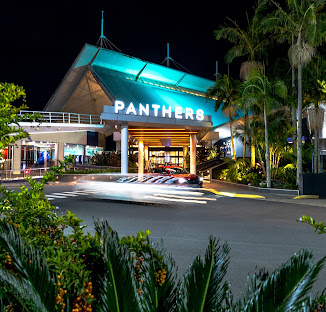
Panthers Port Macquarie

This was the only time that Panthers continued with an amalgamation that was supported by less than 90% of the members of the amalgamating club. This was only a 70% majority. It was the policy of Panthers’ management team to steer clear of local conflicts. If the members wanted to join up with Panthers it would go ahead. In the case of Port Macquarie, the genuine interest and sincerity of people like Col Munro, David Meidling and others was a convincing influence to bend the policy.

Janine Graham says that ultimately it was people power that made the decision.

There was a great deal of ‘spin’ on both sides, but in the end Panthers probably did their job a little better. I would really like to know how they managed to find those agents in Port to wage that campaign for them. It was grapevine and word-of-mouth that made it all happen.

Cowan says it seems that few people in Port Macquarie are aware that it was the ‘agents’ who found Panthers, rather than the other way round. And it was these agents who waged the war and saved the club from a deal that put it at grave risk of having no club at all in ten years.

The 19 faceless men probably agreed to invest $100,000 each. The lower debt negotiated by Panthers meant that the remaining $6.5 million would have been easily borrowed on the security of the valuable real estate they were buying. Recent valuations indicate that each individual investment of $100,000 would already [in 2007] be worth more than $1 million. No wonder they fought so hard to discredit Panthers.

But the politicians had no excuse. They had a responsibility to get to the truth before taking sides – and all it needed was a phone call.


From the Panthers Passion Politics Digital Archive

The Port Macquarie Amalgamation — A Contemporary Record: “Shenanigans” at Port
Follow the controversy through contemporary Port Macquarie News reports and NSW Parliamentary records, from the original support for amalgamation in 2000 through the competing proposals, political intervention and eventual conditional approval in December 2001.

View the Digital Archive →


Related Topics


Related Themes

Conflict · Growth · Licensed Club


To receive new Parts and occasional project updates by email, you may subscribe below.

Readers who hold recollections, documents, or material relevant to this history are welcome to contribute via the Commentary & Contributions page.

Project Updates

Receive updates when new parts are published.
Unexpected Bonuses

This article forms part of the serialised republication of Panthers, Passion & Politics – The Roger Cowan Years.

Start · Reader’s Guide · All Parts

An example of the unexpected bonuses emerging from Panthers’ amalgamations comes from Port Macquarie. When Panthers amalgamated with Port Macquarie RSL1, it also picked up a small bowling club out of town that had already amalgamated with the RSL Club. This little club may end up being one of the jewels in the Panthers crown.2 The Hibbard Bowling Club is on 12 acres of land, with its own sports complex in a residential area. In 2005 council approved a new development of 3000 homes. The new estate backs onto the club’s playing fields, and the area is not far from the Port Macquarie airport. Locals believe Hibbard will become a major satellite suburb of the city, and its Panthers club will be an important part of that new community.

Amalgamations have helped to pump life back into communities that might otherwise have lost their club — along with its sporting amenities, inexpensive meeting rooms and the donations that are part of the club ethos.

Even where amalgamation offered a struggling club a way forward, change was not always readily accepted. Newcastle Panthers former CEO, Bob Adamson, spoke of the way that Panthers’ systems were implemented into each amalgamated club. There were manuals and documented procedures covering every facet of the business, designed to make the operational transition as seamless as possible. But bringing in the Panthers culture was not always so straightforward.

Thomas Paynter had spent some time at Bathurst Panthers before he took on the job of CEO at Port Panthers. He says that the amalgamation in Port was not as smooth as it had been in Bathurst.

There are still some people – members, and a few staff – that do not accept it. They don’t realise that without other clubs coming in, they will fold. There are still people here that believe that clubs should be the same as they were 20 years ago. It’s not just us – another local club is in the process of an amalgamation at the moment, and it’s copping the same sort of flack. People are leaving the club, saying they will never come back. They’re very set in their ways around here.

Growth from one site to 14 was inevitably going to be punctuated by mistakes. Making mistakes is not as bad as being too slow to correct them.

The first general manager appointed by Panthers to the Port Macquarie club proved unpopular with local staff, and his management style appeared at odds with the Panthers culture they had been promised.To staff, he was the antithesis of everything they had been told of Panthers’ philosophy.

Janette Hyde, marketing manager of the Port Macquarie club, had been there many years. She immediately clashed with the new CEO.

He could be very charming, but he had this other side. We were pretty confused. This wasn’t what we expected at all. But we all thought, “Well, this must be what Panthers wants”, so we weren’t saying anything.

We’d heard so much about the Panthers culture …we really cared about the club. And we cared about Panthers. We wanted to be loyal to the new Panthers brand.

When she approached the manager about the way he was treating staff, she was given a formal warning.

Hyde, who said she has seldom taken sick leave, was placed on stress leave. Word soon got out in the community.

Port Macquarie News editor Janine Graham said it was a major topic of conversation.

Janette was the face of the club. She was involved in the community to an enormous extent. The town was very protective of her. You’ve got all these old guys that have been coming in, sitting on their same stools for the past ten years, and they hear that Janette’s off on stress leave!

The whole Panthers culture thing sounded great but this guy was certainly not what we’d been told about the way Panthers does things.

“To give them credit’, says Graham, ‘as soon as they found out about him, they reacted”.

Hyde says that word got through to Penrith that she was on stress leave.

Glenn [Matthews] rang me and asked what was wrong. I said, “I’m going to tell you, even if it costs me my job”.

She says Panthers investigated, talked to others in the club, and found out what was going on. The general manager left, and long-time Panthers manager Don Ellks was appointed as caretaker until Thomas Paynter was able to step into the role.

Hyde said much of the good work that had been done to convince Port Macquarie that Panthers was the best option had been undone.

Another incident was to help overcome these early negative impressions.

Before the Panthers amalgamation, the club had found that its food operation was not financially viable and had contracted a chef to run that side of the business. All the catering staff were transferred to the contractor’s books. Hyde says that while he turned the club’s food operation around, he ultimately went under himself.

He’d kept all the staff, and some of them were not what you’d call good workers. In the two years he was here, he only sacked one person – and he should’ve sacked about 12.

Hyde says that the contractor was in danger of losing everything, including his house. Panthers management heard of his predicament and guaranteed some of the debt. It gave him time to sort things out, and he was able to hang on to his house. When the business folded, all employees were transferred back to Panthers with their entitlements intact, although she adds that some of the more unproductive ones were paid out.

This particular episode would also stand Panthers in good stead with another potential amalgamating club. Gary Kennedy was a board member of ClubNova in Newcastle when discussions came up about a merger with Panthers. Kennedy was also secretary of the Newcastle Trades Hall,3 the seat of union power in that city.

The experience at Port Macquarie suggests that a takeover-style amalgamation would have faced formidable opposition. The evidence from Newcastle also suggests that ClubNova may not have come on board under such a model. Without those two important additions to the group, the attraction of a property trust4 would have been considerably reduced in the marketplace.

For Panthers it had proved an extraordinarily successful strategy — one that was embarked upon with consensus between Board and management. Why then was it the basis of some of the most costly and bitter disagreements?


To receive new Parts and occasional project updates by email, you may subscribe below.

Readers who hold recollections, documents, or material relevant to this history are welcome to contribute via the Commentary & Contributions page.

Project Updates

Receive updates when new parts are published.

  1. The Port Macquarie amalgamation became one of the most controversial undertaken by Panthers. The fuller story, removed from the original narrative for this edition, is available in Beyond the Book: Not Your Everyday Amalgamations — Shenanigans in Port.
    ↩︎
  2. This assessment reflects expectations at the time the original manuscript was written in 2007. In 2014, Hibbard Sports Club de-amalgamated from the Panthers Group, with the club and property returning to local control. The club subsequently experienced financial difficulties and entered liquidation in 2024. It is now permanently closed, with the 12-acre (4.8-hectare) property offered for sale.
    ↩︎
  3. Gary Kennedy resigned his position as Secretary of Newcastle Trades Hall in July 2014.
    ↩︎
  4. The idea of a property trust had been introduced by Panthers’ then Financial Controller, Glenn Matthews, as Panthers began its amalgamation strategy. See Part 28 — The System is the Solution. ↩︎

Part 47 · All Parts · Part 49

Commentary and Contributions

The Political Attention

This article forms part of the serialised republication of Panthers, Passion & Politics – The Roger Cowan Years.

Start · Reader’s Guide · All Parts

The NSW Government’s attention to Panthers’ amalgamation strategy sharpened as the program gathered momentum. There was growing concern within government about the expansion of large clubs. It was never clear whether Mulock directly influenced those concerns about Panthers’ growth, although his publicly expressed opposition to the expansion broadly coincided with views emerging within government.

Pat Rogan was chairman of Clubs NSW during the amalgamation years and had also spent 25 years as a NSW Labor politician. His background gave him a perspective from both sides of the debate.He says that the then Minister for Gaming and Racing, Richard Face, saw the club’s amalgamation process as Panthers gobbling up the rest of the industry. Rogan says that Face did not accept that, in most cases, Panthers was saving clubs from closing down completely.

I told him [Face] that his view was wrong. Panthers was not going out head-hunting. The reverse was happening. There was a regular stream of clubs coming to Panthers. I also told him that the members of the clubs had to vote on any amalgamation, and that Cowan himself had insisted on a 70 per cent majority of members, rather than 50 per cent – otherwise no amalgamation could go through.

Michael Egan was NSW Treasurer at the time. Rogan says the Treasurer held similar views to the Minister, believing that the club industry had “lost its way”. In 2003, Egan introduced substantially increased taxes on poker machine revenue, adding another dimension to the growing conflict between the Government and the club industry.

Clubs NSW CEO David Costello says there was a misguided perception in the Labor government at the time that big was not good.

It’s paradoxical. Michael Egan knew that 97 per cent of all their gaming tax comes from the largest of clubs – that part he was happy with, because it’s an enormous amount of revenue. He didn’t like clubs getting big, but he was happy to take the money.

Clubs have closed in the past few years, and he expects to see more

The effects of the new taxes are starting to be felt, and now there are new smoking regulations that will force clubs to spend large amounts of money on renovations. Some will just not be able to afford it.

In the aftermath of Penrith’s amalgamation push, the government changed the law to implement a ceiling of four on amalgamations. David Costello has dubbed it the ‘Penrith Bill’. He says that Panthers’ vision caused the government to change the law to control its growth.1

The government was uncomfortable with the rate that Panthers was growing. They didn’t bother to try to understand that particular phenomenon, and over-reacted.

The chief executive of Easts Leagues Club, Rob Riddle, says that he never saw Panthers’ 14 clubs as a negative for the industry,

But it scared the life out of the government, so they then turned around and put a cap on it. In my view, their perception was, if a club is weak, it should be allowed to fall by the wayside, and the strong ones should grow. Well, that may be the case, but there’s a lot of sporting fields, bowling greens and other facilities that are no longer going to be available to the community if that’s allowed to happen.

The problem with a limit is that now everyone has to choose. You’re only allowed four, and you think, that poor club down the road is about to fold. So what do I do? Do I save that poor bowling club, or wait for something bigger that seems more attractive – and that can provide me with more growth potential? I would certainly do more [amalgamations] if I could.

Early in 2007, with a state election imminent, the four club ceiling was raised to ten.2

Since the Carr government came to power in 1995, 100 clubs have closed, with another 142 being forced to amalgamate to avoid closure. At the same time, corporate ownership of hotels and their gaming machine entitlements was becoming increasingly concentrated, placing a large proportion of poker machines in the hands of business corporations.3  A single poker machine returns $120,000 to its corporate owner, with none of the regulations that require clubs to return part of poker machine revenues to the community.

Industry leaders argued that the limit had consequences beyond restricting the growth of organisations such as Panthers. As clubs across the state struggled, it also reduced the options available to those seeking an amalgamation partner.

Costello says many more clubs would have amalgamated with Panthers given half a chance.

And the fact of the matter is, that if Penrith hadn’t come to the rescue of those clubs, the majority would be closed today, and those communities would have lost the facilities.

Anyway, it’s a global trend, consolidation of companies is a fact of life. You have to be able to grow your business, and Roger had a vision that nobody else had –twenty years ago, maybe more. He said, I’ve got to have a business on a certain scale, and I have to identify the growing areas, identify the range of products and services and community support that would make a successful club.

Panthers’ amalgamation program did everything expected of it and more. It delivered valuable assets and added to the brand. There were some unexpected bonuses.


To receive new Parts and occasional project updates by email, you may subscribe below.

Readers who hold recollections, documents, or material relevant to this history are welcome to contribute via the Commentary & Contributions page.

Project Updates

Receive updates when new parts are published.


  1. The four-club ceiling was introduced as part of the Gaming Machines Bill 2001. In the Legislative Council second-reading debate on 6 December 2001, the Government stated: “Amalgamations are to be limited to no more than 4 per club”, subject to geographical and transitional exceptions. During the debate, John Tingle specifically referred to the need to curb the expansion of large registered clubs “such as Penrith Panthers”. David Costello’s description of the legislation as the “Penrith Bill” is his own characterisation, but the contemporary parliamentary debate confirms that Panthers’ expansion was expressly raised in support of restricting club amalgamations. Source: NSW Legislative Council Hansard, Gaming Machines Bill, Second Reading, 6 December 2001.
    ↩︎
  2. The Registered Clubs Amendment Bill 2006 increased the maximum number of amalgamations a club could enter into from four to ten. In introducing the Bill, the Government acknowledged that some club groups already at the four-club limit were operating successfully and were capable of assisting additional clubs. It also noted that profitable clubs were frequently approached by smaller clubs seeking amalgamation, but those already at the limit sometimes had no choice but to refuse. Source: NSW Legislative Council Hansard, Registered Clubs Amendment Bill, Second Reading, 16 November 2006.
    ↩︎
  3. For example Woolworths through ALH Group (Australian Leisure and Hospitality Group) became one of the state’s largest operators of gaming machines. It is now Endeavour Group which is the largest hotel operator in Australia with over 350 licensed venues nationwide. ↩︎

Part 46 · All Parts · Part 48

Commentary and Contributions

A Shaky Start, Then — On a Roll!

This article forms part of the serialised republication of Panthers, Passion & Politics – The Roger Cowan Years.

Start · Reader’s Guide · All Parts

‘We are one club, with 14 sites.’

With the framework finally agreed, management could begin putting the strategy into practice. What followed would test not only the amalgamation model itself, but some of the assumptions on which that agreement had been reached.

Once word got out that Panthers was in the market, there were approaches from a number of clubs. Panthers’ management considered about 80 possibilities. Clubs that had good potential, worthwhile assets and the potential to become a strong club in their community were put on a short list and measured against the criteria.

Before Panthers embarked on the amalgamation process, there had already been numerous amalgamations approved by the licensing court apparently without murmur of dissent or opposition from the Department of Gaming and Racing (DGR). 

This smooth process seemed to change when Panthers began submitting applications.

A thorough investigation into the first two amalgamations was carried out by the DGR, with Cowan recalling the Hawkesbury application going back to the court ten times. It took close to a year for them to be approved. It seemed as if Panthers was suddenly being singled out. Was this a portent of things to come?

All this close attention added credibility to John Ralston’s advice that Panthers would not be allowed to amalgamate with any club unless the court was absolutely convinced that it had done everything to protect the members of both clubs.

Cowan discovered that the amalgamation process unearthed a problem that they hadn’t foreseen.

Every amalgamation brought about the transfer of that club’s members to Panthers. The Memoranda of Understanding (MOU) promised the members of the amalgamating clubs that they would become members of Panthers from the time of amalgamation without having to pay any additional fee. But when their membership became due for renewal, they would have to pay the current Panthers membership fee. 

At that time, Panthers’ members were paying $22 a year – probably the highest membership fee in the state, while members of Hawkesbury were paying just $7. We realised that we would lose a lot of them if we insisted on charging them the full $22 to renew.

We decided that when renewals fell due, we should allow them a choice that would include continuing to pay the lower fee.  A new class of social membership was created for a fee of $7 but without the right to vote for the Panthers Board and without the right to stand as a director. 

At first this gave some comfort to those directors who may have felt their positions on the Board were in jeopardy.  Only the members of the new club who opted to pay the full fee could stand for the Board. It was considered that very few would do that. Even if they did, the majority of existing full members would not know them, and so would not vote for them. 

But there was one significant factor in all this.

The MOUs clearly promised that all members of clubs amalgamating with Panthers would be brought across as full members as soon as the amalgamation was approved by the court. They would not lose their rights as full members unless, and until, they made the choice to become social members.

The first amalgamation, with the Bathurst Leagues Club, was approved in early 2000. On the last day of the Bathurst hearing, Cowan received a phone call from Steve Bowers, the club’s legal counsel. He recalls Bowers telling him that the DGR solicitors had advised that the amalgamation would only be approved if Panthers agreed to new conditions regarding the poker machine installation at Bathurst. These conditions which differed from provisions stipulated by current law. Suddenly the legal team was put in the position of trying to negotiate agreement on new provisions.

This was moving the goalposts in the middle of the game.

Cowan recalls his response to the demand was that it was up to the government to make laws, and Panthers would abide by them. However, he said he was not willing to negotiate conditions that would be used as a precedent for restrictive legislation that would affect the whole industry. If the amalgamation could not be approved under the current laws, Panthers would pull out and Bathurst
would probably not survive.

Cowan says it came down to a stand-off..

I refused to do what they wanted and they backed off. They were wrong to ask in the first place and it would have been pretty embarrassing for them if Bathurst had to close over the issue.

Hawkesbury Panthers came into existence a few months later in April.

Even in these early days of amalgamations, one thing became very obvious to the management of Panthers. There was, within the Boards of Directors of amalgamating clubs, discernible appreciation of what Panthers was offering, accompanied by a great degree of respect for Panthers. Most had pursued other options, including amalgamation with other clubs. It was a revelation to them that the Panthers model left them largely in control of their clubs and let them retain a degree of autonomy and ownership. Like many of the other clubs that approached Panthers, Hawkesbury had been in financial trouble. It had tried to pull itself out of the situation by selling some land adjacent to the club, but there were still problems.

Bob Anderson was a director at Hawkesbury Panthers. He says what was most important to the club at the time of amalgamation was to retain its ‘small club’ atmosphere.

‘The first approaches by Panthers were very low key. There was no pressure’, says Anderson.

It was all pretty casual. But it was always made clear that the amalgamation would be for the betterment of the club. We had looked at other offers at the time. One local club came in and we had a meeting, and they virtually said, “Once we take you over, we’ll just close you down”.

Anderson says that Panthers came to them with a memorandum of understanding which made them feel much more confident about the arrangement. There was collaboration all along the way.

We didn’t feel like we were being taken over. Never at any time did it seem that Panthers was dictating what was to happen.

As part of the amalgamation process, Cowan or one of the assistant managers visited each club and had meetings with their Board. Cowan also addressed special meetings of the members, explaining the memorandum. He assured them that they would have equal rights with all other Panther members and be better off as a Panthers club. He also spoke to the staff and encouraged questions and full discussion. The management team at Penrith believed that a culture of openness, trust and honesty was essential for success.

The memorandum of understanding was an integral part of each amalgamation. It was negotiated between the partners and set out in detail the responsibilities of each club. It stressed the benefits for the members of the amalgamating club, especially in relation to Panthers membership.

On 30 January 2001, less than a year after the amalgamation was finalised, the Hawkesbury region was declared a natural disaster area after violent winds ripped through the area. The Club was a scene of devastation after the seven-minute storm ripped through Richmond. Staff put their own safety at risk to rescue a man trapped under a collapsed wall. The club was closed for a short period while the damage was assessed.1

Anderson says that there was insurance, but that everyone had appreciated the full-on way that Panthers stepped in to get it back on its feet again.

Cowan was impressed by people he dealt with in amalgamating clubs.

I doubt if I have ever been more impressed than when I first met the staff of the Mekong club to discuss the prospect of an amalgamation with Panthers.  It was difficult to believe that a club with such enthusiastic and dedicated staff could be in receivership. The fact is, they should never have been in that position.

The process also brought us into contact with the boards from the various clubs.  Club Nova’s directors, for example, were impressive for their sincerity and ability to discuss all the issues rationally, calmly and in depth.  I even had a moment after leaving my first meeting, when I imagined swapping some of their directors for a select few at Penrith. Harmony and logic might become the order of the day.

Most of the boards had experienced great financial stress within their clubs but this had never stopped a committed effort to serve their clubs. They were all impressive, genuine people looking for the best solution.

Another important consideration was the potential to spread many of the fixed overhead costs over a number of sites, without extra cost. Financial management, poker machine management and purchasing were just some of these.

From 2000 to 2003, conditional approval was granted for amalgamation with 13 NSW clubs, all later confirmed.

Amalgamating ClubApproval Date
Bathurst Rugby League ClubFebruary 2000
Bathurst City Bowling Club February 2000
Hawkesbury Sport Club, North Richmond March 2000
The Mekong Club, Cabramatta June 2001
Lavington Sports ClubJune 2001
St Johns Park Community ClubOctober 2001
West Epping Bowling and Recreation ClubOctober 2001
Club Nova Co-operative, Newcastle WestNovember 2001
Cardiff Workers ClubNovember 2001
Port Macquarie RSL ClubDecember 2001
Hibbard Sports Centre, Port MacquarieDecember 2001
Glenbrook Bowling and Recreation ClubApril 2003
Wallacia Golf Club2003

To receive new Parts and occasional project updates by email, you may subscribe below.

Readers who hold recollections, documents, or material relevant to this history are welcome to contribute via the Commentary & Contributions page.

Project Updates

Receive updates when new parts are published.


  1. This extreme weather event doesn’t appear on broad government disasters lists because it was a localised event. On 30 January 2001 violent, localized squall winds knocked down massive trees and blocked local roads around Beaumont Ave and Terrace Road, North Richmond (the location of Panthers North Richmond – as it is now known) There was also intense flash flooding and the Club experienced servere impact resulting in significant roof and property damage. ↩︎

Commentary and Contributions

Building a Framework

This article forms part of the serialised republication of Panthers, Passion & Politics – The Roger Cowan Years.

Start · Reader’s Guide · All Parts

‘We are one club, with 14 sites.’

When Roger Cowan made that statement to Ian Temby, it reflected the philosophy that he had held since he first embraced the concept of amalgamations. It was another factor that helped to put him in that very courtroom on that day in June 2004.

The topic of amalgamations was first raised at Panthers in 1998 by John Wilson, who was then the Club’s gaming manager. The Registered Clubs Act had been amended to encourage the practice, and Wilson had come to believe there was a great opportunity there.1

For a number of reasons, the rate of club closures had been increasing, and the change to the law was aimed at slowing down the trend.

At management meetings Wilson continued to argue strongly for the concept. Eventually a model was developed that overcame most of the concerns and it was agreed that an amalgamation strategy should be recommended to the Board.

The board resolved to test the strategy with a small struggling club not far away from Penrith – the Hawkesbury Sporting Club in Richmond.  This first amalgamation would be a pilot for bigger things in the future.  It had some reasonable potential, although it would not deliver the level of benefits that we hoped to achieve in other amalgamations. 

It would help us learn more about what difficulties might lie ahead and to develop systems to overcome them.  We believed that we could easily turn the club around, by introducing our management systems and by taking advantage of our purchasing power.

We would support them in every way needed, but our model provided that they would always be able to retain their identity and a strong sense of ownership of the club. This would, in turn, encourage a strong commitment to service their local members

When a business is considering something as important as this, the focus has to be on the desired outcomes rather than what has to be done. Management decided on a set of outcomes for the future that show us our amalgamation strategy had been successful. We needed agreement between Board and management on that future picture, and it was extraordinarily difficult to achieve. The failure to reach agreement delayed the start of the strategy for nearly twelve months. 

On the one hand, we could look upon each amalgamation as the formation of a new entity in which all stakeholders would have equal rights.  In the alternative picture, one club is in the centre, having the power and control over all its subsidiaries.  The first model is a true amalgamation.  The second example is effectively a takeover. 

The management of Panthers always believed the first model would be the pathway to success, whereas the takeover path would eventually create limits and barriers.  We believed that we finally had an agreement with the Board on the vision when we submitted a detailed list of the criteria that would be used to qualify clubs under consideration. Everything seemed to be covered and it was discussed to death before the Board gave it the final approval.

The word ‘takeover’ does appear in some early documents, but from day one, Cowan’s original concept was of amalgamation.2 Later, some of the Five would claim that they thought they were agreeing to takeovers, not amalgamations, and that they had been misled by management.

Barry Walsh was chairman of the board when management first floated the amalgamation idea. He says they discussed the concept for more than a year, but there were problems convincing some directors. ‘I saw a number of benefits’, says Walsh.

The outcomes described by management sounded plausible, achievable and worthwhile. We were given a lot of information, and it was obvious to me that they had gone into an extensive research and analysis process. I could see the benefits of spreading our brand into other areas of the state, developing a larger rugby league following, and building assets and cash flow. Because of the financial situations of these clubs, we could get them at very good rates.

While documenting the benefits of amalgamation, the management recommendation put to the Board also highlighted one of the negatives. It would open the possibility that members of another club could nominate for the Board. At the time, this was not seen as an immediate problem, because it was thought they would have to be members for three years before they could stand.

Nevertheless, the prospect that members of an amalgamated club could stand for the Board, even after three years, raised the concerns of some board members to the extent that they simply could not reach agreement. The spectre of ‘reverse takeover’ had entered the picture.

The boardroom delays on the Hawkesbury proposal became very frustrating for management. They tried to explain that amalgamations could help the club to overcome some of the problems it was currently facing in a changing local market.

The threats it faced included over-capitalisation on one site, and the maturity of the local gaming market. Hotels and other clubs were continually improving. In previous years it had been commonplace for bus companies to bring tourists to Panthers from other areas such as Manly, Wollongong and country NSW. The improvement in club facilities in other areas had weakened that business.

Another threat was the attitude of the state government towards clubs, and the associated rumours of higher taxes and restrictive legislation.

There was also the danger of being dependent on one business, in one location, which was already suffering under the strains of its size.

At one Board meeting called specifically to consider whether to adopt an amalgamation strategy, the discussion circled laboriously for nearly four hours. Cowan says the final hour could have been completely eliminated had there been a recording of the first hour. After all that time, the only resolution was that management should prepare further documentation to prove that the threats actually existed. 

A frustrated management team came to the conclusion that the entire exercise had been a deliberate waste of time, and that the request for more information was just an excuse to put off making a decision. Deferring a decision was easier than raising logical argument.

To the management team, the threats were very real – and very obvious. They also should have been obvious to the Board. But how could it be proven that the government attitude, for example, was a threat? Today every club in the state would agree that it was the greatest threat of all.3

A major benefit of amalgamation would be the spreading of support for the rugby league team. That, in turn, would boost opportunities in sponsorship, merchandising and television. With the advent of Pay TV, management considered television exposure as a crucial part of its future success, particularly with the possibility of clubs being rewarded through their popularity on that medium. 

Another important consideration was the potential to spread many of the fixed overhead costs over a number of sites, without extra cost. Financial management, poker machine management and purchasing were just some of these.

Many of the clubs seeking to amalgamate had assets far more valuable than their liabilities, which would have a positive effect on the Club’s balance sheet. This could lay the foundation for future expansion into other profitable areas, and most importantly, it could be a way for Panthers to begin to break its dependency on gaming.

Former director Bateman, one of the Five who often spoke out against the amalgamation strategy, told the Temby Inquiry in 2004,

My initial attitude in regards to amalgamations was that we needed to explore it. I accepted there were pressures on our main source of revenue being gaming, and we needed to spread our wings.

He told Ian Temby – that ‘amalgamations were an appropriate way in which to extend outside our current Penrith base’.

Part of the management recommendation was a set of criteria for clubs wishing to amalgamate with Panthers. After 12 months, the Board agreed that an amalgamation strategy should become high priority. At that time, management was given authority to identify and pursue amalgamation possibilities.

The Board stipulated that every amalgamation must meet the criteria. Even then, there was no authority granted for amalgamations to proceed automatically. Each one had to be recommended and approved separately by the Board. Generally, a board sets policy, defines parameters and leaves management to work towards success within those parameters. In this case the Board put each new proposal under the microscope.

Although there was a lot of discussion about members of amalgamating clubs being able to stand for the Board, nothing was built into the criteria to provide against it. John Ralston4, an acknowledged legal expert in the club industry, had advised that it would be highly unlikely that the licensing court would approve an amalgamation unless the members of both clubs were treated equitably. He also reminded the Club that the Registered Clubs Act requires that at least 50% of members had to have the right to vote for the Board.

Management breathed a sigh of relief when it appeared that the five directors had finally agreed to a strategy that ensured all members be treated equally after amalgamation. At long last, it seemed they understood that the amalgamation strategy could only be successful if Panthers protected the rights of the members of the amalgamating club. Such beliefs by management were to prove naïve.


To receive new Parts and occasional project updates by email, you may subscribe below.

Readers who hold recollections, documents, or material relevant to this history are welcome to contribute via the Commentary & Contributions page.

Project Updates

Receive updates when new parts are published.


  1. The regulatory framework under the Registered Clubs Act increasingly recognised amalgamation as a means of dealing with clubs facing financial or operational difficulty. The Act provided for amalgamations subject to approval by club members and the licensing authority, with the Licensing Court supervising the amalgamation process and the transfer of the relevant club licence. The statutory framework governing amalgamations was subsequently expanded substantially in 2001.
    ↩︎
  2. The terminology used in some early documentation was not always consistent. The distinction being drawn here is between the use of the word takeover and the model advocated by Cowan, under which amalgamating clubs would retain identity and local involvement and their members would ultimately share rights within the wider Panthers organisation.
    ↩︎
  3. “Today” refers to the time of writing of the original manuscript in 2007.
    ↩︎
  4. John Ralston BA LLB (Sydney University) was admitted to legal practice in 1975 and is today a consultant with Pigott Stinson. For more than 30 years he has acted extensively for registered clubs and practised across the wide scope of law affecting clubs and the club industry. Pigott Stinson describes him as one of the leading legal practitioners in the club industry. ↩︎

Part 43 · All Parts · Part 45

Commentary and Contributions

The 1990 Queensland Criminal Justice Commission

The poker-machine transaction examined in Part 24 did not disappear when the NSW investigation ended. Four years later, the same transaction surfaced in the Queensland Criminal Justice Commission’s 1990 report on gaming machines, where Cowan believed the facts were misstated and the implications left uncorrected.

Somehow the Queensland Justice Commission accepted the false proposition, from an undisclosed source, that Panthers had paid $7,000 per machine when the list price was only $5,300. Every piece of documentation Howe had seen had clearly shown that the club paid only $5,300. 

The poker machine purchase from Len Ainsworth’s company, Aristocrat, was mentioned in the Commission’s 1990 report on gaming machines. The QCJC used the purchase to illustrate what it called the ‘Byzantine transactions’ that it said were common in the club industry at the time.

‘Various manufacturers are alleged to have engaged in the offer of inducements of one sort or another to buy gaming machines’, said the report. It continues, ‘There is room in such contorted transactions for any number of corrupt arrangements.’

It quotes the same information that was in the original NSW police allegations, including the listing of only 90 machines. It provides all the figures, and mentions Ainsworth’s subsidisation of the interest, without providing any explanation of the circumstances. The report emphasised the payment by Panthers of an inflated price of $7,000.

After the report was released, Cowan had a solicitor write to the Commission asking that the report be amended to reflect the true facts of the transaction – that Panthers paid $5,300, not $7000, and that the list price was $7000, not $5300. The request was ignored. A subsequent approach was also ignored. No response was ever received, and the false representation still stands in the records.

Although Panthers had been cleared of all the original charges, with no action taken by the NSW police or the Liquor Administration Board, here was the very same information finding its way into the QCJC report. Cowan is mentioned specifically in the same report, saying he ‘has come to the notice of NSW police on a number of occasions and had been unsuccessfully prosecuted once’. No evidence was ever recorded of any specific occasions on which Cowan had ‘come to the notice of police’.

Phil Bennett also read the report, and, knowing the real facts of the transaction, sent a personal response to the QCJC, explaining his own knowledge of the sale. He told the Commission: ‘It was clearly established that there was nothing illegal or improper about this transaction and no action was taken, nor was the matter raised as an objection in Ainsworth’s licence application.

The Commission’s suggestion that this transaction was an example of an inducement paid to people in exchange for their club buying machines is clearly not sustainable.

Bennett also noted in his response that the prices of poker machines quoted in the QCJC report were ‘a nonsense’.

The QCJC did nothing to rectify its erroneous report. The blatant untruth still stands in its records.


Related Topics


Related Themes

Financial Management · Licensed Club


To receive new Parts and occasional project updates by email, you may subscribe below.

Readers who hold recollections, documents, or material relevant to this history are welcome to contribute via the Commentary & Contributions page.

Project Updates

Receive updates when new parts are published.

Gotcha!

This article forms part of the serialised republication of Panthers, Passion & Politics – The Roger Cowan Years.

Start · Reader’s Guide · All Parts

Most of the police and government officers involved in the police raids on Panthers had walked away satisfied that Cowan, and the club, had nothing to answer on any of those original allegations. Mick Howe didn’t give up.

Four months later, newspaper headlines and TV bulletins revealed that Cowan had been charged with four counts of fraud. Howe had finally hit his mark. But the charges had nothing to do with the original investigation or the letter of complaint.

A chance remark to a staff member about a questionable tax deduction, and the discovery of some discrepancies in the accounts of the Panthers’ travel agency1 eventually rewarded the persistence of Detective Sergeant Mick Howe.

Early in 1986, before the investigation started, Cowan had taken a holiday in Thailand, which he booked through the Panthers travel agency. When booking the trip, he advised the manager of the agency that he was not going on club business, and that she should bill the travel expenses to his personal account. Part of the conversation touched on the tax deductibility of his trip.

It was suggested that if the trip was to Brisbane instead of Thailand, he might be able to claim the trip as a tax deduction. But it really was just a holiday, and Cowan did not claim any of the expense on tax. Unfortunately, though, on one of the travel agency records it was entered as a Brisbane trip.

In July 1986, Cowan was in his office when Mick Howe arrived.

He sounded casual and very friendly. “We’re almost finished”, he said. “I just need to look at some of the club’s trust companies. I understand there’s a travel trust? Maybe I could look at that first.

I told him “Not a problem”, with absolutely no inkling of what was happening. I picked up the phone and spoke to Irene Southern, the new travel agency manager. “Mick needs to have a look at the travel agency books. Can you give him whatever help he needs?”

When criminal barrister, Jack Birney, was called in later, his response was vigorous. “You must be crazy! You allowed a simple investigation to turn into a fishing expedition. This person has been doing everything he can to put handcuffs on you for months, and here you are doing your absolute best to help him!”’

A few days after Howe left the office, Cowan received a phone call from the Howe’s secretary.

Mick has asked me to call you to make an appointment. He would like you to come to the station. He needs a final discussion with you to clear up a few issues about minutes.’

Cowan replied, ‘Sure, when does he want me to come?’

She answered, ‘Next Tuesday and Wednesday’.

As I put the phone down, the penny dropped! All this time I had thought the best way to deal with Howe and his investigations was complete co-operation, and all I was doing was just getting myself deeper into some problem I didn’t understand. Eight months after Mick Howe first walked through Panthers’ door, I finally decided it was time to get legal advice.

Cowan’s first port of call was Steve Bowers, who was a solicitor and a personal friend. Bowers agreed urgent advice was needed before Howe’s ‘final interview’. He phoned barrister Jack Birney.2 Birney was tied up in a court case at Parramatta but agreed to see them during the court lunch break.

Cowan explained what had been happening, including the request for a two-day ‘interview’ with the detective.

‘There is no way you will be attending that interview’, Birney said, at the same time suggesting that Cowan had been holding out his wrists to allow the handcuffs to be slipped on.

Awaiting Cowan’s arrival on Tuesday morning, Mick Howe was instead surprised to be confronted by a solicitor and a leading criminal barrister.

Steve Bowers says it was a very long conversation.

Howe just kept asking questions about Roger. How many holidays he took, the renovations on his house, and so many obscure things. While he was pumping us, Birney was pumping him, to try to find exactly where he was coming from.

The discussion centred around the documents which Howe had obtained from the travel agency. At the end of the meeting, the detective told the lawyers that he intended to lay charges against Cowan. The basis of Howe’s case was that Cowan had tried to defraud the Commonwealth by claiming a tax deduction to which he was not entitled. The charges rested solely on Cowan’s trip to Thailand, and the manner in which it had been recorded by the agency.

The conversation went on for two and a half hours‘, says Bowers. ‘Howe eventually got sick of it, and stood up and said, ‘that’s it, get Cowan down here now, or we’re sending the paddy wagon and we’ll bring him back here in handcuffs.’

As the three men left the detective’s office, Bowers remembers Howe ‘ranting and raving’ as they moved towards the foyer. As they passed a conference room, a high-ranking senior policeman in a light blue dress uniform noticed Jack Birney. He greeted the barrister, and the two got into a chat about the old days at the criminal court in Sydney, as Howe hovered in the background.

Bowers says as the conversation between the two old mates was winding up, the policeman said, ‘Jack, you remember — if there’s ever anything I can do for you …’.  The barrister jumped in immediately, ‘Well as a matter of fact, there is one thing. If Detective Sergeant Howe were to issue a summons for Roger Cowan rather than coming down to the club to drag him away in handcuffs, I would be most appreciative?’

The senior police officer looked at Howe and said, ‘I think that can be arranged, can’t it, detective sergeant?’

Bowers says Howe could only growl, ‘Yes, sir!’

That evening, the lead story on the television news was that Cowan had been charged on four counts of fraud.

The likelihood that Mick Howe accidentally came across this evidence as he waded through thousands of travel agency documents is minimal. There was no money missing anywhere, and the travel agency had been paid in full by Cowan. Finding details of a particular journey, then discovering that it had been recorded incorrectly somewhere else would be an amazing stroke of luck. It would have been like finding a gold nugget in a haystack when you were actually looking for a needle.

Irene Southern remembers Howe’s visit clearly. ‘In actual fact, he had ‘waded through’ very few documents.’ She told Cowan later, ‘He spent a short time in the office, made a couple of casual requests, then went straight to your file and pulled out some documents. He knew exactly what he was looking for, and where to find it.’

Looking back, Roger Cowan supposes that a complainant from within the Club became aware of the discrepancy in the travel agency records, and tipped off Detective Sergeant Howe. It might have been mere coincidence that the old travel agency manager had been terminated a matter of days before Howe’s visit.

Jack Birney appeared for Cowan at the court hearing. Cowan’s main witness was the accountant who had prepared his tax returns for the previous year. He produced documents proving that Cowan had made no attempt to claim the Thailand trip as a tax deduction. Howe had not taken the simple and obvious step of obtaining a copy of the tax return, which would instantly have shown him there was no case to answer.

Cowan was found not guilty on all four charges.

During the hearing, Jack Birney was cross-examining Mick Howe. ‘Sergeant Howe, you have alleged that Mr Cowan committed fraud. Would you tell the court who he defrauded or attempted to defraud?’.

Howe’s answer: ‘I don’t have to say who it was.’

Former police gaming machine investigator, Steve Foote, tells what he knew of the history of the Poker Machine Task Force.

Howe, and the detectives he worked with, took a proposal to the Police Commissioner to set up the task force, probably around the late seventies or early eighties. They were asking for special resources to combat crime in clubs and were virtually a group of untouchables. The original brief was specifically to catch poker machine cheats, but the technology was progressing so fast in the early eighties, the opportunity for poker machine fraud all but vanished.

Foote says that when the task force’s main reason to exist all but disappeared, they had to find another focus to justify keeping the squad in operation, and they began to investigate club managers.

Says Foote: ‘Those guys in the task force always had a ‘holier than thou’ attitude, they were a pretty self-righteous group.

Mick Howe resigned from the police force in 2005 at the level of Detective Inspector. He was contacted for his comments during the writing of this book but did not respond.


To receive new Parts and occasional project updates by email, you may subscribe below.

Readers who hold recollections, documents, or material relevant to this history are welcome to contribute via the Commentary & Contributions page.

Project Updates

Receive updates when new parts are published.


  1. Panthers ran its own travel agency for may years. It operated under a separate trust company.
    ↩︎
  2. Jack Birney had been the Federal Member for Phillip from 1975 he was defeated by Jeanette McHugh in the 1983 election. Before his political career he’d been a barrister. ↩︎

Part 24 · All Parts · Part 26

Commentary and Contributions

Negotiating a Good Deal Becomes the Act of a Criminal

This article forms part of the serialised republication of Panthers, Passion & Politics – The Roger Cowan Years.

Start · Reader’s Guide · All Parts

The second part of the police investigation was about the club’s purchase of 100 poker machines.

Bob Donaghy was one of the club’s two assistant managers, and his responsibilities included purchase of poker machines. Aristocrat was the largest manufacturer in the industry, but the Club had not bought any of its machines for quite a long period.  Donaghy believed the quality of their machine design and security had slipped. But when the club was ready to freshen up its gaming area with 100 new machines, Donaghy recommended the latest release by Aristocrat, telling Cowan he now had confidence in their products.

They began to talk about cost. The listed price of the machines was $7,000 each. Cowan suggested that they go to Aristocrat with an offer. It was a large purchase, maybe even unprecedented in Australia. As such, it should warrant a considerable discount. They decided to offer $5,000 per machine. conditional on Aristocrat arranging the finance for leasing and subsidising the interest rate.

Aristocrat mostly agreed with the proposal but set a total price of $530,000 for the 100 machines; still an extraordinarily large discount on the $700,000 they would have paid at list price. Cowan and Donaghy were celebrating. It was a straightforward transaction, and they had done a great deal. The complications arose for Panthers in the accounting offices of Aristocrat.

Aristocrat had obtained leasing finance for the total amount of $530,000, and that was correct. But they had listed only 90 machines on their sale documents. In effect, they had financed 90 machines for $530,000 and given Panthers ten machines at no charge. It made no difference to the club, and it was Aristocrat’s own choice to account for the machines the way they did, but the ramifications moved even beyond the police investigations at Panthers in 1985, to resound in the Queensland Criminal Justice Commission in 1990.1

The purchase was the subject of almost a full hour of questioning by Mick Howe after the fraud squad officer had left having no more interest. Cowan tried in vain to explain how the price of the machines and the interest rate had been discounted. He says the long conversation seemed to travel around in circles but it can be summarised easily in just a few paragraphs:2

Mick Howe: I have been to the Liquor Administration Board to examine the records of your poker machine purchases and I found that you had applied for the purchase of 100 machines. There were 100 serial numbers listed. I then did a survey of the machines in the club and found all 100 machines with those serial numbers. However, when I looked at the finance company records I found only 90 machines listed on their records.

Cowan: I don’t know what is listed in the finance company records, but I cannot understand what the problem is. We bought 100 machines at a heavily discounted price, and we correctly submitted licence numbers to the department. You know that all the machines have been installed, and you know that Aristocrat has been paid for them. I don’t understand what you think is wrong with the transaction?

Mick Howe: You know, that’s what I have been trying to figure out, and now I can see it. If the club goes broke, the finance company will only be able to repossess 90 machines, yet they have financed the payment for 100.

Reflecting on this exchange Cowan commented,

I was astounded at the detective’s logic: “Well so what!” I said. “We would hardly buy 100 machines if we thought we were likely to be going broke. In any event, if we had paid the list price for the machines, the borrowings would have been a lot more and the finance company’s security a lot less.”

Mick Howe remained unconvinced. He just did not get it.

The third matter for police investigation was the sale of the Station Street property. Rumours of something questionable in that transaction were investigated. Most of the police and government officers involved in the police raids on Panthers walked away satisfied that Cowan and the Club had nothing to answer on the original allegations.

Mick Howe stood out as the expectation.

The Station Street property transactions, discussed earlier in this series as part of the Club’s property strategy3, were also examined. Again, investigators found no evidence of criminal wrongdoing.

By now, most of the allegations that had prompted the raids had failed to produce the evidence investigators had hoped to find. For many involved, the matter appeared to be drawing to a close. Detective Sergeant Mick Howe saw things differently.


To receive new Parts and occasional project updates by email, you may subscribe below.

Readers who hold recollections, documents, or material relevant to this history are welcome to contribute via the Commentary & Contributions page.

Project Updates

Receive updates when new parts are published.


  1. Read Beyond the Book — Queensland Criminal Justice Commission for more on this. ↩︎
  2. The following paragraphs are not a verbatim conversation but a paraphrasing of the conversation that eliminates the repetition and redundancy that characterises these types of discussion. ↩︎
  3. See Part 13 — Bulding the Future, a Block at a Time ↩︎

Part 23 · All Parts · Part 25

Commentary and Contributions

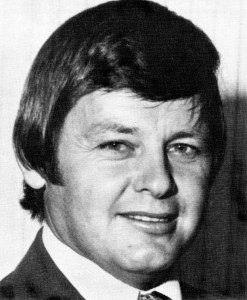
Major Player: Don Ellks

Don Ellks
Image Source: PRLC Annual Report 1976

Donald Stanley Ellks

Senior Manager/General Manager 1980s–1992

Donald (Don) Ellks was one of the most significant operational managers in Panthers’ history.Beginning as a casual barman carrying a drinks tray, he progressed through the ranks over more than twenty-five years to become General Manager, helping guide the club through its relocation to Mulgoa Road and the rapid growth that followed.

His association with Penrith Rugby League Club began through rugby league, including playing for St Marys and Penrith A Grade and serving as a committeeman.

Role in the Narrative

Don was an Assistant Manager then General Manager for the planning, establishment and ongoing operation of the club’s relocation to Mulgoa Rd and the addition of the hotel and Cables Ski Park.

He was also instrumental in supporting the unified governance model that ultimately transformed the management of Panthers.

Background

Born: 1940
Died: 2025

Recognition by Panthers
• Life Membership, Penrith Panthers (1994)

Relevance to Events Described

Panthers was early to recognise the importance of providing pathways for talent, effort and results to progress through the ranks instead of seniority. Don was a case in point, starting as a bar attendant and progressing to General Manager.

Don’s operational management skills and experience complemented Roger’s leadership. In the first few years after the relocation to Mulgoa Road, the club achieved strong double-digit year-on-year sales growth but remained under significant financial pressure. High interest rates, construction cost overruns and the operational demands of rapid expansion meant that increased turnover did not immediately translate into financial security. Don’s experience working in departments, managing departments and managing managers led to the development of the systems and procedures needed for the effective and efficient operation of all departments and the ultimate success of the relocation.

Don’s long history with rugby league and operations also provided Roger with valuable support in the boardroom and dealing with politics.

Don Ellks’ career reflected many of the qualities that underpinned Panthers’ growth during the Cowan era: loyalty, practical experience, operational discipline and a willingness to take responsibility.

While others often occupied the public spotlight, Don was a key figure responsible for turning vision into day-to-day reality.

Related Topics


Related Themes:

Licensed Club · Culture


To receive new Parts and occasional project updates by email, you may subscribe below.

Readers who hold recollections, documents, or material relevant to this history are welcome to contribute via the Commentary & Contributions page.

Project Updates

Receive updates when new parts are published.


Editorial Note

This profile is presented as contextual background.
Additional material may be introduced as the narrative progresses.


Negotiating with Council — The Station St Road Closures

A removed section from the original Chapter 5: Building the Basics — Business Principles and Property. This examines the challenges faced in negotiating with Council over the Station Street site.

Roger reflected that certain individuals within Council held the view — and perhaps the expectation — that he would eventually be taken down a notch or two. To this day one aspect of this attitude irks Cowan, describing it as one of his worst memories.

While others involved in the negotiations may have viewed the issues differently, Roger believed the Club received little recognition for its contribution to the community. In his view, the charges and conditions imposed during the sale and development process reflected a lack of support for what Panthers was attempting to achieve.

I think the Club was treated very unfairly by Council. Before we could start building on Mulgoa Road, we had to sell the Station Street site. Council made it extraordinarily difficult. One of the conflicts related to two roads on the Station Street property. One of them was no more than a line on a map. It had never been a road. But the only way we were going to be able to sell that property was to negotiate with Council. The price Council sought was $850,000 — around a quarter of the total amount the Club expected to receive for the entire property.

I tried everything to get a better deal. I told them of a similar case where a club had been able to negotiate an agreement with its local council to close a road for the nominal sum of $1, as a sign of support for the club.

Our involvement in our community was far greater than that of the other club. For instance, we had previously agreed to a joint venture with Council to build a Police Citizen’s Boys Club in Penrith. It was the first boys club ever built without the need to raise funds from the public. We were sponsoring most sports in the area. On top of this the Club’s work to get Penrith to the elite level of rugby League had dramatically increased the city’s profile. I thought we had earned the right to support from Council, rather than obstruction. The city was benefiting on a number of levels from the work we had done, and it was giving nothing back. In fact it was profiteering from our planning.

I told them what we were planning to do would be a tremendous boost for Penrith. But all they saw were the problems, rather than the advantages.

The roads incident was not the only problem imposed on us by Council over that property sale. Another episode contributed to a very nasty police investigation a few years later.

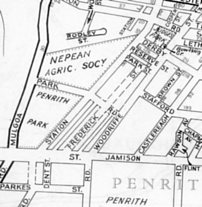
One of the key issues underlying these negotiations related to what are known as paper roads. Paper roads are sections of land set aside by councils for roads in the future. According to Pat Sheehy:

Council planners had discovered the paper road in earlier negotiations for the property. It meant that Panthers did not own the whole site, with the result that Council said “OK, if you want to buy that land back from us, this is what we’re going to charge. All this happened before I was on council, but as far as Panthers was concerned it was absolutely exorbitant.

Robinsons 1957 Street Directory showing Frederick St ( a “paper road”) between Station & Wooddriff Sts. The other street in the negotiation was Park St.

Cowan said the problems extended beyond the property sale and continued into the approval process for the new site:

Council imposed a per hectare sewerage fee on the property based on the total area of land we owned. We were planning to build the club on an area of about 8 hectares. Most of the land was flood-prone, so you couldn’t build on it anyway. But we were hit with this huge bill, based on 86 hectares.

We had to negotiate to defer the payment, but this also became an issue. Even though we eventually came to an agreement, there are still people on Council who believe that Panthers ripped off the Council over that sewerage fee. Under the circumstances, that’s quite laughable

These issues illustrate the complexity of the negotiations and the differing perspectives that would continue to shape relations between the Club and Council.


Related Topics


Related Themes

Governance · Growth · Board Decisions · Licensed Club · Conflict


To receive new Parts and occasional project updates by email, you may subscribe below.

Readers who hold recollections, documents, or material relevant to this history are welcome to contribute via the Commentary & Contributions page.

Project Updates

Receive updates when new parts are published.