A removed section from the original Chapter 13: Amalgamations Not Takeovers. It tells the remarkable story of the contest over the future of Port Macquarie RSL Club — a dispute involving competing amalgamation proposals, an intense local campaign, political intervention and even a bomb hoax. It has been removed from the main narrative because the level of detail interrupts the broader account of Panthers’ amalgamation strategy, but the episode provides important context for both the Port Macquarie amalgamation and the political reaction to Panthers’ expansion.
The Port Macquarie Panthers story reads like the script for a Bruce Willis movie. It had secret meetings and bomb threats, vandalism, office bugging, threatening phone calls, 19 faceless men, and, of course, who let the dog out?
But the most important element of all was people power.
In mid-2000, the Board and management of the Port Macquarie RSL agreed to approach Panthers about an amalgamation. The club was in trouble and had been for many years.
The original RSL club was born in 1947 in a corrugated Nissen hut, in the centre of what was then a small beachside town. The local sub-branch owned the site and leased it to the licensed club.
After a failed attempt to buy the property from the sub-branch in 1986, the club bought the land in Bay Street where its new premises would be built. It was a short distance from the centre of town, in what was to become a prime waterfront location.
The club moved into its new premises in August 1993, but due to the recession and a blow-out in the building costs, it started with a $22 million debt. Within a few months, it became clear that the new location had not attracted local members in the numbers anticipated. The locals were staying away in droves.
By early 1994, management knew they were in trouble. The club went into voluntary administration in May of that year and continued to operate that way until Panthers came on the scene.
An agreement was struck very quickly between Panthers and the club’s chief executive, Greg Willcocks, and board chairman Graham Linn. Board and management of both clubs negotiated a memorandum of understanding. Roger Cowan and Glenn Matthews attended a meeting of around 800 members on 26 November 2000. Linn told members that the amalgamation offered members ‘a brighter and more certain option for the future’.
Contemporary reports and parliamentary records relating to the Port Macquarie amalgamation are available in the PPP Digital Archive: The Port Macquarie Amalgamation — A Contemporary Record: “Shenanigans” at Port .
Roger Cowan also spoke, assuring members that the Panthers model would preserve the club’s local identity, retain local management and that staff would have all their benefits honoured.
He told the meeting that Panthers had been able to negotiate with the bank to bring the club’s debt of $44 million dollars down to around $8.8 million. The members voted almost unanimously to proceed with the amalgamation.
Cowan explains,
The club had been in trouble for a long time, and the debt was growing. A lot of the accumulated debt was unpaid interest. The bank had not been able to bring about any improvements in the club’s trading position and wanted to write it off their books. At that point, they knew that there was no chance that they would ever collect the total debt, so it was just a matter of how far they would come down. We worked out a figure that we thought was manageable and negotiated from that angle.
For Panthers, the next phase began. An application to the licensing court was approved, and it appeared that everything was on track for a smooth transition.
Around the middle of 2001, Cowan received word that the club was looking at an alternative proposition. In the next couple of months, details of the new offer were revealed. A group of 19 local businessmen had put a proposition to the club.
Freely admitting that they were taking advantage of the new, lower debt that had been negotiated by Panthers, they said they had raised $2 million and had finance for the remainder. Their plan was to pay out the debt and take over the ownership of the prime Bay Street site. The club would retain ownership of its bowling club at Hibbard.
The relationship between Panthers and Graham Linn, and to a lesser extent with Willcocks, began to come apart. Unwilling to become embroiled in a local conflict, Panthers decided to back off. To them it seemed that the Port Macquarie club was committing itself to a deal that was almost suicidal, but they could also see there was no point in persisting where they were not wanted.
The nineteen investors were looking at a windfall. They would be buying a prime property for less than $9 million and renting it back to the club. After ten years, or if the club defaulted, they would have the right to sell or redevelop it. Property values in Port Macquarie were increasing, particularly on such a prime waterfront site, adjacent to the only major shopping centre in town. By 2004, the value of Port Panthers site was already close to 25 million. It had increased even more when development opportunities were explored in 2006.
It was a wonderful deal for the investors, but for the club it was a different prospect.
At the end of the ten years it would need to find a new site, in a suitable position, reasonably close to town, in a property market that was going through the roof. If profits were consistently high over the ten years, it may have accumulated the funds to buy the club back or to secure another site and rebuild. If it didn’t, its only alternative would be to relocate to the Hibbard club a few kilometres out of town and build a new club there. It would take an extremely optimistic view to believe that the club could accumulate, in ten years of trading, sufficient capital to start again in a reasonable way. Taking into account its trading history, and that the investors could do nothing to help in that regard, it was more than optimistic.
The biggest complaint from the locals was the fact that these 19 men, throughout the entire process, refused to reveal their identities. The secrecy, the future security of the club, and the enormous profit potential soon had members thinking and talking.
The ‘19 faceless men’ saga became the biggest story in town. Nine months earlier, there had been an overwhelming vote to go with Panthers, but now there were many who now saying that ‘local ownership’ was a better option than letting the big out-of-town super-club come in to take over the world. Today the club is probably much more a locally-owned club than it would have been had it taken the offer to sell the premises.
The club’s chairman and others were now enthusiastically backing the alternative bid. One of the points they would continue to push during the campaign was that the non-Panthers bid would see the club become ‘debt free’. What they failed to mention, however, was that it would also be free of its greatest asset. Instead of paying interest on its loans, it would be paying rent.
One group of members was particularly concerned about the disappearance of Panthers from the negotiating table. These ten ‘concerned club members’ formed their own little consortium. One of them, Col Munro, made a personal phone call to Roger Cowan. He asked, ‘you’re not dumping us, are you?’
I explained to Col that Panthers was not interested in pushing in where it was not wanted. This was a local issue and the members had to sort it out for themselves. He told me that we had been given the wrong impression. A large majority of members still wanted the Panthers amalgamation and the perception in town was that Panthers was letting them down. I finally agreed to meet his group to see if we should become involved again.
The following morning, a breakfast meeting was held in a Port Macquarie coffee shop. It was attended by Roger Cowan, Barry Walsh, and the ten concerned members. Munro was later elected to Port Macquarie Panthers’ advisory board. Another member of the group was David Meidling, also on the advisory board. David also was elected to Panthers’ group board.
Panthers agreed it would honour its original commitment provided there was sufficient support by the members.
The group mounted a campaign, bombarding the local Port News newspaper with letters to the editor. They also got out amongst the townspeople, talking, rallying members and getting signatures on petitions. This tactic would continue over the next three months, and in the end, was the thing that tipped the balance.
A meeting of members was scheduled for 11 October. Both sides would put their case. A local businessman would speak for the 19. It was here that the high farce began. Greg Wilcocks introduced the parties, and Roger Cowan addressed the large crowd for about 30 minutes. A speaker from the other side had just begun to speak when word came through that there was a bomb in the club.
‘Nobody moved for a while, the reaction was quite hostile,’ says Meidling. ‘There were boos and catcalls and the situation became quite ugly. Nobody at the meeting believed there was a bomb, and most refused to leave.’
The police were called and the meeting broke up, but the high farce continued.
Both sides accused each other of staging the hoax, but it did not stop there. Even the Sydney media got involved. In typical tabloid style, a Daily Telegraph story told of ransacked offices, glue in the locks of someone’s car and house, and anonymous phone threats being made to people on both sides. In a particularly bizarre turn, the story said that a gate had been deliberately opened, ‘allowing the general manager’s beagle to wander off’.
Col Munro shrugs that allegation off. ‘That dog had roamed the North Shore all its life’, says Munro. ‘It didn’t know what a fence was.’
‘We also got accused of bugging the boardroom’, says Munro, ‘though I don’t know how we got past security to do it. We used to meet in a little coffee shop near my place.’
Secret meetings became a way of life, for both sides.
Port News editor Janine Graham says the paranoia in people made the bomb threat seem real. ‘That was what pushed it into wierdsville’, she says.
The bomb did turn out to be a hoax, but it was totally unrelated to amalgamations, faceless men, or either club. A local woman had a little too much to drink and made the call. She received a fine and a suspended sentence.
The meeting galvanised the town. It split down the middle, with a massive media campaign. Full page ads ran in the Port News, and the Holiday Coast Pictorial. The latter publication began full-scale attacks on Panthers and the pro-amalgamation group of members. An ad run by a local businessman called the Panthers’ interest a ‘hostile takeover’. The ad stated that Panthers had never clarified the deal and warned that jobs would be in jeopardy.
He had either not been informed that a detailed memorandum of understanding had been signed by both parties, or he chose to ignore it.
The Hastings Council also got into the act, vocally supporting the local bid. One councillor dismissed concerns about the 19 men. ‘It’s not an issue knowing who is in the consortium,’ he said.
Another full-page ad featured local businesspeople and two local politicians, Rob Oakeshott and John Tingle. Tingle called the consortium ‘white knights’ and said their anonymity should not be seen as anything sinister, and spoke of Panthers’ ‘aggressive takeover program’. Richard Face, became involved and asked the DGR look into the situation.
It could all have been clarified with just one phone call: a copy of the memorandum of understanding would have been available to anyone who asked for it within hours. There was nothing secret about it.
The story moved into the annals of NSW parliamentary history. In state parliament, in answer to a Tingle question, minister for gaming and racing, Richard Face said the happenings in Port Macquarie in October 2001 have ‘strengthened my resolve to reform laws relating to club amalgamations’.
Hansard [27.10.2001] records the minister saying,
The new legislation will require that two clubs that are proposing to amalgamate will have to enter into a deed of amalgamation, clearly setting out key information about the amalgamation. One of the key areas … covered in the deed will be a statement as to what degree the management and staff of the dissolving club are to be retained by the continuing club. The deed will also be required to outline how the local identity of the club is maintained by the continuing club after the amalgamation.
Ironically, each of the legislated gaming reform measures were already part of Panthers’ amalgamation model. They had been resolved and approved by the Club’s management and board in 1999, far in advance of the minister’s announcement of the reform package in July 2001.
The minister could have discovered, in less than an hour, that Panthers was actually doing more to protect the interests of the amalgamating clubs than anything he was proposing.
The Port Macquarie issue was finally resolved by a postal vote. Around 15,000 ballot papers were sent to members. Col Munro said a disused police cell was hired to keep the votes secure until they were counted. Counting took place at the police station, each side had scrutineers, and a policeman wandered around keeping an eye on things. Of the 6399 members who responded, 4459 voted to amalgamate with Panthers.
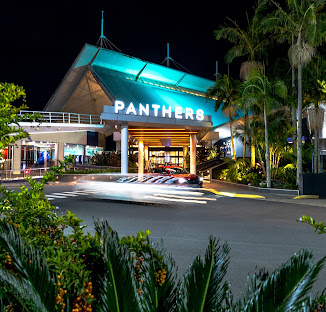
This was the only time that Panthers continued with an amalgamation that was supported by less than 90% of the members of the amalgamating club. This was only a 70% majority. It was the policy of Panthers’ management team to steer clear of local conflicts. If the members wanted to join up with Panthers it would go ahead. In the case of Port Macquarie, the genuine interest and sincerity of people like Col Munro, David Meidling and others was a convincing influence to bend the policy.
Janine Graham says that ultimately it was people power that made the decision.
There was a great deal of ‘spin’ on both sides, but in the end Panthers probably did their job a little better. I would really like to know how they managed to find those agents in Port to wage that campaign for them. It was grapevine and word-of-mouth that made it all happen.
Cowan says it seems that few people in Port Macquarie are aware that it was the ‘agents’ who found Panthers, rather than the other way round. And it was these agents who waged the war and saved the club from a deal that put it at grave risk of having no club at all in ten years.
The 19 faceless men probably agreed to invest $100,000 each. The lower debt negotiated by Panthers meant that the remaining $6.5 million would have been easily borrowed on the security of the valuable real estate they were buying. Recent valuations indicate that each individual investment of $100,000 would already [in 2007] be worth more than $1 million. No wonder they fought so hard to discredit Panthers.
But the politicians had no excuse. They had a responsibility to get to the truth before taking sides – and all it needed was a phone call.
From the Panthers Passion Politics Digital Archive
The Port Macquarie Amalgamation — A Contemporary Record: “Shenanigans” at Port
Follow the controversy through contemporary Port Macquarie News reports and NSW Parliamentary records, from the original support for amalgamation in 2000 through the competing proposals, political intervention and eventual conditional approval in December 2001.
Related Topics
Related Themes
Conflict · Growth · Licensed Club
To receive new Parts and occasional project updates by email, you may subscribe below.
Readers who hold recollections, documents, or material relevant to this history are welcome to contribute via the Commentary & Contributions page.
Project Updates
Receive updates when new parts are published.

