Part 20 of 70 — Original Chapter: Chapter 7: The 16 Year Struggle to Streamline Rugby League
This article forms part of the serialised republication of Panthers, Passion & Politics – The Roger Cowan Years.
Although the new structure fell short of the model Cowan had long advocated, it was seen at the time as a significant step forward.
Both Cowan and the board were pleased with the appointment of Charlie Gibson. He was part of rugby league’s inner circle1, a close friend of Kevin Humphreys, and the man recommended by Mackie and the Super Six for the role of rugby league secretary at Penrith.
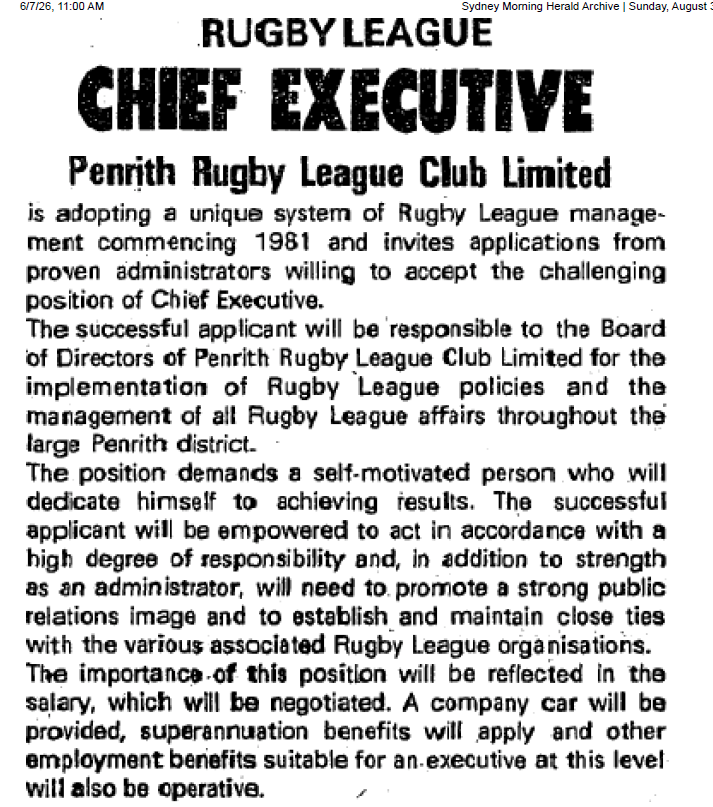
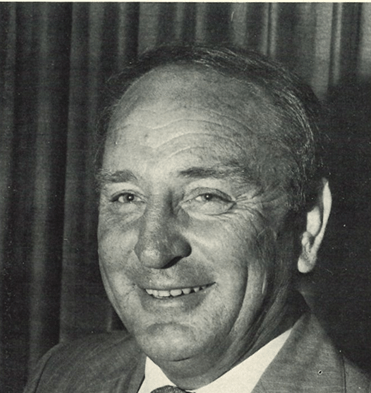
Gibson came with excellent credentials. He had been secretary of the South Sydney club for ten years and was there during the club’s winning streak of four premierships between 1967 and 1971. While the structure fell far short of the ultimate solution Cowan had been fighting to achieve for more than ten years, it was a huge step in the right direction. The Board and Cowan made an agreement that he would concentrate on the licensed club and take no further part in rugby league management. Cowan recalls;
We all thought – great! Charlie really knows his way around the rugby league world and that is what we need. We thought it could be the turning point in our rugby league fortunes.
I thought the board was making a mistake by having him report direct to the board, but I was willing to give it a go. I even agreed to have my contract changed to reflect that rugby league was no longer part of my responsibilities.
Charlie’s role was going to involve a lot of co-operation with the licensed club management in areas of accounting, ground maintenance, and in football-related marketing and promotions.
My vision for the club had always been a structure that united all the expertise available. For example, the club’s catering manager was far better qualified to manage rugby league functions than honorary committees or a rugby league manager. The club’s maintenance and cleaning managers could look after the ground. Financial management could come under the club’s finance manager. Making rugby league successful would require a united effort and a high degree of co-operation.
Problems began to emerge quite early.. They were used to working as a team with overlapping needs, and they felt there was a lack of co-operation that was making their jobs difficult.
The fact is that we were not ready for such a radical departure from the way football was managed in those days.
Although no one realised it at the time, we were again seeing culture at work. This time it was a clash of cultures. Charlie was new to the organisation and we probably should have done more to talk through the tensions that were building. Culture can be a building force but it can also be destructive.
Keith Rhind says that Charlie Gibson was very much a part of the old rugby league ethos. Penrith was developing a culture that was unique, and Gibson often found it hard to adapt. It started out well enough, but eventually the cracks began to appear as the management culture developing at Penrith came into conflict with the rugby league culture that had helped Gibson achieve success at South Sydney.
Tension between the club and rugby league was growing. But that was only the tip of the iceberg. The Gibson appointment would also create a bitter division within the board and ultimately destroy a long-standing friendship between the chairman and Cowan. It would also light the slow-burning fuse that culminated in Detective Sergeant Mick Howe’s raid on the club a few years later.
When the election was held in 1980 for the first joint board, John Hewett became chairman. He had held that position on the licensed club board for the previous ten years, and he and Cowan had become good friends and built a strong working relationship.
Rhind says that Gibson also developed a close relationship with Hewett, taking him to events and functions to meet the high-profile people in his rugby league circles. Hewett was enjoying the attention. Another director from those days describes him as ‘basking in the reflected glory’.
When a Kangaroo tour was coming up, Hewett told others on the board that Gibson was going to use his influence to take him on the tour. It seems likely that Hewett was pushing for this favour and Gibson was doing his best to accommodate him. But there was disquiet among other members of the board, and Gibson himself also appeared unhappy about it.
Looking back, it was a relatively minor issue. Yet it became one of those moments where personality, disappointment and misunderstanding combined to produce consequences far beyond the original dispute.
Hewett believed that he was about to be invited to join league heavyweights on a Kangaroo Tour2, but that belief was against the designs of the heavyweights themselves. When it didn’t happen, Hewett was devastated and the conflict within the Board intensified. His disappointment, and the atmosphere of conflict on the board, caused him to resign as chairman in 1982. But his bitterness remained.
Deputy chairman Barry Hubbard, who was Hewett’s close friend, also resigned, leaving two vacancies on the board executive. Both men remained on the board. Keith Rhind, then deputy chairman, moved into the chairman’s role, which he held until the following AGM. At that meeting, Leo Armstrong was elected unopposed, and would become the club’s longest serving chairman.
Few could have known it at the time, but Armstrong would go on to become the longest-serving chairman in Panthers history and preside over some of the most significant years in the Club’s development.
Nevertheless the tensions that had been building were far from resolved — and the consequences were only just beginning to emerge.
To receive new Parts and occasional project updates by email, you may subscribe below.
Readers who hold recollections, documents, or material relevant to this history are welcome to contribute via the Commentary & Contributions page.
Project Updates
Receive updates when new parts are published.
- For more on Cowan’s experiences within the NSW Rugby League hierarchy, Removed Section in Beyond the Book – Rugby League’s Inner Circle. ↩︎
- A Kangaroo Tour was regarded as a high honour and a prestigious experience for rugby league administrators during this era. ↩︎

