Beyond the Book — Commentary & Contributions
Phil Morehead remembers an unusual sponsorship idea — and the leadership lesson that followed.
Contributor: Phil Morehead
Phil Morehead was a partner in Thomas Marsden Advertising the advertising agency and design studio that supported Panthers for many years. Phil also was a long-time active member and President of the Penrith Valley Chamber of Commerce. In this contribution he recalls how Penrith P Panther came into existence and became a recognisable community figure.
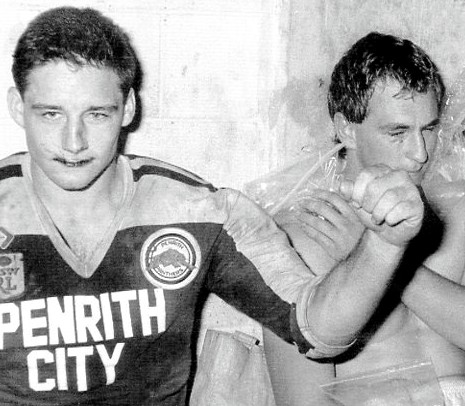
In 1988, the name across the front of the Penrith Panthers jersey wasn’t a company or a commercial product.
It was PENRITH CITY.
The arrangement lasted for just one season. But the story of how it came about provides an interesting glimpse into the relationship between the Panthers, the business community and the city during a period when all three were growing.
For Phil Morehead, however, the strongest memory isn’t really about sponsorship at all.
It is about Roger Cowan.
Phil was a partner in Thomas Marsden Advertising, the long-time advertising agency for Panthers, and at the time was also President of the Penrith Chamber of Commerce. He remembers Roger approaching him because Panthers had been unable to secure what Roger regarded as a suitable major jersey sponsor.
Roger saw another possibility.
The football team was appearing regularly on television and in newspapers, carrying the Penrith name far beyond the district. If a commercial sponsor couldn’t be found, why not use that exposure to promote Penrith itself?
As Phil recalls:
Roger was big on promoting Penrith and realised the massive media exposure our football team was delivering every time they played. It was Roger’s concept to have PENRITH CITY on the jerseys.
Phil was wearing what he describes as his “two hats” — advertising man and Chamber President — and the two began developing a plan around the idea.
A city gets behind its team
The proposal went well beyond simply putting PENRITH CITY on a football jersey.
An Art Union was planned. Local motor dealers came on board with a new car as first prize. Other businesses would provide additional prizes, while the Chamber’s extensive business network would help sell and promote the tickets.
Responsibilities were allocated among the various people involved and another meeting was scheduled to check progress.
By then, Roger had acted — the jerseys had been ordered.
Phil had acted too. Retailers were prepared and the posters, tickets and other promotional material had been produced.
Then came the follow-up meeting.
In Phil’s recollection, almost nobody else had completed what they had undertaken to do. He particularly remembers a young Royce Simmons, then working with the junior clubs, apologising because he hadn’t had time to complete his part.
The original plan was in trouble.
“We will have to put this aside”
Roger looked at the situation and made the decision.
The jerseys could no longer be altered. Thousands of dollars had already been spent on promotional material. But without the other elements in place, the broader campaign could not achieve what had originally been intended.
Phil remembers Roger saying:
Well, the jerseys cannot be altered, we’ve already spent thousands of dollars on promotional material and I don’t think we can achieve our goal. We will have to put this aside and go back to the drawing board.
What impressed Phil was not simply the decision. It was the absence of everything that might easily have accompanied it.
No anger. No criticism. No ‘what are we going to do now’?
The plan had not come together. People had failed to deliver what they had agreed to do. Roger was undoubtedly disappointed.
But, as Phil remembers it, there was no attempt to embarrass anyone, allocate blame or prolong the failure.
A decision was made and everyone was allowed to move on.
For Phil, it became an enduring example of Roger’s leadership — particularly his capacity to make a hard decision without condemning the people whose actions had helped make that decision necessary.
The unexpected result
The original promotional scheme may not have proceeded as intended, but something significant remained.
The jerseys had already been produced.
So, throughout the 1988 season, the Penrith Panthers ran onto the field carrying PENRITH CITY across their jerseys.
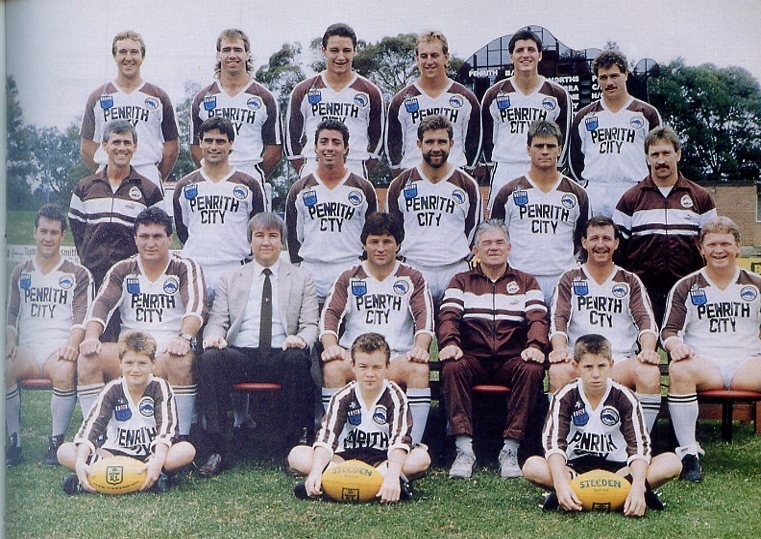
BACK (l to r): Rod McNeil, Matt Goodwin, Mark Geyer, John Cartwright, Graeme Bradley, Cal Van Der Voort.
MIDDLE(l to r): Bryan Hider, Neil Baker, Greg Alexander, Geoff Gerard, Chris Mortimer, Steve Colman.
FRONT (l to r): Greg Clements, Peter Kelly, Steve Robinson, Royce Simmons (c), Ron Willey (coach), David Greene, Brad Izzard.
Ballboys (l to r): Tim Bailey, Paul Bicknell, Brad Bateup.
For Phil, wearing his Chamber of Commerce hat, there was a considerable consolation. Panthers honoured the costs already incurred in producing the promotional material, while the Chamber could tell the local business community that its football team would be promoting Penrith City throughout the season without cost to the Chamber.
It was, in Phil’s words, one of the “win win” experiences of his time as Chamber President.
And the unusual arrangement proved short-lived.
In 1989, Calphos became the Panthers’ major jersey sponsor. In 1990, DahDah took over the major sponsorship, apppeared in a grand final, then a major change in colours, and a premiership win — impeccable timing. DahDah remained on the jersey through to 1993.
Phil wonders whether that prominent PENRITH CITY branding across the Panthers jersey helped open the door for the commercial sponsorships that followed.
Perhaps it did. But his recollection leaves another legacy.
A plan had failed. Money had already been spent. Commitments hadn’t been met. Roger had every reason to be frustrated.
Yet the thing Phil Morehead remembers almost four decades later isn’t the frustration.
It is the way Roger treated the people around the table.
Related Topics
- Beyond the Book — How Penrith P. Panther Was Born
- Beyond the Book — Bringing Phil Gould Back to Penrith
- Beyond the Book — Following the Merger Debate
Related Themes
Culture · Innovation · Football Club · Leadership
To receive new Parts and occasional project updates by email, you may subscribe below.
Readers who hold recollections, documents, or material relevant to this history are welcome to contribute via the Commentary & Contributions page.
Project Updates
Receive updates when new parts are published.

