The anti-rugby-league tag is the one that angers Cowan most. It was such a ridiculous claim; he says.
I fought for years to bring about a more streamlined administration of Rugby League despite the conflict, and the criticism that I was bringing down on myself. The results speak for themselves. I was single minded about the need to run a profitable club. If we had spent all our money on football in the seventies, we would not have grown from that very tiny base to one that continues to compete at the top level. Whenever the football club was in crisis I stepped in and did both jobs.
Panthers’ group chairman Barry Walsh worked with Cowan for most of those forty years. He says that on a number of occasions when the team was going through a series of losses and nothing seemed to be working for the coach, Cowan assisted with player motivation. He adds that only very few people ever knew of Cowan’s involvement at that level.
It involved many hours of preparation and attendance at every game. On many occasions he was providing weekly counselling sessions for individual players who had specific problems affecting their performances.
Cowan recalls:
One of my greatest interests for many years has been the power of the unconscious to affect performance. There are many ways of tapping into that power. Meditation, yoga, hypnosis and NLP (Neuro Linguistic Programming) are all examples and the benefit different people in different ways. I found that a sequence of losses could always be altered by changing patterns of thinking. The majority of athletes, even in losing teams, respond to some of the techniques. I also discovered some of the pitfalls of trying too much.
I only ever offered help after the team had suffered a string of defeats, and on every occasion, there was a turnaround at the very next game. Every time. There was no personal gain – my only motive was to help the team perform better and assist the coach.
My critics say that I would not pay the cost of having a good team. Yet some of them held a majority on the board and made the policy decisions. They never suggested any changes to the budgets for rugby league. When a coach was going through a tough time some of them held secret meetings with players. This brought bad publicity and further demoralised a coach who already had enough problems.
Supporting Rugby League goes far beyond cheering the team from free seats in the grandstand or a private box, rubbing shoulders with the stars of the game, grandstanding at annual meetings, and enjoying spectacular Rugby League events as an invited guest. Directors – and the patron of the club – held that privileged position. It was always disappointing to me that Ron Mulock did not appreciate it to the extent that he would at least accept an invitation from the Chairman to settle his differences quietly and privately in the Boardroom, rather than with very public criticisms.
The reader might be just a little puzzled at this stage about who was really anti-rugby-league – it always puzzled me.
If Cowan really had been anti-rugby-league, he could have saved himself a lot of anguish by leaving the hard decisions to others. He could have left the stress that goes with changing coaches and staff, running workshops, writing recommendations and fighting for a united administration to others, and kept right out of it. It is difficult to criticise someone for doing nothing.
It wasn’t as if there weren’t other things to think about. The Club was embarking on a brand-new path – to amalgamate with other clubs. Although totally unrelated to football, this new strategy would be used by some to feed the fires of the anti-rugby-league myth.
To receive new Parts and occasional project updates by email, you may subscribe below.
Readers who hold recollections, documents, or material relevant to this history are welcome to contribute via the Commentary & Contributions page.
Football fans are always looking for defining moments in their team’s history. A new coach arrives. A star player signs. A premiership follows. The story writes itself.
For Penrith, one of those defining moments was the appointment of Phil “Gus” Gould as first-grade coach in late 1989.
The most common version of this story is simple. Ron Willey departs, Gould returns, and within two seasons the Panthers are premiers.
A simple story that rings truth when told — but, really, the story is only partly told. And, so, does not hold the whole truth
The return of Phil Gould to Penrith, as coach, was undoubtedly one of the most significant decisions in the Club’s history. His influence on standards, preparation, selection and tactical innovation would prove decisive. Yet his appointment was not the beginning of Penrith’s rise. Rather, it was the culmination of a long organisational journey that had transformed the club over more than two decades but most dramatically during the seven years preceding his appointment.
Understanding why Gould succeeded at Penrith requires understanding the club he inherited.
Building a club capable of winning
When Roger Cowan became General Manager in 1965, Penrith was little more than an ambitious newcomer attempting to survive in Sydney’s fiercely competitive rugby league landscape.
The years that followed were devoted to building foundations — foundations of financial stability, sound governance, operational capability and an increasingly professional culture.
The club established administrative systems where few had previously existed. It strengthened its financial position, developed licensed club operations, invested in junior rugby league and gradually created an organisation capable of supporting elite football.
Many of these changes attracted little public attention — and some internal pain and conflict — yet each became another piece of the structure upon which future success would rest.
At the same time, a remarkable generation of local footballers was emerging.
From hopefuls to contenders
Tim Sheens deserves enormous credit for changing the direction of Penrith football.
His young side reached the club’s first semi-final in 1985 and, perhaps more importantly, changed what players and supporters believed was possible.
For the first time, Penrith expected to compete rather than merely participate.
When Ron Willey succeeded Sheens in 1987, he inherited a talented but still developing football team. Over the following three seasons he consolidated much of the progress already achieved — he also instilled a harder competitive edge — what many describe as ‘mongrel’ — that had previously been missing.
The Panthers’ consistency ramped up a couple of pegs, reaching the semi-finals again in 1988 before finishing second on the ladder in 1989, only to bow out in “straight sets” — a loss to Balmain (12-24) in Major Preliminary Semi-Final followed by a loss to Canberra (18-27) in the Minor Semi-final. Canberra went on to win the Grand Final over Balmain.
Willey’s contribution is often overshadowed by what followed, but history should remember that he coached Penrith through an important stage of its development. He inherited an emerging football side and left behind a genuine premiership contender.
By the end of 1989, however, there was a sense that the club had reached an important crossroads. Penrith’s next coach would need to be fully devoted to the Panthers and build upon the foundations already laid. In this late 1989 article Roger Cowan tells Roy Masters:
We need a coach who can devote four or five hours a day to our best juniors and then supervise the Panthers’ three grades in the evenings.
Sydney Morning Herald 28 Sep 1989 — click image to enlarge and read
While the club had become more competitive, the question was whether it could become the best.
The right coach at the right time
Phil Gould did not arrive to rescue a struggling football club.
He arrived at a club already pounding on the door. Today, you’ll often hear the expression “premiership window” — well, Gus joined when that window was wide open.
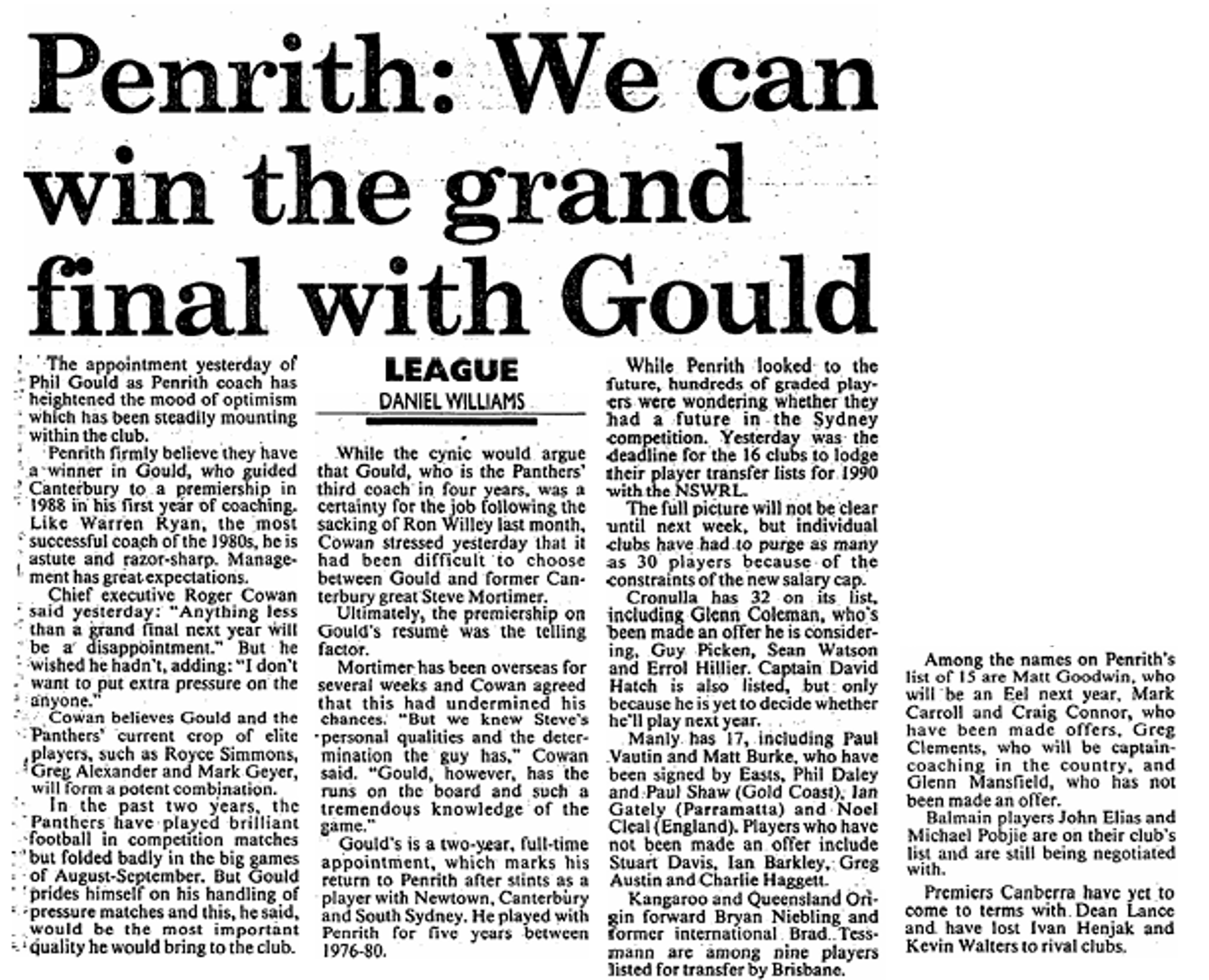
Sydney Morning Herald Headline 14 Oct 1989 — click image to read full article.
His coaching philosophy was uncompromising. Fitness standards rose. Preparation became more meticulous.
Selection became ruthless when necessary. Reputation alone offered no protection. Gould was prepared to make difficult decisions if he believed they improved the team, even when they involved respected senior players.
The controversial decisions surrounding Royce Simmons during both 1990 and 1991 illustrated both the personal cost and Gould’s willingness to place team performance ahead of sentiment. Those decisions were fiercely debated at the time but reflected the standards he expected throughout the organisation. Bound for Glory recounts Gould’s insistence that difficult decisions were necessary if Penrith was to push through that premiership window and transform from contenders to champions.
His greatest contribution may not have been introducing entirely new ideas, but demanding that every aspect of the football operation meet a higher standard.
Royce Simmons, in Hooked on League, describes some of the changes in 1990:
With Phil Gould at the helm … Weight coaches came to the club for the first time, there was a bit more money in the game and you were able to get away from work a little earlier and get fitter. The game was becoming semi-professional. … Phil was much more structured in his approach with not as much emphasis on skills but certainly a lot more education on how to play a more structured game.
Importantly, he inherited players capable of responding to those demands.
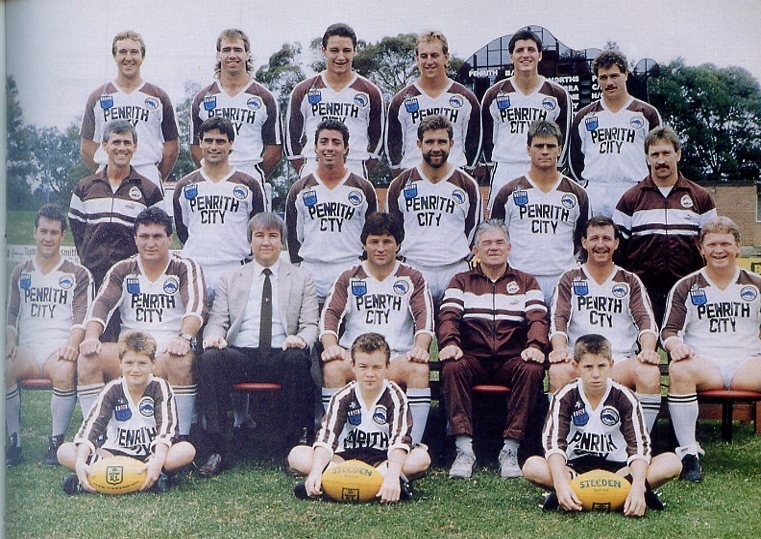
Greg Alexander, Royce Simmons, Mark Geyer, John Cartwright, Brad Izzard, Brad Fittler, Colin van der Voort, Col Bentley and others had largely developed together through Penrith’s football system. Gould refined them into a premiership side.
Just as importantly, he inherited a club capable of supporting elite football.
Behind the scenes, Penrith’s administration continued to expand sponsorship, strengthen finances, modernise marketing and deepen its connection with the wider district. As Bound for Glory records, the Club’s transformation extended well beyond the playing field, with new sponsorships, a new black playing strip for 1991, a rapidly growing marketing operation and increasing community engagement all reinforcing the confidence of an organisation entering the 1990s with growing belief.
The football team was improving because the club itself was improving.
More than one architect
It is tempting to view premierships through the lens of individuals.
Roger Cowan, Tim Sheens, Ron Willey, Phil Gould. Greg Alexander, Royce Simmons — each individually occupies an important place in the history of the Penrith Panthers that led to the 1991 Winfield Cup heading west to Penrith.
Yet focusing too heavily on any one figure risks missing the broader story.
Successful organisations rarely emerge because of one appointment or one season. They are built through hundreds of decisions, made by countless people over many years.
Roger Cowan with successive boards and countless staff built the organisation.
Tim Sheens rebuilt belief.
Ron Willey consolidated competitiveness.
Phil Gould delivered the final refinement.
Each stage depended upon the one before it.
The Final Piece
Looking back on those days, Gould’s appointment appears inevitable.
It was anything but.
It is now well-known that Steve Mortimer was a very strong contender for the Panthers role — and had he not been on a world trip at the crucial time discussions were being held, he may have landed the job. Sliding doors.
Had the Board chosen differently at the end of 1989, Penrith may still have remained one of the competition’s strongest clubs. Whether it would have climbed the final step can never be known.
What history can say with confidence is that Gould arrived at precisely the moment when Penrith was ready for him.
The Panthers did not become premiers simply because they appointed Phil Gould.
They became premiers because, after twenty-five years of organisational development, administrative reform, financial strengthening, football rebuilding and cultural change, the club had finally become capable of making the most of a coach of his calibre.
That is the story. It is a more complete story than the “Gould arrives — Panthers become premiers — Gould is the hero” popular narrative.
Phil Gould’s return was not the beginning of Penrith’s rise — it was the moment when years of patient preparation found their final catalyst.
Over more than forty years Royce Simmons has beome one of the most enduring figures in Penrith Panthers history, as player, captain, premiership winner, coach, mentor, ambassador and community leader. His player and coaching statistics alone can’t paint his true portrait or explain why generations of Panthers supporters speak of him with such affection and respect.
Royce represents something beyond football. His determination, humility, loyalty and connection with the community reflects the culture Panthers spent decades trying to build. As the club evolved from perennial battlers into premiers and one of Australia’s leading sporting organisations, Royce Simmons became its most recognisable human face.
Few individuals have become so closely woven into the identity of a sporting club.
Role in the Narrative
Royce Simmons occupies a unique place within Panthers Passion & Politics because his involvement spans many of the defining periods of the club’s history.
He first appears as one of the emerging players who would become central to the football transformation initiated during the 1983 Strategic Reset. As captain, he became the on-field leader of a club that was consciously reshaping its culture, systems and expectations. The success of those reforms ultimately culminated in Penrith’s first premiership in 1991, with Royce scoring two tries in his farewell match.
His importance to the narrative does not end there.
Returning as head coach, Royce led the football club through one of the most turbulent periods in rugby league history. The Super League conflict, the introduction of competition criteria, financial pressures and the difficult rebuilding years all form major themes within this series. Throughout those challenges, Royce provided continuity, stability and leadership at a time when the organisation faced extraordinary uncertainty.
Royce through leadership, example and an unwavering commitment to the club became one of the constants in the Panthers story.
More broadly, Royce represents one of the central themes running throughout Panthers Passion & Politics: that lasting organisational success depends as much upon culture and character as it does upon talent or strategy. Repeatedly, teammates, coaches and commentators describe him not simply as a champion footballer but as the embodiment of what it meant to be a Panther.
Country Beginnings
Born on 2 May 1959 in the small central western New South Wales town of Gooloogong, Royce grew up immersed in country sport and the values that accompanied it — hard work, resilience, mateship and community. Rugby Union initially occupied much of his attention and he represented NSW Country at under-16 level before turning his focus to Rugby League. After playing senior football for Cowra and Canowindra, he travelled to Sydney seeking an opportunity in first grade.
Trials with St George and South Sydney failed to produce a contract, but the Panthers coach, Len Stacker, got a tip about Simmons from former Parramatta teammate Barry Rushworth. It was a good tip – and would prove to be one of signings in the club’s history.
Growing with the Club
Royce arrived at Penrith in 1980 when the club was still searching for both consistency and identity. Success remained elusive and Panthers were still regarded by many as one of the competition’s easy-beats.
As Panthers undertook the organisational reforms that occurred in late 1983, Royce emerged as one of the players who best reflected those changes — in fact he played an influential role in developing those reforms, and in ensuring Tim Sheens changed his plans and stayed to coach the Panthers.
Initially playing at lock before establishing himself as the club’s first-choice hooker, he became captain in 1983 and quickly developed a reputation for leading through actions rather than words. While representative honours followed—including ten State of Origin appearances for New South Wales and ten Test matches for Australia—his greatest contribution was arguably the standards he set within the club itself.
Phil Gould would later declare:
Royce Simmons is the heart and soul of this club.
That description has been echoed repeatedly by teammates, coaches, journalists and supporters.
The Embodiment of Panthers Culture
Within the story told throughout Panthers Passion & Politics, Royce Simmons represents something more significant than an outstanding football career.
The Panthers of the 1980s were intent on turning the club around through building a new organisational culture. The cultural values were being developed throughout the club, from the Board and administration to coaches, staff and players.
His leadership displayed the standards the club’s administrators and coaches were working to establish throughout the organisation.
John Cartwright later reflected:
Royce was our glue. He held the whole thing together.
Greg Alexander described him as:
The toughest bloke I ever played with. He never took a backward step.
Mark Geyer perhaps captured his influence most simply:
Royce taught us what it meant to be Panthers.
Those comments describe a footballer and, more importantly, a cultural leader.
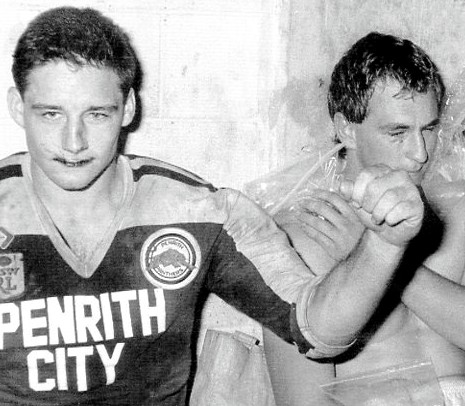
Two leaders – both knock-about blokes — photo: Craig Golding (SMH)
A Fitting Farewell
Royce captained Penrith through 1980s during the Club’s transformation, an played in its first Finals Series appearance, first Grand Final appearance and first Premiership.
His two tries in the 1991 Grand Final helped secure Penrith’s first premiership and provided one of the most memorable farewells in Australian rugby league history. He retired immediately afterwards, having helped transform the club from competition battlers into premiers.
Royce’s celebration after scoring his second try in that grand final win is one of the most iconic images in Panthers’ history … and perhaps in Rugby League history.
Returning to Lead
Retirement from playing did not end Royce’s service to Panthers.
When Royce returned to coach Penrith in 1994, he inherited a club coming out of a very unstable era where club culture had drifted badly. As well, the Club was entering another period that would prove difficult to navigate.
His coaching tenure coincided with one of the most turbulent periods in rugby league history. Super League divided the game, the salary cap reshaped recruitment, and Panthers entered another rebuilding phase.
Despite those challenges, Royce guided the club to finals appearances in both the 1997 Super League competition and the 2000 NRL season. He remained fiercely loyal to his players during difficult years and was reluctant to publicly criticise individuals when results deteriorated.
At the end of the 2001 Season his tenure as Panthers coach finished but the impact he had on the Club had not. Following the 2003 premiership victory John Lang, Panthers premiership-wining coach, credited Royce Simmons with some of that victory praising the work he’d done creating the core of that winning team.
Simmons’ value as a leader during his coaching tenure should not be measured by win-loss statistics but through the stability, integrity and belief be inspired.
Beyond Football
Despite having some successful coaching stints away from Penrith — Hull (1992-94), Wests-Tigers (2003-10), as Assistant to Tim Sheens, and St Helens (2011-12) — he never lost touch with Penrith.
He has remained one of the Club’s most respected ambassadors, supporting a stack of community initiatives and continues to show the younger Panthers what it means to be a Panther.
Following his diagnosis with Alzheimer’s disease in 2021, Royce transformed personal adversityinto public advocacy. Through fundraising walks and awareness campaigns, he has helped raise both funds and understanding for dementia research while continuing to inspire the broader community.
His appointment as Brand Ambassador for The Royce retirement communicty reflects the qualities that have endeared him with Panthers supporters and the wider rugby league community — down-to-earth honesty, humour and humility.
Perhaps his greatest achievement has been the initiation and development of the Royce Simmons Foundation which is dedicated finding a cure to dementia and supporting those wh are affected by it. His Big Walks have very quickly eastablished themselves as legendary, just like the man hwo has choreographed them You can get involved through donation or participation — for more see https://www.roycesimmonsfoundation.com.au/.
Background
Born: 2 May 1959, Gooloogong, New South Wales
Profession: Rugby League player, coach. Ambassador.
Panthers Involvement • First Grade Player (1980-1991) • Club Captain (1983-1990) • Head Coach (1994-2001) • Club Ambassador
Representative Honours • New South Wales (10 State of Origin matches) • Australia (10 Tests)
Honours • Penrith Panthers Player of the Year — 1981, 84, 86, 87 (renamed Merv Cartwright Medal in 2006) • John Farragher Award for Courage & Determination — 1982, 85 (shared with Matt Goodwin), 89. • 1991 NSWRL Premiership • Panthers Life Member (1992) • Panthers Team of Legends (2006) • Panthers Hall of Fame (2016) • Australian Sports Medal (2000) • Centenary Medal (2001) • Medal of the Order of Australia (OAM) (2025
Relevance to Events Described
Royce Simmons presence throughout the Panthers, Passion & Politics series is significant. He features in:
As captain during the Club’s 1983 transformation and strategic reset.
Evolution of the Club’s culture — especially as Coach when his leadership positively impacted the connection between licensed club and football club teams.
Simmons was instrumental in the development of the “Five-by-Five” focus on local talent and leadership.
Super League – helped guide the Panthers through this tumultuous era, including the rationalisation trauma.