
Bringing Phil Gould Back to Penrith

Success rarely begins with the final appointment

Football fans are always looking for defining moments in their team’s history. A new coach arrives. A star player signs. A premiership follows. The story writes itself.

For Penrith, one of those defining moments was the appointment of Phil “Gus” Gould as first-grade coach in late 1989.

The most common version of this story is simple. Ron Willey departs, Gould returns, and within two seasons the Panthers are premiers.

A simple story that rings truth when told — but, really, the story is only partly told. And, so, does not hold the whole truth

The return of Phil Gould to Penrith, as coach, was undoubtedly one of the most significant decisions in the Club’s history. His influence on standards, preparation, selection and tactical innovation would prove decisive. Yet his appointment was not the beginning of Penrith’s rise. Rather, it was the culmination of a long organisational journey that had transformed the club over more than two decades but most dramatically during the seven years preceding his appointment.

Understanding why Gould succeeded at Penrith requires understanding the club he inherited.

Building a club capable of winning

When Roger Cowan became General Manager in 1965, Penrith was little more than an ambitious newcomer attempting to survive in Sydney’s fiercely competitive rugby league landscape.

The years that followed were devoted to building foundations — foundations of financial stability, sound governance, operational capability and an increasingly professional culture.

The club established administrative systems where few had previously existed. It strengthened its financial position, developed licensed club operations, invested in junior rugby league and gradually created an organisation capable of supporting elite football.

Many of these changes attracted little public attention — and some internal pain and conflict —  yet each became another piece of the structure upon which future success would rest.

At the same time, a remarkable generation of local footballers was emerging.

From hopefuls to contenders

Tim Sheens deserves enormous credit for changing the direction of Penrith football.

His young side reached the club’s first semi-final in 1985 and, perhaps more importantly, changed what players and supporters believed was possible.

For the first time, Penrith expected to compete rather than merely participate.

When Ron Willey succeeded Sheens in 1987, he inherited a talented but still developing football team. Over the following three seasons he consolidated much of the progress already achieved — he also instilled a harder competitive edge — what many describe as  ‘mongrel’ — that had previously been missing.

The Panthers’ consistency ramped up a couple of pegs, reaching the semi-finals again in 1988 before finishing second on the ladder in 1989, only to bow out in “straight sets” — a loss to Balmain (12-24) in Major Preliminary Semi-Final followed by a loss to Canberra (18-27) in the Minor Semi-final. Canberra went on to win the Grand Final over Balmain.

Willey’s contribution is often overshadowed by what followed, but history should remember that he coached Penrith through an important stage of its development. He inherited an emerging football side and left behind a genuine premiership contender.

By the end of 1989, however, there was a sense that the club had reached an important crossroads. Penrith’s next coach would need to be fully devoted to the Panthers and build upon the foundations already laid. In this late 1989 article Roger Cowan tells Roy Masters:

We need a coach who can devote four or five hours a day to our best juniors and then supervise the Panthers’ three grades in the evenings.
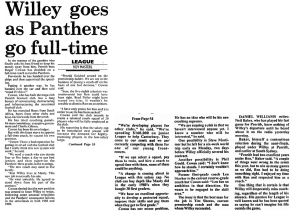
While the club had become more competitive, the question was whether it could become the best.

The right coach at the right time

Phil Gould did not arrive to rescue a struggling football club.

He arrived at a club already pounding on the door. Today, you’ll often hear the expression “premiership window” — well, Gus joined when that window was wide open.
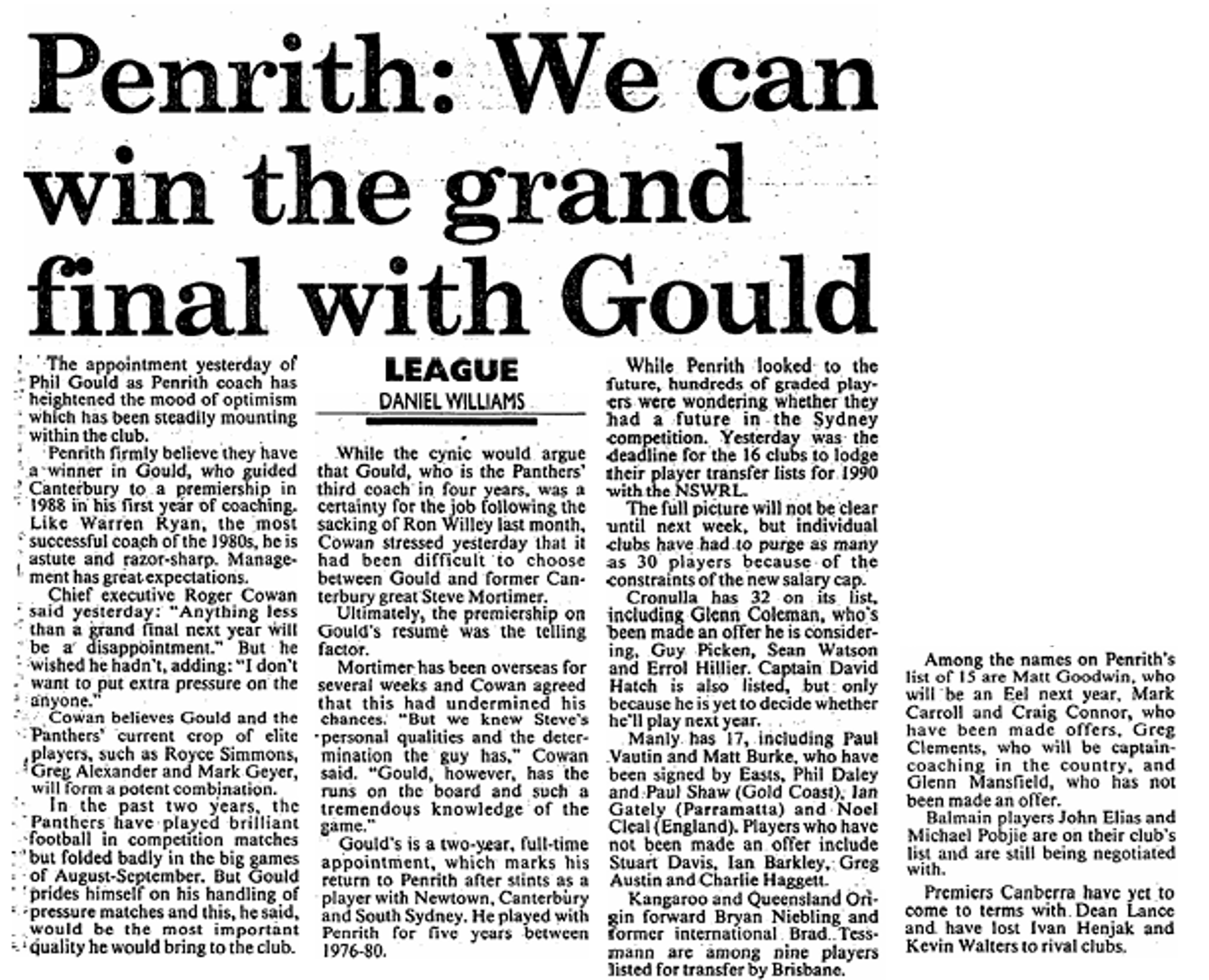
Sydney Morning Herald Headline 14 Oct 1989 — click image to read full article.

His coaching philosophy was uncompromising. Fitness standards rose. Preparation became more meticulous.

Selection became ruthless when necessary. Reputation alone offered no protection. Gould was prepared to make difficult decisions if he believed they improved the team, even when they involved respected senior players.

The controversial decisions surrounding Royce Simmons during both 1990 and 1991 illustrated both the personal cost and Gould’s willingness to place team performance ahead of sentiment. Those decisions were fiercely debated at the time but reflected the standards he expected throughout the organisation. Bound for Glory recounts Gould’s insistence that difficult decisions were necessary if Penrith was to push through that premiership window and transform from contenders to champions.

His greatest contribution may not have been introducing entirely new ideas, but demanding that every aspect of the football operation meet a higher standard.

Royce Simmons, in Hooked on League, describes some of the changes in 1990:

With Phil Gould at the helm … Weight coaches came to the club for the first time,  there was a bit more money in the game and you were able to get away from work a little earlier and get fitter. The game was becoming semi-professional. … Phil was much more structured in his approach with not as much emphasis on skills but certainly a lot more education on how to play a more structured game.

Importantly, he inherited players capable of responding to those demands.

Greg Alexander, Royce Simmons, Mark Geyer, John Cartwright, Brad Izzard, Brad Fittler,  Colin van der Voort, Col Bentley and others had largely developed together through Penrith’s football system. Gould refined them into a premiership side.

Just as importantly, he inherited a club capable of supporting elite football.

Behind the scenes, Penrith’s administration continued to expand sponsorship, strengthen finances, modernise marketing and deepen its connection with the wider district. As Bound for Glory records, the Club’s transformation extended well beyond the playing field, with new sponsorships, a new black playing strip for 1991, a rapidly growing marketing operation and increasing community engagement all reinforcing the confidence of an organisation entering the 1990s with growing belief.

Beyond the Book: Phil Morehead recalls an earlier example of Panthers combining football, marketing and promotion of the wider district — the unusual story of how PENRITH CITY came to appear on the Panthers jersey in 1988.

The football team was improving because the club itself was improving.

More than one architect

It is tempting to view premierships through the lens of individuals.

Roger Cowan, Tim Sheens, Ron Willey, Phil Gould. Greg Alexander, Royce Simmons — each individually occupies an important place in the history of the Penrith Panthers that led to the 1991 Winfield Cup heading west to Penrith.

Yet focusing too heavily on any one figure risks missing the broader story.

Successful organisations rarely emerge because of one appointment or one season. They are built through hundreds of decisions, made by countless people over many years.

Roger Cowan with successive boards and countless staff built the organisation.

Tim Sheens rebuilt belief.

Ron Willey consolidated competitiveness.

Phil Gould delivered the final refinement.

Each stage depended upon the one before it.

The Final Piece

Looking back on those days, Gould’s appointment appears inevitable.

It was anything but.

It is now well-known that Steve Mortimer was a very strong contender for the Panthers role — and had he not been on a world trip at the crucial time discussions were being held, he may have landed the job. Sliding doors.

Had the Board chosen differently at the end of 1989, Penrith may still have remained one of the competition’s strongest clubs. Whether it would have climbed the final step can never be known.

What history can say with confidence is that Gould arrived at precisely the moment when Penrith was ready for him.

The Panthers did not become premiers simply because they appointed Phil Gould.

They became premiers because, after twenty-five years of organisational development, administrative reform, financial strengthening, football rebuilding and cultural change, the club had finally become capable of making the most of a coach of his calibre.

That is the story. It is a more complete story than the “Gould arrives — Panthers become premiers — Gould is the hero”  popular narrative.

Phil Gould’s return was not the beginning of Penrith’s rise — it was the moment when years of patient preparation found their final catalyst.


Related Topics


Related Themes

Leadership · Strategic Planning · Football Club


To receive new Parts and occasional project updates by email, you may subscribe below.

Readers who hold recollections, documents, or material relevant to this history are welcome to contribute via the Commentary & Contributions page.

Project Updates

Receive updates when new parts are published.
Outlining the Risk for the Board

This article forms part of the serialised republication of Panthers, Passion & Politics – The Roger Cowan Years.

Start · Reader’s Guide · All Parts

Considering the possible contingency responses was one thing. Recommending a course of action to the Board was another. By early 1998 management believed it could no longer treat the issue as a theoretical exercise.

By early 1998, Cowan says he and Levy had reached an unavoidable conclusion.

We came to the conclusion – we just have to do something, otherwise Panthers is going to disappear off the face of the earth as far as rugby league is concerned

We were in a weak bargaining position because it was quite obvious that we could not make it under the criteria.  If we started negotiations early enough, we could use the strength of the Panther brand and our junior league to reinforce our position. Waiting until we missed selection would leave us nothing more than a takeover target. If we had to merge it should be as an equal partner. Then, at least, half of our games would still be played in Penrith and the Panther brand would continue to strengthen.

Together they prepared their first formal recommendation to the Board—that Panthers should at least begin exploring the possibility of a merger with Parramatta.

Every chief executive has a duty to advise the Board of risks that may threaten the organisation’s future. Failing to do so would represent a serious dereliction of responsibility. Equally important is the obligation to identify available options and make appropriate recommendations. If Panthers genuinely faced exclusion from the national competition, management had a duty to ensure the Board understood both the risks and the possible responses.

Management’s recommendation was not that Panthers should merge with another club. Rather, it was that the Board should investigate every realistic contingency before circumstances removed those choices. If the club’s worst fears were realised, directors would then be able to make an informed decision from a position of preparation rather than desperation.

Between 1995 and1999, the structure of the Panthers board changed dramatically. John Bateman, who had been elected to Penrith Council in 1995, was appointed to a board vacancy in the same year. He had worked well in what had been a strong and cohesive board. But between 1997 and 1999, three seats became available on the Board. They were filled by Craig Terry, Greg Evans and Dennis Coffey, some of whom had social and business ties with Bateman.

Cowan began to feel a change in the attitude of long-term director Geoff James who seemed to be developing a close alliance with the other four. Before long, the removal of long-serving Chairman Leo Armstrong would point to the existence of a faction for the first time in the Panthers history. In answer to a question in 2007, John Bateman insisted that there never was a faction, except in his final year on the Board, 2002.

Despite the changed board dynamics at Penrith, both Penrith and Parramatta
were willing to discuss all options in the early stages of negotiations. Neither board really wanted to amalgamate, as Cowan explains,

Had there been a vote at Parramatta the outcome may have been a small minority in favour. We know what the vote at Penrith would have been and there is absolutely no doubt about it – nine directors against amalgamation and none in favour. That never, ever changed.

So, if that was the case, what was the point of discussing it at all? And why was there a softer attitude towards amalgamation at Parramatta
than there was at Penrith? Probably, the main reason was that for Parramatta, it was never a life and death decision.

For us, it was. All the facts that Mark and I had presented to the board showed that we were in critical danger of not being in the competition. We were way behind in the criteria stakes and the teams would be only selected on the basis of criteria points. Confronted by such evidence, it would have been totally irresponsible for a board to sit back and do nothing. All the directors were prepared to look at options, but not one of them would have voted in favour.

Mark and I believed we had a responsibility to make sure the board was fully informed about the risks. We could keep putting off any decision until the last possible moment but if we had nothing planned by the time the axe started to fall it would be too late.

There was some strong logic behind the Penrith directors’ total opposition to amalgamation. Parramatta was in a much stronger negotiating position and some felt that it would be more of a takeover than an amalgamation.

My discussions with Denis Fitzgerald were never in that vein, however. In fact, our discussions were only ever about how we could set up a new club with equal ownership that would be the strongest club in the competition. If we were to be simply taken over, the option of buying naming rights would be a better commercial decision because it would leave open the possibility of fighting for reinstatement through the courts

So, all nine Panthers directors were adamantly opposed to any such idea, but they generally agreed that there could be no harm in opening discussions with Parramatta.

Significantly, there were no objections, even from the five directors who would eventually claim recognition as the ‘Footy Five’. A couple of joint board meetings of the two clubs were held around August that year. The first was hosted in the Panthers boardroom over dinner. Everything went reasonably smoothly, and it was decided that Parramatta would host the next meeting.

It was clear at these meetings that neither directors nor managers from either club were over the moon about the prospect of amalgamating. At that stage, both clubs were still prepared to examine the possibilities rationally. That would soon change.


To receive new Parts and occasional project updates by email, you may subscribe below.

Readers who hold recollections, documents, or material relevant to this history are welcome to contribute via the Commentary & Contributions page.

Project Updates

Receive updates when new parts are published.


Part 31 · All Parts · Part 33

Commentary and Contributions

Preparing for the Worst

This article forms part of the serialised republication of Panthers, Passion & Politics – The Roger Cowan Years.

Start · Reader’s Guide · All Parts

By this stage, Panthers’ management believed it had three realistic contingency options. Their aim was to have each sufficiently developed before the NRL announced which clubs would survive. 1

One option was to negotiate a favourable merger with another club — a merger that would be a true partnership with equal rights. Half the home games would have to be played in Penrith and the team would have to be called Panthers. Years of consistent marketing had established Panthers as one of the club’s strongest commercial assets, giving it value in any merger negotiations.

Another option was to buy the naming rights of another club. It would have been little consolation to Panther supporters to have a Melbourne Panthers or a St George Panthers, but from a purely commercial point of view it would have been better than having the Panther brand completely eliminated from the competition.

The other option was to prepare for a legal fight based on the fraudulent activities of some clubs in their claims under the criteria. How could the criteria be used for selection if it could be proved that several clubs had blatantly cheated? And Panthers had that proof2. There were difficulties with this strategy. Court proceedings are inherently uncertain and can take years to resolve. Panthers would almost certainly have been excluded from the competition during that period, making the option financially and operationally damaging.

Although very different in their execution, each option had the same objective.

Management was not searching for reasons to abandon Panthers’ identity. Quite the opposite. Every proposal was an attempt to preserve the Panthers brand and ensure the club remained part of the national competition if the selection criteria ultimately went against them.

If exclusion proved unavoidable, management believed an equal-rights merger offered the best opportunity to preserve both the Panthers identity and a continuing presence in the national competition. But it would be difficult.  A merger could be stalled as long as possible, but the negotiations should not be left so late that they had to be rushed and driven by the desperation of any final decision to cut Panthers. 

The combination of Penrith and Panthers had brought valuable publicity to the city and a strong word association. The loss of that association became one of the strongest objections by those who opposed a merger. From management point of view it was better to salvage the Panthers brand than to finish with nothing at all. To some people, though, nothing at all was better than linking Panthers with another locality.

For management, preserving some future for Panthers was preferable to risking no future at all. For many supporters, however, the very thought of compromise was unacceptable.

There was also an inconsistency in the arguments of some. In their early days with Super League, the Board and management had been discussing the marketing disadvantages of the name Penrith Panthers. 

Some surveys had indicated that having Penrith in the name was detracting from support in nearby population centres such as St Marys, Mt Druitt, and Blacktown. Geographically, these should have been areas of support. Penrith junior league extended as far as Blacktown. Many players were coming out of those areas, yet many people from those areas supported other teams. The Board decided that it might help build support if a name were chosen that allowed people to believe they were supporting a team representative of their own area.

The unanimous decision of the Board was to register the name, ‘Western Sydney Panthers’.

Early in 1998, Cowan and football club CEO Mark Levy began to look closely at the merger possibilities. Options included Western Suburbs, Parramatta, and Balmain. Geographical remoteness was against a merger with Balmain, and for Wests, Canterbury seemed a more suitable choice.  However, the club did have discussions with Western Suburbs.

If the club were forced to merge, Parramatta had to be the most logical choice. It was geographically perfect and the combined strengths of Parramatta and Penrith would have created the most powerful club in the competition. 

Penrith had twelve months to compete for points. Two clubs – the Hunter Mariners and the South Queensland
Crushers – had already dipped out, leaving 20 teams vying for 14 places. 

Denis Fitzgerald agrees. He says that the Parramatta club’s preferred choice for a merger was Balmain.

They were going to struggle to make the criteria, and their district boundary comes to the Clyde/Carlingford railway line here, so it’s quite close to us. A lot of people who live around the Ryde area might support both Parramatta and Balmain. But some of the old Balmain stalwarts felt that we were too strong. I was disappointed when it fell down. I thought maybe Penrith would be too strong themselves, but there could have been a great future in a joint venture with Penrith.

If it had happened, it was going to dominate the whole of western Sydney and all those growth areas. Although there’s some growth in the south-west, the biggest area stretches from Granville/Rydalmere to the lower Blue Mountains. It is a massive area. Commercially, it had great sense, but it was football, where so many positions are not based on logical, commercial reality, but on emotion and tradition — and that’s what ultimately happened.’

Parramatta was interested in a joint venture for a number of reasons but had not made any decision other than to investigate the various options.

The Parramatta Chairman, Alan Overton, sent a letter to his club’s members outlining his reasons for considering the move. In part, it said:

I think all keen, long term Eels fans, like myself, would love the club to continue as we have for the past 50 years, and continue to be the Parramatta Eels, playing at Parramatta Stadium. But … whether we like it or not, there will be only 14 teams in the NRL in 2000.

He went on to say that,

boards cannot afford to adopt a narrow minded or blinkered approach to joint ventures but rather should attempt to be as objective and professional as possible.

Although their club was safely ensconced in the fourteen, the Parramatta board saw benefits in a merger. The new league administrators were offering major incentives for teams to merge, both on a financial level and in various guarantees. Increased supporter base, sponsorship and gate receipts would be additional benefits. At that time there was great uncertainty about the potential for stand-alone clubs to compete with the joint ventures for more than a few years. Even clubs certain of selection, such as Parramatta, had the nagging doubt that their survival might be for the short term only. Parramatta was taking the responsible course examining all options for its future.

Fitzgerald said the early talks with Cowan were very informal, just chatting more than real discussions.

Roger was concerned with their position — making the criteria. They were in the worst position of any of the Super League franchises. When the curtain went down after one year of Super League and the NRL was formed, Penrith was in a pretty weak position.

For us, it was certainly about the money, and the risk. We had all spent money, but the ARL clubs had never had the type of subsidies that Super League had given its franchises. That funding was now being chopped off with the NRL starting.


To receive new Parts and occasional project updates by email, you may subscribe below.

Readers who hold recollections, documents, or material relevant to this history are welcome to contribute via the Commentary & Contributions page.

Project Updates

Receive updates when new parts are published.


Part 30 · All Parts · Part 32

Commentary and Contributions

The Article That Changed Panthers’ Thinking

In 1990, while preparing for Panthers’ first ever rugby league Grand Final appearance, Roger Cowan read a management article that changed the way he thought about organisations.

The article was Evolution and Revolution as Organizations Grow, written by American management academic Larry E. Greiner and first published in the Harvard Business Review in 1972. It would become one of the most influential pieces of management writing Cowan ever encountered and the catalyst for a complete reassessment of how Panthers should be managed.

A Different Way of Looking at Growth

Greiner challenged one of the most common assumptions about successful organisations—that growth is simply a matter of becoming bigger.

Instead, he argued that growing organisations pass through a series of distinct developmental stages. Each period of relatively stable growth, which he called an evolutionary phase, eventually reaches a point where the existing structure, management style and systems can no longer cope with the organisation’s increasing size and complexity.

At that point, growth stalls.

Frustrations build.

Old methods begin to fail.

The organisation enters what Greiner described as a revolutionary phase—a period of crisis requiring significant organisational change before growth can continue.

His central message was both simple and powerful:

Successful organisations recognise these moments and adapt. Those that fail to change often stagnate or decline.

The Five Stages

Greiner identified five broad stages through which many organisations pass:

  1. Growth through Creativity – entrepreneurial energy establishes the organisation until stronger leadership becomes necessary.
  2. Growth through Direction – clearer structures and management systems bring stability but eventually create demands for greater autonomy.
  3. Growth through Delegation – authority is pushed down through the organisation, creating faster decision-making before coordination problems begin to emerge.
  4. Growth through Coordination – increasingly formal systems and procedures restore control but, over time, can create excessive bureaucracy or what Greiner called a “red tape” crisis.
  5. Growth through Collaboration – organisations move beyond rigid structures, relying more on teamwork, flexibility, shared responsibility and cooperation across traditional departmental boundaries.

Greiner stressed that these stages were not rigid rules applying to every organisation. Rather, they described a recurring pattern observed in many growing businesses.

Why This Resonated with Roger Cowan

As Cowan read the article, he came to a stark realisation.

Panthers had already experienced several of the evolutionary and revolutionary cycles Greiner described.

Looking back over twenty-five years, he remembered periods when growth appeared to stall, followed by difficult struggles to overcome new problems. Once solutions had been found, the organisation would enter another period of rapid growth before eventually confronting the next set of challenges.

What had previously seemed like isolated management problems suddenly appeared as part of a much larger pattern.

Most importantly, the conclusion he’d arrived at in 1990 was profound:

The management systems that had delivered outstanding results during one phase of growth could not be assumed to work indefinitely. Panthers needed new ways of thinking if it was to continue developing.

A Beginning, Not an Answer

The Greiner article did not provide a blueprint for Panthers’ future.

Rather, it provided a framework for asking better questions.

For him, the issue was ultimately one of organisational unity.

It convinced Cowan that the club needed to rethink almost every aspect of its management philosophy and organisational structure. That realisation triggered an intensive period of reading, research and experimentation as Panthers searched for new ideas capable of supporting its next stage of growth.

Many of the management changes introduced during the early 1990s can be traced back to that moment of discovery.

Looking back years later, Cowan often described reading Greiner’s article as one of the defining moments of his management career—not because it supplied all the answers, but because it fundamentally changed the questions he was asking.


Source Material

For those readers who wish to read the Larry Greiner article (PDF) in full:


Related Topics


Related Themes

Strategic Planning


To receive new Parts and occasional project updates by email, you may subscribe below.

Readers who hold recollections, documents, or material relevant to this history are welcome to contribute via the Commentary & Contributions page.

Project Updates

Receive updates when new parts are published.


The Panthers Magazine Arrangement

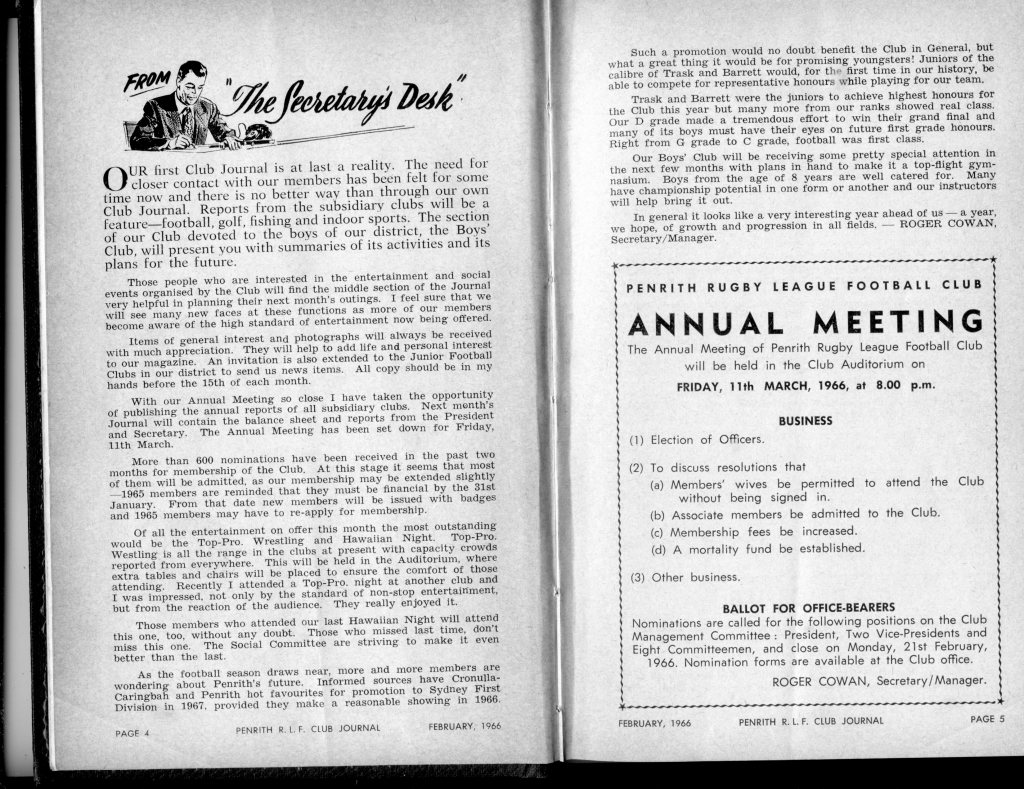
In February 1966, the Penrith Rugby League Football Club published the first edition of its official members’ journal.

The publication, issued monthly, was introduced at a critical point in the club’s development — as it sought admission to the New South Wales Rugby League First Division.

A central feature of the journal was a column titled From the Secretary’s Desk, written by Roger Cowan in his role as Secretary-Manager. In the opening issue, Cowan outlined club activities, membership growth and upcoming events, and referred to the club’s ambition of securing promotion to First Division.

The magazine was largely written and produced by Cowan and served as a means of communicating with members during the club’s First Division campaign.

In June 1968, Phyro Holdings Pty Ltd was registered, with Roger and Phyllis Cowan as directors. The name itself was derived from their first names — Phy from Phyllis and Ro from Roger.

In the years that followed, responsibility for publishing the club’s magazine — The Panthers Magazine — was transferred to Phyro Holdings under an arrangement approved by the club committee. The structure included conditions relating to profit limits, auditing of accounts and the remuneration deetails of Cowan’s role.

The arrangement formalised the transfer of publication responsibilities from the club to Phyro Holdings, under agreed financial and audit conditions.

The magazine arrangement — and the broader financial relationship between the club and Phyro Holdings — was later subject to scrutiny. Questions raised in subsequent decades focused on governance, transparency and the management of related-party transactions.

The Panthers Magazine became much more than a publication for PRLC members – it was a powerful community voice and was distributed to over 200,000 households in the Penrith Junior Rugby League District – Katoomba to Blacktown.

Those issues are examined in more detail in later sections of this project.


Related Topics


Related Themes

Financial Management · Strategic Planning


To receive new Parts and occasional project updates by email, you may subscribe below.

Readers who hold recollections, documents, or material relevant to this history are welcome to contribute via the Commentary & Contributions page.

Project Updates

Receive updates when new parts are published.