
Success rarely begins with the final appointment
Football fans are always looking for defining moments in their team’s history. A new coach arrives. A star player signs. A premiership follows. The story writes itself.
For Penrith, one of those defining moments was the appointment of Phil “Gus” Gould as first-grade coach in late 1989.
The most common version of this story is simple. Ron Willey departs, Gould returns, and within two seasons the Panthers are premiers.
A simple story that rings truth when told — but, really, the story is only partly told. And, so, does not hold the whole truth
The return of Phil Gould to Penrith, as coach, was undoubtedly one of the most significant decisions in the Club’s history. His influence on standards, preparation, selection and tactical innovation would prove decisive. Yet his appointment was not the beginning of Penrith’s rise. Rather, it was the culmination of a long organisational journey that had transformed the club over more than two decades but most dramatically during the seven years preceding his appointment.
Understanding why Gould succeeded at Penrith requires understanding the club he inherited.
Building a club capable of winning
When Roger Cowan became General Manager in 1965, Penrith was little more than an ambitious newcomer attempting to survive in Sydney’s fiercely competitive rugby league landscape.
The years that followed were devoted to building foundations — foundations of financial stability, sound governance, operational capability and an increasingly professional culture.
The club established administrative systems where few had previously existed. It strengthened its financial position, developed licensed club operations, invested in junior rugby league and gradually created an organisation capable of supporting elite football.
Many of these changes attracted little public attention — and some internal pain and conflict — yet each became another piece of the structure upon which future success would rest.
At the same time, a remarkable generation of local footballers was emerging.
From hopefuls to contenders
Tim Sheens deserves enormous credit for changing the direction of Penrith football.
His young side reached the club’s first semi-final in 1985 and, perhaps more importantly, changed what players and supporters believed was possible.
For the first time, Penrith expected to compete rather than merely participate.
When Ron Willey succeeded Sheens in 1987, he inherited a talented but still developing football team. Over the following three seasons he consolidated much of the progress already achieved — he also instilled a harder competitive edge — what many describe as ‘mongrel’ — that had previously been missing.
The Panthers’ consistency ramped up a couple of pegs, reaching the semi-finals again in 1988 before finishing second on the ladder in 1989, only to bow out in “straight sets” — a loss to Balmain (12-24) in Major Preliminary Semi-Final followed by a loss to Canberra (18-27) in the Minor Semi-final. Canberra went on to win the Grand Final over Balmain.
Willey’s contribution is often overshadowed by what followed, but history should remember that he coached Penrith through an important stage of its development. He inherited an emerging football side and left behind a genuine premiership contender.
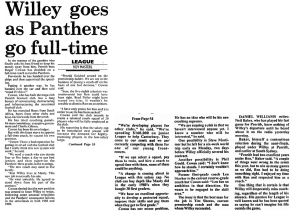
By the end of 1989, however, there was a sense that the club had reached an important crossroads. Penrith’s next coach would need to be fully devoted to the Panthers and build upon the foundations already laid. In this late 1989 article Roger Cowan tells Roy Masters:
We need a coach who can devote four or five hours a day to our best juniors and then supervise the Panthers’ three grades in the evenings.
While the club had become more competitive, the question was whether it could become the best.
The right coach at the right time
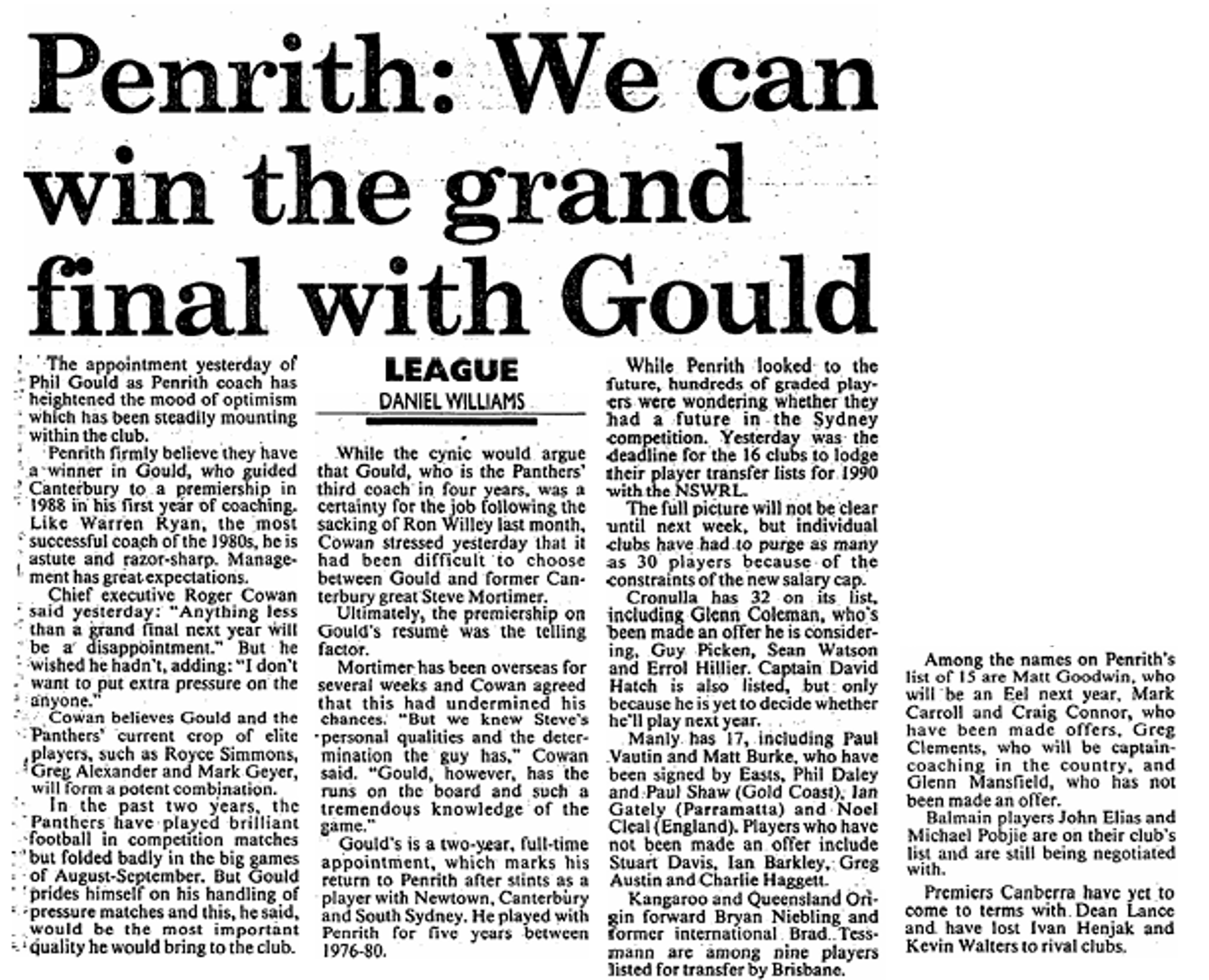
Phil Gould did not arrive to rescue a struggling football club.
He arrived at a club already pounding on the door. Today, you’ll often hear the expression “premiership window” — well, Gus joined when that window was wide open.
His coaching philosophy was uncompromising. Fitness standards rose. Preparation became more meticulous.
Selection became ruthless when necessary. Reputation alone offered no protection. Gould was prepared to make difficult decisions if he believed they improved the team, even when they involved respected senior players.
The controversial decisions surrounding Royce Simmons during both 1990 and 1991 illustrated both the personal cost and Gould’s willingness to place team performance ahead of sentiment. Those decisions were fiercely debated at the time but reflected the standards he expected throughout the organisation. Bound for Glory recounts Gould’s insistence that difficult decisions were necessary if Penrith was to push through that premiership window and transform from contenders to champions.
His greatest contribution may not have been introducing entirely new ideas, but demanding that every aspect of the football operation meet a higher standard.
Royce Simmons, in Hooked on League, describes some of the changes in 1990:
With Phil Gould at the helm … Weight coaches came to the club for the first time, there was a bit more money in the game and you were able to get away from work a little earlier and get fitter. The game was becoming semi-professional. … Phil was much more structured in his approach with not as much emphasis on skills but certainly a lot more education on how to play a more structured game.
Importantly, he inherited players capable of responding to those demands.
Greg Alexander, Royce Simmons, Mark Geyer, John Cartwright, Brad Izzard, Brad Fittler, Colin van der Voort, Col Bentley and others had largely developed together through Penrith’s football system. Gould refined them into a premiership side.
Just as importantly, he inherited a club capable of supporting elite football.
Behind the scenes, Penrith’s administration continued to expand sponsorship, strengthen finances, modernise marketing and deepen its connection with the wider district. As Bound for Glory records, the Club’s transformation extended well beyond the playing field, with new sponsorships, a new black playing strip for 1991, a rapidly growing marketing operation and increasing community engagement all reinforcing the confidence of an organisation entering the 1990s with growing belief.
Beyond the Book: Phil Morehead recalls an earlier example of Panthers combining football, marketing and promotion of the wider district — the unusual story of how PENRITH CITY came to appear on the Panthers jersey in 1988.
The football team was improving because the club itself was improving.
More than one architect
It is tempting to view premierships through the lens of individuals.
Roger Cowan, Tim Sheens, Ron Willey, Phil Gould. Greg Alexander, Royce Simmons — each individually occupies an important place in the history of the Penrith Panthers that led to the 1991 Winfield Cup heading west to Penrith.
Yet focusing too heavily on any one figure risks missing the broader story.
Successful organisations rarely emerge because of one appointment or one season. They are built through hundreds of decisions, made by countless people over many years.
Roger Cowan with successive boards and countless staff built the organisation.
Tim Sheens rebuilt belief.
Ron Willey consolidated competitiveness.
Phil Gould delivered the final refinement.
Each stage depended upon the one before it.
The Final Piece
Looking back on those days, Gould’s appointment appears inevitable.
It was anything but.
It is now well-known that Steve Mortimer was a very strong contender for the Panthers role — and had he not been on a world trip at the crucial time discussions were being held, he may have landed the job. Sliding doors.
Had the Board chosen differently at the end of 1989, Penrith may still have remained one of the competition’s strongest clubs. Whether it would have climbed the final step can never be known.
What history can say with confidence is that Gould arrived at precisely the moment when Penrith was ready for him.
The Panthers did not become premiers simply because they appointed Phil Gould.
They became premiers because, after twenty-five years of organisational development, administrative reform, financial strengthening, football rebuilding and cultural change, the club had finally become capable of making the most of a coach of his calibre.
That is the story. It is a more complete story than the “Gould arrives — Panthers become premiers — Gould is the hero” popular narrative.
Phil Gould’s return was not the beginning of Penrith’s rise — it was the moment when years of patient preparation found their final catalyst.
Related Topics
- The 1983 Strategic Reset
- The 1983 Strategic Reset — Did It Work
- Major Player: Tim Sheens
- 1991 — Shadows Behind the Story
Related Themes
Leadership · Strategic Planning · Football Club
To receive new Parts and occasional project updates by email, you may subscribe below.
Readers who hold recollections, documents, or material relevant to this history are welcome to contribute via the Commentary & Contributions page.
Project Updates
Receive updates when new parts are published.

