Part 69 of 70 — Original Chapter: Chapter 20: The Reaction to a Fruitless Inquiry
This article forms part of the serialised republication of Panthers, Passion & Politics – The Roger Cowan Years.
On 16 May 2004, Sydney’s Sun-Herald newspaper ran a story with the headline ‘Mega-clubs face inquiry of ICAC proportions’. Alex Mitchell, the writer, revealed that Premier Bob Carr was about to announce that former ICAC chief Ian Temby QC would head up an investigation into the NSW clubs industry. According to the report, the proposed inquiry would have powers comparable to those of a Royal Commission. It would target mega-clubs such as Panthers, Bulldogs, Cronulla Sharks and Parramatta Leagues. The hearings would start on 1 June, said Mitchell.
ClubsNSW CEO David Costello questioned the fact that the new legislation would only target clubs. Hotels, casinos, online betting companies and a number of other industries also come under the department’s jurisdiction.
Of course, the Department of Gaming and Racing receives complaints. But only about one third of them pertain to clubs. And of that number – as in any system of complaints to government bodies – many are frivolous or vexatious.
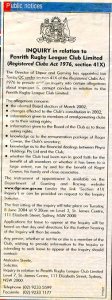
In the last week of May 2004, a small, one-column ad was run in two Sydney newspapers and publications in Penrith, Newcastle and Port Macquarie. It was headed ‘Inquiry into Penrith Rugby League Club Limited’. This was the first and only notification to Panthers that they specifically would be the focus of the new legislation. Cowan and the club had less than three weeks to prepare.
The ad, under the NSW Coat of Arms, went on to say that the director of Gaming and Racing had appointed Ian Temby to preside over an inquiry into allegations in relation to the club, under the new section 41X of the Registered Clubs Act. Six allegations were listed, and readers were directed to the DGR website. It said that anyone could seek leave to appear at the inquiry.
The six allegations fell broadly into three areas. The first four concerned the aborted March 2002 Board election, subsequent constitutional changes affecting voting rights, and whether members of amalgamating clubs or the Panthers Board had been misled about those rights.
The fifth concerned the disclosure of information about Cowan’s remuneration and the financial dealings between Panthers and Phyro Holdings. The sixth, and most serious, alleged that the Club had been run for the benefit of Cowan, his family and close associates, rather than in the interests of its members.
The allegations were set out in the public notice announcing the Inquiry, reproduced here.
There was a period of frenzied activity at Panthers.
The allegations gave some idea of what would be required, but the extent of the investigations was yet unknown. In retrospect, a more measured assessment of the allegations might have led Panthers to approach the Inquiry differently. At the time, however, management began assembling whatever documentation it believed might be required, even though no subpoenas had yet been issued. Chairman Barry Walsh said they were flying blind.
That week, a story appeared in the Penrith Press in which Roger Cowan said ‘Bring it on’. Neither he nor the club had anything to fear, he said. But it was obvious to everyone at Panthers in June 2004 that the government meant business.
Ron Mulock asserted that Cowan’s challenge to ‘bring it on’ was the catalyst for calling the Inquiry, even though it had already been announced. Cowan calls Mulock’s claim nonsense.
He repeated the comment at a Panthers annual meeting after I said I believed he had lobbied for the Inquiry.
As for the remark, when the reporter asked me for my reaction to the calling of the Inquiry, I was certainly not going to say, “Please don’t”. That would have looked like an admission of guilt. The only thing I could say was that we had nothing to hide, and basically – if there had to be an inquiry, so be it. There was nothing we could do about it, except cop it sweet.
One thing I learned very early in life. You don’t stop the bully by looking scared or asking for mercy.
Former ClubsNSW chairman Pat Rogan says the government was very confident going into the Inquiry.
They were sure they were going to get something. Egan was looking for a scalp with the new tax coming in. If they could get a big one, the clubs would fall into line.
Souris believed that the government needed to discredit the club movement to justify the new taxes, and that they deliberately targeted the highest profile club and its CEO.
What really struck me was the fact that they actually got to the point of creating new legislation. Then they decided. We choose Penrith Panthers, we choose Roger Cowan.
George Souris, the Shadow Minister for Gaming and Racing agrees,
They were getting a bit of needle, particularly from some of those members from strong western suburbs electorates. They were cock-a-hoop that if they could scandalise Panthers to a great extent, the public mood would turn against the clubs. And their back bench would calm down.
Souris says the opposition’s support of the clubs on this issue was much more than token opposition.
It was the vindictiveness of Egan and Carr. They were peddling this personal hatred stuff, trying to win the argument over the taxes by killing off one of the star players. It was a campaign of personal denigration, singling out one club and one man.
We had become greater friends with the club movement anyway. We’d marched in the street with them. But I was amazed at the level of fervour from a government that seemed intent on attacking its own heartland.
And suddenly you’ve got this brand new legislation with the powers of a Royal Commission. What was that all about? The DGR has always been able to conduct investigations under the act, and it does so – quite vigorously. There’s probably a couple of hundred investigations going on at any one time.
So here’s 41X and the first time they use it, they pick Ian Temby – sure to attract the maximum media coverage – to run it’, Souris said. ‘It was specifically designed to escalate into some kind of judicial, some kind of Royal Commission circus, and it did.
Terrence Lynch appeared for Panthers at the Inquiry. He says the government knew what it was doing when it appointed Temby.
They thought that he would suit them, because if they really believed there was corruption, he was someone who would be aggressive about it.
Temby’s a moralist. He was once quoted as saying “to lie is corruption”. He had run high-profile inquiries, prosecuting Neville Wran and Lionel Murphy. He also made the finding of corruption against Nick Greiner – which of course was later overturned.1 This is the point with Temby. What he regarded as corruption might be so in a perfectly moral world, but we live in the real world, and we must be judged – and judge others – by its standards. Basically, you have to assess the quality of conduct within some objective standards.
But the DGR had to act. Even Roger Cowan agreed on that point.
The DGR had no choice. It was the government that betrayed our system of justice and democracy when it decided to investigate the complaints by establishing a specially designed fishing expedition with quite extraordinary powers.
It was virtually saying, “Our investigators haven’t come up with the results we want. Let’s throw a big net over everything under Royal Commission powers, and we’re sure to find something”.
Such a high level of confidence on the part of the DGR and the government might explain what Cowan perceived as frustration in Mr Staehli, who was one of the counsel assisting the Inquiry. Cowan believed that the government’s expectations influenced the conduct of the Inquiry. Looking back, he offers his interpretation of the approach taken by David Staehli:
In this case Staehli was acting as a prosecutor. There can be no doubt that his task was to find evidence that would justify the allegations that had been made. Before it all started I believed in fairies, I think. I really thought that the inquiry would be looking for all the facts in an objective and impartial manner. In my opinion it did not happen that way at all.
I don’t know how a prosecutor works, but I imagine he would have made a detailed plan before he started. He had obviously been given a lot of information by the DGR, he would have information provided by the Footy Five, and there was all the information that I had been asked to provide for the previous ten years for Phyro Holdings, my wife and myself.
The DGR had spent the past year or so investigating the Club and taken no action. If Egan and his people were not expecting Temby to dig out something the DGR couldn’t find, there is a second possibility that is too horrible to contemplate – that the government knew from the start there was nothing to find. What if they suspected or knew the complaints didn’t hold water and that the claims had been discredited very early in the investigation by a team of competent DGR officers? If this were the case, it would mean that the Inquiry had no intended outcome for the government other than to heap negative publicity on the club industry.
Still, if there was an air of confidence Staehli would have drawn up his battle plans. I imagine he would have listed all the crimes I might have committed. Then he would have taken each one and drawn up a plan to lead me through events leading up to it.
He would start with questions that seemed broad and innocuous, questions that would encourage me to think I could twist the truth. As I became more comfortable, the questions would become more focused and more specific. Variations or contradictions in my answers would be highlighted. Gradually I would be led into each of the traps and there would be no escape route.
One reason it did not work was that I had no reason to twist the truth at any time. In fact, I believed that getting at the truth was the only thing that could save me from the jaws of a very formidable predator – the NSW Government.
A second reason is that Staehli had probably based his list of possible crimes on information that had been supplied to him but was not true.
I was patiently led up the paths of questioning. But there were no contradictions, no lies and therefore no trap to spring when Staehli arrived at each of his destinations. Towards the end of the Inquiry, his frustration bubbled over into anger.
Cowan later recalled being told an anecdote about Staehli’s frustration during the Inquiry. Although he had no firsthand knowledge of the conversation, he found the story consistent with his experience:
After the inquiry ended, I was told an interesting story. Staehli was speaking to some legal friends of his frustrations during the Inquiry. He likened the experience to playing the old thimble and pea trick, where there is one pea and three thimbles, and the trick is to pick which thimble the pea is under. On a number of occasions he said he was convinced that a certain line of questioning would find the corruption he was seeking, but every time he lifted the thimble, there was no pea.
To receive new Parts and occasional project updates by email, you may subscribe below.
Readers who hold recollections, documents, or material relevant to this history are welcome to contribute via the Commentary & Contributions page.
Project Updates
Receive updates when new parts are published.
- Ian Temby and the Greiner case: As NSW’s first ICAC Commissioner, Ian Temby presided over the investigation into Premier Nick Greiner’s appointment of former minister Terry Metherell to a public service position. ICAC found Greiner’s conduct to be technically corrupt under the legislation. The NSW Court of Appeal subsequently overturned the findings, although Greiner had already resigned as Premier in 1992. See ICAC Explained – a 2016 article from ABC News.
↩︎

