Truth and the Media: The Western Weekender and the Aftermath

This article forms part of the serialised republication of Panthers, Passion & Politics – The Roger Cowan Years.

Start · Reader’s Guide · All Parts

The preceding instalment examined the Sydney Morning Herald’s coverage of Roger Cowan, Panthers and the Temby Inquiry, against the standards of accuracy, fairness and balance set out in the Journalists’ Code of Ethics.

Those same standards provide the context for this instalment, which turns to the Western Weekender — a newspaper owned by Greg Evans, one of the Footy Five — and the wider consequences of the inquiry’s media coverage.

Cowan was not surprised that Greg Evans’ Western Weekender also covered the inquiry.

Why wouldn’t they? Evans had proudly proclaimed himself as a member of the Footy Five, and it was some — or all — of that group that made those complaints to the DGR. This was what they wanted.

He was also not surprised by the Weekender’s ‘distorting emphasis’. He says the only perplexing thing was why it took them so long to get into it.

The timing is interesting.

The newspaper’s owner, Greg Evans, appeared before Ian Temby on 21 July. Although the Weekender had already commented on the inquiry in its editorial columns, its sustained front-page coverage began around the time Evans gave his evidence. The inquiry sat for 29 days, and a substantial part of the proceedings had already taken place before the Weekender’s coverage began.

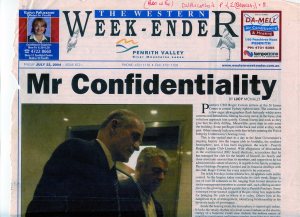
The front page on 23 July screamed ‘Mr Confidentiality’. More than half the page was taken up with a photo of Cowan in profile. The background is dark, and his face is in shadow. There is a sinister aspect to the image. Inside was another page of text, under the heading ‘Six million dollar man’. The article estimated Cowan’s earnings over the previous ten years at $6 million, without explaining how that figure had been calculated.
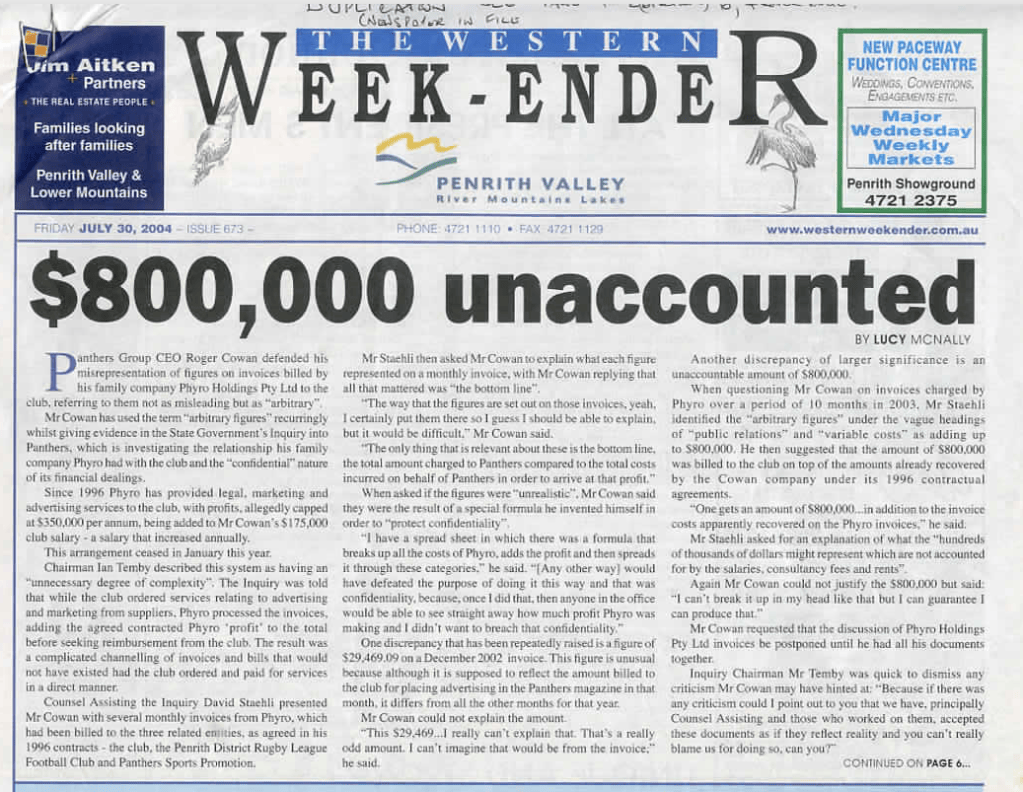
Once the Weekender began its onslaught, there was no stopping it. The following week’s front page said ‘$800,000 unaccounted’. Yet the figure had emerged during questioning, early in the Inquiry, about the allocation of amounts across Phyro’s invoices, not from any finding that $800,000 was missing. Cowan explained that the amounts had been distributed among different accounting categories and undertook to provide further detail. The distinction was hardly apparent from the headline.

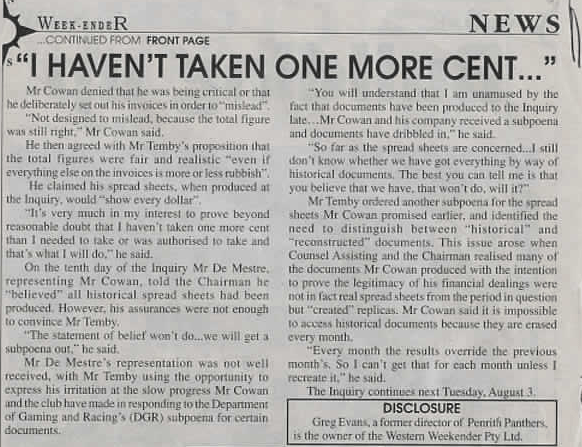
The inside subheading was ‘I haven’t taken one more cent’ — a truncated version of Cowan’s response that, without its qualification, could suggest he had previously been taking money improperly.
After its belated start on coverage, the Weekender was playing catch up.

Another headline was, ‘I’ve got no idea’, The story makes much about Cowan’s discomfort trying to explain one of the hundreds of payments made by Phyro over the previous ten years. It was a payment to a member of Cowan’s family, which Cowan maintained had nothing to do with the Club. But by this time everything was fair game. Like all the Weekender stories, it was damning stuff. The newspaper seized upon the most damaging aspects of the questioning, while the explanations and qualifications offered in evidence often received far less prominence. The overall impression was one of sustained criticism of Cowan, with little corresponding attention to evidence that might have placed the allegations in a different light.

Criticisms of Barry Walsh and Keith Rhind — two directors targeted in the Weekender’s Board Wars campaign — were reported. Yet the questioning of the Footy Five, including significant criticisms of their conduct, appeared to escape the newspaper’s attention altogether.

At the inquiry Greg Evans took pains to assure Ian Temby that he did not have editorial control of the publication. Neither, he said, did he ever pass on to it anything controversial from Panthers’ boardroom.

When interviewed, Evans acknowledged that some people may find this difficult to believe.

I know everybody thinks I did. I’ll forever be tarred with that brush, particularly about the envelope on the doorstep that precipitated the Board Wars story. But it was not me.

If Evans did not exercise editorial control, responsibility for the newspaper’s coverage rested with its editor, who maintained that he and his publication covered the inquiry in a fair and balanced way. Readers of this book can make up their own minds. His weekly editorial column, called ‘Just an Opinion’, is meant to be a witty, pithy piece that deals with the issues of the day. It is often pontification, and frequently laced with sarcasm, vitriol and hypocrisy.

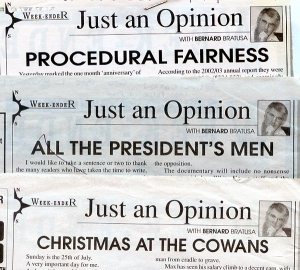
The editor’s first column relating to the inquiry, on 9 July, was titled ‘Procedural fairness’. He noted, with a hypocrisy that defies belief, that as chairman of the Wallacia Panthers, he had a responsibility to ensure that the good name of Panthers was upheld. The column strongly criticised Rhind, but praised Heidtmann — quoting Heidtmann’s evidence out of context that he ‘welcomed the winds of change’ in the arrival of the younger members (the Footy Five). He summarised the first days of sitting in a series of negative grabs and pompous judgements.

He pledged that in his coverage of the inquiry, Within a couple of weeks, the drawer was well and truly opened, and the ‘cheap shots’ flew out.

… facts and direct quotes will be the order of the day, with “cheap shots” left in the sarcasm draw [sic].

It did not take long before the drawer was well and truly opened, and the ‘cheap shots’ flew out.

His children often feature in his column. In one case he spoke of his son’s recent birthday and the presents. That led to the ‘revelation’ that ‘Roger Cowan gave his son Max a Christmas gift of a large sum of money one year.’ The editor wrote: ‘My immediate reaction was Roger please adopt me’, adding such comments as ‘ho, ho, ho, and then some’. The venom continued, with Max Cowan the prime recipient. The piece ended with the editor’s philosophical maxim that ‘money is the root of all evil’.

In one of his more pretentious columns, titled ‘All the President’s Men’, the editor invoked the Washington Post journalists Bernstein and Woodward, whose reporting helped expose President Richard Nixon in the Watergate scandal. The parallels he invited readers to draw with the Panthers controversy were hardly subtle. His editorial standards and his ego were weird bedfellows. In poorly veiled analogies, he talked about how power corrupts. ‘Paranoia about enemies, perceived traitors, and a leader who was bogged down by a war, but wanted to make universal changes without the approval of relative [sic] authorities, namely the US Senate.

He exhorted readers to watch a documentary on Watergate the movie ‘All the President’s Men’ — which, incidentally, was also title of his column — ‘to help maintain a little objectivity in a world where ‘everything is not always what it appears.’

Previously he had written “The truth is the only thing worth reading’, certainly not a recommendation for his own work.
On 29 October 2004, the Weekender’s front-page headline was ‘End in sight’. The story reported that the inquiry was nearing its conclusion and that Cowan had breathed a sigh of relief. The Weekender would ensure that the relief was a little premature.

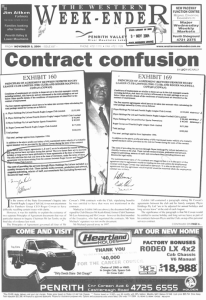
The paper had another shot at Cowan in its following issue, on 5 November. Under the headline ‘Contract confusion’, the front page prominently displayed two versions of the Principles of Agreement examined on the final day of evidence. The story and its continuation focused on the differences between the documents and Cowan’s inability to recall how they had come about. The story rehashed much of the inquiry, making the most of this final chance to denigrate and discredit. Greg Evans may have been delighted that without any direction from him, his editorial staff maintained the paper’s relentless attacks on Cowan.
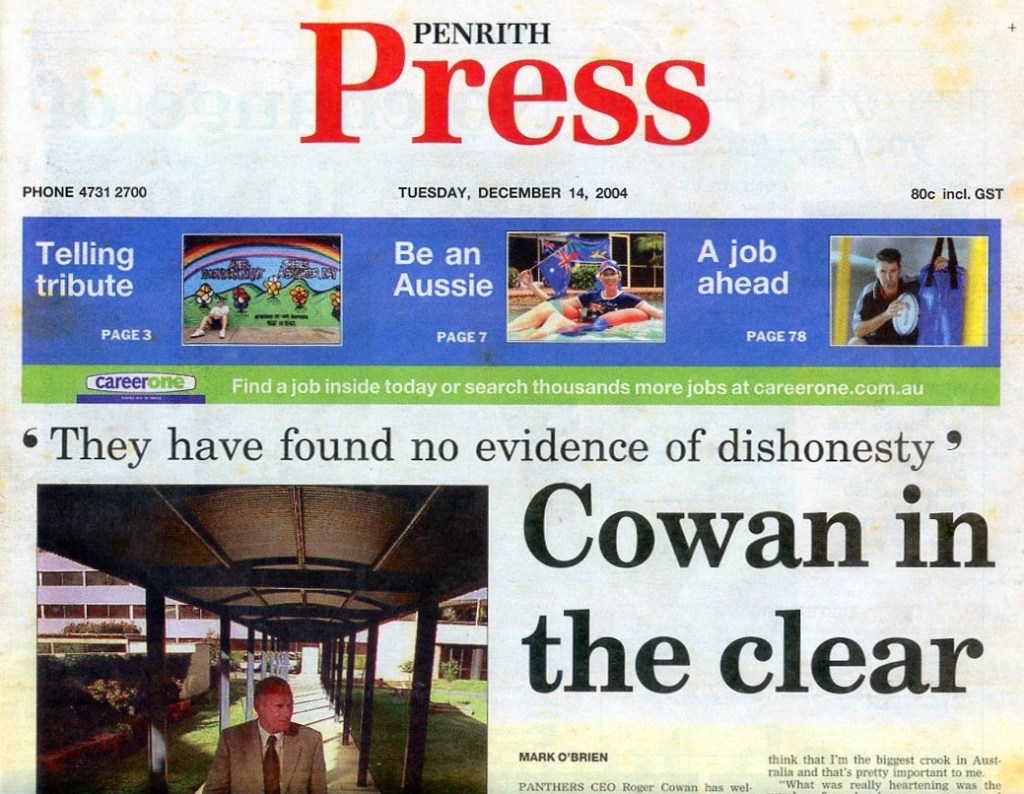
When Temby’s findings were released in December 2004, the headline on the front page of the Penrith Press said, ‘Cowan in the clear’. The Weekender’s front page said, ‘Cowan criticised’.
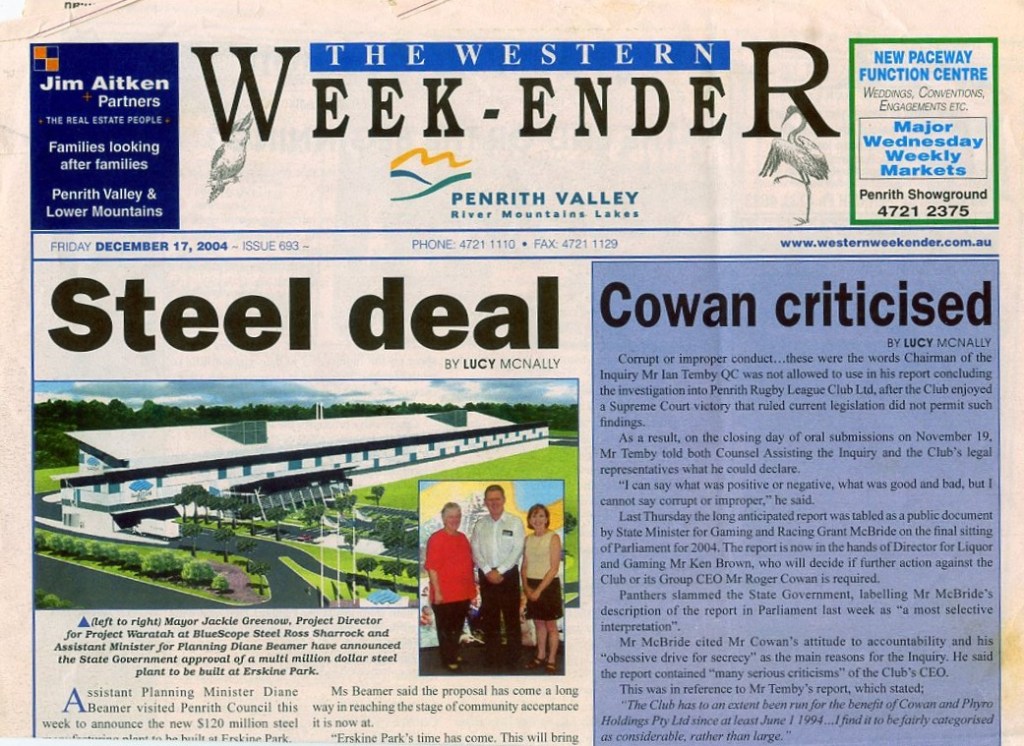
Weekender journalist Lucy McNally started her report with the words:

Corrupt or improper conduct . .

and went on to say that,

. . . these were the words that Ian Temby QC was not allowed to use in his report.

They were, however, the first words to hit anyone reading the story.

The story was almost a direct lift from the very misleading speech made by Minister McBride to parliament when he released the report. It contained a number of quotes from the minister, in particular one relating to allegation 6 that the Club ‘has been to an extent run for the benefit of Cowan and Phyro Holdings’.

Temby’s conclusion that allegation 6 had not been established was omitted from McNally’s account, despite the prominence given to the minister’s criticism.

The Penrith Press, on the other hand, provided a detailed account of Temby’s findings. Its coverage listed the matters investigated, item by item, and summarised the conclusions. Temby’s criticisms of Cowan and the Club were included, but readers were also given the context needed to understand the findings. There was no distortion of fact.

The editor’s column in the Weekender called Panthers a ‘castle of hate’ and suggested that the Temby report was ‘just the beginning’.

The editor also used his column to criticise his rivals’ coverage of the report, particularly, it seemed, the Penrith Press. With characteristic hypocrisy, he stated: ‘I can only suggest that other local media scribes have either not attended the inquiry, nor read the transcripts and Mr Temby’s report, or worse still, failed to research material supplied to them by interested parties.’ The last couple of phrases are of particular note. One can only speculate on the identity of the ‘interested parties’ and on the material itself. Perhaps it arrived on the Penrith Press doorstep in a brown envelope and was dismissed accordingly?

The other allusion, to ‘local scribes’ who had not read the report, is laughable. The Penrith Press account demonstrated a more detailed engagement with Temby’s findings. The Weekender’s report relied heavily on the minister’s presentation of the findings, highlighting his criticisms while omitting Temby’s conclusion on allegation 6. If the Weekender’s Lucy McNally truly had read the full report, it is not evident in her article.

The Telegraph’s headline said, ‘Obsessive, secretive, but Cowan’s not guilty’. True to form, Davies’ and Totaro’s page three story in the Herald was headed ‘Panthers boss accountable to no-one’. The story does, however, include a couple of Temby’s more positive findings, acknow- ledging that Cowan ‘took no more than his due entitlements’, and that ‘he is not a thief’.
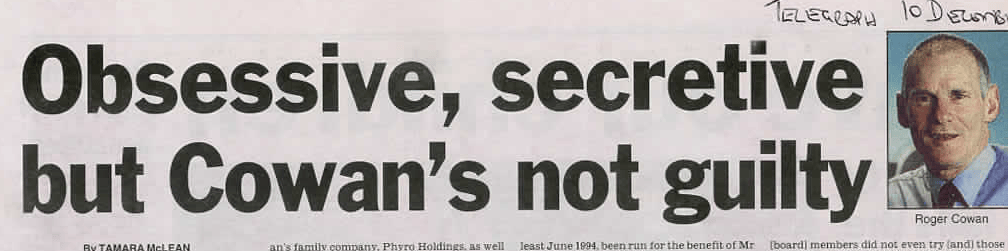

The contrasting headlines of the Daily Telegraph and Sydney Morning Herald following the release of the Temby Report.

For the Herald, the war was not yet over.

In March 2006, 15 months after Ian Temby handed down his report, the director of Gaming and Racing issued his response. The brief notice did not even mention the name of Roger Cowan, except where it listed the original 41X allegations. Totaro’s coverage of the release says that the only reason the government is not proceeding against the Club is the cost of a protracted legal battle. The headline reads: ‘Panthers spared court: suspended sentence for bad accounts’. Surely, one must be charged, tried, and found guilty before one can receive a suspended sentence. The story speaks of Temby’s ‘scathing’ report, and once again raises the issue of Cowan and his financial affairs.

Roger Cowan — and those around him — respect the rights of journalists and the media in general to report the news. But Cowan says he also has rights — particularly the right to expect that the whole story would be told with some degree of balance. At Panthers’ 2005 Annual General Meeting, he spoke to club members about the inquiry.

The Sydney Morning Herald wrote some very damaging headlines, and there is no way I will ever outlive them, but do you know, if you go back over them now that not one of them was proven true. Not one. All those damaging headlines that made me look like I was a crook; that I’d stolen money; that I’d done everything and that I’d acted against the interest of Panthers. Not one was proved true, but the damage was done.

He adds,

… we never asked for special treatment, we just wanted them to be fair and tell the truth.

Later correspondence and discussion had Cowan reflecting more broadly on the influence of the media, his concerns well beyond his own experience.

I think we underestimate the damage done by biased reporting in Newspapers and in magazines. Print journalists have time to research sufficiently to get close to the truth. Sometimes they are too lazy and sometimes they are too anxious to persuade readers to their own beliefs and prejudices. What they write forms the foundation of what citizens can know. Radio and television information also draws on the written media. They have an enormous responsibility that many of them seem not to understand. Every time they go for a headline that ignores truth they are destroying the credibility of their profession and stealing our right to know the truth.

Sometimes we are moved so strongly by our attitudes that we want to take action. There is a huge stir, for example, about the lraq situation and possibly 99% of those involved have no knowledge about it whatsoever except what they have read, heard or seen in the media. A lot of what we read, hear and see about Iraq is obviously biased and sometimes little more than a journalist’s opinion dressed up to look like news. Sometimes, you can see information that does not ring true and has been inserted to add weight to the bias. The fact is that few of us have any idea of the truth in Iraq, but we think we do.

The now famous disturbances at Cronulla caused a widespread, inflammatory emotional response. The avalanche of media coverage included exaggerations, lies, beat ups and truth. The need for us is to be able to recognise which parts of the coverage are truth and to form our attitudes accordingly. Unfortunately that is very close to impossible,

Because of my experiences over many years, I find little value in reading newspapers. When I read an interesting story my response is always the same — I wonder which parts of that story are true, which are fiction and which are opinions of the writer.None of us is in a position of knowing all the facts. Those facts we do know can push us to conclusions that might fall apart if we had more information.

The subject of honesty in the media arises frequently in discussions involving people from many different walks of life. The response is predictable. People claim not to trust the media. But the weirdness becomes obvious when their expression of distrust is followed by the opening discussion about a media story as though it were fact.

At one stage my home was burgled three times over a short period. it was a nasty experience, but it was easily fixed. It was a cost to me and the insurance company and a lesson that I needed better security, but it made no difference to the long term and important things in my life such as self-image, respect, or reputation. You can replace what a burglar steals, but you can never replace a reputation once it has been stolen. I wonder who is more dishonest — a burglar stealing material goods or a journalist stealing someone’s reputation with unsubstantiated information or unbalanced reporting.

Charges can be laid against those who inflict harm on others, but there is nothing to protect innocent people against media lies and exaggerations that destroy reputations, inflict psychological damage and have even led to suicides. What’s the difference? People suffering physical assault can report it to the police and the police can lay charges. People suffering assault on their reputations are faced with the daunting prospect of taking action under defamation laws that are difficult to win and horrendously expensive.


A note on the source material

Selected newspaper images are reproduced in this instalment. A series of Digital Archives containing more extensive coverage from the newspapers of the time is being prepared for Beyond the Book. Links to those archives will be added here as they become available, enabling readers to examine the original reporting in greater detail.


To receive new Parts and occasional project updates by email, you may subscribe below.

Readers who hold recollections, documents, or material relevant to this history are welcome to contribute via the Commentary & Contributions page.

Project Updates

Receive updates when new parts are published.


← Part 75 · All Parts · Part 76 →

Commentary and Contributions

Truth and the Media: The Sydney Morning Herald’s Coverage

This article forms part of the serialised republication of Panthers, Passion & Politics – The Roger Cowan Years.

Start · Reader’s Guide · All Parts

Item number one in the Journalists’ Code of Ethics tells journalists to:

Report and interpret honestly, striving for accuracy, fairness and disclosure of all essential facts. Do not suppress relevant available facts nor give distorting emphasis.1

Over the years, Roger Cowan and Panthers have had their share of media attention. It goes back to the tall poppy syndrome, and — as anyone in the public eye in Australia can attest — it is part of our way of life. That does not make it any easier, however, when you are the target. Cowan says that although he had been the focus of some derogatory stories in the past, nothing prepared him for what happened in 2004.

My problem was that I became very cynical about The Sydney Morning Herald. I started to believe there was a conspiracy between the government and journalists at the newspaper. Of course, I had no way of knowing what the relationship was, but they certainly seemed to be singing from the same hymn book. My suspicions were strengthened by information that Paola Totaro had been a staffer in Bob Carr’s office2 and that she had a lot of Labor in her family background. The thought that a major newspaper would do the bidding of a government sounds a bit far-fetched in a democratic country that defends freedom of the press. It is even harder to understand that a trained investigative journalist was not able to look at the timing and other factors and conclude that the government’s actions might have been based on illogical and untrue claims.

Adding to my cynicism was the claim by Greg Evans, one of the Footy Five, that he had no control over the editorial views expressed in his newspaper, The Western Weekender. I could only imagine how pleased he must have been with the efforts of his editor who had no qualms about showing incredible bias against me and the directors who were not members of the Five.

I started to wonder what Freedom of the Press really means. Is it freedom to act dishonestly or dishonourably? Or are we fighting for principles a bit more noble than that?

The Sydney Morning Herald’s campaign started on 27 September the previous year (2003), four days before one of the rallies against the new state government poker machine tax. The newspaper ran a front page headline: ‘Panthers boss charged the club millions’. The story was dressed up like an exposé. It focused on $2.9 million paid to Phyro Holdings by Panthers.3 It outlined complaints made by the defeated directors, but there was no mention of the rally scheduled for the following Wednesday.

The Sydney Morning Herald 27-28 September 2003 — front-page coverage of Panthers and Phyro Holdings

When the Herald arranged for an interview with Cowan for the story, it was in the middle of the poker machine tax debate. He assumed he was being interviewed about the tax, and he invited John Wilson to join him in the interview. As the Club’s gaming manager, Wilson could help explain any of the more technical aspects of the tax and gaming revenue.

As the interview progressed, Cowan became more and more mystified at the line of questioning. Suddenly the penny dropped. He said to the journalists, “You’ve been talking to the Footy Five!“4

When the interview was over John Wilson laughed and told Cowan, ‘you were a bit slow today. I woke up to what was going on about ten minutes before you did.’

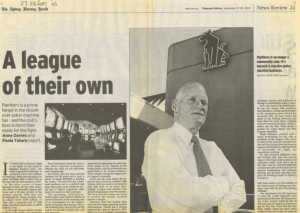
In the paper’s News Review section, a feature story, also about Cowan and Panthers, was headed ‘A league of their own’. Both stories were co-written by Paola Totaro and another Herald journalist, Anne Davies.

The News Review piece followed the perspective of the Five, its content resembling their allegations particularly in relation to Phyro.

On the same day, one of the Five, Geoff James, phoned Ray Hadley on 2GB to dispute a statement attributed to Cowan in the Herald. His comments challenged Cowan’s account of what the directors had known about Phyro. John Bateman also called Hadley that afternoon, supporting James and broadening the criticism to questions of governance and remuneration.

On Monday 29 September, a story appeared, with the by-line ‘Paola Totaro, State Political Editor’. Its purported theme was legislation that was being pushed through by the government to ban club executives from having business dealings with their clubs. It quickly segued to Roger Cowan and Phyro.

It was a busy week for Totaro. The following day it was much of the same. The Tuesday story carried an inset of the Saturday headlines about ‘boss charging the club millions’.

The rest of the media was intently covering the forthcoming Axe the Tax rally. Television news programs featured interviews with politicians and high profile sports people. ClubsNSW was bombarding all media with information and press releases, as were many other sporting and registered club organisations. But in four major stories written or co-written by Totaro for the Herald in that week — which mentioned Michael Egan, the new taxes, new club legislation, and particularly one of clubland’s highest profile clubs and CEOs — the raging news story of the moment — the forthcoming “Axe the Tax” rally — never rated a word.

Cowan remembers a particular incident that contributed to his cynicism about the fairness of journalists.

One Thursday I received an email from Anne Davies. She listed a number of questions and said she wanted answers by noon the following day for a story she was preparing for Saturday’s edition. The questions related to allegations by a disgruntled employee that were absurd and totally untrue. My immediate reaction was to answer the questions as quickly as possible and remove the allegations from the agenda. I managed to have all the answers by about 4:10 pm that evening, ready to send to Anne Davies next day. The following morning my secretary said that Anne Davies had called and left a message that she did not need my answers after all. The story was being held over till the following week.

Later that morning, I had a call from the chairman, Barry Walsh. He said that Davies had left a message on his phone asking him to call her about a story she was doing for Saturday. Then another director, Keith Rhind, called to tell me he had received a similar request from the journalist.

I was afraid that she was still planning a story for Saturday, but without my responses. It would make a much more sensational story if the allegations were listed, and not answered. If she had had another look at the allegations and realised how stupid they sounded, she would also have realised that my answers, if they came in, would kill her story.

I emailed the answers she no longer wanted, so at least she could not use the questions.

In their landmark 1994 book, Ethics and the Australian Media, John Hurst and Sally White criticise political bias in journalism, saying it denies the public the ability to make a truly informed choice about an issue.

The day after the rally, there was a Herald editorial calling for clubs to ‘uncover’ their finances. Thereafter, the intensive coverage of Cowan and Panthers subsided. It would return with renewed force eight months later, in June 2004, when the government’s inquiry under section 41X began.

Once Totaro began to cover the inquiry, the state political editor title no longer appeared with her stories. Why had it disappeared? Such a title identified her as a high-ranking member of the NSW press gallery.

In the modern world, there is often a symbiotic relationship between politicians and media. In his book The Latham Diaries, the former Labor leader — Mark Latham — wrote of the phenomenon.

In practice, journalists see only a fraction of what goes on in politics. Often they believe they have captured ‘inside’ information and stories when politicians give them off-the-record briefings.

He says that a politician who is not prepared to put his or her name to information is trying to manipulate the media for personal advantage.

Invariably, the public receives a jaundiced view of events.

Once the inquiry began, it was open slather. For Phyllis Cowan, opening the Herald each day became an act of courage. She says it felt as if her family history was being ripped open and spread across the paper.

It was never fact, just about the questions they were asking that day. But even when what was in the headline was explained, or proved untrue that day or the following day in the inquiry, they never corrected it or followed anything up.5

The media always had some idea of what was happening on each day of the hearings. Most mornings before the start of proceedings, the DGR held a media briefing. This was unusual in itself — or perhaps not? After all, this was the first inquiry of its kind, set up under fairly unusual circumstances, at a time that appeared rather convenient for the state government. So why not set another precedent?

There was a precedent of sorts already, in connection with a proper Royal Commission of great importance to NSW citizens. In 1994, the government launched the Wood Royal Commission into corruption in the NSW police service. Media were briefed every morning before the commission sat. They were told who would be appearing, and if it was going to be a particularly interesting or controversial day. Corruption in police forces is a scourge on our entire society.

Why did the NSW government attach the same media importance to the doings of one registered club and its CEO? Like the choice of Ian Temby, it reinforced Cowan’s belief that the government was intent on getting as much mileage as possible from the whole event.

Paola Totaro attended most sessions of the inquiry, and usually whenever Cowan appeared. Many of her stories reflect a level of bias not expected from a writer of her calibre, who has won journalism awards. Where the evidence was detrimental to Cowan, it was there. If it shed a negative light on others — notably those who made the original complaints to the government — it seldom surfaced.

Her stories frequently received prominent placement in the newspaper, several appearing within the first seven pages, or in prime positions elsewhere.

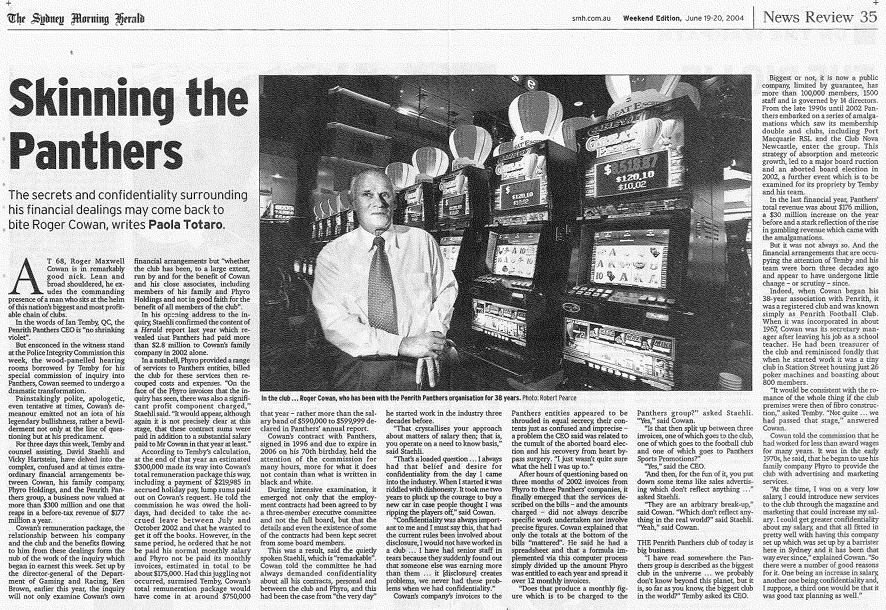
At the end of the first week of sittings in the weekend News Review section, her story was topped with the headline ‘Skinning the Panthers’.

The connotation and the imagery surrounding the word ‘skinning’ is negative, even in the context of removing the skin of an animal (such as a Panther). Metaphorically, there is a very strong connotation of ‘ripping off’, even stealing.

Centred in the half-page story was a photo across four of the page’s seven columns. Cowan stands in front of a line of poker machines large enough for dollar signs and amounts of money to be seen in their windows. This image, combined with the savage imagery of the headline, tells a story even to someone who doesn’t read the article — leaving the impression that Cowan was ripping off the Panthers.

Skinning the Panthers — the Herald’s News Review coverage at the end of the first week of the inquiry.

The Herald followed a similar pattern throughout much of the inquiry. Regardless of the particular evidence being presented, several reports returned to the September 2003 story about the ‘payment of $2.9 million’ to Cowan’s family company, Phyro Holdings.

The full story about that payment emerged early in the inquiry, but even after those facts were clearly spelled out in evidence, the substantial figure continued to feature in subsequent reporting, sometimes without the context needed to distinguish the company’s billings from Cowan’s personal earnings.

The more sensational revelations of the day were also there, but the context and qualifications offered by witnesses did not always receive the same emphasis. Panthers director Terry Heidtmann appeared on 24 June, and his evidence was covered the following day. Totaro reported criticisms he made about the way some things had been done at the club, but also referred to his trust in Cowan. However, her language seemed to portray that his trust was misplaced. She also described Heidtmann’s ‘intricate business relationship with the club’ and reported that he had sold four properties owned by the Club — she failed to explain that those four sales took place over a period of 40 years.

The stories continued to emphasise perceived faults and failings revealed in Cowan’s evidence, yet the testimony of some other witnesses drew less attention. Counsel and Ian Temby were at times searching — even ruthless — in their questioning of the directors known as the Footy Five. Their evidence raised questions about the decision to cancel the election, including the motives behind it. Some even recanted or changed parts of their testimony. Yet these aspects of the proceedings received comparatively little attention in the Herald’s coverage.

It was the headlines that were felt to be the most damaging by those associated with Panthers and Cowan. Phrases like ‘blind loyalty goes right to the top’; ‘accountant had doubts’; ‘we didn’t ask questions’; ‘close knit Panthers family’, were felt to be demeaning of the Club’s directors, management and staff. Many witnesses say they were appalled at the misleading way their statements were quoted.


A note on source material

Selected newspaper images are reproduced in this instalment. A series of Digital Archives containing more extensive coverage from the newspapers of the time is being prepared for Beyond the Book. Links to those archives will be added here as they become available, enabling readers to examine the original reporting in greater detail.


  1. MEAA Journalist Code of Ethics. MEAA: Media Entertainment & Arts Alliance. This code was first created in 1984, it was updated in 1986 and again in 1999. The 1999 version remains current today.
    ↩︎
  2. Totaro worked in Carr’s office when he was Leader of the Opposition. It was during a period when she’d taken a sabbatical from journalism.
    ↩︎
  3. The $2.9 million represented gross payments to Phyro Holdings for services supplied to Panthers, not Roger Cowan’s personal income or the company’s profit. Phyro incurred expenses in providing those services. Cowan reported a net profit of $43,498 from the arrangement, although the accuracy and accounting treatment of that figure became matters of contention during the Temby Inquiry. The distinction between gross billings, company profit and personal remuneration is important when interpreting the newspaper’s reporting.
    ↩︎
  4. Sadly, there is no record of their response to this. Possibly it was “journalists don’t reveal their sources”.
    ↩︎
  5. Although rare, The Sydney Morning Herald published at least one correction during its coverage of the inquiry. It concerned the reporting of Terry Heidtmann’s evidence in June 2004. Phyllis Cowan’s comments reflect her broader experience of the coverage and the impression left by its headlines.
    ↩︎

To receive new Parts and occasional project updates by email, you may subscribe below.

Readers who hold recollections, documents, or material relevant to this history are welcome to contribute via the Commentary & Contributions page.

Project Updates

Receive updates when new parts are published.

← Part 74 · All Parts · Part 76 →

Commentary and Contributions

Royal Commission Powers

Originally Chapter 22 of Panthers, Passion & Politics, Royal Commission Powers examines the extraordinary investigative powers available to the Temby Inquiry and their consequences for Roger Cowan.

The chapter combines Jennie Bentley’s criticism of the inquiry process with Roger’s personal recollections of what he described as the worst period of his life. His account reveals the uncertainty, psychological strain and sense of injustice he experienced during the proceedings, together with the effects of the accompanying media coverage.

In preparing the serialised edition, this chapter was removed from the main narrative because much of its discussion of the inquiry’s powers and justification overlaps with material examined elsewhere. Roger’s personal account, however, provides a perspective not conveyed as directly in the surrounding chapters.

It is reproduced here as part of the original publication, preserving both the author’s interpretation of events and Roger’s recollections of his experience. Readers should distinguish those perspectives from the formal findings of the Temby Inquiry, which are addressed elsewhere in the series.

Royal Commission Powers

Royal Commissions exercise investigative powers that go well beyond those available in ordinary legal proceedings. They can compel witnesses to give evidence and produce documents, subject to the protections and limitations established by law. Refusal to comply with lawful requirements can attract serious penalties, including imprisonment.

Such powers are generally reserved for investigations considered sufficiently serious or difficult that ordinary investigative procedures may be inadequate. Examples include the NSW Police Royal Commission and the NSW Royal Commission into Drug Trafficking.

Section 41X of the NSW Registered Clubs Act 1976 allowed an inquiry to exercise powers conferred under the Royal Commissions Act 1923. The Department of Gaming and Racing could initiate such an inquiry on the basis of allegations of corrupt or improper conduct, without first establishing that those allegations were supported by evidence.1

The identity of those making the allegations, and the material supporting them, need not necessarily be disclosed to the subjects of the inquiry. This created the possibility of an investigation being established on allegations that had not been adequately tested.

An inquiry can be called just in the hope something will turn up.

Our political system is celebrated for its constitutional safeguards. But any majority government can give itself these powers, and use them to silence dissent, weaken opponents, and punish subjects who have made its task of ruling difficult.

A person charged with murder, rape, drug-peddling or other serious crimes is protected by a  set of legal rights developed over hundreds of years.

  • The suspect is investigated by officers of the law until there is sufficient evidence for charges to be laid.
  • The suspect must be fully informed of any charges and of their rights to silence and legal representation.
  • At the hearing to establish guilt or innocence, the suspect has the choice to give evidence or not give evidence.
  • Rules of evidence generally exclude irrelevant material and restrict the circumstances in which a previous criminal record may be admitted.
  • The suspect is presumed innocent until the prosecutors can convince the judge or jury of guilt beyond reasonable doubt.
  • Court rules lay down standards regulating what forms of questioning are permissible.
  • Hearsay evidence is generally excluded, subject to recognised exceptions.
  • A lot of court time is taken up with debate about what evidence is admissible.

In an inquiry exercising Royal Commission powers, many of these protections do not apply in the same way. In the government’s case against Panthers and Cowan:

  • The allegations leading to this Inquiry had been investigated by officers of the government over nearly a year. Nothing was found to justify any charges or complaints against the Club or any individual in the Club.
  • Cowan and the Club were compelled to deliver information on short notice and in broad categories. For example, Cowan was told to deliver all his financial records for ten years, including those of his wife and family company.
  • There was no charge to answer or defend, only allegations.
  • There was no right not to give evidence or refuse to answer questions not related to the allegations.
  • There were limited opportunities to object to questioning. Throughout the hearing, Cowan’s lawyer made no objection to a question.
  • There were no boundaries for questioning. Any answer could become the track for an entirely different line of questioning.
  • There was no warning of the line of questioning to be followed.
  • Hearsay was admitted.

How does such an inquiry affect the individual? Cowan has described it as the worst time in his life. Even reliving the events two years on is traumatic.

When the inquiry was over I had a cup of coffee with Terrence Lynch. Terrence strongly advised me to take at least four months off work and do nothing unless it was relaxing, and of personal interest. He said I would probably be underestimating the impact the inquiry would have on me, and it would be better to take preventative measures rather than letting it build up. He was right of course.

Unfortunately, I did not take his advice.

A few weeks before the inquiry started, I attended a function where I spent some time with some solicitor friends. They were aghast when I told them I did not intend to be legally represented. “I’ll just tell the truth,” I told them. “I have nothing to hide, so why go to the expense.” How naïve that was, and they told me so in no uncertain terms.

I should have taken their advice immediately.

Leading up to the inquiry I underestimated its seriousness. During the inquiry I underestimated what was happening behind the scenes. After the inquiry I underestimated the severity of the psychological impact it would have.

In other words, I never really came to grips with it at all.

It was made worse by my perception that the premier and treasurer of NSW wanted to do as much damage as possible to my reputation and credibility. To make matters worse, it seemed to me that they had a powerful ally in The Sydney Morning Herald.

Such powerful adversaries are enough to make anyone nervous.

I knew that the group of people who had been attacking me publicly was behind the allegations that brought about the investigation, but no way of knowing the nature of the accusations. I was also having difficulty coming to grips with the fact that people would act that way.

The government announcement of the inquiry was worded to make me look bad and yet I had not been charged with any offence. I did not have access to the allegations, and I had not had the opportunity to answer them. There is nothing more damaging to peace of mind than injustice.

It was explained to me that the appointment of Ian Temby was an indication that the government was very serious. When the full implications of the Royal Commission rules were explained to me, it added to a very menacing environment. For that period, and it felt like a very long period indeed, I lived in a state of pure stress. I started out by telling myself that all I had to do was answer their questions truthfully and there was nothing they could do to hurt me. Soon, I discovered I was wrong. A throw-away line from Ian Temby in the first few days — that perhaps there could be $800,000 missing — appeared as a headline the next day in the Herald, making it sound like a fact.2 There had been no evidence to support the comment, and I had given evidence that there was nothing missing. I started to realise that they were going to extract every possible headline regardless of the evidence or the truth.

I would toss and turn at night with the same questions flying around my head.

What if I have made a mistake somewhere?

What if something has happened that could make me look guilty and I don’t even know about it?

What have they been told that could possibly justify this time and expense?

What if I have been set up somewhere and not realised it?

They seem determined to make me look bad, and what lengths will they go to?

The questions and various imagined outcomes produced a burning sensation in my gut. I would wake up tired, but determinedly telling myself that I must be strong.

At times I could feel myself losing hope. The enemy seemed too powerful. Was I becoming neurotic? There seemed to be no relief from despair and hopelessness. But it was vital to hide those feelings. It was not the time to show any weakness, no matter how I felt.

There was no privacy and there I was in the full glare of the spotlight — the last place I would normally choose. Sometimes when I walked towards the entrance to the court, there were more television crews than normal. I would wonder what they had been told to expect that day. They knew more than I did.

Every morning Phyllis and I would wake up fearful of what had been published overnight in the Herald. Our hearts would sink as we read another headline that made me look like a criminal. When there was no story, we would breathe a sigh of relief, but the peace was always short lived.

Both the Herald and the Western Weekender gave me the impression from the outset that they intended to brand me as corrupt and dishonest. Fortunately, Alan Jones at 2GB seemed to wake up to what was going on very early, and his comments helped me keep some balance. He proved that if anyone was prepared to look carefully and logically at what was happening, they would be able to see what a farce it really was. It provided a spark of hope that in the end some sanity might prevail and the truth would win.

Despite the often-repeated claim that “you can’t believe everything you read”, people do believe what they read.

In a media dominated world, our opinions, knowledge and attitudes are very strongly influenced by what is communicated to us by the media. Those who experience the dishonesty of the media first hand become more cynical, and nobody could be more cynical than me.

The positive findings of the inquiry could never undo those negative stories and headlines. Even after the report was handed down, the government continued to attack my credibility.

If anything positive came out of it, it was a deeper understanding of how seemingly unrelated events interconnect, and the realisation that I had failed to handle some quite difficult situations as well as I should have.

It reinforced in my mind the difficulty of bridging differences in values. Let’s use a topical example. A Christian, a Muslim and an atheist see certain things very differently. They could probably work together very well, but not if religion was the agenda. In many ways business is similar. If you don’t recognise and respect those differences, you can easily find yourself caught up in misunderstandings and conflict without knowing why.

Even this matter of losing a fight and then going to authorities to “tell tales” about your opponent is outside my understanding. If you don’t recognise and respect those differences, you can easily find yourself caught up in misunderstandings and conflict without knowing why. You just get up and try again. I tried to teach that value to my four sons and I observed it when I was a teacher — “don’t tell tales, stand up for yourself.”

I have difficulty reconciling in my mind the picture of children running off telling tales to their teacher or mother with that of a tough ex-front rower and a burly ex-policeman running to the authorities with complaints that had no factual basis. It doesn’t fit unless they really believed they were reporting criminal activities, but what was their evidence?


Related Topics


Related Themes

Conflict · Temby Inquiry · Governance


To receive new Parts and occasional project updates by email, you may subscribe below.

Readers who hold recollections, documents, or material relevant to this history are welcome to contribute via the Commentary & Contributions page.

Project Updates

Receive updates when new parts are published.
  1. Editorial note: The Temby Inquiry was established under section 41X of the Registered Clubs Act 1976 and exercised specified powers under the Royal Commissions Act 1923. It was an investigative inquiry, not a criminal trial. Consequently, the rules governing compulsory testimony, evidence and questioning differed from those applying in criminal proceedings. The exercise of these powers remained subject to statutory requirements and judicial supervision.
    ↩︎
  2. Contemporary reporting confirms that the question of approximately $800,000 in payments through Phyro Holdings attracted considerable attention during the Temby Inquiry. On 23 June 2004, The Sydney Morning Herald reported that an estimated $800,000 appeared not to have been accounted for after employment and other costs were deducted from payments made to Phyro. Roger Cowan disputed this, insisting that he could account for every cent. On 30 July 2004, the Western Weekender published a prominent headline, “$800,000 unaccounted”. The particular Herald headline recalled by Cowan has not yet been located.
    ↩︎

The Temby Inquiry — Instrument of Appointment

30 April 2004 | Director of Liquor and Gaming, NSW

On 30 April 2004, Kenneth Maxwell Brown, NSW Director of Liquor and Gaming, formally appointed Ian Temby AO QC to conduct an inquiry into allegations of corrupt or improper conduct concerning Penrith Rugby League Club Limited.

The Instrument of Appointment identified six allegations for investigation. These concerned the cancellation of a Board election, changes to the Club’s constitution, the voting rights of members of amalgamated clubs, information provided to the Board, Roger Cowan’s remuneration and the financial dealings between Panthers and Phyro Holdings.

The sixth and most far-reaching allegation was that the Club had, to a large extent, been run for the benefit of Roger Cowan and his close associates, rather than in good faith for the benefit of all members.

The Instrument also conferred on Temby powers under the Royal Commissions Act 1923, subject to specified exceptions, and established procedures for conducting the inquiry.

Why this document is important

The Instrument of Appointment provides the formal terms on which the Temby Inquiry was established. It identifies the allegations that were to be investigated and the powers available to the inquiry.

It is particularly relevant to Part 74 of Panthers, Passion & Politics, in which Jennie Bentley examines each allegation and questions whether the information available to the Department of Gaming and Racing justified establishing an inquiry with such extensive investigative powers.

Readers can examine the original wording of the allegations and consider the issues raised in the book.

The original document

The Instrument of Appointment is reproduced below from the final report of the Temby Inquiry.

Source: Ian Temby AO QC, Inquiry into the Penrith Rugby League Club Limited — Report, December 2004. Instrument of Appointment dated 30 April 2004.


Related Topics


Related Themes

Conflict · Temby Inquiry · Board Decisions · Governance


To receive new Parts and occasional project updates by email, you may subscribe below.

Readers who hold recollections, documents, or material relevant to this history are welcome to contribute via the Commentary & Contributions page.

Project Updates

Receive updates when new parts are published.
A Royal Commission into Corruption at Panthers

This article forms part of the serialised republication of Panthers, Passion & Politics – The Roger Cowan Years.

Start · Reader’s Guide · All Parts

Editorial Introduction

In this chapter, Jennie Bentley examines the six allegations that formed the basis of the Temby Inquiry, questioning whether the information available to the Department of Gaming and Racing justified establishing an inquiry with powers comparable to those of a Royal Commission.

Her principal concern is not what Ian Temby QC ultimately found, but whether the allegations and the information available at the time justified establishing such an inquiry in the first place.

The chapter also examines Panthers’ Supreme Court legal challenge to the inquiry and reflects the author’s strongly held views about the government’s exercise of its investigative powers.

The original allegations

The six allegations examined in this chapter were formally set out in the Instrument of Appointment issued on 30 April 2004.

The original document, including the powers conferred on the inquiry, is available in the Digital Archive: The Temby Inquiry — Instrument of Appointment (30 April 2004)

The Instrument of Appointment issued by the Director of Liquor and Gaming, Ken Brown, appointed Ian Temby to preside over an inquiry under Section 41X of the Registered Clubs Act 1976, to investigate allegations of corrupt or improper conduct in relation to Penrith Rugby League Club Limited.

Six allegations are listed.

The first allegation was just a suspicion about the motive for cancelling an election. Incredible as it seems, the NSW Labor government had such disregard for natural justice that it allowed its officers to investigate complaints, find no evidence and turn their suspicions into allegations, to be investigated with the powers of a royal commission.

The motives for cancelling an election might be suspect. However, DGR officers had access to a legal opinion from a reputable firm which, as Temby found, provided the Board with grounds for cancelling the election. A suspicion that the cancellation was motivated by self-interest could never, in itself, justify an allegation of corruption or improper conduct. It is an obvious nonsense. In the report that was a catalyst for Panthers’ approach to the Supreme Court, counsellor Vicki Hartstein claimed that the cancellation was about self-interest. In Temby’s findings, he seemed to agree to a large extent.

Roger Cowan says, so what?

The legal advice was solid matter. Motivation is just mist of the mind which nobody can claim to know with certainty.

The second allegation concerned constitutional changes approved by Panthers members more than four years earlier. Those changes remained in the constitution, unaltered. The changes must have been legal then, and must still be legal.

True, the changes enabled proxies, allowed employees to vote and precluded ordinary members from voting directly. Everyone knew the effects long before the inquiry. There was nothing illegal about those effects. Yet somebody came up with the claim that this is an allegation about corruption or improper conduct. It is an allegation that a legally permissible action had caused legally permissible effects. As a ground for Temby’s inquiry, it makes even greater nonsense than the first allegation.

The third allegation was that the Board and/or Cowan had misled members of clubs amalgamated with Panthers about their continuing voting rights. What Cowan had promised members was set out in documents that were available all along to DGR investigators. Promises were broken, but not by Cowan. There may have been grounds for legal action by an amalgamating club sufficiently aggrieved by what had occurred. All of this was clearly known before the inquiry was called, yet nothing had been done about it.

The fourth allegation was that Cowan misled the Penrith Board as to the voting rights of amalgamating clubs. This was obviously untrue, as DGR inspectors would have known from examining Board documents, and as Temby subsequently found. In its absurdity it outstrips the first three allegations.1

The fifth allegation was that information about Cowan’s remuneration and Phyro’s dealings with the Club had been withheld from the Board and members. That information had been withheld was already known; there was no dispute about it. The confidentiality clauses in the contracts meant that Cowan and Phyro were entitled to withhold the information. Temby found that it was true. But the practice involved no wrongdoing, so this was another allegation about legally permissible causes that had legally permissible effects.

Editorial note: Temby subsequently found that the confidentiality provisions in the Phyro contracts did not justify the extent to which information was withheld from directors. That finding concerned the adequacy of disclosure; it did not, by itself, determine whether the information available before the inquiry was called justified establishing it. (Temby Report, paragraph 9.27, page 84.)

How do you make some sense of this? The government was, in effect, saying:

‘We know it is true, but we also know it’s legal and we can do nothing about it. So, we’ll make it subject to Temby’s inquisition and be doubly sure it is true so that we can do nothing about it.

None of the first five allegations could possibly justify spending millions and endowing the inquiry with royal commission powers. Under normal circumstances the DGR officers would have taken less than an hour to see that allegations one, two, four and five were nonsense. Allegation three might have taken a few days.

So, were these five allegations simply padding — intended to convince the public that there was substantial evidence of serious wrongdoing to investigate? If so, and if the entire exercise were to have any credibility at all, the sixth allegation would have to be strong enough to justify the whole exercise.

The sixth allegation claimed that the Club had been, to a large extent, run by and for the benefit of Cowan and his close associates, including members of his family and Phyro Holdings, and not in good faith for the benefit of all members of the Club.

Imagine for a moment that this was a normal, justifiable Royal Commission — perhaps into organised drug crime. Imagine the evidence that would have had to be assembled to justify establishing it, and the witnesses who would be called to test that evidence.

This sixth allegation, the only possible justifiable grounds for an inquiry, was so important that there should have been a wealth of evidence waiting in ambush for the hapless defendants. Would there be links to organised crime or other forms of corruption of such seriousness that royal commission powers were needed to weed it out? How many witnesses were lined up to complete a picture of crime and corruption?

The answers? There was a vain — and blatantly unfair — attempt to discredit the decision to employ Max Cowan. Yet Max had more than established himself as a talented and productive contributor to the Club’s success, earning the respect of his peers in management.

Much of the inquiry was devoted to an unsuccessful attempt to establish that Phyro Holdings had received more than it was contractually entitled to. The maximum that Phyro could earn was in written agreements subject to audit by the Club’s auditors. Any questions could easily have been answered without further investigation.

There must have been more.

There wasn’t.

The inquiry was not genuinely about the allegations at all. The allegations were aimed at making people believe there was actually something to inquire into.

As the inquiry proceeded, a more realistic purpose became increasingly apparent: to uncover evidence that Cowan had been dishonest or had undisclosed conflicts of interest in areas previously unknown to the DGR and the public.

The government hoped he had something worth hiding. No evidence, just hope. Meaning that the inquiry was called for no valid reason at all.

After examining the Club’s affairs in extraordinary detail, it failed to substantiate the most serious allegation.

No wonder Bernard Coles QC commented soon after the inquiry was announced, ‘This is bizarre!’

But it is frightening too — not just for Roger Cowan, but for anyone who works in a state governed with similar standards of justice and integrity as those demonstrated by the NSW State Government led by Bob Carr.

The state government is able to legislate to give itself witch-hunting powers to inquire into allegations against anybody it sees as a useful target.

It is able to use unfounded suspicions from within its own cloisters to devise allegations. It is able to compel its victims to attend, to swear oaths and to place their private affairs on public record. And in this context it can make accusations about actions that are not even wrong, and can investigate accusations it already knows to be true or false.

When the Club challenged the inquiry in the Supreme Court, Justice Hamilton ruled on several questions concerning its powers. He directed that two remaining questions be heard separately:

  • Whether the DGR could establish an inquiry under section 41X without first receiving allegations of corrupt or improper conduct.
  • Whether the DGR had received allegations sufficient to justify establishing this particular inquiry.

To someone without legal training, the proceedings might seem difficult to reconcile with ordinary notions of fairness. The practical dilemma confronting the Club could be illustrated by an imagined exchange:

CLUB: We do not believe you have any allegations to support the terms of reference for this inquiry.

GOVERNMENT: It’s up to you to prove we don’t have allegations.

CLUB: We want to prove it. So we are asking you to show us some documents that are evidence of allegations.

GOVERNMENT: Tell us specifically which document you want to see.

CLUB: How can we do that? We don’t believe that you have any documents at all. How can we specify a document we don’t believe exists?

GOVERNMENT: If you can’t specify it, we can’t produce it.

The case was tossed out – and the result for justice in this state? It seems that an inquiry can be called by a government to investigate allegations that have absolutely no basis, and that there is no way for the accused person or organisation to prove this.


  1. Temby rejected the allegation that Roger Cowan had misled the Board about voting rights. He also found that Cowan had been authorised to make promises to members of amalgamating clubs, that subsequent Board decisions had broken those promises, and that no blame attached to Cowan. Temby expressed a preference for Cowan’s approach (rather the approach expressed by the five ex-Board members) to the rights of amalgamating club members. See Temby Report, paragraphs 7.16–7.17, pages 62–63.
    ↩︎

To receive new Parts and occasional project updates by email, you may subscribe below.

Readers who hold recollections, documents, or material relevant to this history are welcome to contribute via the Commentary & Contributions page.

Project Updates

Receive updates when new parts are published.


← Part 73 · All Parts · Part 75 →

Commentary and Contributions

What Temby Actually Found — Steve Bowers Reports to the Board

A removed section from the original Chapter 20: The Reaction to a Fruitless Inquiry. This section originally appeared at the end of Chapter 20, taht is at the Part 73 of The Series. It reproduces the allegations examined by Ian Temby and his conclusions on each, as presented in a report to the Panthers Board by the Club’s Group General Counsel, Steve Bowers.

The material has been removed from the main narrative because its level of detail interrupts the account of the Inquiry and its aftermath. However, it provides an important opportunity to examine the Commissioner’s findings directly, including both his criticisms of the Club’s governance and his conclusions concerning Roger Cowan.

Shortly after the report was tabled in Parliament, Steve Bowers prepared a report for the Panthers Board incorporating Temby’s conclusions on each allegation. The relevant extracts appear below.

Allegation (a)
The Board of the Club aborted the March 2002 Board election because of an apprehension that the election, if carried through to conclusion, would or might lead to loss of power by the existing Board;

Finding (a) (Temby Report: paragraph 5.29)

My conclusion is that most of the then eight members of the Board believed that if the election results were declared there would be a change in Board composition, largely because of the ticket. That was a worry to most of them, and a greater worry than the fact of electioneering; it is clear to me that most were more concerned about outcome than principle. There was, however a factor of greater significance, namely the serious doubt which arose as to whether members of Port RSL and ClubNova were entitled to vote. The Board was put in the invidious position of having conflicting legal advice, and it preferred to follow the Boon advice which was that members of those two Clubs could not vote. In part the preference for that legal view arose from strong distrust of management by the majority of the Board, and in part it arose from the fact that Boon’s advice was palatable, it was seen as justifying the decision to cancel the then current election. However, the Board cannot carry too far the proposition that it simply followed Boon’s advice, because he was at pains to stress, both at the meeting on 21 March and when he gave evidence before me, that he did not advise cancellation of the election.

Allegation (b)
Constitutional changes were then effected with a view to, or which had the effect (direct or indirect) of, enabling proxies to vote, enabling Club employees to vote, and precluding all Club ordinary members from directly voting in the Board election held later in 2002, and subsequent elections;

Finding (b) (paragraph 5.30)

There were certainly constitutional changes effected in September 2002, and certainly they had an effect that was very much intended. It was to preclude all Club ordinary members, including those from amalgamating Clubs, from directly voting for all Board positions. The Board which after long and often bitter discussion put up constitutional amendments did so precisely in order to entrench the rights of existing Penrith Club members, the consequence being that those members could indirectly (through the Football Club elections) choose nine out of 14 members of the expanded Board, and members of amalgamating Clubs could have a say in the choice of only the remaining five. This diminished the rights of the latter group significantly. It is not now the case that all Club ordinary members can, in any meaningful way, directly vote in Board elections. They are thus precluded from doing so, at least in effect, and have been since September 2002. The effect of the constitutional amendments was to enable Club employees to vote indirectly in the Club elections. I do not think that was intended, it was an accidental, although important, consequence. The question of proxies, it emerged from the evidence, was one of no significance.

Allegation (c)
The Club, by its Board and/or Mr Roger Cowan, misled members of the Clubs with which the Club had amalgamated between 1998 and 2003 as to the continuing voting rights of members of those Clubs;

Finding (c) (paragraph 7.16)

To summarise my conclusion, Cowan was authorised by the Board and did in fact make representations to members of amalgamating Clubs as to their continuing voting rights, namely they would have the same entitlement as members of the existing Penrith Club. As a result of actions taken by the Board, in full knowledge of what Cowan had done, those promises were broken. Each of the cancellation of the February-March 2002 election, and the constitutional change effected in September 2002, had the effect that members of amalgamating Clubs could not vote for the Club Board generally, and thereby disappointed their legitimate expectations. I repeat that no blame attaches to Cowan

Allegation (d)
Mr Cowan misled the Board of the Club as to those voting rights;

Finding (d) (paragraph 7.17)

The fourth allegation is that Cowan misled the Board of the Club as to those voting rights. My conclusion is otherwise. At least in this context, to mislead is to deceive in a deliberate manner. Cowan did not do so. He fought hard to deliver on the promises he had made, and he was pursuing the interests of all members, not just those from the Penrith site. Most members of the Board, in contrast, saw their principle allegiance as being to the Penrith members. Cowan’s approach, as to amalgamations and voting questions, is to my mind distinctly preferable to theirs.

Allegation (e)
Information as to the remuneration package of Mr Cowan, and the financial dealings between Phyro Holdings Pty Limited and the Club, and benefits flowing to Mr Cowan and that company whether directly or indirectly from the position he holds and from those financial dealings, have since at least 1 June I994 been withheld from the Club’s Board and its members;

Finding (e) (paragraph 9.27)

That allegation is made out. The Board generally did not know how or in what amount Cowan was remunerated until the hearings of the Inquiry, although members of the Executive did. Board members generally, including members of the Executive, did not know of the nature and extent of the financial dealings between Phyro and the Club, or the benefits flowing directly to Phyro and indirectly to Cowan, again until the hearings of the Inquiry. Naturally, Club members had no more information than did their Directors. The very large extent to which information was withheld from Directors is attributable to Cowan and his obsession with secrecy, and could not be justified on the basis of the very limited confidentiality provisions contained in the three Phyro contracts – see 8.11-8.13 above. It is clear that Cowan got his way in blocking proper information flows because of his strength of personality and, on the Board’s side, a lack of vigour in asserting controls. Recent Panthers history shows that Cowan played a key role in getting rid of those Directors who sought to control him.

NOTE: In the report the Club’s Counsel advised the Board that Mr Temby has concluded this information was “withheld” in the sense that it was simply not communicated nor conveyed. He did not accept the submission from the Club that “withheld” meant to keep back where there was an obligation to provide.

Allegation (f)
The Club is, and has since at least 1 June 1994 been, to a large extent run by and for the benefit of Mr Cowan and his close associates, including members of his family and Phyro Holdings Pty Limited, and not in good faith for the benefit of all members of the Club;

Finding (f) (paragraph 12.17 – 12.19)

I do not find that Cowan’s involvement with the Club, on balance, has been against the best interests of members generally. He has done it and them much good. Nor do I find that he has done other than seek in good faith to benefit those members. Disbenefit to them will arise only if and to the extent that, because financial affairs cannot be worked out in a confident fashion between Phyro and the Club, the company gets away with more than it is entitled to. It is likely that the extent of that – if it happens, and it may not – will never be known.

Cowan cares passionately about the Club, and it is clear he wants to benefit its members – all of them including members of amalgamating Clubs. He cares more about those members than he does about Club Directors. Because of his obsessive drive for secrecy, his attitude to accountability is one which caused grave problems, and largely led to the current Inquiry.

I find Allegation 6 – fairly described by Counsel for the Club as “the most serious allegation” – not to have been made out.


Temby Report — In Full.

The full report (PDF) arising from the Inquiry in Relation to Penrith Rugby League Ltd conducted by Ian Temby AO QC is available. Click the link or the cover page image below.


Related Topics


Related Themes

Conflict · Temby Inquiry · Governance


To receive new Parts and occasional project updates by email, you may subscribe below.

Readers who hold recollections, documents, or material relevant to this history are welcome to contribute via the Commentary & Contributions page.

Project Updates

Receive updates when new parts are published.

The Temby Inquiry: The Findings and the Fallout

This article forms part of the serialised republication of Panthers, Passion & Politics – The Roger Cowan Years.

Start · Reader’s Guide · All Parts

Of the allegations against Cowan, only one was found to have been made out. It concerned the withholding of information about his remuneration and the nature and extent of the Club’s financial dealings with Phyro Holdings. Although members of the executive knew about Cowan’s remuneration, the full Board did not. Nor did directors generally know the extent of the financial arrangements involving Phyro.

Cowan responds that trust was a major issue with him at the time.

If I believed that I could trust everyone on the Board, it would never have got as bad as it did.

But I was being attacked publicly and quite viciously by Ron Mulock and it was obvious that he was getting confidential information from someone on the board. So I continued to insist on the confidentiality clause in my contract. There was no legal requirement to disclose these matters to the full board or to the members. The criticism by Temby was that I had insisted on confidentiality.

My guess is that if you asked Terrence Lynch or Ian Temby what they earned last year they would quite rightly tell you to mind your own business. Most people prefer confidentiality of their earnings. When I was insisting on confidentiality, it was just as legal for me to do so as it still is for both Terrence Lynch or Ian Temby. It was perfectly legal.

In August 2004, following the circulation of an issues paper indicating that Ian Temby might make findings of corrupt or improper conduct, Panthers commenced proceedings in the Supreme Court to clarify the limits of his powers under section 41X of the Registered Clubs Act.

As described in the preceding Part — Part 72 — the Government responded by introducing legislation that would have extended the powers of special inquiries, including inquiries already underway. The proposal encountered strong parliamentary opposition and ultimately failed to become law.

Grant McBride had one final present for Panthers leading up to Christmas 2004. Ian Temby had heard final evidence in the Inquiry on 27 October. Roger Cowan was the last witness. All that he, Panthers’ management and the Board of Directors could do now was wait. Their information was that Ian Temby would deliver his report to Ken Brown, the Director General of Liquor and Gaming on 12 December.

Had this happened, however, state politicians in NSW would have been off on their Christmas break, and most members of the parliamentary press gallery would have packed up for the year. Influential media personalities were also about to break.

We can only imagine what might have been going on within the halls of power in Macquarie Street up to that point. By then, the evidence presented during the Inquiry must have given the Government some indication that its most serious allegations against Cowan were unlikely to be sustained. They did not need Ian Temby’s report – their own legal experts would be keeping them well in the loop. The Supreme Court decision had dampened the potential for headlines that would do more damage to Cowan, or Panthers – headlines which would have justified the enormous expenditure in time and money over the previous six months. The ruling prevented Temby from expressing an opinion that, for example, a certain matter might have been evidence of corruption. Not much perhaps, but a skilled journalist would have been able to create negative headlines

Cowan describes the tight spot Michael Egan and Bob Carr were in with an analogy:

The government had chartered and expensive boat to trawl the waters for big fish. Now they were returning to the harbour with a small jar, only quarter filled with fingerlings

But the government might still salvage something from the failed fishing trip if it could get hold of the report before the promised release date. Minister McBride could report to parliament that he had received the report and frame his speech in a manner that would spark the sensational headlines they craved. The early release would deny Panthers the opportunity of preparing a media release which reflected the full report, and which could have been authenticated by those journalists who pursue the truth. The surprise tactics would prevent leading broadcasters, including Alan Jones and John Laws, getting in first with the facts and spoiling a good story.

Sensational headlines would also divert the media from some very pertinent questions – not the least, what a wasted exercise had it been, and how much did it cost? Were the allegations investigated before the Inquiry was called?

Government press releases had been distributed and all was ready for the final announcement before the Christmas break.

McBride’s presentation concentrated on Temby’s criticisms of Cowan’s secrecy and the Club’s governance, without mentioning that the Commissioner had rejected the most serious allegation against him. The timing gave the Minister an opportunity to establish the initial public interpretation of the report before Panthers could examine it and respond.

Towards the end of question time on 9 December, the final day of sittings for 2004, McBride made his play for the headlines. The Hansard record has him stating:

Allegation 6 reads, in part:
The Club is, and has since at least 1 June 1994 been, to a large extent run by and for the benefit of Mr Cowan and his close associates, including members of his family and Phyro Holdings Pty. Limited, and not in good faith for the benefit of all members of the Club.

Ian Temby’s report says:

I find Allegation 6, fairly described by Counsel for the club as “the most serious allegation” – not to have been made out.

Part of the Commissioner’s conclusion was:

I do not find that Cowan’s involvement with the club has, on balance, been against the best interests of members, generally. He has done it, and them, much good.

In the face of that report, Grant McBride was able to stand up in Parliament, look at all the members who had not yet had the opportunity to read the report, and tell them something completely different. He told the House that Temby found that:

The club has, to an extent, been run for the benefit of Cowan and Phyro Holdings Pty Ltd since at least June 1994.

He went on to say,

The Temby report shows the type of unhealthy practices that have developed in parts of the New South Wales industry, bring discredit on the vast majority of decent clubs … highlighting the need for reform in the clubs industry and in club practice and governance.

How the minister could get it so wrong is a mystery. But it is an error that fits neatly if one accepts the theory that the real intention of the inquiry was to discredit Cowan and Panthers – and ultimately the club industry. Truth and factual evidence were totally passed over by the minister. Because of the timing of the distribution of press releases, and the minister’s speech, most radio and television news headlines reflected only McBride’s very skewed interpretation of the report.

Fortunately for Panthers, there were a lot of members of parliament who had followed the story and developed sympathy for Panthers and Cowan. As soon as they realised what was happening, one of them actually left the chamber and made a quick phone call to Steve Bowers. A hastily organised trip to Sydney, a faxed copy of Temby’s report, and some urgent media releases by Panthers media manager Rob Weaver were able to dampen the government’s unfair advantage, slightly.

In his breakfast show on 10 December 2004, Alan Jones said:

I just don’t know if the government is aware of the damage they have done.

Jones commented that the government had been crying poor about not having enough money to maintain the state’s schools,

… but we can spend one and a half million dollars… trying to find out that Roger Cowan’s a crook.

He called it a spiteful inquiry into Panthers, simply because of opposition to the poker machine tax.

He quotes Temby’s words that “Cowan seeks only to benefit members” saying,

The sadness is – if not the disgrace – that we all knew that before the inquiry began.

In the early stages of research for this book, Grant McBride’s office was contacted several times with a request for an interview. There was no response. In late 2006, just before the book was published, the minister was approached to ask about the manner in which the report had been released, and whether he felt he had misled parled parliament in his interpretation of Mr Temby’s findings.

Quite late in the research, rumours also surfaced that DGR investigators advised the government, some time before the Inquiry was called, that they had completed their investigation and recommended that no further action be taken. Mr McBride was asked for a comment on both issues, by certified mail. McBride’s office acknowledged the first inquiry and advised that the matter was being examined. No substantive response had been received by the time the manuscript was completed.

In his speech to the parliament, the minister also made reference to the Supreme Court ruling by Justice Hamilton, insinuating that it had prevented the Commissioner from doing his job.1 As a minister of the crown, one could expect that the minister understands the judicial process, and that he had read Justice Hamilton’s judgement. It said in part,

The Commissioner’s function is to investigate. He is to gather material. He may make findings of fact … The Commission is primarily an investigative body whose investigations are intended to facilitate the actions of others in combating corrupt conduct.

It was also the judge’s view that the usefulness of the report was not ‘compromised by a lack of findings in terms of corruption or impropriety. The Director will still have the benefit of the investigative procedure, together with findings as to particular factual matters …’

Fifteen months later, Minister McBride’s contention that the ruling somehow obstructed the government was perpetuated by the DGR when director-general Ken Brown finally released his report on the Inquiry. It had taken until 1 March 2006 – the day of his retirement from the position.2

The delay in the release of the report was almost farcical, except that for the people waiting in limbo, there was absolutely no humour. It said, in part:

The Director considers there is sufficient evidence to support complaint proceedings against the Club under … the Registered Clubs Act 1976, which provides:

“A club shall keep correct accounts and books in respect of the financial affairs of the club showing the particulars usually shown in accounts and books of a like nature.“

However, and after careful consideration of the potential financial implications facing club members and the community in general, together with the remedial action taken by the club, the Director has decided not to commence complaint proceedings in the Licensing Court of NSW.

Was there any truth in this communication to the club?

In 50,000 pages of Inquiry documents, there is not slightest shred of evidence that the Club had not kept correct accounts. The DGR itself has never issued a complaint nor has there been any qualification by auditors that reflected on the standards of accounting at Panthers. The only criticism arising from the Inquiry was that Phyro Holdings Pty Ltd had not kept the Club informed accurately about the amount it was owed under its contracts.

There is an enormous question left hanging here. The government mounted an inquiry to find evidence that could be used against a club or a club official – and enable the appropriate measures to be taken. It cost millions and caused disruptions for a year. Now the Director was saying ‘there is sufficient evidence to support complaint proceedings’– but that he had decided to take no further action.

It just does not add up!

A compliance notice was served on the club secretary the same day, requiring the Club to comply with certain provisions in the Act. The notice was also to be placed on the agenda of the next board meeting. The Club would be monitored and audited by special inspectors during 2006, it said. The DGR followed the compliance notice with a Notice of Determination, which gave a more detailed account of Mr Brown’s deliberations.

Brown mentioned what he described as the

regrettable comments of individuals associated with the club who loudly and publicly contended that Mr Temby had not found either the club or Mr Cowan guilty of corrupt or improper conduct.

He also stated that,

Mr Temby was prevented by the decision of Mr Justice Hamilton of the Supreme Court from making any such findings.

Cowan was appalled at this statement;

There was no restriction on Temby’s powers to find and report evidence. The Supreme Court decision only restricted his power to express a personal opinion regarding corrupt or improper conduct.

Strictly speaking, Ken Brown’s remark about regrettable comments was correct. The individuals should have loudly and publicly contended that “Mr Temby had not found any evidence that suggested corrupt or improper conduct.” It seems to be playing with words rather than facts but it would have been more accurate

On 19 April, then Panthers group CEO Glenn Matthews responded to Mr Brown’s notice on behalf of the group board:

… you appear to criticise the club’s action in bringing the Supreme Court proceedings concerning the conduct of Mr Temby’s inquiry. Those proceedings were successful. The principle of the judgement was to confine Mr Temby’s report to findings of fact and preclude the expression of his merely personal opinion.

The letter continued that Temby had found no dishonesty in the dealings between either Cowan or Phyro Holdings and the Club. Further, Matthews said that if Brown was suggesting that the Supreme Court proceedings precluded the Commissioner from such findings, he was incorrect.

The Board and senior management were incensed by the Notice’s claim that during their investigation in 2003, the department’s special inspectors had not received ‘full and forthcoming assistance’ from the Club. ‘Had the club co-operated fully from the outset’, said Ken Brown, ‘there might not have been the need for me to commission Mr Temby to conduct an inquiry.’

To Panthers’ management, Brown’s explanation appeared to shift responsibility for the Inquiry onto the Club itself, despite the failure of its most serious allegation against Cowan. A classic case of “blaming the victim”.

Matthews’ view on the level of cooperation with the DGR is clear:

From the day I started at Panthers more than twenty years ago, Roger always insisted that we give full co-operation to all the department’s inspectors. And with a club our size, they were often in there. I think even the DGR inspectors – if they were allowed to say it – would tell you how open we always were with them.

Matthews described the suggestion that Panthers didn’t co-operate as ‘untrue to the point of offensiveness’, pointing out that the Club received no complaints from the DGR at the time, nor any compliance notices.

The suggestion of non-co-operation was never put to any club witness appearing at the Temby Inquiry, especially in the context of Mr Cowan having asserted “full” co-operation with department inquiries at all times.

Matthews remembers instances where the Club had legal advice that the DGR was requesting information that went beyond its powers to request. But, in order to co-operate fully with the investigations, they did provide the information, he said.

Ken Brown’s Notice of Determination also said that some matters emanating from the Inquiry were being referred to other government bodies, such as the Licensing Court, Taxation Department and the Department of Commerce. Matthews acknowledged this statement, but in his response letter concluded:

It remains the club’s impression that it was subjected to the 41X inquiry not because departmental inquiries suggested corrupt or other improper conduct as to the matters of the Terms of Reference for that inquiry, but because those inquiries did not tend to confirm the rumours reflected in those terms and that such an outcome was unacceptable to the powers that be.

The Instrument of Appointment notice inaugurating the Inquiry first appeared on the DGR website in May 2004, listing the six allegations against Roger Cowan and Panthers. Temby delivered his report to Ken Brown on 8 December that year. The allegations remained on the department’s website as apparently unanswered accusations until Brown released his notices on 1 March 2006.

Had the Temby report provided evidence that supported proceedings against Cowan or Panthers there is no doubt there would have been headlines to that effect immediately in the Sydney Morning Herald. It probably also would have been proudly and loudly displayed on the DGR website along with the allegations.

Such a prize eluded the government.

Ian Temby had found only one of the allegations against Cowan to be ‘made out’ and it related to activities that were not illegal and could not possibly have led to any action against Cowan or the Club by any government or legal body.

Although the allegations against Cowan and Panthers remained on the DGR website for almost two years, Temby’s findings never appeared there.3

Immediately following the release of Temby’s Report, Steve Bowers prepared a report for the Panthers Board of Directors. This report included a section showing Temby’s findings against each of the initial allegations. This summary is available in What Temby Actually Found — Steve Bowers Reports to the Board.


To receive new Parts and occasional project updates by email, you may subscribe below.

Readers who hold recollections, documents, or material relevant to this history are welcome to contribute via the Commentary & Contributions page.

Project Updates

Receive updates when new parts are published.


  1. In Penrith Rugby League Club Ltd v Brown [2004] NSWSC 932, Justice Hamilton held that section 41X of the Registered Clubs Act 1976 did not authorise the Commissioner to make definitive findings that a person had engaged in corrupt or other improper conduct. The judgment did not prevent the Commissioner from making factual findings, including findings that might reflect adversely on individuals. See The Series Part 72 — The Panic Amendment for details on how the Labor Government attempted to push through an amendment to Section 41X to retrospectively change the rules of the Inquiry.
    ↩︎
  2. Ken Brown, Director-General of Gaming and Racing, issued his determination on 1 March 2006, more than a year after the Temby Report was delivered. The determination and Panthers’ response are discussed here as recorded in the original manuscript. A complete copy of the determination has not yet been located for independent verification.
    ↩︎
  3. Max’s note: I am unsure about this final phrase. I think Temby’s Report was eventually available on the department’s website. It was hard to find. I think the digital copy I have of the report was downloaded from that website. ↩︎

← Part 72 · All Parts · Part 74 →

Commentary and Contributions

The Panic Amendment

This article forms part of the serialised republication of Panthers, Passion & Politics – The Roger Cowan Years.

Start · Reader’s Guide · All Parts

When Panthers’ legal team, led by Bernard Coles QC, decided to challenge the scope of the Temby Inquiry’s powers in the Supreme Court, Roger Cowan was uncomfortable.

I could see the sense in what the Club was doing, but from the start I was concerned that a successful outcome by the Club would be misinterpreted as a win for me. It was my strong belief that the result would actually mean very little to me.

There were two counsel assisting on behalf of the Department of Gaming and Racing (DGR): David Staehli was to focus on the allegations against Cowan and Vicki Hartstein’s brief covered issues relating to the Club.

The crunch came came to when Vicki Hartstein, counsel assisting the Inquiry, presented submissions proposing findings of improper conduct against several Panthers directors. The Club’s lawyers argued that such findings would exceed the powers conferred on the Inquiry by section 41X of the Registered Clubs Act 1976.

She submitted a report which criticised a number of people, especially some directors on the Panthers Board. It focused on the cancellation of an election for the Board, and on changes in the Club’s constitution that had, in effect, served to circumvent the Registered Clubs Act.

Panthers’ legal team, led by Bernard Coles QC and barrister Terrence Lynch, took their objection to the Supreme Court on 17th August 2004.

On 8 October, Justice Hamilton in the Supreme Court ruled in the Club’s favour and made a direction restraining Ian Temby from making a finding of corrupt or other improper conduct by any person in respect of Penrith Rugby League Club.1

Justice Hamilton’s decision took reputation into account. If a person is found corrupt after an inquiry, the label sticks. That person may later face court and be found not guilty on the basis of fuller evidence, yet a reputation has been permanently damaged.

Independent MLC Peter Breen cited the case of Nick Greiner, whom he calls ‘arguably the most honest Premier in the past 50 years’. Within hours of Ian Temby’s finding of corruption against Greiner, headlines blared: ‘Greiner Corrupt’. The subsequent overturning of the finding by the NSW Court of Appeal could never erase that headline.2

Throughout the Temby Inquiry the government appear to want the headlines.

Cowan had opposed the strategy of going to the Supreme Court, believing it would be of great benefit to the Footy Five and potentially damaging to him.3

In fact, if Vicky Hartstein’s submission had been adopted, from Cowan’s perspective it would have introduced one tiny element of justice into the whole nightmare, because her report was much kinder to him than it was to the Footy Five.

Vicky Hartstein was highly critical of the directors for not honouring agreements, for cancelling an election and for their action in instigating certain changes to the constitution of the Club. She contended that the directors had acted in self-interest, and not in the interests of the Club as a whole when they aborted the March 2002 election, and when they changed the constitution. She said they had a duty to take into consideration the promises they knew had been made to members of other clubs – promises they had authorised Cowan to make on behalf of the Club.

She was scathing in her criticism of the Footy Five in relation to broken promises to amalgamating clubs.

She dismissed the allegations by some of the Five that Cowan had misled the Board of Panthers, the members of Panthers or the members of other clubs. She acknowledged that his authority, granted originally by a resolution of the Board, to make offers to other clubs, had never been revoked, and that the terms of those offers were clearly set out in the memorandum of understanding for each club, all of which the Board also subsequently approved. She stated that Cowan and other members of senior management were genuinely concerned about the breaches but were overborne by the Board.

In fact, there was only one criticism of Cowan in the entire document.

She claimed that it was inappropriate that he, and others in the management team, had relayed information to the Board about the number of members who had voted.

Those who chose to misinterpret the decision of the Supreme Court and use it to continue the attacks on Cowan included Ron Mulock, the Minister for Gaming and Racing Grant McBride, and the director general of the DGR, Ken Brown. It remains unclear whether they actually believed what they were saying, or just echoing the sentiments of a government which needed to justify its actions. McBride would demonstrate his position on the matter very clearly by his skewed report to parliament on Temby’s final report. Cowan says they should have given it a bit more thought before jumping to such a silly conclusion.

Going to the Supreme Court was of no benefit to me. The whole purpose of the Inquiry was to rake around for any evidence that could be used to show that I was corrupt or dishonest. No Supreme Court ruling would ever change that.

If Temby had reported any evidence of corruption or dishonesty incriminating me, the department would have charged me before the ink was dried on his report. That was the whole purpose of the exercise. What they all insist on ignoring, in a blatantly unfair way, is that there was no evidence of dishonesty or corruption.

The Supreme Court challenge made no difference to me. But it did stop some other people from being negatively labelled.

If the government had been confident when it drafted the 41X legislation it was now facing a problem. A fishing expedition with the powers of a royal commission should be catching something. Now, months into the Inquiry, there had still been no revelations of dishonesty or corruption. The Sydney Morning Herald headlines were helping their cause but they lacked substance when readers looked beyond the headlines.

Now it was starting to appear that Panthers’ counsel might have a valid argument to present to Justice Hamilton. There must have been some frenzied activity in the government corridors in Parliament House around this time. Between 17 August and 1 September – exactly two weeks – legislation was drafted and put before parliament.

On 1 September, before the Supreme Court handed down its judgment, Grant McBride introduced the amendment bill in the NSW Legislative Assembly. The Government presented it as part of a broader package of measures to strengthen accountability in registered clubs. However, one provision would expressly permit certain special inquiries to report findings of corrupt or improper conduct — precisely the power being challenged in the Supreme Court.

The timing raised an obvious question: was the Government attempting to circumvent an adverse decision it anticipated from the Court?

The member for the Upper Hunter, George Souris, accused the government of introducing the amendments with a sinister agenda. He believed that the original 41X legislation was failing to uncover corruption that the government was looking for, and that the amendments were designed to find another way.

At the time, Souris was Shadow Minister for Gaming and Racing and had a particular interest in the Inquiry. He was regarded by many in the registered clubs industry as a strong supporter of the sector. He is respected in the club industry as a person who deals straight, tells it like it is and supports the clubs. This is in stark contrast to the general perception of his government counterpart, Minister McBride.

George Souris led the opposition’s response. His opening remarks expressed his displeasure that he had only just received a copy of the bill, which he said ‘smacks of an ambush’.

Looking back on the debate Souris remarks:

Initially I was a bit lost at sea, because it suddenly appeared. It happened a great deal faster than is usually the case. There wasn’t the usual build up with new legislation. You have time to examine it, and you get all the consultant briefs. All I really got was an emergency briefing from one of the lawyers. It was just unbelievable.

In 2004 Souris suggested to the House that the legislation was ‘specifically designed to give retrospective powers to the presiding officer of the inquiry presently under way in relation to Panthers Rugby League Club’.

The relevant transitional provision extended the proposed new powers to inquiries already under way, provided their reports had not yet been produced. This meant the amendment could apply to the Panthers Inquiry even though much of its evidence had already been heard.

The Government maintained that it was clarifying the powers of special inquiries. Souris and other Opposition members argued that it was retrospectively changing the rules for an inquiry already approaching completion.

Souris continued,

So these new laws would apply retrospectively to that almost completed inquiry.

He called the legislation ‘philosophically obnoxious’ and said it would deny natural justice to all those witnesses who had already appeared. He said the witnesses had received legal advice and given their evidence, in the knowledge that the inquiry was being conducted under existing parameters. These witnesses knew that their evidence could, in extreme cases, lead to charges being laid against them, but that they would at least be entitled to a fair trial. The proposed changes meant that their evidence might be used to publicly label them as corrupt long before they would be given a chance to demonstrate their innocence.

Once the limitations of the 2003 legislation became the subject of Supreme Court proceedings, the Government moved to change the rules. Its opponents saw this as an attempt to secure powers that could produce findings damaging to individuals’ reputations and to the club industry.

Souris says that the appointment of Temby in the first place, and the action of the government in almost panic mode introducing new legislation indicates how serious it was about the issues.

They were so blindly, madly obsessed. They were even prepared to introduce a further piece of legislation. But the fact that it was retrospective – that was really too much for us all.

What the Government could never have planned for was the crossbench opposition that the legislation triggered.

The Independents – and this is a feat rarely achieved – agreed to defeat the bill in the Upper House.

Now, remember that there are Greens up there and left-wingers – all of whom usually hate clubs and anything to do with them. But this legislation was beyond principle.

Also exceptional in the Parliament was the fact that every member of the Coalition spoke against the bill in the Lower House.

The member for Epping, Andrew Tink, called the amendments ‘incompetence at its worst.’ He asked whether the incompetence resided in the offices of the Premier and the Treasurer. He added that if the people in the DGR were left to their own devices, ‘they would know better than to bring in a rubbishy bill like this’.

Independent MLC Peter Breen said these new provisions were ‘a case of the punishment seriously outweighing the crime’. He noted that normal rules of evidence did not apply, yet such evidence could be used as the basis of published findings.

And once a person is labelled corrupt, that person is forever known in the press as “the corrupt Mrs Brown”, even though those allegations were never tested in a court of law.’

Breen added that the bill was ‘pure politics dressed up as law reform’.

The bill also contained provisions allowing the Government to recover certain investigation costs from clubs. In Panthers’ case, this could add $1.5 million to the $800,000 it had spent to that point. The injustice of it was not lost on many politicians.

It seemed the government wanted to send a very strong message to the big clubs – cop the tax quietly, stop criticising the government, or it will cost you very dearly indeed. In the worst possible scenario, a government with that sort of disdain justice could pluck allegations out of the air to bring against dissident clubs.

Any analysis of the allegations behind this Inquiry is a stark reminder of that possibility.

The government’s numbers ensured that the legislation passed quickly through the Lower House. Newspaper stories at the time said that it was expected to also pass through the Upper House with the support of the cross-benchers.

Minister McBride continued to maintain in the press that the bill was not retrospective.

Other Labor politicians jumped in. Around the time that Justice Hamilton handed down his ruling, Paul Gibson4 [Labor member for Blacktown] made a stinging attack on the Club in parliament, including a statement that Panthers had been bad for Penrith. Gibson used an example the large number of restaurants he had to choose from in the days when he himself was a Penrith footballer. One comment he made was:

Now, the club has been allowed to get so big … that it has traded most local restaurants out of Penrith.

Panthers responded with an ad in the local press put together by Panthers media chief, Rob Weaver. It said, in part:

Today there are 133 eateries in the Penrith local government area. In the early 70s, when Mr Gibson played with Penrith, there were fewer than 20

The ad went on to shoot down the rest of Gibson’s outrageous – and obviously unresearched – claims and accused the politician of ‘twisting the truth’.

When Panthers got wind of the government’s latest ploy, Steve Bowers told the chairman of Panthers that he would like to try to defeat the legislation. At first, it sounded a little Quixotic – like duelling with windmills – but there was no harm in giving it a go.

Bowers spoke about the bill to Peter Breen, who had been watching the Panthers case. Breen wanted assurances that Cowan really was as honest as Bowers claimed. If he was going to support the push against the legislation, he – and the other cross-benchers – would need to be sure. Bowers says:

The independents did not want to stick their necks out and later find out he was a crook. All I could tell them was my experience of Roger for the past 30 years, what I personally knew of the man, his integrity, and what he had achieved. Fortunately, it must have been enough.

They already had a commitment from Souris that the opposition would vote against the bill. There were 11 cross-benchers, and to defeat it in the Upper House, Bowers needed nine. The government only needed three. He spent three long days walking the corridors of parliament, greatly assisted by Breen.

Bowers phoned each of them to make an appointment. A couple gave a direct ‘no’.

John Tingle refused to speak to me, and had an assistant phone ClubsNSW to tell me not to call again.

Tingle had supported the so-called ’19 faceless men’ who had tried to buy the building of what is now Port Macquarie Panthers. He had attacked Panthers in the press and in parliament at the time.5

From his time on Lane Cove Council, Bowers already knew Greens MLC Lee Rhiannon.

She was brilliant – she attended the appointment with her research assistant and spent about 45 minutes. She was very willing to listen, and we knew that she would speak to the other two Greens.

He did not feel it was right to ask Rhiannon for a straight-out commitment of support, but did his best to explain about the legislation and its ramifications. He says she gave him an undertaking that she would call him if she was lobbied again, to give him an opportunity to respond.

As we spoke to each one, we found there was particular opposition to the fact that the legislation would be retrospective. They were also shocked to discover that it would overturn the Supreme Court ruling. All the cross benchers we spoke to seemed to have great respect for the judiciary, particularly in a case such as this’.

Most of them were also surprised that the Labor staffers who had talked to them about the bill had not mentioned the Supreme Court decision. They saw such ‘less than frank’ lobbying as quite unfair.

I spoke to David Oldfield on the phone and he was supportive. Jon Jenkins from the Outdoor Recreation Party was also very supportive and certainly opposed to the bill.

With the Greens that meant Bowers had six on side.

We spoke to Fred Nile and Gordon Moyes. Peter Wong listened, but he was non-committal.

I was often in touch with ClubsNSW. Of course, the Labor Party kept turning up the heat. They knew what we were doing, so they kept putting the bill on the list and then taking it off again at the last minute.

Bowers agrees with George Souris about the unique aspects of the response to this bill in the Upper House.

The cross-benchers come from such diverse positions, it is almost unheard of for them to unite to defeat legislation. But they treated the matter very seriously, and they gave it respect.

Terrence Lynch praises Bowers’ efforts in stalling the amendments.

There was absolutely no doubt of the government’s determination to get them through. The importance of that lobbying, and the time that Stephen spent in Macquarie Street cannot be underestimated.

After the inquiry was over, he wrote to each of those Independents personally to thank them for their consideration.

Grant McBride must have discovered the effectiveness of the lobbying of Bowers and Breen.  September 2004 amendments were never tested in the Upper House. Bowers says it wasn’t that the legislation just died. It was put to death by a group of politicians united in their resolve to crush what was, at best, a very cynical exercise.

The government’s proposed amendments were never brought to a vote in the Legislative Council. Although they were not formally defeated on the floor of the House, Bowers believed the crossbench opposition had effectively ended their prospects.

It was never formally withdrawn, nor was it ever mentioned again.6


To receive new Parts and occasional project updates by email, you may subscribe below.

Readers who hold recollections, documents, or material relevant to this history are welcome to contribute via the Commentary & Contributions page.

Project Updates

Receive updates when new parts are published.


  1. In Penrith Rugby League Club Ltd v Brown [2004] NSWSC 932, delivered on 8 October 2004, Justice Hamilton held that section 41X of the Registered Clubs Act 1976 did not authorise a special inquiry to make definitive findings that a person had engaged in corrupt or other improper conduct. The Court did not prevent the inquiry from making factual findings, including findings that might reflect adversely on individuals. The final declarations were settled on 14 October 2004.
    ↩︎
  2. The judgment of the appeal court was 2-1 in favour of Greiner. The justices were Chief Justice Murray Gleeson, Justice Lancelot Priestley and Justice Dennis Mahoney. Justice Mahoney was the dissenting voice.
    ↩︎
  3. This bellief proved quite prophetic. In most post-Inquiry ccommentary referring to Temby’s findings on Cowan, there is reference to this Supreme Court judgement as if it somehow “handcuffed” Temby. It is never mentioned that Cowan had joined with the DGR and Temby as a defent opposing the claim by Penrityh Rugby League Club Ltd. ↩︎
  4. Paul Gibson is an ex-rugby league Penrith player who was also on the football board in the days of Merv Cartwright. He was also one of the members of the ‘insidious football committee’ that was described by Roy Masters as treacherous and anti-intellectual.
    ↩︎
  5. For more details on this see: Beyond the Book — Not Your Everyday Amalgamation — Shenanigans in Port
    ↩︎
  6. The Bill passed the Legislative Assembly on 26 October 2004 but stalled in the Legislative Council, where debate was adjourned on 28 October 2004. It remained on the parliamentary agenda until 13 September 2005, when it was formally discharged from the Legislative Council’s Business Paper. The proposed amendments never became law. ↩︎

← Part 71 · All Parts · Part 73 →

Commentary and Contributions

The Temby Inquiry: Untangling the Phyro Arrangements

This article forms part of the serialised republication of Panthers, Passion & Politics – The Roger Cowan Years.

Start · Reader’s Guide · All Parts

Among the most complicated allegations examined by the Temby Inquiry were those concerning Phyro Holdings. The arrangements between Phyro and Panthers dated back to the early 1970s, making their reconstruction particularly demanding. Cowan says,

One of the criticisms that Temby made was that the Club didn’t really know what it owed me, and in 2002, I probably wasn’t sure either

From the time that the arrangement with Phyro began, I had always kept meticulous records of the work it did for the club. The trouble was, from about 1998, I had allowed myself to be drawn into conflict with some directors. By mid-2001 things were really starting to go downhill between Board and management. Then I had a heart attack and a bypass operation in January 2002. Six weeks later we were in the middle of a major conflict and I was back at work, full bang into the fight. They called Boon in, we had the aborted election and it was almost an all-in brawl a lot of the time.

Conflict in the boardroom was taking a lot of my time and energy. It started to dominate my thoughts and I began to take short cuts. I always made sure I was taking less than the contracts stipulated but sometimes I would put off doing an exact invoice because of more pressing issues. There was a time when the board executive used to come in every month and tick everything off, and the auditors used to check it regularly. My biggest regret during the inquiry was that I had not continued to maintain that quality of accounting.

The difficulty, as Cowan described it, was not the absence of records but the need to reconcile historical transactions with the contractual entitlements they represented.

Terrence Lynch says it was obvious from the outset that Phyro would be a contentious issue. In the months leading up to the announcement of the Inquiry the media had focused on its arrangements with Panthers. Michael Egan had made a number of comments on it, both in parliament and to the media. Phyro had been the subject of a front-page story and a feature article in the weekend Herald in September 2003, mentioning $2.9 million which had been paid by the Club to Phyro. This sum would be trotted out again and again by Herald journalist Paola Totaro in her stories covering the Inquiry, even after the facts surrounding it were brought out in evidence.

Most of the $2.9 million had been paid to third parties. More than $1 million went towards publishing and distributing 140,000 copies of Panthers Magazine each month, while another $1 million or more was spent on advertising. These were two examples of where the money went.

The contracts, in fact, spelled out very clearly that Cowan could not use his position to push more business to Phyro. How did this work? It was actually a quite simple arrangement. The contracts placed limits on the remuneration Phyro could receive from specified advertising and sponsorship activities. Those limits were intended to prevent Phyro’s financial benefit from increasing indefinitely as Panthers’ business expanded. However, the adequacy of the auditing and accounting arrangements would itself become an issue during the Inquiry.

Cowan agrees that it would have been inappropriate for his private company to hold open-ended contracts that could have been fattened by his decisions. That was never the case. He adds that if that had happened, it would certainly have come out in the extensive questioning and in the tens of thousands of pages of documents in the Temby Inquiry.

But from the day that Phyro started doing work for the Club, there was a limit on profit, and that was set in concrete by agreement with the Board executive. The Herald made continuous reference to a payment of $2.9 million to Phyro. It would have made no difference whether the sum was $2.9 million, or $29 million. The Phyro benefit would have been the same.

By the time the book was published in 2007, Phyro was no longer providing those services, and Panthers was paying other suppliers directly.

Allegations about Phyro in recent events could be countered readily enough. But Phyro’s longevity and Cowan’s insistence on confidentiality in his contracts obliged the Club’s counsel to rely on Cowan’s records for earlier years. Lynch describes how it was done:

Roger had told us that he had kept all these records, so very early in the piece, we actually forced him to go back over the previous ten years. We asked him to work out month by month what he was charging the club, and what he was getting over that entire period. It took some to-ing and fro-ing for Roger to get the idea of what we wanted, and the process was happening through the first part of the inquiry.

Something becomes obvious in Roger’s testimony if you read it – maybe if you didn’t see it happening, you wouldn’t know – but I could see it. As the reconstruction exercise progressed and clarified, Roger’s self-confidence in the witness box grew. At times in those first days, he sounded hesitant and fumbled over answers. One of the great fears you have when you face something like this is that you’re going to get a question about things eight years ago without notice. In that instant, how do you know whether you did something that long ago?

Reconstructing what he had done month by month was reassurance for himself, to let him know what he had done. So by the time they tried to drop a bundle on him, he had a very strong sense of how he had conducted himself.

And I believe that Temby responded to that. I think at some stage it started to dawn on him. I’m sure that at first, he probably did think there was corruption, but it dawned on him that there were deals, and some hanky panky accounting, but not corruption. No taking of money. For instance, when Roger said the figures were arbitrary in those first days, it sounded really bad, and everyone made a big issue of it, including the media. But through the process it came out, and Temby eventually got this, that the arbitrariness was about how you describe it, not about the actual figures. It was an arbitrary description that had nothing to do with dishonesty or corruption.

Cowan says there was one lucky break for him amongst all the blackness of the time.

I was becoming frustrated by questions that seemed to go around and around in circles, go nowhere, but leave the impression that I had taken more than my entitlements under the contracts. It was maximising the value of the inquiry for the media and making me look dishonest. Several times I gave evidence that I had taken less than my entitlements, and that the club owed me money. But of course there was no news value in that.

I asked John de Mestre, my legal counsel, to write a letter to the inquiry and offer a way to bring it to a head. The letter told them that they could select any forensic accountant of their choice to carry out a thorough audit of Phyro. I said I would pay for it, and I would make everything available to assist in such an audit. They refused my offer.

I thought it weird at the time, but now I wonder whether my goal – of  killing off media speculation – was one they preferred not to pursue. 

Later, I discovered that the exercise would have cost me around $200,000, so they did me a big favour.


To receive new Parts and occasional project updates by email, you may subscribe below.

Readers who hold recollections, documents, or material relevant to this history are welcome to contribute via the Commentary & Contributions page.

Project Updates

Receive updates when new parts are published.


← Part 70 · All Parts · Part 72 →

Commentary and Contributions

The Temby Inquiry: Staff Intimidation Under Scrutiny

This article forms part of the serialised republication of Panthers, Passion & Politics – The Roger Cowan Years.

Start · Reader’s Guide · All Parts

Barry Walsh recalled that Panthers had 20 people working night and day for months, assembling material for the Inquiry.

They were digging through files and going through archives, trying to put everything together, and the photocopier ran non-stop. We’d think we’d finished, there’d be another day of sittings and they’d want more.

The Inquiry eventually generated approximately 50,000 pages of documentation, filling some 200 lever-arch files. Most of the material was provided by Panthers.

The first sitting day was 8 June. The first witnesses, called for 15 June, were Barry Walsh and Roger Cowan. Walsh recalled being subjected to particularly rigorous questioning, which he considered at times amounted to badgering.

He says that every time he walked into the inquiry, he never knew what was coming.

I had no idea what I would be asked, and it was an extremely stressful time for everyone who was on the list to appear. They were asking you about things that happened sometimes twenty or more years ago, and to be perfectly honest, sometimes when you get older, you can forget some things. But they made it sound bad that you didn’t remember. Once you’d been there, you would worry night and day, waiting for the call to say that you had to appear again.

Walsh believed that the government was treating the five former directors who had made complaints as ‘Crown witnesses’. There were also rumours that members of the Footy Five met with DGR lawyers before giving evidence. Whether those meetings occurred, and what their purpose might have been, was not established.

Witnesses appearing before the Inquiry were subject to investigative powers that differed significantly from the procedures and evidentiary protections applying in ordinary criminal proceedings.

There was a period of frenzied activity at Panthers.

In the preamble to his final report, Ian Temby spoke of the legal requirements covering his appointment. He said that the one essential outcome was the provision of a report to the director of Liquor and Gaming stating his findings. If the director believed there had been a breach of the law in any Australian jurisdiction, or of any relevant act, he could then refer the matter to a law enforcement agency or any other interested body. The director could also order the Club to provide details on findings to all members, and to hold an election of the Board.

Temby also noted that the Royal Commission Act empowered him not just to summon witnesses. The Act states that witnesses shall not be excused from answering questions or producing documents on the grounds that doing so may incriminate them. These rules do not apply in a normal court of law. He added that under the Act, a person presiding at an inquiry such as this ‘is not bound by the rules or practice of evidence’. Temby reported,

While most of the evidence received by the inquiry was of the sort that would be admissible in an ordinary court, there were exceptions.

The Inquiry had extensive powers to compel witnesses to answer questions and produce documents, subject to the applicable legislation. Where second-hand or overheard remarks are inadmissible in a normal court of law, they were acceptable by Ian Temby under the rules of this Inquiry.

Some witnesses recounted conversations in which unnamed Panthers employees had allegedly claimed they were intimidated before an election. Those employees did not appear before the Inquiry, but the accounts were admitted into evidence. Their admission did not, of itself, establish that intimidation had occurred.

Staff intimidation was among the more serious allegations dealt with by the Inquiry. The way it was handled raises questions. One witness did appear, saying she felt that she had been intimidated before the October 2002 election. Her name was on a list of around 40 staff members that Panthers had provided to the DGR, at the DGR’s request. The DGR was given their names, addresses and contact phone numbers.  Glenn Matthews says:

The names primarily came from attendees at the SCOT meeting1 [the team leaders’ meeting] and from some friends of the Footy Five who tried to insist that management were pressuring staff.

Two others from the list of 40 appeared as witnesses, both denied any intimidation.

Greg Evans claimed to have the names of employees who said they had been intimidated. However, the manuscript records no evidence that those names, or supporting statements from the employees concerned, were produced during the Inquiry.

We know that some of the Five signed letters to the DGR. Logically the Five would have been interviewed about such allegations. If they had names, or affidavits, to back up some of their claims, wouldn’t they have handed them over to the DGR? The evidence was never produced – but such allegations are on the record anyway.

Terrence Lynch asked DGR counsel in final submissions to the Inquiry – did any, or all of the remaining 39 employees2 on the list deny having been intimidated? Lynch argued that the absence of testimony from other employees raised serious questions about how the allegations had been investigated. If those employees could substantiate the claims, he questioned why they had not been called. If they could not, he believed their absence cast doubt on the objectivity of the investigation.3


To receive new Parts and occasional project updates by email, you may subscribe below.

Readers who hold recollections, documents, or material relevant to this history are welcome to contribute via the Commentary & Contributions page.

Project Updates

Receive updates when new parts are published.


  1. [1] SCOT Meetings included all the team leaders at Panthers (approx. 50) and the focus of these meetings was the Synergy and Cooperation Of Teams (SCOT).
    ↩︎
  2. The original publication says “the remaining 379 employees”. That number makes no sense as Panthers had almost 1000 employees. This refers to the remaining employees who were on the list provided to the DGR.
    ↩︎
  3. In his final report, Temby criticised Glenn Matthews’ conduct at the September 2002 staff meeting, concluding that he had encouraged support for the management ticket. The Report distinguished this conduct from the broader allegations of employee intimidation. ↩︎

← Part 69 · All Parts · Part 71 →

Commentary and Contributions