Part 75 — Original Chapter: Chapter 24: Truth and the Media
This article forms part of the serialised republication of Panthers, Passion & Politics – The Roger Cowan Years.
Item number one in the Journalists’ Code of Ethics tells journalists to:
Report and interpret honestly, striving for accuracy, fairness and disclosure of all essential facts. Do not suppress relevant available facts nor give distorting emphasis.1
Over the years, Roger Cowan and Panthers have had their share of media attention. It goes back to the tall poppy syndrome, and — as anyone in the public eye in Australia can attest — it is part of our way of life. That does not make it any easier, however, when you are the target. Cowan says that although he had been the focus of some derogatory stories in the past, nothing prepared him for what happened in 2004.
My problem was that I became very cynical about The Sydney Morning Herald. I started to believe there was a conspiracy between the government and journalists at the newspaper. Of course, I had no way of knowing what the relationship was, but they certainly seemed to be singing from the same hymn book. My suspicions were strengthened by information that Paola Totaro had been a staffer in Bob Carr’s office2 and that she had a lot of Labor in her family background. The thought that a major newspaper would do the bidding of a government sounds a bit far-fetched in a democratic country that defends freedom of the press. It is even harder to understand that a trained investigative journalist was not able to look at the timing and other factors and conclude that the government’s actions might have been based on illogical and untrue claims.
Adding to my cynicism was the claim by Greg Evans, one of the Footy Five, that he had no control over the editorial views expressed in his newspaper, The Western Weekender. I could only imagine how pleased he must have been with the efforts of his editor who had no qualms about showing incredible bias against me and the directors who were not members of the Five.
I started to wonder what Freedom of the Press really means. Is it freedom to act dishonestly or dishonourably? Or are we fighting for principles a bit more noble than that?
The Sydney Morning Herald’s campaign started on 27 September the previous year (2003), four days before one of the rallies against the new state government poker machine tax. The newspaper ran a front page headline: ‘Panthers boss charged the club millions’. The story was dressed up like an exposé. It focused on $2.9 million paid to Phyro Holdings by Panthers.3 It outlined complaints made by the defeated directors, but there was no mention of the rally scheduled for the following Wednesday.
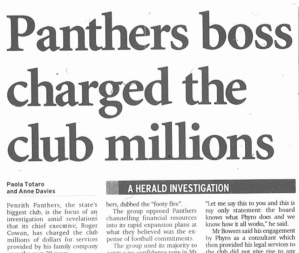
When the Herald arranged for an interview with Cowan for the story, it was in the middle of the poker machine tax debate. He assumed he was being interviewed about the tax, and he invited John Wilson to join him in the interview. As the Club’s gaming manager, Wilson could help explain any of the more technical aspects of the tax and gaming revenue.
As the interview progressed, Cowan became more and more mystified at the line of questioning. Suddenly the penny dropped. He said to the journalists, “You’ve been talking to the Footy Five!“4
When the interview was over John Wilson laughed and told Cowan, ‘you were a bit slow today. I woke up to what was going on about ten minutes before you did.’
In the paper’s News Review section, a feature story, also about Cowan and Panthers, was headed ‘A league of their own’. Both stories were co-written by Paola Totaro and another Herald journalist, Anne Davies.
The News Review piece followed the perspective of the Five, its content resembling their allegations particularly in relation to Phyro.
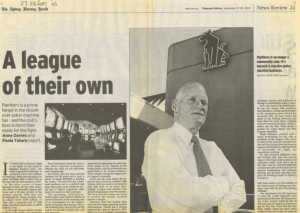
27-28 September 2003 — the accompanying feature by Paola Totaro and Anne Davies.
On the same day, one of the Five, Geoff James, phoned Ray Hadley on 2GB to dispute a statement attributed to Cowan in the Herald. His comments challenged Cowan’s account of what the directors had known about Phyro. John Bateman also called Hadley that afternoon, supporting James and broadening the criticism to questions of governance and remuneration.
On Monday 29 September, a story appeared, with the by-line ‘Paola Totaro, State Political Editor’. Its purported theme was legislation that was being pushed through by the government to ban club executives from having business dealings with their clubs. It quickly segued to Roger Cowan and Phyro.
It was a busy week for Totaro. The following day it was much of the same. The Tuesday story carried an inset of the Saturday headlines about ‘boss charging the club millions’.
The rest of the media was intently covering the forthcoming Axe the Tax rally. Television news programs featured interviews with politicians and high profile sports people. ClubsNSW was bombarding all media with information and press releases, as were many other sporting and registered club organisations. But in four major stories written or co-written by Totaro for the Herald in that week — which mentioned Michael Egan, the new taxes, new club legislation, and particularly one of clubland’s highest profile clubs and CEOs — the raging news story of the moment — the forthcoming “Axe the Tax” rally — never rated a word.
Cowan remembers a particular incident that contributed to his cynicism about the fairness of journalists.
One Thursday I received an email from Anne Davies. She listed a number of questions and said she wanted answers by noon the following day for a story she was preparing for Saturday’s edition. The questions related to allegations by a disgruntled employee that were absurd and totally untrue. My immediate reaction was to answer the questions as quickly as possible and remove the allegations from the agenda. I managed to have all the answers by about 4:10 pm that evening, ready to send to Anne Davies next day. The following morning my secretary said that Anne Davies had called and left a message that she did not need my answers after all. The story was being held over till the following week.
Later that morning, I had a call from the chairman, Barry Walsh. He said that Davies had left a message on his phone asking him to call her about a story she was doing for Saturday. Then another director, Keith Rhind, called to tell me he had received a similar request from the journalist.
I was afraid that she was still planning a story for Saturday, but without my responses. It would make a much more sensational story if the allegations were listed, and not answered. If she had had another look at the allegations and realised how stupid they sounded, she would also have realised that my answers, if they came in, would kill her story.
I emailed the answers she no longer wanted, so at least she could not use the questions.
In their landmark 1994 book, Ethics and the Australian Media, John Hurst and Sally White criticise political bias in journalism, saying it denies the public the ability to make a truly informed choice about an issue.
The day after the rally, there was a Herald editorial calling for clubs to ‘uncover’ their finances. Thereafter, the intensive coverage of Cowan and Panthers subsided. It would return with renewed force eight months later, in June 2004, when the government’s inquiry under section 41X began.
Once Totaro began to cover the inquiry, the state political editor title no longer appeared with her stories. Why had it disappeared? Such a title identified her as a high-ranking member of the NSW press gallery.
In the modern world, there is often a symbiotic relationship between politicians and media. In his book The Latham Diaries, the former Labor leader — Mark Latham — wrote of the phenomenon.
In practice, journalists see only a fraction of what goes on in politics. Often they believe they have captured ‘inside’ information and stories when politicians give them off-the-record briefings.
He says that a politician who is not prepared to put his or her name to information is trying to manipulate the media for personal advantage.
Invariably, the public receives a jaundiced view of events.
Once the inquiry began, it was open slather. For Phyllis Cowan, opening the Herald each day became an act of courage. She says it felt as if her family history was being ripped open and spread across the paper.
It was never fact, just about the questions they were asking that day. But even when what was in the headline was explained, or proved untrue that day or the following day in the inquiry, they never corrected it or followed anything up.5
The media always had some idea of what was happening on each day of the hearings. Most mornings before the start of proceedings, the DGR held a media briefing. This was unusual in itself — or perhaps not? After all, this was the first inquiry of its kind, set up under fairly unusual circumstances, at a time that appeared rather convenient for the state government. So why not set another precedent?
There was a precedent of sorts already, in connection with a proper Royal Commission of great importance to NSW citizens. In 1994, the government launched the Wood Royal Commission into corruption in the NSW police service. Media were briefed every morning before the commission sat. They were told who would be appearing, and if it was going to be a particularly interesting or controversial day. Corruption in police forces is a scourge on our entire society.
Why did the NSW government attach the same media importance to the doings of one registered club and its CEO? Like the choice of Ian Temby, it reinforced Cowan’s belief that the government was intent on getting as much mileage as possible from the whole event.
Paola Totaro attended most sessions of the inquiry, and usually whenever Cowan appeared. Many of her stories reflect a level of bias not expected from a writer of her calibre, who has won journalism awards. Where the evidence was detrimental to Cowan, it was there. If it shed a negative light on others — notably those who made the original complaints to the government — it seldom surfaced.
Her stories frequently received prominent placement in the newspaper, several appearing within the first seven pages, or in prime positions elsewhere.
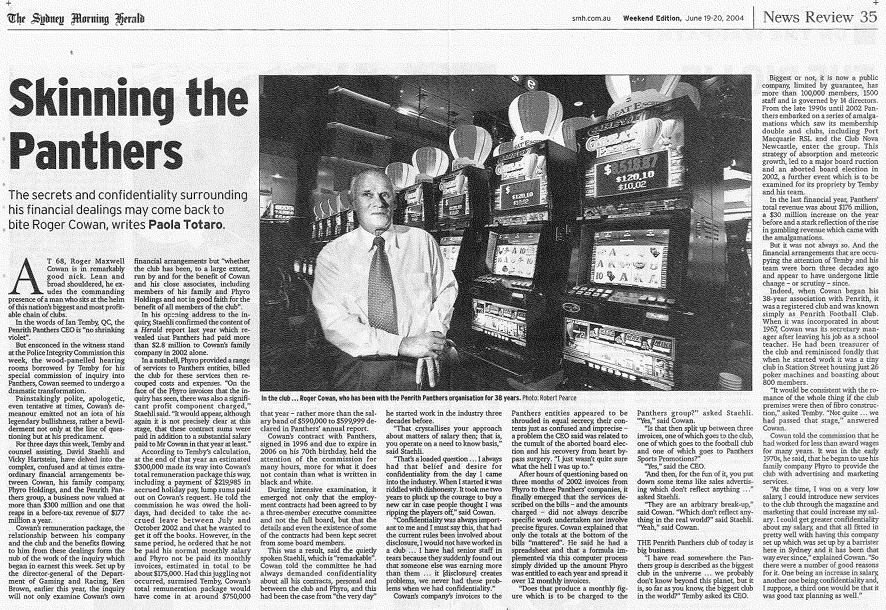
At the end of the first week of sittings in the weekend News Review section, her story was topped with the headline ‘Skinning the Panthers’.
The connotation and the imagery surrounding the word ‘skinning’ is negative, even in the context of removing the skin of an animal (such as a Panther). Metaphorically, there is a very strong connotation of ‘ripping off’, even stealing.
Centred in the half-page story was a photo across four of the page’s seven columns. Cowan stands in front of a line of poker machines large enough for dollar signs and amounts of money to be seen in their windows. This image, combined with the savage imagery of the headline, tells a story even to someone who doesn’t read the article — leaving the impression that Cowan was ripping off the Panthers.
The Herald followed a similar pattern throughout much of the inquiry. Regardless of the particular evidence being presented, several reports returned to the September 2003 story about the ‘payment of $2.9 million’ to Cowan’s family company, Phyro Holdings.
The full story about that payment emerged early in the inquiry, but even after those facts were clearly spelled out in evidence, the substantial figure continued to feature in subsequent reporting, sometimes without the context needed to distinguish the company’s billings from Cowan’s personal earnings.
The more sensational revelations of the day were also there, but the context and qualifications offered by witnesses did not always receive the same emphasis. Panthers director Terry Heidtmann appeared on 24 June, and his evidence was covered the following day. Totaro reported criticisms he made about the way some things had been done at the club, but also referred to his trust in Cowan. However, her language seemed to portray that his trust was misplaced. She also described Heidtmann’s ‘intricate business relationship with the club’ and reported that he had sold four properties owned by the Club — she failed to explain that those four sales took place over a period of 40 years.
The stories continued to emphasise perceived faults and failings revealed in Cowan’s evidence, yet the testimony of some other witnesses drew less attention. Counsel and Ian Temby were at times searching — even ruthless — in their questioning of the directors known as the Footy Five. Their evidence raised questions about the decision to cancel the election, including the motives behind it. Some even recanted or changed parts of their testimony. Yet these aspects of the proceedings received comparatively little attention in the Herald’s coverage.
It was the headlines that were felt to be the most damaging by those associated with Panthers and Cowan. Phrases like ‘blind loyalty goes right to the top’; ‘accountant had doubts’; ‘we didn’t ask questions’; ‘close knit Panthers family’, were felt to be demeaning of the Club’s directors, management and staff. Many witnesses say they were appalled at the misleading way their statements were quoted.
A note on source material
Selected newspaper images are reproduced in this instalment. A series of Digital Archives containing more extensive coverage from the newspapers of the time is being prepared for Beyond the Book. Links to those archives will be added here as they become available, enabling readers to examine the original reporting in greater detail.
- MEAA Journalist Code of Ethics. MEAA: Media Entertainment & Arts Alliance. This code was first created in 1984, it was updated in 1986 and again in 1999. The 1999 version remains current today.
↩︎ - Totaro worked in Carr’s office when he was Leader of the Opposition. It was during a period when she’d taken a sabbatical from journalism.
↩︎ - The $2.9 million represented gross payments to Phyro Holdings for services supplied to Panthers, not Roger Cowan’s personal income or the company’s profit. Phyro incurred expenses in providing those services. Cowan reported a net profit of $43,498 from the arrangement, although the accuracy and accounting treatment of that figure became matters of contention during the Temby Inquiry. The distinction between gross billings, company profit and personal remuneration is important when interpreting the newspaper’s reporting.
↩︎ - Sadly, there is no record of their response to this. Possibly it was “journalists don’t reveal their sources”.
↩︎ - Although rare, The Sydney Morning Herald published at least one correction during its coverage of the inquiry. It concerned the reporting of Terry Heidtmann’s evidence in June 2004. Phyllis Cowan’s comments reflect her broader experience of the coverage and the impression left by its headlines.
↩︎
To receive new Parts and occasional project updates by email, you may subscribe below.
Readers who hold recollections, documents, or material relevant to this history are welcome to contribute via the Commentary & Contributions page.
Project Updates
Receive updates when new parts are published.


One thought on “Truth and the Media: The Sydney Morning Herald’s Coverage”
Comments are closed.