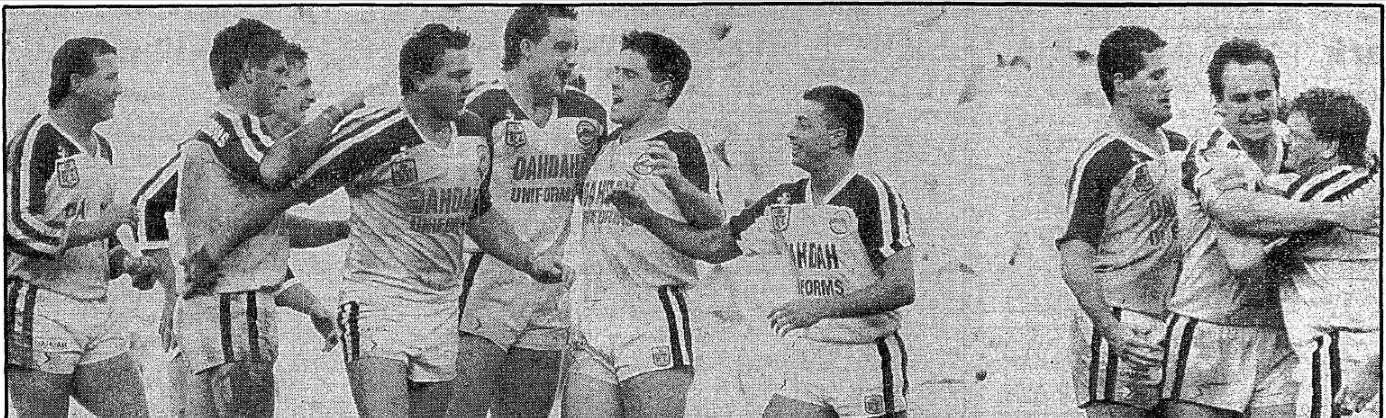
In Season 1985, Panthers fans were celebrating the “arrival” of their team to compete in September games — a semi-final against archrivals Parramatta beckoned. The chant rose for fans to take the “XPT to the SCG”. Alas, the Eels were way too slick for the Panthers and the trip back to Penrith was on a “red rattler” — arrival was quickly followed by eviction.
But a few years later …
Penrith Arrived
On 8 September 1990, Penrith Panthers produced one of the most significant performances in the club’s history.
Facing defending premiers Canberra in the Major Semi-Final at the Sydney Football Stadium, the Panthers won 30–12 after extra time to advance directly to their first Grand Final.
It was a remarkable achievement because the Raiders had a lethal, and very experienced team. Gould believed they were an even better team than the Raiders’ 1989 premiership team.
For a club that had spent much of its first 23 seasons struggling to establish itself in Sydney’s premier rugby league competition, this game set a new benchmark – way above anything that preceded it.
For the players, it was the culmination of years of development. For the administration, it was confirmation that the considerable investment in football facilities, recruitment and junior development was producing results.
And for the people of Penrith, it was an opportunity to see their club compete for rugby league’s greatest prize.
The Sydney Morning Herald captured the significance of the victory in its headline the following day:
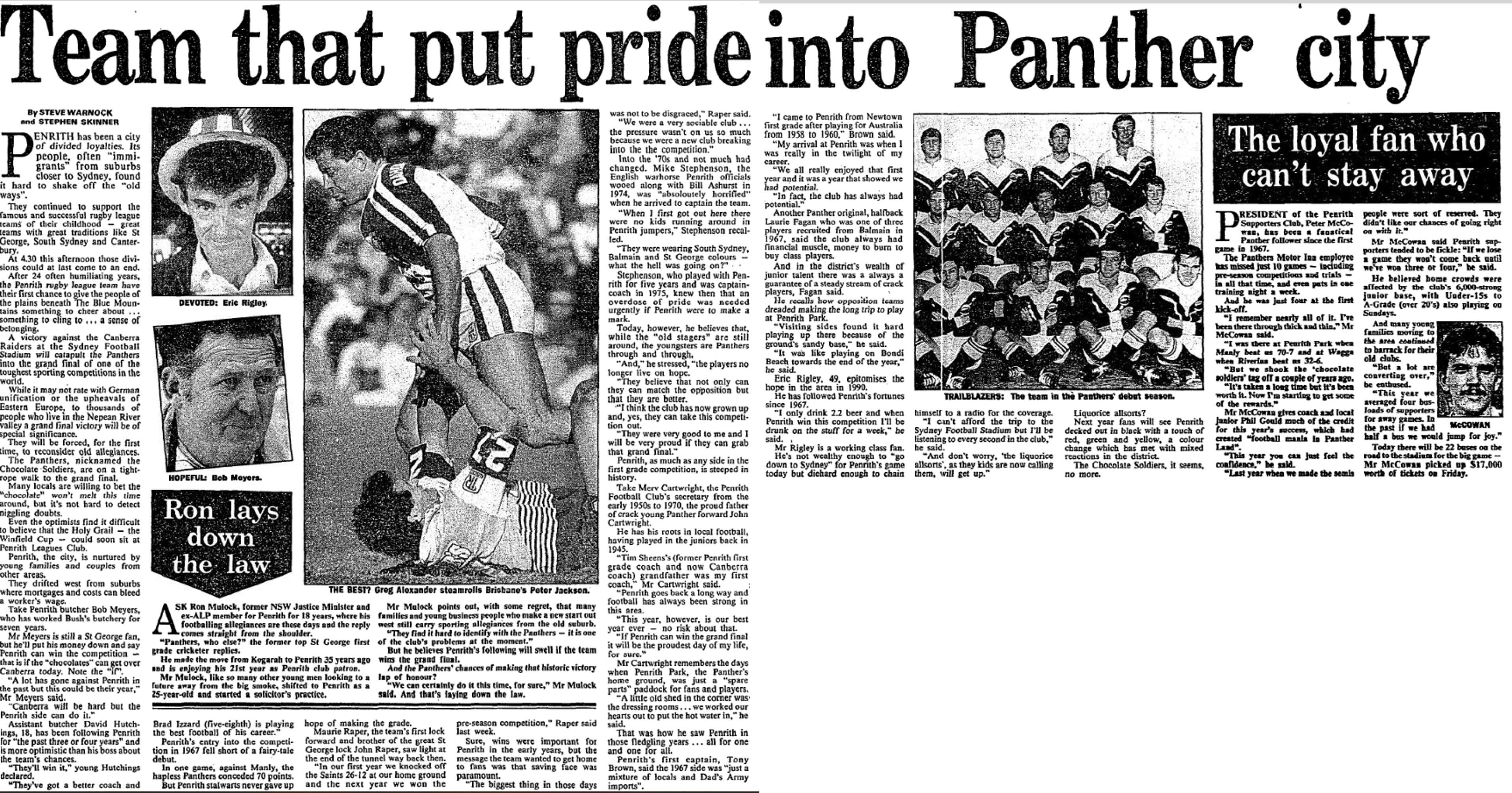
The Panthers would ultimately lose the Grand Final to Canberra. But the 1990 season represented a decisive turning point in Penrith’s history.
The Foundations Were Already There
Penrith’s emergence in 1990 was the product of several years of football development
Tim Sheens had transformed the football operation during his tenure from 1984 to 1987. He introduced greater professionalism, developed young local players and helped establish expectations that had previously been difficult to sustain.
Ron Willey, who succeeded Sheens in 1988, inherited a much stronger football club. He brought a disciplined and uncompromising approach, strengthening the team’s resilience and competitiveness.
Penrith had qualified for the finals through fifth-place playoffs in both 1985 and 1988. In 1989, the Panthers took another step forward, recording more wins than in either of those seasons and qualifying for the finals outright for the first time.
Yet despite that progress, questions remained about the team’s ability to perform in the biggest matches. Some of Willey’s selections and tactical decisions, particularly under finals pressure, had attracted criticism. By the end of 1989, the club had decided that a change of coach was needed if Penrith was to take the next step.
The decision did not diminish Willey’s contribution. Penrith already possessed an experienced and talented playing group. The challenge was to find a coach capable of bringing out its full potential.
The appointment of Phil Gould for 1990 provided that opportunity.
Interestingly, Gould himself acknowledged the foundations he had inherited.
In a Sydney Morning Herald article published on 7 March 1990, ahead of the pre-season Challenge Cup final between Penrith and Canberra, Gould credited his predecessor Tim Sheens with much of the club’s progress.
A lot of the turnaround at Penrith is owed to Tim’s years as coach here. He laid the platform for me in the 90’s.
It was a generous acknowledgment, particularly from a coach who had already won a premiership with Canterbury and was now expected to take Penrith to another level.
Canberra won the pre-season final 12–2, but the teams would meet three more times during 1990 — in the regular season, the Major Semi-Final and, ultimately, the Grand Final.
Gould’s First Season
Gould’s coaching techniques differed from Willey’s, although he was no less demanding.
He placed considerable emphasis on preparation, physical conditioning, tactical organisation and the psychological aspects of football.
His willingness to make difficult selection decisions was demonstrated early in the season.
Royce Simmons, one of Penrith’s most respected players and a central figure in the club’s development, was dropped from first grade. Gould also made changes involving other established players.
These decisions caused considerable controversy, particularly among supporters who regarded Simmons as the embodiment of the Panthers’ spirit.
But Gould was determined to establish a team capable of winning the premiership, even if that required painful changes.
Whatever difficulties Gould’s methods may have created for some players, the results were immediate. Penrith reached the pre-season Challenge Cup final and then opened the premiership season with a loss followed by five wins and a draw.
It was an extraordinary start fro Penrith, although maintaining that momentum throughout a long season would prove another challenge. As the season progressed, the team developed the resilience and cohesion needed to compete with the game’s best.
Gould had inherited a talented playing group, but talent alone is not sufficient for consistent results. His task was to mould those individuals into a team capable of performing under pressure.
By the latter part of the season, it was clear that he was succeeding. Across rounds 15 to 21 of the 22-round regular season, Penrith conceded just three tries. Their opponents during those seven matches included every team that would qualify for the finals, along with two that narrowly missed out.
Building Momentum
Penrith possessed a remarkable collection of football talent.
Greg Alexander had developed into one of the game’s most accomplished attacking players. His speed, creativity and ability to control a match made him central to the Panthers’ ambitions.
Brad Fittler, still a teenager, was emerging as an exceptional talent.
John Cartwright, Mark Geyer, Brad Izzard and Steve Carter provided strength and versatility, while experienced players such as Royce Simmons, Chris Mortimer and Paul Clarke contributed leadership and stability.
The team’s progress was increasingly evident in its results.
Penrith won ten of its final thirteen regular-season matches, despite continuing injury problems.
By the end of the regular season, the Panthers had finished third on the ladder, behind Canberra and Brisbane.
For a club whose football history had been characterised by long periods of disappointment, this was a notable achievement.
But the greatest test was still to come.
The Performance That Changed Everything
Penrith faced Canberra in the Major Semi-Final on 8 September.
The Raiders were defending premiers, with an experienced team containing some of rugby league’s finest players. They had been in the play-offs for the previous three years, made the Grand Final twice and won it once, in 1989.
Penrith had only recently had their first taste of finals football, only seven days previously had won their first ever finals game and had never reached a Grand Final.
Yet the Panthers produced a performance that demonstrated how far they had progressed.
After a very close but thrilling first sixty seven minutes, Canberra took a 12–10 lead through a Glen Lazarus try. There were thirteen minutes remaining, and Penrith equalised with five minutes left. At full-time, the scores were locked at 12–12.
That scoreline barely conveys the intensity of the contest. Canberra’s attack was relentless, and for much of the match Penrith appeared to be hanging on by the skin of its teeth. Yet somehow the Panthers kept finding a way to hold the Raiders at bay — even with Chris Mortimer and Col Bentley each spending time in the sin-bin.
The match went into extra time — ten minutes each way.
A massive cheer — and sense of relief — erupted from Panthers fans about three minutes into extra time when Steve Carter made a long-range break, passed to Brad Izzard who almost scored and Brandy finished it off diving over from dummy-half.
Penrith then took complete control, scoring eighteen unanswered points to win 30–12.
Greg Alexander was outstanding.
He scored two tries, kicked seven goals and finished with 22 points, repeatedly challenging Canberra’s defence and creating opportunities for his teammates.
Penrith had produced an exceptional team performance, but Alexander had been its dominant figure.
There would be no preliminary final to negotiate and Penrith, for the first time, was in the last game of the season!
More Than a Team Performance
The Major Semi-Final also produced some remarkable individual stories.
John Cartwright’s performance was particularly memorable.
Cartwright had been deeply affected by the serious illness of his close friend, Mick Lewis, who was battling brain cancer.
Had the Board chosen differently at the end of 1989, Penrith may still have remained one of the competition’s strongest clubs. Whether it would have climbed the final step can never be known.
His determination to perform for his friend gave the occasion a deeply personal significance, captured in Roy Masters’s Sydney Morning Herald report, Cartwright gives all — for a special mate.
It was a reminder that the commitment within a football team is not always explained by coaching methods, tactics or physical preparation.
Personal relationships, loyalty and determination can be equally powerful.
There was another important dimension to Penrith’s performance.
Royce Simmons, whose position in the team had been under threat earlier in the season, had returned to play an important role.
For Simmons and other long-serving Panthers, reaching the Grand Final was particularly meaningful. They had experienced the disappointments of earlier years and understood just how difficult the journey had been.
The District Comes Alive
The excitement following the major semi-final reach well beyond the Club and its members.
In a special Sydney Morning Herald feature published on 9 September, Steve Wancroft and Stephen Skinner explored what the achievement meant to Penrith and its people.
Their article described a city whose residents had often retained football allegiances to clubs elsewhere in Sydney. Penrith’s success was helping create a shared identity around the Panthers.
Long-serving supporters such as Eric Rigley and Bob Meyers recalled the difficult years and their hopes for the club.
Former players, including Maurice Raper, Tony Brown and Laurie Fagan, reflected on Penrith’s beginnings in first grade and the challenges of establishing a competitive team.
Supporters Club president Peter McCowan, who had followed the Panthers since their inaugural season in 1967, spoke of the loyalty that had sustained the club through years when success seemed a distant prospect.
These were not simply recollections of football matches.
They were stories of a district and its people, of loyalty maintained through disappointment, and of the pride that came from seeing their club finally compete among the game’s best.
For many, reaching the Grand Final was much more than sporting success.
Penrith was no longer just a developing district on Sydney’s western fringe. A football team earning its place among the game’s best was a catalyst for building a stronger, more connected community.
A Milestone for the Organisation
This first Grand Final appearance was also a milestone for the wider Panthers organisation.
The licensed club’s growth had provided resources for investment in football facilities, recruitment, coaching and junior development. In turn, the football team’s success strengthened the Panthers identity and its connection with the district.
This was the relationship between football and the wider organisation that Roger Cowan and successive Boards had worked to develop.
Years earlier, the Five-by-Five Committee led by Cowan had outlined an ambitious plan to build a competitive first-grade team substantially from players developed within the district, supported by an organisation capable of identifying and nurturing local talent.
For more detail on this see the related Beyond the Book articles: The 1983 Strategic Reset and The 1983 Strategic Reset — Did it Work?
The 1990 Grand Final appearance was powerful evidence that this long-term approach was working.
Grand Final Fever
Reaching the Grand Final brought an entirely new set of demands — demands not previously experienced by the club or the players.
For Gould and his players, the priority was preparation for Canberra. But for the wider Panthers organisation, the fortnight before the match involved an extraordinary level of activity.
Sponsors, supporters, media organisations and community groups all wanted to participate in the excitement.
Gould was determined to protect his players from unnecessary distractions, while the administration had responsibilities extending well beyond the playing group.
As Bound for Glory recounts, Panthers suddenly found itself at the centre of attention throughout the district.
The club had worked for years to establish its reputation and build its relationship with the community. Now it was experiencing the consequences of becoming one of rugby league’s leading clubs.
September 23, 1990
Canberra reached the Grand Final after defeating Brisbane 32–4 in the preliminary final.
The Raiders were defending premiers and had considerable experience of football’s biggest occasions. Penrith, by contrast, was appearing in its first Grand Final.
The match was played at the Sydney Football Stadium before a crowd of more than 40,000.
Canberra established an early advantage, but Penrith fought back.
The Panthers demonstrated the determination and attacking ability that had carried them through the season.
Yet the Raiders’ experience and composure ultimately proved decisive. Canberra won 18–14, securing its second successive premiership.
For Penrith, the disappointment was profound. The players had come within four points of winning the premiership in their first Grand Final appearance. There were tears and disbelief.
But there was also considerable pride.
The Panthers had demonstrated that they belonged among the game’s leading teams.
The Beginning of Something Greater
Although the Grand Final had been lost, Penrith’s achievement was celebrated.
In Hooked on League, Royce Simmons reflects on the disappointment of the defeat and the determination that followed.
For Simmons, who had spent much of his career at Penrith during its difficult years, reaching the Grand Final was an achievement that once seemed a distant ambition. Losing was painful, but the players now knew they could compete with the best.
They had experienced the pressures of Grand Final football, discovered what was required to compete for a premiership and learned the disappointment of falling short.
Those lessons would be carried into the following season.
The achievement reflected the contributions of many people over many years.
Tim Sheens had helped transform the football operation. Ron Willey had strengthened its competitiveness. Phil Gould had brought the coaching expertise and determination needed to take the team to another level.
The players had responded.
And behind them stood the Panthers organisation whose development had made sustained football success increasingly possible.
For Roger Cowan and those who had worked to build Panthers, the Major Semi-Final win and the Grand Final appearance that followed represented another important stage in the realisation of a much longer ambition.
But after September 1990, Penrith no longer needed to wonder whether it belonged among rugby league’s leading clubs.
It had proved that it did.
Related Topics
- Beyond the Book — Bringing Gould Back to Penrith
- Major Player: Phil “Gus” Gould AM
- Major Player: Tim Sheens
- Major Player: Greg “Brandy” Alexander
- Major Player: Royce Simmons OAM
Related Themes
Football Club · Strategic Planning · Culture
Feature Image: photo by Palani Mohan. Appeared in Sydney Morning Herald 3rd September 1990 after Penrith defeated the Broncos in the Major Preliminary Semi-Final
To receive new Parts and occasional project updates by email, you may subscribe below.
Readers who hold recollections, documents, or material relevant to this history are welcome to contribute via the Commentary & Contributions page.
Project Updates
Receive updates when new parts are published.

