Part 76 — Original Chapter: Chapter 24: Truth and the Media
This article forms part of the serialised republication of Panthers, Passion & Politics – The Roger Cowan Years.
The preceding instalment examined the Sydney Morning Herald’s coverage of Roger Cowan, Panthers and the Temby Inquiry, against the standards of accuracy, fairness and balance set out in the Journalists’ Code of Ethics.
Those same standards provide the context for this instalment, which turns to the Western Weekender — a newspaper owned by Greg Evans, one of the Footy Five — and the wider consequences of the inquiry’s media coverage.
Cowan was not surprised that Greg Evans’ Western Weekender also covered the inquiry.
Why wouldn’t they? Evans had proudly proclaimed himself as a member of the Footy Five, and it was some — or all — of that group that made those complaints to the DGR. This was what they wanted.
He was also not surprised by the Weekender’s ‘distorting emphasis’. He says the only perplexing thing was why it took them so long to get into it.
The timing is interesting.
The newspaper’s owner, Greg Evans, appeared before Ian Temby on 21 July. Although the Weekender had already commented on the inquiry in its editorial columns, its sustained front-page coverage began around the time Evans gave his evidence. The inquiry sat for 29 days, and a substantial part of the proceedings had already taken place before the Weekender’s coverage began.
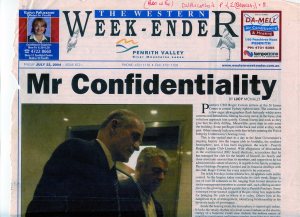
The front page on 23 July screamed ‘Mr Confidentiality’. More than half the page was taken up with a photo of Cowan in profile. The background is dark, and his face is in shadow. There is a sinister aspect to the image. Inside was another page of text, under the heading ‘Six million dollar man’. The article estimated Cowan’s earnings over the previous ten years at $6 million, without explaining how that figure had been calculated.
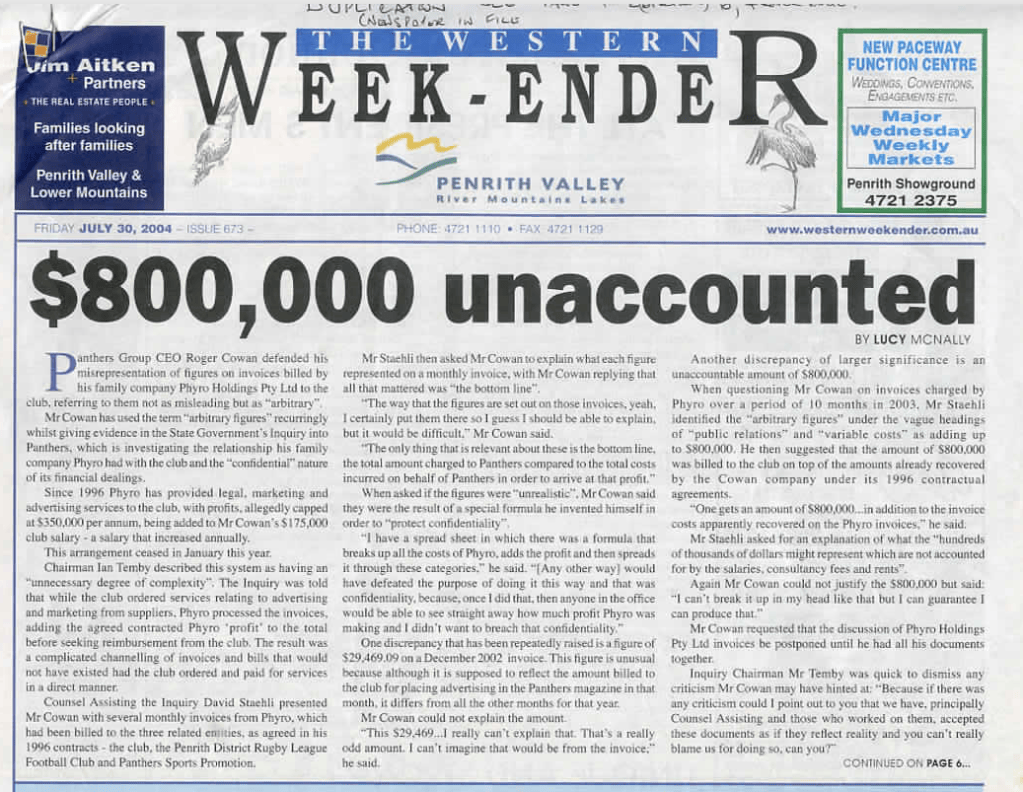
Once the Weekender began its onslaught, there was no stopping it. The following week’s front page said ‘$800,000 unaccounted’. Yet the figure had emerged during questioning, early in the Inquiry, about the allocation of amounts across Phyro’s invoices, not from any finding that $800,000 was missing. Cowan explained that the amounts had been distributed among different accounting categories and undertook to provide further detail. The distinction was hardly apparent from the headline.
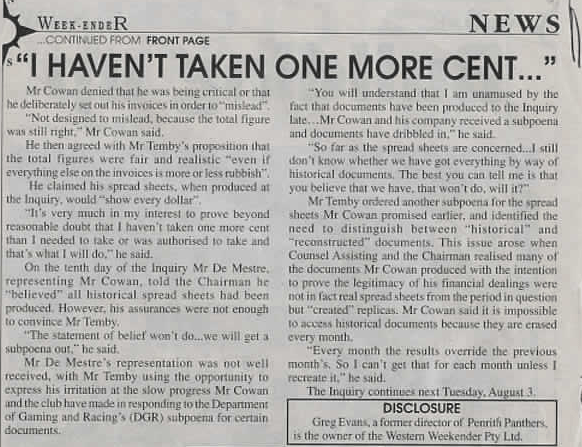
The inside subheading was ‘I haven’t taken one more cent’ — a truncated version of Cowan’s response that, without its qualification, could suggest he had previously been taking money improperly.
After its belated start on coverage, the Weekender was playing catch up.
Another headline was, ‘I’ve got no idea’, The story makes much about Cowan’s discomfort trying to explain one of the hundreds of payments made by Phyro over the previous ten years. It was a payment to a member of Cowan’s family, which Cowan maintained had nothing to do with the Club. But by this time everything was fair game. Like all the Weekender stories, it was damning stuff. The newspaper seized upon the most damaging aspects of the questioning, while the explanations and qualifications offered in evidence often received far less prominence. The overall impression was one of sustained criticism of Cowan, with little corresponding attention to evidence that might have placed the allegations in a different light.
Criticisms of Barry Walsh and Keith Rhind — two directors targeted in the Weekender’s Board Wars campaign — were reported. Yet the questioning of the Footy Five, including significant criticisms of their conduct, appeared to escape the newspaper’s attention altogether.
At the inquiry Greg Evans took pains to assure Ian Temby that he did not have editorial control of the publication. Neither, he said, did he ever pass on to it anything controversial from Panthers’ boardroom.
When interviewed, Evans acknowledged that some people may find this difficult to believe.
I know everybody thinks I did. I’ll forever be tarred with that brush, particularly about the envelope on the doorstep that precipitated the Board Wars story. But it was not me.
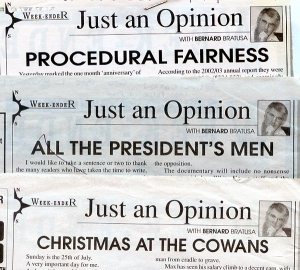
If Evans did not exercise editorial control, responsibility for the newspaper’s coverage rested with its editor, who maintained that he and his publication covered the inquiry in a fair and balanced way. Readers of this book can make up their own minds. His weekly editorial column, called ‘Just an Opinion’, is meant to be a witty, pithy piece that deals with the issues of the day. It is often pontification, and frequently laced with sarcasm, vitriol and hypocrisy.
The editor’s first column relating to the inquiry, on 9 July, was titled ‘Procedural fairness’. He noted, with a hypocrisy that defies belief, that as chairman of the Wallacia Panthers, he had a responsibility to ensure that the good name of Panthers was upheld. The column strongly criticised Rhind, but praised Heidtmann — quoting Heidtmann’s evidence out of context that he ‘welcomed the winds of change’ in the arrival of the younger members (the Footy Five). He summarised the first days of sitting in a series of negative grabs and pompous judgements.
He pledged that in his coverage of the inquiry, Within a couple of weeks, the drawer was well and truly opened, and the ‘cheap shots’ flew out.
… facts and direct quotes will be the order of the day, with “cheap shots” left in the sarcasm draw [sic].
It did not take long before the drawer was well and truly opened, and the ‘cheap shots’ flew out.
His children often feature in his column. In one case he spoke of his son’s recent birthday and the presents. That led to the ‘revelation’ that ‘Roger Cowan gave his son Max a Christmas gift of a large sum of money one year.’ The editor wrote: ‘My immediate reaction was Roger please adopt me’, adding such comments as ‘ho, ho, ho, and then some’. The venom continued, with Max Cowan the prime recipient. The piece ended with the editor’s philosophical maxim that ‘money is the root of all evil’.
In one of his more pretentious columns, titled ‘All the President’s Men’, the editor invoked the Washington Post journalists Bernstein and Woodward, whose reporting helped expose President Richard Nixon in the Watergate scandal. The parallels he invited readers to draw with the Panthers controversy were hardly subtle. His editorial standards and his ego were weird bedfellows. In poorly veiled analogies, he talked about how power corrupts. ‘Paranoia about enemies, perceived traitors, and a leader who was bogged down by a war, but wanted to make universal changes without the approval of relative [sic] authorities, namely the US Senate.
He exhorted readers to watch a documentary on Watergate the movie ‘All the President’s Men’ — which, incidentally, was also title of his column — ‘to help maintain a little objectivity in a world where ‘everything is not always what it appears.’
Previously he had written “The truth is the only thing worth reading’, certainly not a recommendation for his own work.
On 29 October 2004, the Weekender’s front-page headline was ‘End in sight’. The story reported that the inquiry was nearing its conclusion and that Cowan had breathed a sigh of relief. The Weekender would ensure that the relief was a little premature.
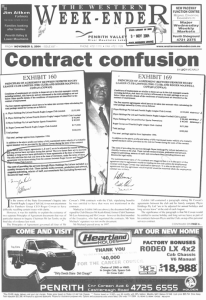
The paper had another shot at Cowan in its following issue, on 5 November. Under the headline ‘Contract confusion’, the front page prominently displayed two versions of the Principles of Agreement examined on the final day of evidence. The story and its continuation focused on the differences between the documents and Cowan’s inability to recall how they had come about. The story rehashed much of the inquiry, making the most of this final chance to denigrate and discredit. Greg Evans may have been delighted that without any direction from him, his editorial staff maintained the paper’s relentless attacks on Cowan.
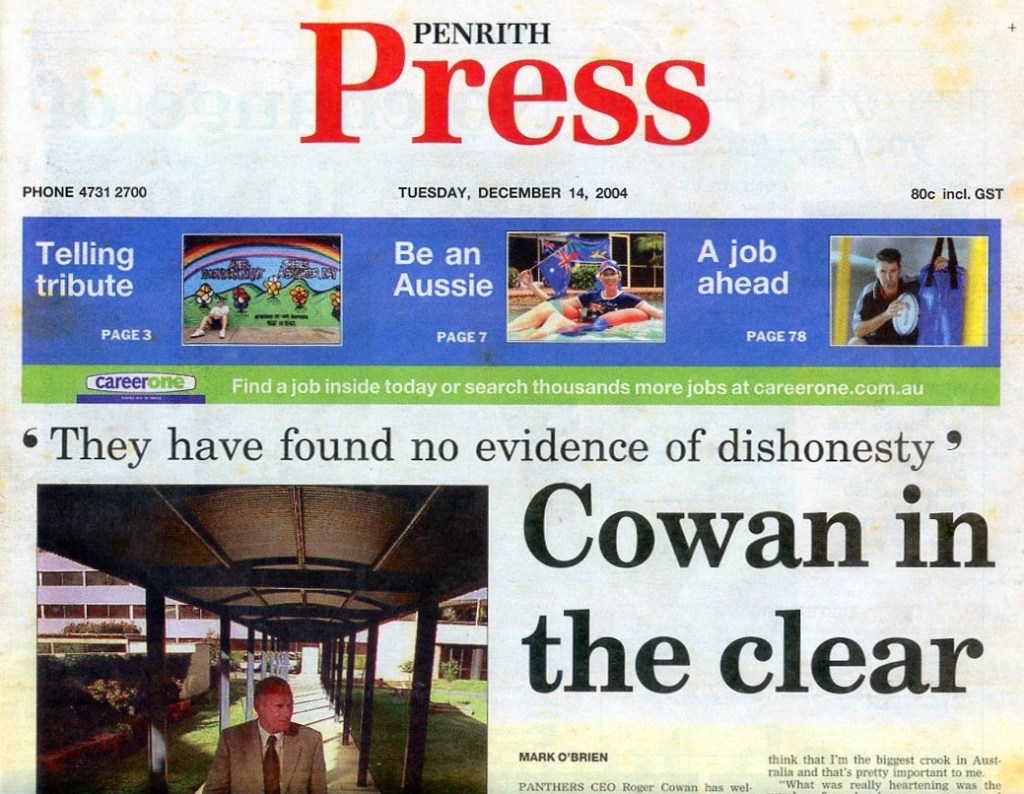
When Temby’s findings were released in December 2004, the headline on the front page of the Penrith Press said, ‘Cowan in the clear’. The Weekender’s front page said, ‘Cowan criticised’.
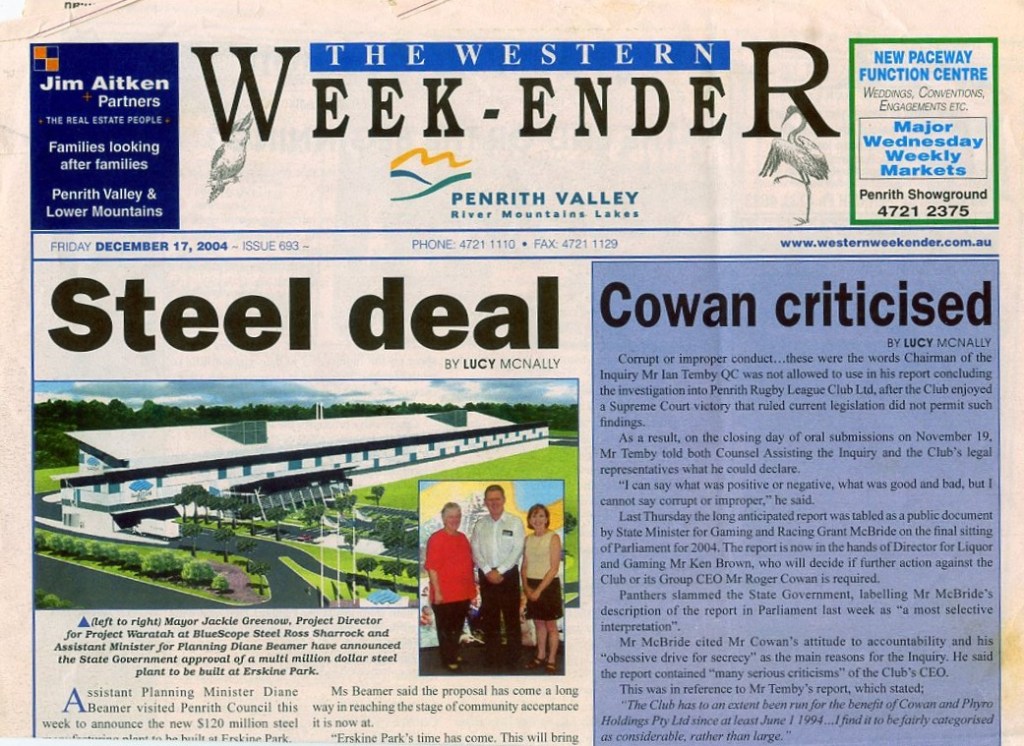
Weekender journalist Lucy McNally started her report with the words:
Corrupt or improper conduct . .
and went on to say that,
. . . these were the words that Ian Temby QC was not allowed to use in his report.
They were, however, the first words to hit anyone reading the story.
The story was almost a direct lift from the very misleading speech made by Minister McBride to parliament when he released the report. It contained a number of quotes from the minister, in particular one relating to allegation 6 that the Club ‘has been to an extent run for the benefit of Cowan and Phyro Holdings’.
Temby’s conclusion that allegation 6 had not been established was omitted from McNally’s account, despite the prominence given to the minister’s criticism.
The Penrith Press, on the other hand, provided a detailed account of Temby’s findings. Its coverage listed the matters investigated, item by item, and summarised the conclusions. Temby’s criticisms of Cowan and the Club were included, but readers were also given the context needed to understand the findings. There was no distortion of fact.
The editor’s column in the Weekender called Panthers a ‘castle of hate’ and suggested that the Temby report was ‘just the beginning’.
The editor also used his column to criticise his rivals’ coverage of the report, particularly, it seemed, the Penrith Press. With characteristic hypocrisy, he stated: ‘I can only suggest that other local media scribes have either not attended the inquiry, nor read the transcripts and Mr Temby’s report, or worse still, failed to research material supplied to them by interested parties.’ The last couple of phrases are of particular note. One can only speculate on the identity of the ‘interested parties’ and on the material itself. Perhaps it arrived on the Penrith Press doorstep in a brown envelope and was dismissed accordingly?
The other allusion, to ‘local scribes’ who had not read the report, is laughable. The Penrith Press account demonstrated a more detailed engagement with Temby’s findings. The Weekender’s report relied heavily on the minister’s presentation of the findings, highlighting his criticisms while omitting Temby’s conclusion on allegation 6. If the Weekender’s Lucy McNally truly had read the full report, it is not evident in her article.
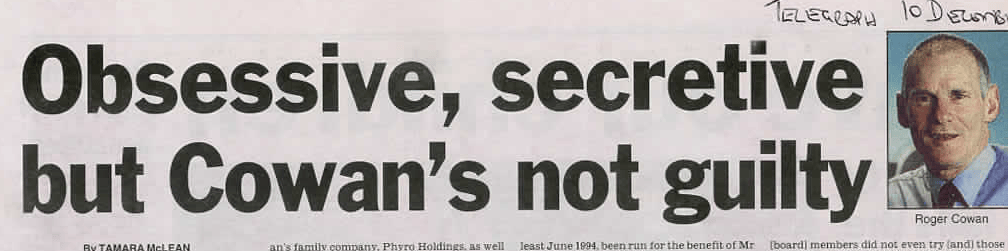
The Telegraph’s headline said, ‘Obsessive, secretive, but Cowan’s not guilty’. True to form, Davies’ and Totaro’s page three story in the Herald was headed ‘Panthers boss accountable to no-one’. The story does, however, include a couple of Temby’s more positive findings, acknow- ledging that Cowan ‘took no more than his due entitlements’, and that ‘he is not a thief’.

For the Herald, the war was not yet over.
In March 2006, 15 months after Ian Temby handed down his report, the director of Gaming and Racing issued his response. The brief notice did not even mention the name of Roger Cowan, except where it listed the original 41X allegations. Totaro’s coverage of the release says that the only reason the government is not proceeding against the Club is the cost of a protracted legal battle. The headline reads: ‘Panthers spared court: suspended sentence for bad accounts’. Surely, one must be charged, tried, and found guilty before one can receive a suspended sentence. The story speaks of Temby’s ‘scathing’ report, and once again raises the issue of Cowan and his financial affairs.
Roger Cowan — and those around him — respect the rights of journalists and the media in general to report the news. But Cowan says he also has rights — particularly the right to expect that the whole story would be told with some degree of balance. At Panthers’ 2005 Annual General Meeting, he spoke to club members about the inquiry.
The Sydney Morning Herald wrote some very damaging headlines, and there is no way I will ever outlive them, but do you know, if you go back over them now that not one of them was proven true. Not one. All those damaging headlines that made me look like I was a crook; that I’d stolen money; that I’d done everything and that I’d acted against the interest of Panthers. Not one was proved true, but the damage was done.
He adds,
… we never asked for special treatment, we just wanted them to be fair and tell the truth.
Later correspondence and discussion had Cowan reflecting more broadly on the influence of the media, his concerns well beyond his own experience.
I think we underestimate the damage done by biased reporting in Newspapers and in magazines. Print journalists have time to research sufficiently to get close to the truth. Sometimes they are too lazy and sometimes they are too anxious to persuade readers to their own beliefs and prejudices. What they write forms the foundation of what citizens can know. Radio and television information also draws on the written media. They have an enormous responsibility that many of them seem not to understand. Every time they go for a headline that ignores truth they are destroying the credibility of their profession and stealing our right to know the truth.
Sometimes we are moved so strongly by our attitudes that we want to take action. There is a huge stir, for example, about the lraq situation and possibly 99% of those involved have no knowledge about it whatsoever except what they have read, heard or seen in the media. A lot of what we read, hear and see about Iraq is obviously biased and sometimes little more than a journalist’s opinion dressed up to look like news. Sometimes, you can see information that does not ring true and has been inserted to add weight to the bias. The fact is that few of us have any idea of the truth in Iraq, but we think we do.
The now famous disturbances at Cronulla caused a widespread, inflammatory emotional response. The avalanche of media coverage included exaggerations, lies, beat ups and truth. The need for us is to be able to recognise which parts of the coverage are truth and to form our attitudes accordingly. Unfortunately that is very close to impossible,
Because of my experiences over many years, I find little value in reading newspapers. When I read an interesting story my response is always the same — I wonder which parts of that story are true, which are fiction and which are opinions of the writer.None of us is in a position of knowing all the facts. Those facts we do know can push us to conclusions that might fall apart if we had more information.
The subject of honesty in the media arises frequently in discussions involving people from many different walks of life. The response is predictable. People claim not to trust the media. But the weirdness becomes obvious when their expression of distrust is followed by the opening discussion about a media story as though it were fact.
At one stage my home was burgled three times over a short period. it was a nasty experience, but it was easily fixed. It was a cost to me and the insurance company and a lesson that I needed better security, but it made no difference to the long term and important things in my life such as self-image, respect, or reputation. You can replace what a burglar steals, but you can never replace a reputation once it has been stolen. I wonder who is more dishonest — a burglar stealing material goods or a journalist stealing someone’s reputation with unsubstantiated information or unbalanced reporting.
Charges can be laid against those who inflict harm on others, but there is nothing to protect innocent people against media lies and exaggerations that destroy reputations, inflict psychological damage and have even led to suicides. What’s the difference? People suffering physical assault can report it to the police and the police can lay charges. People suffering assault on their reputations are faced with the daunting prospect of taking action under defamation laws that are difficult to win and horrendously expensive.
A note on the source material
Selected newspaper images are reproduced in this instalment. A series of Digital Archives containing more extensive coverage from the newspapers of the time is being prepared for Beyond the Book. Links to those archives will be added here as they become available, enabling readers to examine the original reporting in greater detail.
To receive new Parts and occasional project updates by email, you may subscribe below.
Readers who hold recollections, documents, or material relevant to this history are welcome to contribute via the Commentary & Contributions page.
Project Updates
Receive updates when new parts are published.

