The Temby Inquiry Begins: Panthers in the Firing Line

This article forms part of the serialised republication of Panthers, Passion & Politics – The Roger Cowan Years.

Start · Reader’s Guide · All Parts

On 16 May 2004, Sydney’s Sun-Herald newspaper ran a story with the headline ‘Mega-clubs face inquiry of ICAC proportions’. Alex Mitchell, the writer, revealed that Premier Bob Carr was about to announce that former ICAC chief Ian Temby QC would head up an investigation into the NSW clubs industry. According to the report, the proposed inquiry would have powers comparable to those of a Royal Commission. It would target mega-clubs such as Panthers, Bulldogs, Cronulla Sharks and Parramatta Leagues. The hearings would start on 1 June, said Mitchell.

ClubsNSW CEO David Costello questioned the fact that the new legislation would only target clubs. Hotels, casinos, online betting companies and a number of other industries also come under the department’s jurisdiction.

Of course, the Department of Gaming and Racing receives complaints. But only about one third of them pertain to clubs. And of that number – as in any system of complaints to government bodies – many are frivolous or vexatious.

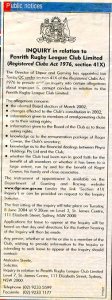
In the last week of May 2004, a small, one-column ad was run in two Sydney newspapers and publications in Penrith, Newcastle and Port Macquarie. It was headed ‘Inquiry into Penrith Rugby League Club Limited’. This was the first and only notification to Panthers that they specifically would be the focus of the new legislation. Cowan and the club had less than three weeks to prepare.

The ad, under the NSW Coat of Arms, went on to say that the director of Gaming and Racing had appointed Ian Temby to preside over an inquiry into allegations in relation to the club, under the new section 41X of the Registered Clubs Act. Six allegations were listed, and readers were directed to the DGR website. It said that anyone could seek leave to appear at the inquiry.

The six allegations fell broadly into three areas. The first four concerned the aborted March 2002 Board election, subsequent constitutional changes affecting voting rights, and whether members of amalgamating clubs or the Panthers Board had been misled about those rights.

The fifth concerned the disclosure of information about Cowan’s remuneration and the financial dealings between Panthers and Phyro Holdings. The sixth, and most serious, alleged that the Club had been run for the benefit of Cowan, his family and close associates, rather than in the interests of its members.

The allegations were set out in the public notice announcing the Inquiry. The notice in appeared in various metropolitan and regional publications. It is reproduced here.
There was a period of frenzied activity at Panthers.

The allegations gave some idea of what would be required, but the extent of the investigations was yet unknown. In retrospect, a more measured assessment of the allegations might have led Panthers to approach the Inquiry differently. At the time, however, management began assembling whatever documentation it believed might be required, even though no subpoenas had yet been issued. Chairman Barry Walsh said they were flying blind.

That week, a story appeared in the Penrith Press in which Roger Cowan said ‘Bring it on’. Neither he nor the club had anything to fear, he said. But it was obvious to everyone at Panthers in June 2004 that the government meant business.

Ron Mulock asserted that Cowan’s challenge to ‘bring it on’ was the catalyst for calling the Inquiry, even though it had already been announced. Cowan calls Mulock’s claim nonsense.

He repeated the comment at a Panthers annual meeting after I said I believed he had lobbied for the Inquiry.

As for the remark, when the reporter asked me for my reaction to the calling of the Inquiry, I was certainly not going to say, “Please don’t”. That would have looked like an admission of guilt. The only thing I could say was that we had nothing to hide, and basically – if there had to be an inquiry, so be it. There was nothing we could do about it, except cop it sweet.

One thing I learned very early in life. You don’t stop the bully by looking scared or asking for mercy.

Former ClubsNSW chairman Pat Rogan says the government was very confident going into the Inquiry.

They were sure they were going to get something. Egan was looking for a scalp with the new tax coming in. If they could get a big one, the clubs would fall into line.

Souris believed that the government needed to discredit the club movement to justify the new taxes, and that they deliberately targeted the highest profile club and its CEO.

What really struck me was the fact that they actually got to the point of creating new legislation. Then they decided. We choose Penrith Panthers, we choose Roger Cowan.

George Souris, the Shadow Minister for Gaming and Racing agrees,

They were getting a bit of needle, particularly from some of those members from strong western suburbs electorates. They were cock-a-hoop that if they could scandalise Panthers to a great extent, the public mood would turn against the clubs. And their back bench would calm down.

Souris says the opposition’s support of the clubs on this issue was much more than token opposition.

It was the vindictiveness of Egan and Carr. They were peddling this personal hatred stuff, trying to win the argument over the taxes by killing off one of the star players. It was a campaign of personal denigration, singling out one club and one man.

We had become greater friends with the club movement anyway. We’d marched in the street with them. But I was amazed at the level of fervour from a government that seemed intent on attacking its own heartland.

And suddenly you’ve got this brand new legislation with the powers of a Royal Commission. What was that all about? The DGR has always been able to conduct investigations under the act, and it does so – quite vigorously. There’s probably a couple of hundred investigations going on at any one time.

So here’s 41X and the first time they use it, they pick Ian Temby – sure to attract the maximum media coverage – to run it’, Souris said. ‘It was specifically designed to escalate into some kind of judicial, some kind of Royal Commission circus, and it did.

Terrence Lynch appeared for Panthers at the Inquiry. He says the government knew what it was doing when it appointed Temby.

They thought that he would suit them, because if they really believed there was corruption, he was someone who would be aggressive about it.

Temby’s a moralist. He was once quoted as saying “to lie is corruption”. He had run high-profile inquiries, prosecuting Neville Wran and Lionel Murphy. He also made the finding of corruption against Nick Greiner – which of course was later overturned.1 This is the point with Temby. What he regarded as corruption might be so in a perfectly moral world, but we live in the real world, and we must be judged – and judge others – by its standards. Basically, you have to assess the quality of conduct within some objective standards.

But the DGR had to act. Even Roger Cowan agreed on that point.

The DGR had no choice. It was the government that betrayed our system of justice and democracy when it decided to investigate the complaints by establishing a specially designed fishing expedition with quite extraordinary powers.

It was virtually saying, “Our investigators haven’t come up with the results we want. Let’s throw a big net over everything under Royal Commission powers, and we’re sure to find something”.

Such a high level of confidence on the part of the DGR and the government might explain what Cowan perceived as frustration in Mr Staehli, who was one of the counsel assisting the Inquiry. Cowan believed that the government’s expectations influenced the conduct of the Inquiry. Looking back, he offers his interpretation of the approach taken by David Staehli:

In this case Staehli was acting as a prosecutor. There can be no doubt that his task was to find evidence that would justify the allegations that had been made. Before it all started I believed in fairies, I think. I really thought that the inquiry would be looking for all the facts in an objective and impartial manner. In my opinion it did not happen that way at all.

I don’t know how a prosecutor works, but I imagine he would have made a detailed plan before he started. He had obviously been given a lot of information by the DGR, he would have information provided by the Footy Five, and there was all the information that I had been asked to provide for the previous ten years for Phyro Holdings, my wife and myself.

The DGR had spent the past year or so investigating the Club and taken no action. If Egan and his people were not expecting Temby to dig out something the DGR couldn’t find, there is a second possibility that is too horrible to contemplate – that the government knew from the start there was nothing to find. What if they suspected or knew the complaints didn’t hold water and that the claims had been discredited very early in the investigation by a team of competent DGR officers?  If this were the case, it would mean that the Inquiry had no intended outcome for the government other than to heap negative publicity on the club industry.

Still, if there was an air of confidence Staehli would have drawn up his battle plans. I imagine he would have listed all the crimes I might have committed. Then he would have taken each one and drawn up a plan to lead me through events leading up to it.

He would start with questions that seemed broad and innocuous, questions that would encourage me to think I could twist the truth. As I became more comfortable, the questions would become more focused and more specific. Variations or contradictions in my answers would be highlighted. Gradually I would be led into each of the traps and there would be no escape route.

One reason it did not work was that I had no reason to twist the truth at any time. In fact, I believed that getting at the truth was the only thing that could save me from the jaws of a very formidable predator – the NSW Government.

A second reason is that Staehli had probably based his list of possible crimes on information that had been supplied to him but was not true.

I was patiently led up the paths of questioning. But there were no contradictions, no lies and therefore no trap to spring when Staehli arrived at each of his destinations. Towards the end of the Inquiry, his frustration bubbled over into anger.

Cowan later recalled being told an anecdote about Staehli’s frustration during the Inquiry. Although he had no firsthand knowledge of the conversation, he found the story consistent with his experience:

After the inquiry ended, I was told an interesting story. Staehli was speaking to some legal friends of his frustrations during the Inquiry. He likened the experience to playing the old thimble and pea trick, where there is one pea and three thimbles, and the trick is to pick which thimble the pea is under.  On a number of occasions he said he was convinced that a certain line of questioning would find the corruption he was seeking, but every time he lifted the thimble, there was no pea.


To receive new Parts and occasional project updates by email, you may subscribe below.

Readers who hold recollections, documents, or material relevant to this history are welcome to contribute via the Commentary & Contributions page.

Project Updates

Receive updates when new parts are published.


  1. Ian Temby and the Greiner case: As NSW’s first ICAC Commissioner, Ian Temby presided over the investigation into Premier Nick Greiner’s appointment of former minister Terry Metherell to a public service position. ICAC found Greiner’s conduct to be technically corrupt under the legislation. The NSW Court of Appeal subsequently overturned the findings, although Greiner had already resigned as Premier in 1992. See ICAC Explained – a 2016 article from ABC News.
    ↩︎

← Part 68 · All Parts · Part 70 →

Commentary and Contributions

From Headlines to Investigation

This article forms part of the serialised republication of Panthers, Passion & Politics – The Roger Cowan Years.

Start · Reader’s Guide · All Parts

In September 2003, while the Treasurer was fighting off the flak generated by the new taxes, Panthers suddenly began to receive adverse media coverage.

When the allegations against Roger Cowan came to light in The Sydney Morning Herald, their timing was politically advantageous for Michael Egan. But was it just coincidence? We know that the government and the Herald were sent the same allegations in 2002. The newspaper had the information for around a year.

Was it just coincidental that the Herald timed its coverage perfectly for the government?1

The two Herald journalists – Anne Davies and Paola Totaro – were to play a big part in the story.  In many articles through 2003, Totaro’s by-line carried the title ‘State Political Editor’. In her later stories covering the inquiry, this by-line was not used.

The first major hit on Panthers came in the weekend edition of the Herald, 27-28 September 2003, with the lead story by the two journalists in the paper’s News Review section. The story made allegations about Roger Cowan’s family company and its dealings with Panthers. The Herald ran stories about Cowan and the Club over four consecutive days. In another apparent coincidence, 28 September was the day that former directors Geoff James and John Bateman spoke to Ray Hadley on the radio. James boasted that he and his colleagues had initiated complaints to the DGR.

According to a number of sources from the press gallery and Macquarie Street that Ron Mulock was walking the halls of Parliament around this time, lobbying on the subject of Roger Cowan and Panthers.

Though he did not admit to that accusation when Cowan put it to him at a Panthers 2005 AGM, Mulock said that “questions needed to be asked and answers needed to be given and they haven’t been given over the past 27 years”.

The club industry’s protest rally was scheduled for 1st October, three days after the article appeared. The rally would see 15,000 people march on Parliament House in Sydney. The crowd included club patrons, management and staff, representatives of religious and community groups, entertainers, suppliers, sporting people and federal and state politicians.

George Souris, Shadow Minister for Gaming and Racing, was one of the leaders of the march, as was Pat Rogan. Speaking late in 2005, Souris said,

In attacking the clubs, Labor is attacking its own heartland, I can’t understand this. People that go to clubs are the everyday people out there in the suburbs. The bowling clubs, the soccer clubs, they often provide the only sports facilities for the community in their areas. If the tax forces them to close, those facilities are lost forever.

At the time of the Allen report2, sporting venues maintained by clubs included 1,621 bowling greens, 102 gyms, 325 sporting fields and 338 golf courses. While some clubs own their facilities, others are council owned, and the clubs take responsibility for maintaining them. Panthers’ rugby league ground — Penrith Stadium — is an example. It is held in trust by Penrith City Council, but it has been maintained by the club since Penrith joined the rugby league first division in 1967.

The ten electorates to be hardest hit by the tax were held by Labor.3 Egan was facing a backbench revolt. The day after the rally, a vote was taken in the ALP caucus on a motion to review the tax. The count was 34 all.4

Against that background, the publication of serious allegations against the CEO of the country’s biggest licensed club came at a politically convenient time for the government.

Cowan recalls a further burst of activity by the DGR at Panthers soon after the revelations in the Sydney Morning Herald and wonders whether the government was putting extra pressure on DGR officers.

A few weeks after the October rally, planned changes to the Registered Clubs Act 1976 were announced that would provide broad new powers of inquiry. The new provision became Section 41X.5

George Souris had entered the fight against the new legislation quite early in the picture. In 2005 he said,

41X came in during the campaign against the clubs. It was never part of the Act before 2003. This whole thing with Royal Commission/inquisition inquiry powers [is new]. It’s always been possible to have investigations under the Act. There are investigations going on all the time – about 200 going on now, as we speak. And in appointing Ian Temby, they knew they’d get maximum mileage.

Souris believed that the government needed to discredit the club movement to justify the new taxes, and that they deliberately targeted the highest profile club and its CEO.

What really struck me was the fact that they actually got to the point of creating new legislation. Then they decided. We choose Penrith Panthers, we choose Roger Cowan.

He added,

And then there’s the sub-plot; they were being fed all this crap which gave them the ammunition they needed.

Panthers was going to be one of the worst affected by this tax regime. It would be expected to pay a minimum of $17 million additional tax each year. By the time the tax was fully implemented, the club’s tax would increase from $26 million to $43 million, provided that its revenue remained at the same level.

Apart from being an outspoken critic of the NSW government’s moves against the clubs, Roger Cowan was seen by some in the government as the prime mover behind the Registered Clubs Party6, which formed in the late 90s and ran candidates for the Upper House.

Second on the party’s ticket was Cowan’s son, Stephen.

But Cowan always questioned the wisdom of running candidates representing the club industry.

I was particularly averse to the use of the name Registered Club Party. In my mind, we were on a hiding to nothing. I thought any gains from a win would be marginal, and a loss would demonstrate that the industry was politically weak.

Till recently, I never really held to the common belief that the two million plus club members in NSW could be mobilised to a strong electoral advantage. The government has made such an enormous attack on the industry that circumstances might have changed … they haven’t moved the goalposts, they’ve chopped them down.

In the late 90s, despite his reservations, some people identified Cowan with the new party.

It later became clear that some people within the Labor party were hostile about the entire episode, and to a large extent, they held me responsible. The fact is, I had nothing to do with the decision to form a party. Once it was decided, I felt I had to recommend that Panthers support it.  If it had been my choice, there would never have been a Registered Clubs Party.

Looking back, it was probably a tactical error, but the government reaction is still difficult to understand. It is just one example of some of the spitefulness that existed within the Carr government. To me, none of this seemed to fit the image of the traditional ‘light-on the-hill’ party built by, and for the working man.

But I was once warned in no uncertain terms, over a completely different issue, that this party does not forgive, or forget those who oppose it. The warning came from someone who should know – a former deputy premier of NSW, Ron Mulock.

Cowan says he always tried to ensure that club management worked with the industry regulatory bodies in a spirit of open and honest co-operation. Phil Bennett, who was an inspector for the Liquor Administration Board – the forerunner of the DGR – in the seventies, bears this out.

‘Roger was usually very co-operative in his dealings with the LAB’, said Bennett.

He always used to put his hand up. He was a man of conviction, and if he believed something was wrong, he would always stick his hand up and say so. He didn’t always go with the flow, but he always tried to work with the department to educate officers about new trends and innovations, which most LAB people saw as positive.

Glenn Matthews confirmed this:

We were always totally open with the DGR – still are. Roger always maintained that it was best to work with them and co-operate fully. We had such good systems in place that everything was easy to track anyway.

The result was what Cowan describes as ‘a very good working relationship with the department and its principal officers’.  Cowan says they worked out quite quickly that the investigations in October 2003 related to elections and amalgamations. Geoff James’ call to Ray Hadley had confirmed the origin – and the timing – of the complaints, and also that a second letter had been sent in June of 2003.

An unnamed source gave Cowan details of the June letter. It was worded much more strongly and threatened that the matters would be taken to ICAC (NSW’s Independent Commission Against Corruption) unless urgent attention was given by the DGR to the original allegations. It seemed that the Footy Five were not about to let the matter die.

But most of the complaints had already been investigated, and the DGR had taken no action. We knew that there were allegations related to Phyro, and several questions about that subject had been answered. The new legislation relating to salary disclosures was in the pipeline, so I assumed the DGR would want more when that came through. I was still not really concerned. I could see no areas where we would have anything to answer.

During the investigations into my own situation, the inspector made one appointment [to see me] on the pretext of verifying the accuracy of salary disclosures given by the club. He made it sound routine, and said they were carrying out the same exercise with the top 50 clubs. This appeared quite logical, given the new legislation.

Very soon into the interview, his questions made it quite obvious there were broader objectives in play.

One of the criticisms levelled at Roger Cowan is that for a man of his talents and business acumen, he has, at times in his life, been incredibly trusting, even naïve. This time things suddenly began to fall into place in his head, and he started to become concerned.

It became obvious in the mad flurry of publicity and investigations that I needed to take some good legal advice. The gist of it [the advice] was that the combination of recent events made it very foolish to continue our policy of openness and co-operation with the DGR.

This caused some conflict for me. I asked for a meeting with Darryl Freeman from the DGR and reiterated my preference to maintain our policy of openness. But I also needed to protect my own interests. Yes, they had a right to expect my co-operation, but I questioned their right to go on a wild fishing trip into my affairs.

I explained my suspicions that the DGR was under pressure to find anything, no matter how minor, to discredit me and thus to discredit Panthers.

Memories of the police investigation some 15 years earlier7 had made Cowan a little shy of co-operating with people who may be on a witch hunt. Despite his experience, when the inquiry began Cowan still did not have personal legal representation. The Club was represented by Terrence Lynch.

I appointed my own legal representative a few weeks after the Inquiry commenced, when I belated came to understand that my interests and the interest of the Club were quite separate.


To receive new Parts and occasional project updates by email, you may subscribe below.

Readers who hold recollections, documents, or material relevant to this history are welcome to contribute via the Commentary & Contributions page.

Project Updates

Receive updates when new parts are published.


  1. In Part 67 we noted that the very well respected journalist, Paola Totaro, worked in Bob Carr’s team for period between 1988 and 1995.
    ↩︎
  2. The Allen Consulting Group’s 2004 report, commissioned by ClubsNSW, examined the economic and community contribution of registered clubs in NSW and the potential consequences of the proposed gaming tax increases. The report was also discussed in Part 67.
    ↩︎
  3. Speaking in the NSW Legislative Assembly on 15 October 2003, Liberal MP Anthony Roberts (Member for Lane Cove) claimed that the electorates most heavily affected by the proposed gaming tax increases were held by Labor. He identified Cabramatta, Penrith, Bankstown, Lakemba, Smithfield, Mount Druitt, Tweed, Parramatta and Strathfield, stating that the affected electorates contributed approximately $807 or more per voter. (NSW Parliamentary Hansard, Legislative Assembly, 15 October 2003.)
    ↩︎
  4. Under NSW Labor’s caucus rules, a caucus majority could require the government to reconsider a Cabinet decision. A motion was put seeking to reopen negotiations over the proposed gaming tax thresholds. The vote was tied at 34–34. As the motion failed to secure a majority, it was defeated, leaving the government’s position unchanged.
    ↩︎
  5. Section 41X of the Registered Clubs Act 1976 provided for formal inquiries into registered clubs. The provision was introduced in 2003 and later repealed in 2011. Its significance is discussed in Part 66.
    ↩︎
  6. The Registered Clubs Party was established in the late 1990s to represent the interests of the registered-club industry in NSW politics. It contested seats in the NSW Legislative Council but did not achieve electoral success. Its involvement in state politics became another source of tension between the industry and the Labor Government.
    ↩︎
  7. This investigation is covered in Chaprter 8 — A Taste of Injustice (Parts 22-25). ↩︎

← Part 67 · All Parts · Part 69 →

Commentary and Contributions

The Temby Inquiry

The Temby Inquiry was a formal investigation into the governance and operations of Penrith Rugby League Club Limited, established by the NSW Department of Gaming and Racing in April 2004.

Conducted by Ian Temby AO QC, a former Commonwealth Director of Public Prosecutions and NSW Independent Commission Against Corruption Commissioner, the inquiry examined allegations of corrupt or improper conduct involving the Club, its Board and senior management.

The inquiry arose against a background of prolonged conflict within Panthers, particularly over Board control, amalgamations, members’ voting rights and the relationship between directors and management.

The allegations and the inquiry’s powers

On 30 April 2004, Kenneth Maxwell Brown, Director of Liquor and Gaming, formally appointed Temby to conduct the inquiry under section 41X of the Registered Clubs Act 1976.

The Instrument of Appointment identified six allegations concerning the Club’s governance, constitutional arrangements, voting rights, Roger Cowan’s remuneration and financial dealings involving Phyro Holdings.

These powers, and the circumstances in which the inquiry was established, became important issues in the controversy surrounding the investigation.

The original Instrument of Appointment, including the six allegations and the powers conferred on the inquiry, is available in the PPP Digital Archive: The Temby Inquiry — Instrument of Appointment.

The legal challenge

Penrith Rugby League Club Limited challenged aspects of the inquiry in the NSW Supreme Court in 2004. The proceedings were brought by the Club, not by Roger Cowan personally. Cowan was named as a defendant, alongside Ian Temby and Kenneth Brown, the Director of Liquor and Gaming.

In October 2004, Justice Hamilton ruled that an inquiry established under section 41X of the Registered Clubs Act 1976 could investigate allegations and make factual findings, but could not formally determine that a person had engaged in corrupt or improper conduct.

The Club also challenged whether the Director had received allegations sufficient to establish the inquiry. Its remaining claims were dismissed in November 2004, with written reasons delivered in December.

The Court’s decisions addressed the statutory powers and legal proceedings surrounding the inquiry; they did not determine whether the allegations investigated by Temby were ultimately true.

The report and its aftermath

Temby’s report was delivered in December 2004.

It examined the allegations and made findings concerning aspects of the Club’s governance, the relationship between directors and management, and the disclosure of information about financial arrangements.

The inquiry did not result in criminal charges against Roger Cowan.

Nevertheless, its consequences extended beyond its formal findings. The investigation attracted extensive media attention and became a major episode in the conflict surrounding Panthers during the final years of Cowan’s leadership.

For Cowan, the personal and reputational consequences were profound.

Understanding the inquiry in the Panthers Passion and Politics narrative

The Temby Inquiry is an important reference point throughout Panthers, Passion & Politics.

Earlier chapters describe the relationships, decisions and disputes that eventually became subjects of the investigation. Later chapters examine the allegations, the inquiry’s findings and the political and personal consequences.

The original manuscript reflects Jennie Bentley’s interpretation of these events, including her criticism of the circumstances in which the inquiry was established.

Readers should distinguish those interpretations, and the recollections of participants, from the formal findings recorded in Temby’s report.

The supporting material available elsewhere on this website provides opportunities to examine both perspectives and original historical documents.

Related Topics

Related Themes

Conflict · Temby Inquiry · Governance


To receive new Parts and occasional project updates by email, you may subscribe below.

Readers who hold recollections, documents, or material relevant to this history are welcome to contribute via the Commentary & Contributions page.

Project Updates

Receive updates when new parts are published.