A removed section from the original Chapter 20: The Reaction to a Fruitless Inquiry. This section originally appeared at the end of Chapter 20, taht is at the Part 73 of The Series. It reproduces the allegations examined by Ian Temby and his conclusions on each, as presented in a report to the Panthers Board by the Club’s Group General Counsel, Steve Bowers.
The material has been removed from the main narrative because its level of detail interrupts the account of the Inquiry and its aftermath. However, it provides an important opportunity to examine the Commissioner’s findings directly, including both his criticisms of the Club’s governance and his conclusions concerning Roger Cowan.
Shortly after the report was tabled in Parliament, Steve Bowers prepared a report for the Panthers Board incorporating Temby’s conclusions on each allegation. The relevant extracts appear below.
Allegation (a)
The Board of the Club aborted the March 2002 Board election because of an apprehension that the election, if carried through to conclusion, would or might lead to loss of power by the existing Board;
Finding (a) (Temby Report: paragraph 5.29)
My conclusion is that most of the then eight members of the Board believed that if the election results were declared there would be a change in Board composition, largely because of the ticket. That was a worry to most of them, and a greater worry than the fact of electioneering; it is clear to me that most were more concerned about outcome than principle. There was, however a factor of greater significance, namely the serious doubt which arose as to whether members of Port RSL and ClubNova were entitled to vote. The Board was put in the invidious position of having conflicting legal advice, and it preferred to follow the Boon advice which was that members of those two Clubs could not vote. In part the preference for that legal view arose from strong distrust of management by the majority of the Board, and in part it arose from the fact that Boon’s advice was palatable, it was seen as justifying the decision to cancel the then current election. However, the Board cannot carry too far the proposition that it simply followed Boon’s advice, because he was at pains to stress, both at the meeting on 21 March and when he gave evidence before me, that he did not advise cancellation of the election.
Allegation (b)
Constitutional changes were then effected with a view to, or which had the effect (direct or indirect) of, enabling proxies to vote, enabling Club employees to vote, and precluding all Club ordinary members from directly voting in the Board election held later in 2002, and subsequent elections;
Finding (b) (paragraph 5.30)
There were certainly constitutional changes effected in September 2002, and certainly they had an effect that was very much intended. It was to preclude all Club ordinary members, including those from amalgamating Clubs, from directly voting for all Board positions. The Board which after long and often bitter discussion put up constitutional amendments did so precisely in order to entrench the rights of existing Penrith Club members, the consequence being that those members could indirectly (through the Football Club elections) choose nine out of 14 members of the expanded Board, and members of amalgamating Clubs could have a say in the choice of only the remaining five. This diminished the rights of the latter group significantly. It is not now the case that all Club ordinary members can, in any meaningful way, directly vote in Board elections. They are thus precluded from doing so, at least in effect, and have been since September 2002. The effect of the constitutional amendments was to enable Club employees to vote indirectly in the Club elections. I do not think that was intended, it was an accidental, although important, consequence. The question of proxies, it emerged from the evidence, was one of no significance.
Allegation (c)
The Club, by its Board and/or Mr Roger Cowan, misled members of the Clubs with which the Club had amalgamated between 1998 and 2003 as to the continuing voting rights of members of those Clubs;
Finding (c) (paragraph 7.16)
To summarise my conclusion, Cowan was authorised by the Board and did in fact make representations to members of amalgamating Clubs as to their continuing voting rights, namely they would have the same entitlement as members of the existing Penrith Club. As a result of actions taken by the Board, in full knowledge of what Cowan had done, those promises were broken. Each of the cancellation of the February-March 2002 election, and the constitutional change effected in September 2002, had the effect that members of amalgamating Clubs could not vote for the Club Board generally, and thereby disappointed their legitimate expectations. I repeat that no blame attaches to Cowan
Allegation (d)
Mr Cowan misled the Board of the Club as to those voting rights;
Finding (d) (paragraph 7.17)
The fourth allegation is that Cowan misled the Board of the Club as to those voting rights. My conclusion is otherwise. At least in this context, to mislead is to deceive in a deliberate manner. Cowan did not do so. He fought hard to deliver on the promises he had made, and he was pursuing the interests of all members, not just those from the Penrith site. Most members of the Board, in contrast, saw their principle allegiance as being to the Penrith members. Cowan’s approach, as to amalgamations and voting questions, is to my mind distinctly preferable to theirs.
Allegation (e)
Information as to the remuneration package of Mr Cowan, and the financial dealings between Phyro Holdings Pty Limited and the Club, and benefits flowing to Mr Cowan and that company whether directly or indirectly from the position he holds and from those financial dealings, have since at least 1 June I994 been withheld from the Club’s Board and its members;
Finding (e) (paragraph 9.27)
That allegation is made out. The Board generally did not know how or in what amount Cowan was remunerated until the hearings of the Inquiry, although members of the Executive did. Board members generally, including members of the Executive, did not know of the nature and extent of the financial dealings between Phyro and the Club, or the benefits flowing directly to Phyro and indirectly to Cowan, again until the hearings of the Inquiry. Naturally, Club members had no more information than did their Directors. The very large extent to which information was withheld from Directors is attributable to Cowan and his obsession with secrecy, and could not be justified on the basis of the very limited confidentiality provisions contained in the three Phyro contracts – see 8.11-8.13 above. It is clear that Cowan got his way in blocking proper information flows because of his strength of personality and, on the Board’s side, a lack of vigour in asserting controls. Recent Panthers history shows that Cowan played a key role in getting rid of those Directors who sought to control him.
NOTE: In the report the Club’s Counsel advised the Board that Mr Temby has concluded this information was “withheld” in the sense that it was simply not communicated nor conveyed. He did not accept the submission from the Club that “withheld” meant to keep back where there was an obligation to provide.
Allegation (f)
The Club is, and has since at least 1 June 1994 been, to a large extent run by and for the benefit of Mr Cowan and his close associates, including members of his family and Phyro Holdings Pty Limited, and not in good faith for the benefit of all members of the Club;
Finding (f) (paragraph 12.17 – 12.19)
I do not find that Cowan’s involvement with the Club, on balance, has been against the best interests of members generally. He has done it and them much good. Nor do I find that he has done other than seek in good faith to benefit those members. Disbenefit to them will arise only if and to the extent that, because financial affairs cannot be worked out in a confident fashion between Phyro and the Club, the company gets away with more than it is entitled to. It is likely that the extent of that – if it happens, and it may not – will never be known.
Cowan cares passionately about the Club, and it is clear he wants to benefit its members – all of them including members of amalgamating Clubs. He cares more about those members than he does about Club Directors. Because of his obsessive drive for secrecy, his attitude to accountability is one which caused grave problems, and largely led to the current Inquiry.
I find Allegation 6 – fairly described by Counsel for the Club as “the most serious allegation” – not to have been made out.
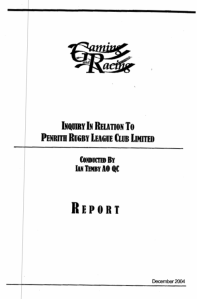
Temby Report — In Full.
The full report (PDF) arising from the Inquiry in Relation to Penrith Rugby League Ltd conducted by Ian Temby AO QC is available. Click the link or the cover page image below.
Related Topics
- Part 73 — The Temby Inquiry: The Findings and the Fallout
- Part 71 — The Temby Inquiry: Untangling the Phyro Arrangements
- Part 69 — The Temby Inquiry Begins: Panthers in the Firing Line
Related Themes
Conflict · Temby Inquiry · Governance
To receive new Parts and occasional project updates by email, you may subscribe below.
Readers who hold recollections, documents, or material relevant to this history are welcome to contribute via the Commentary & Contributions page.
Project Updates
Receive updates when new parts are published.

