
Part 17 of 70 — Original Chapter: Chapter 7: The 16 Year Struggle to Streamline Rugby League
This article forms part of the serialised republication of Panthers, Passion & Politics – The Roger Cowan Years.
From early in the 70s, Roger Cowan maintained an absolute commitment to the belief that rugby league would never succeed at Penrith while it was a separate entity. Cowan passionately believed that the secret of success was to integrate rugby league, uniting all the expertise within the management structure.
It took more than ten years to achieve that goal. Yet the struggle came with an unforeseen downside — the move to integrate had a negative impact on some relationships and reputations.
Cowan says there had been consistent failure under the two-committee system, and serious conflict.
I sometimes wonder what would have happened if I had taken the easy path and simply kept out of rugby league. I am not sure that it would have been possible to do that and also protect the interests of the licensed club. In so many ways, the two are interdependent. But if I had found a way to do it, there is no chance whatsoever that the police would have walked through that door in 1985.
I know some very successful CEOs of large clubs who have kept right out of Rugby League. I think they were smarter than me. If Rugby League had been managed openly, honestly and effectively in the first few years there would have been no need for me to ever get involved. But I was never about to lead a team working for the success of the Registered Club and have it all blown away by irresponsible management of football.
As the club moved into the seventies, the licensed club continued its growth. But on the football side of things, the club was struggling
The results told the story.
The team’s best performance throughout the seventies was equal seventh in the 12-team competition, in 1971. It was second-last twice and had collected its first wooden spoon in 1973.
Something had to be done to improve performance and Cowan formed a small strategic sub-committee to focus on new strategies. The group included Cowan, Tom Wilson – who would become the club’s director of coaching the following year, Dave Podmore, a local businessman and Frank Ley, a schoolteacher who was also heavily involved in school rugby league. Podmore, Wilson and Ley were on the football committee.
The group devised a whole new concept of coaching.
The plan was to appoint a panel of coaches. The head coach would lead a team of specialist coaches – one for backs, one for forwards, and one skilled in tactics and strategy. The panel would oversee all three grades of football, and each would train the players in their specialty.
This was a new concept for Australian sport and structurally very different. There were similar systems used at the time in American football. Balmain coach Jack Gibson1 had also spoken in support of such a coaching system, although he never actually used it. It is now in common use in all football codes.
The system was introduced in time for the 1974 season.
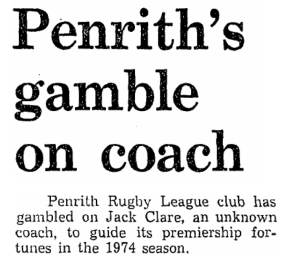
Roy Masters, who would become a prominent Sydney sports journalist2, was part of that 1974 coaching panel. Barry Harris – a former state representative – was to be the forwards coach, and Wilson, already established as a coach, would oversee the backs. The fourth member of the team was Jack Clare. Clare was popular in the world of rugby league and seen as a ‘nice bloke’. He had been chairman of selectors with the Balmain club but had no experience coaching at grade level. He had coached high school teams and had only ever played five first grade matches.
Cowan and the strategy team wanted Masters as head coach. He had coached a number of successful school teams, notably the Australian schoolboys’ team that returned unbeaten from a tour of England in 1973.
Tom Wilson remembers that some of the group travelled to Tamworth to meet with Masters, who was teaching high school there at the time.
We spoke to Roy for 40 minutes on the sideline of a training session. We watched the session, and Masters didn’t say a thing to the team the whole time. They went through 43 moves – and dropped the ball once. What an efficient team!
Roy had developed a completely different way of doing things. It was a real management concept. We convinced him to leave Tamworth and come to Penrith to head up the new coaching panel.
But it would not prove that easy! Wilson continues,
When they got back and started to work on the new strategy, the old brigade came out fighting, “What would some schoolteachers and a couple of businessmen know about football?” The committee was prepared to go along with the new coaching concept but personality clashes within the committee caused a poor decision that derailed the strategy. The decision was later corrected by Cowan in quite extraordinary circumstances, but the strategy did not recover.
Masters says there were problems from the start.
The pervading culture on the football committee at that time was anti-intellectual. If you were a schoolteacher, you were gone from the start. There was one particular person on the board who really had it in for me. He was very vocal and wielded a lot of power.
There was something like 16 men on that committee, and most of them were the same.
It was never going to work. Frank Ley – who was a teacher – signed me. Roger, the club secretary, had also been a teacher, and here was I, another one. They just would not accept me. And it was all down to the prejudices of this unbelievably insidious committee.
It was even worse than that, says Cowan.
Frank Ley was unpopular with the committee, and he was seen by the committee as the driving force behind the appointment of Roy Masters, so the vote to appoint Jack Clare as the head coach was really a vote against Frank Ley. Personal prejudices easily won the battle over logical argument.
To receive new Parts and occasional project updates by email, you may subscribe below.
Readers who hold recollections, documents, or material relevant to this history are welcome to contribute via the Commentary & Contributions page.
Project Updates
Receive updates when new parts are published.
- Jack Gibson did not coach Balmain. In 1973 he coached Newtown and in 1974, he was in his second stint as coach of Eastern Suburbs. ↩︎
- Roy Masters later became a prominent journalist and columnist with the Sydney Morning Herald and is now based in Melbourne. ↩︎

