
In telling the history of Penrith Rugby League Club, one phrase appears again and again — the “tin shed.”
It is often used to describe the club’s early years: humble, under-resourced, and far removed from the scale of the modern Panthers organisation.
Like many origin stories, the reality is both more specific — and more revealing.
What Was the “Tin Shed”?
As former director Max Connors recalled, the so-called “tin shed” was not a clubhouse in the way the term is now understood. It was, in fact, a kiosk at the showground where the team played.
The tin shed that people talk about was actually a kiosk on the showground where they used to play. It was run by the ladies, and the players used to get three free tickets each, and the supporters could buy three tickets for two shillings.
The structure doubled as a dressing area for players, reflecting the limited facilities available at the time.
Penrith’s “Tin Shed” Mark II
Many would label this building as the “tin shed” of Penrith’s history.
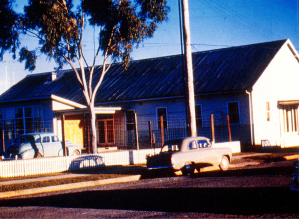
It would be a fair label, for this too is a far cry from the building that, in 1963, opened along side it. But this second “tin shed” was already multi-functional, and efficiently so. Dining room, function room, gymnastics (see feature image), boxing, calisthentics, jiu-jitsu, weights and of course, the club staples of bar and poker machines.
A Familiar Story
The idea of a club beginning in a “tin shed” is not unique to Penrith.
Across New South Wales, the history of registered clubs abounds with stories of “tin shed” origins — always small, improvised buildings, often constructed from basic materials and supported by volunteer labour.
Whether literally accurate or not, the phrase has become a kind of shorthand for humble beginnings and community effort.
In that sense, the “tin shed” is as much a cultural expression as a physical description.
How Myths Take Shape
Over time, the image of the “tin shed” has taken on a broader symbolic meaning — shorthand for:
- hardship
- simplicity
- and the idea of a club built from nothing
This kind of simplification is very common in tales of sporting and community history. The details are simplified, merged, or reshaped into something more easily remembered and retold.
The result is not necessarily inaccurate — but it is selective.
The Penrith Version
At Penrith, the story is slightly more nuanced.
While the original “tin shed” referred to the showground kiosk described by Connors, later early facilities — including the original Station Street club building — were also modest in scale and construction.
In practical terms, they fit very well with the image the phrase now conveys.
The mythology, in that sense, is not entirely misplaced — but it is an interpretation crossing several realities.
Why it Matters
Understanding the reality behind the “tin shed” does not diminish the achievement of those early years.
If anything, it clarifies it.
The club did not begin in abstraction or myth, but in a very real, very practical setting — a showground, a kiosk, and a community effort sustained by volunteers, financiers — lenders and donors — players, and supporters.
That distinction matters, because it grounds the story of Penrith not just in adversity, but in structure, place, and people.
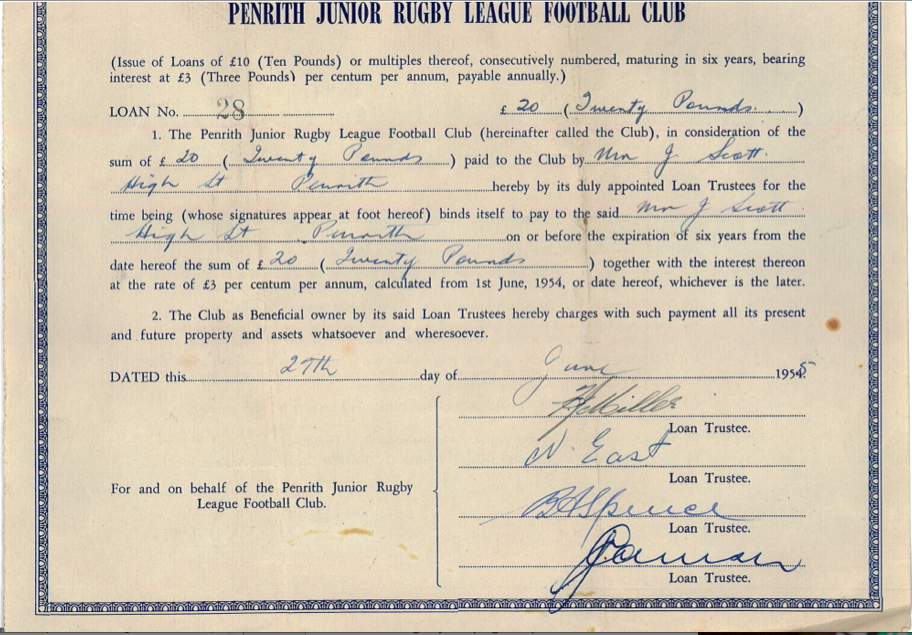
One of the people who helped Penrith Rugby League Club move beyond tin shed was Mr John Scott who provided the Penrith Junior Rugby League with a loan of £20 in 1955. The Scott family have supported the Club from its very beginnings, have seen many changes, great growth, challenges and remain firmly part of the Panthers family today.
In the Narrative
The reference to the “tin shed” appears in Part 4 — From Small Beginnings, where it helps frame the scale of the club’s early operations, and the distance between those beginnings and what would follow.
Related Materials
- From Small Beginnings — Rugby League Takes Off In Penrith
- From Tin Shed to Taj Mahal — Scale and Contrast in 1963
Related Themes
To receive new Parts and occasional project updates by email, you may subscribe below.
Readers who hold recollections, documents, or material relevant to this history are welcome to contribute via the Commentary & Contributions page.
Project Updates
Receive updates when new parts are published.
 Panthers, Passion & Politics - The Roger Cowan Years