“We’ve Made It!” — The Decision to Admit Penrith to First Division

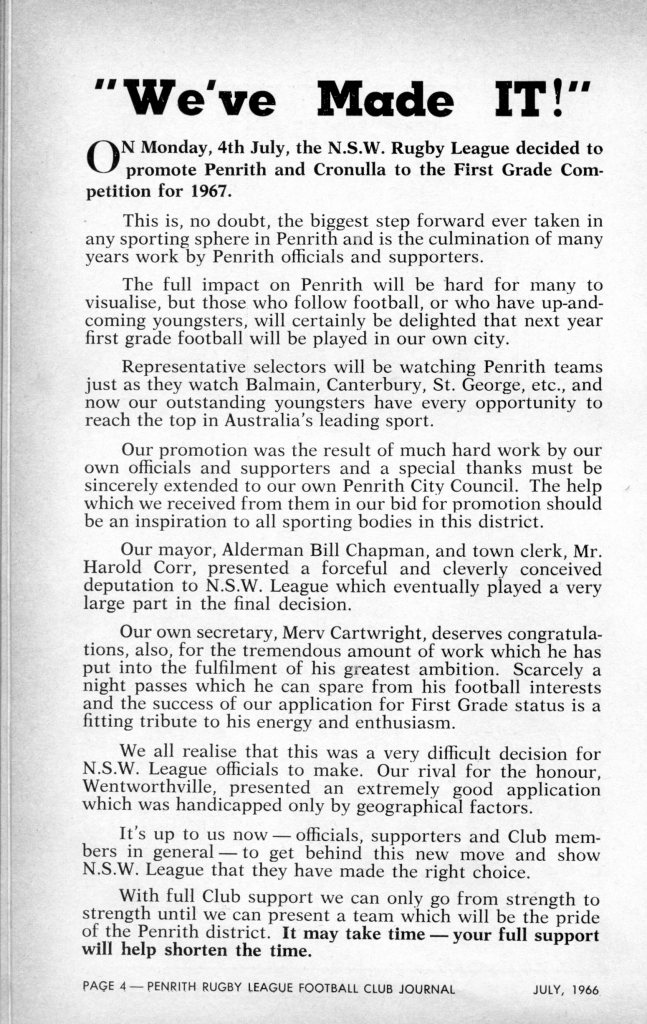
On Monday, 4 July 1966, the New South Wales Rugby League confirmed that Penrith and Cronulla would be admitted to the First Grade competition for the 1967 season.

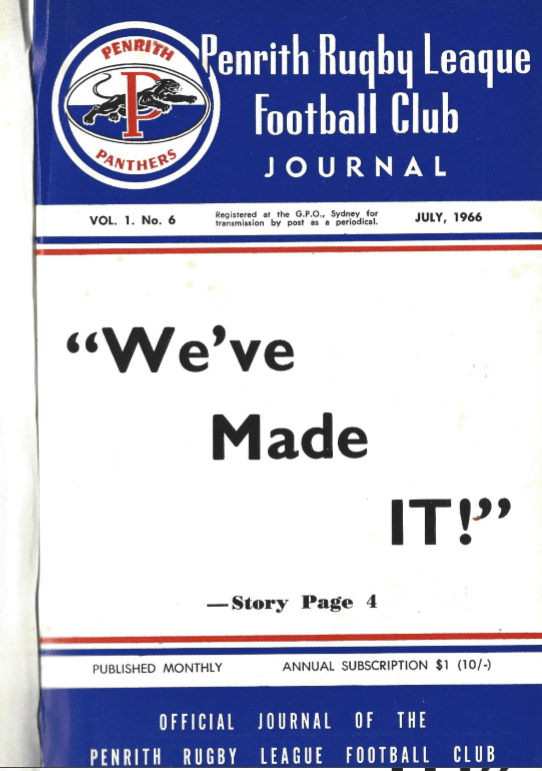
Within the club, the decision was received as a defining moment. The July 1966 edition of the Penrith Rugby League Football Club Journal captured the announcement simply and emphatically on its cover: “We’ve Made It!”

Inside, the accompanying article described the promotion as “the biggest step forward ever taken in any sporting sphere in Penrith” and emphasised that it was the culmination of many years of work by club officials and supporters. It also acknowledged the contribution of civic leaders, including mayor Bill Chapman and town clerk Harold Corr, whose efforts were said to have played a significant role in the final decision.

The sense of achievement within the club is also reflected in later recollections. Coach Leo Trevena described the moment in more understated terms, recalling that when he heard the news, his reaction was immediate and practical: “The bell’s ringing; now the fight’s on.”

Different Reactions

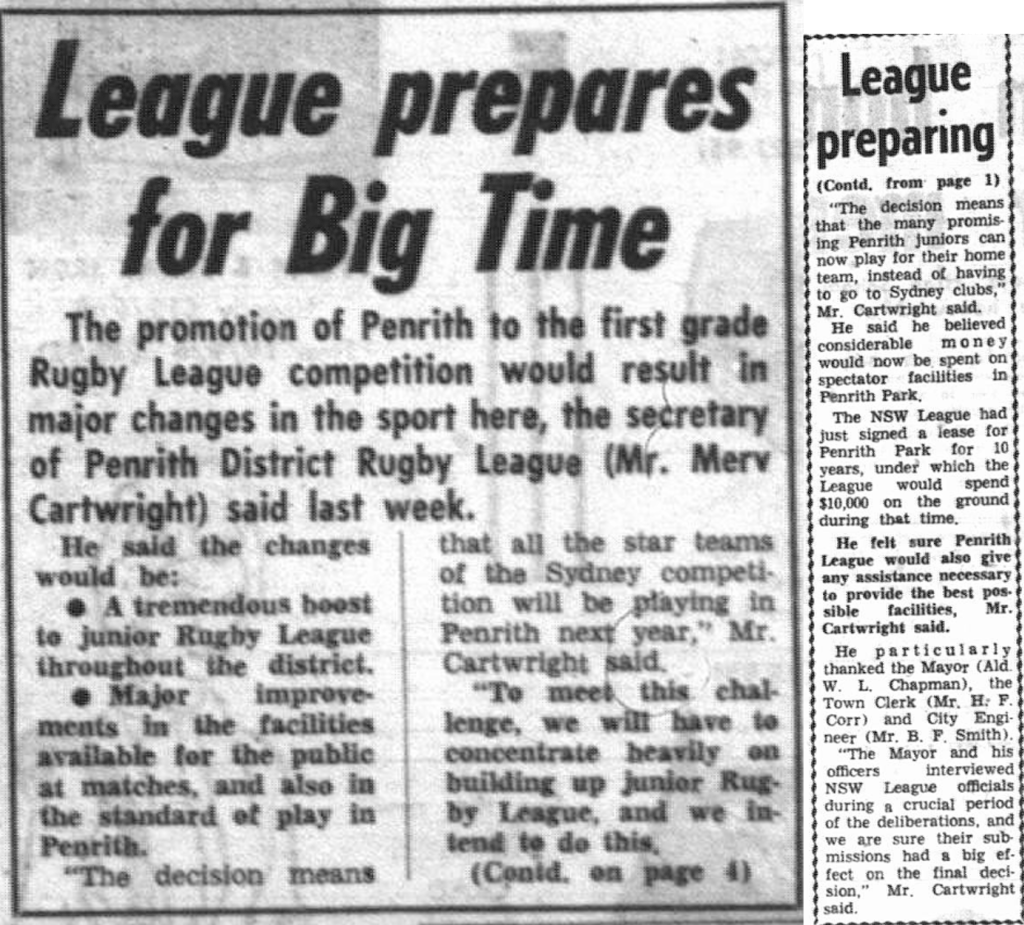
Beyond the club, the reaction was more measured. Contemporary coverage in the Penrith Press focused on the implications of the decision — including improvements to facilities, increased junior opportunities and the challenge of competing at a higher level — rather than celebration.

The contrast between the club’s own presentation of the moment and the more restrained tone of the local press is notable.

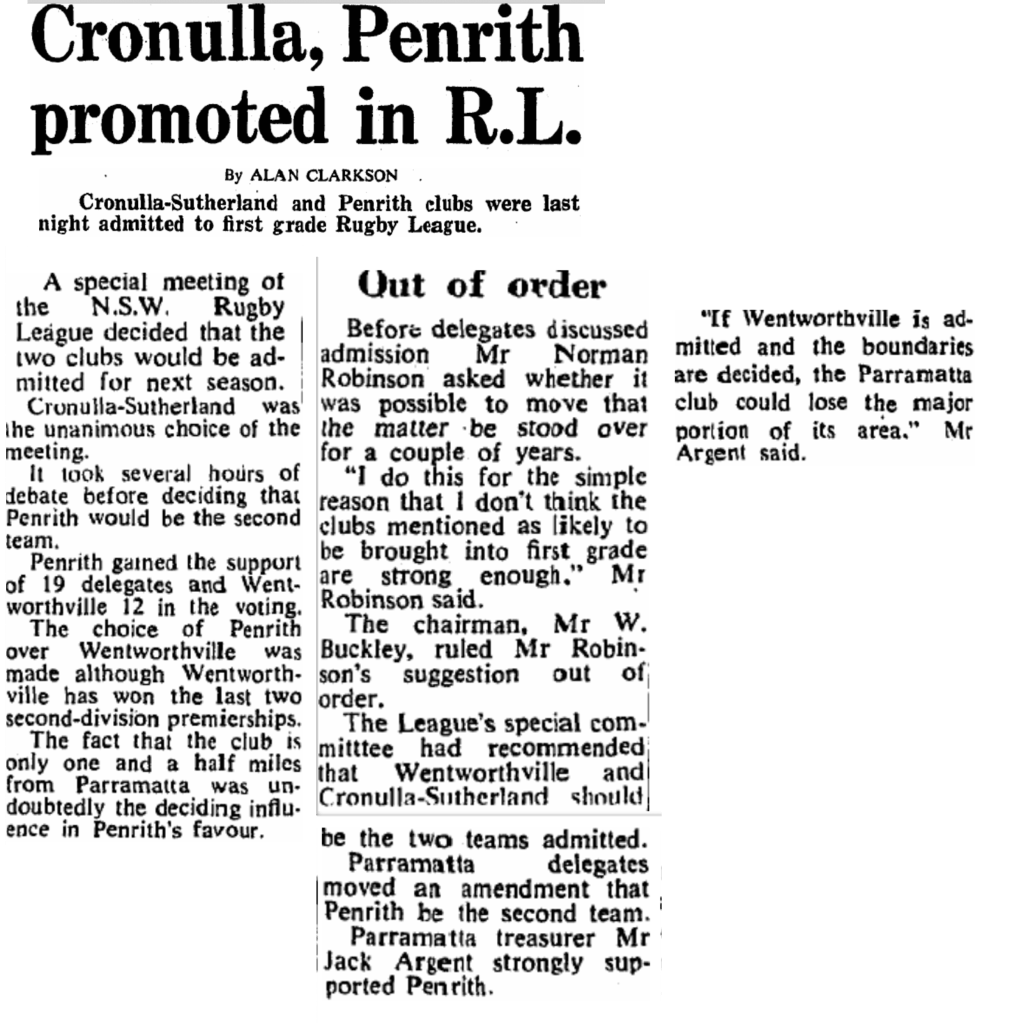
The Sydney Morning Herald also highlighted how narrow the decision had been, including Wentworthville’s unsuccessful attempt to have the matter deferred following the announcement.

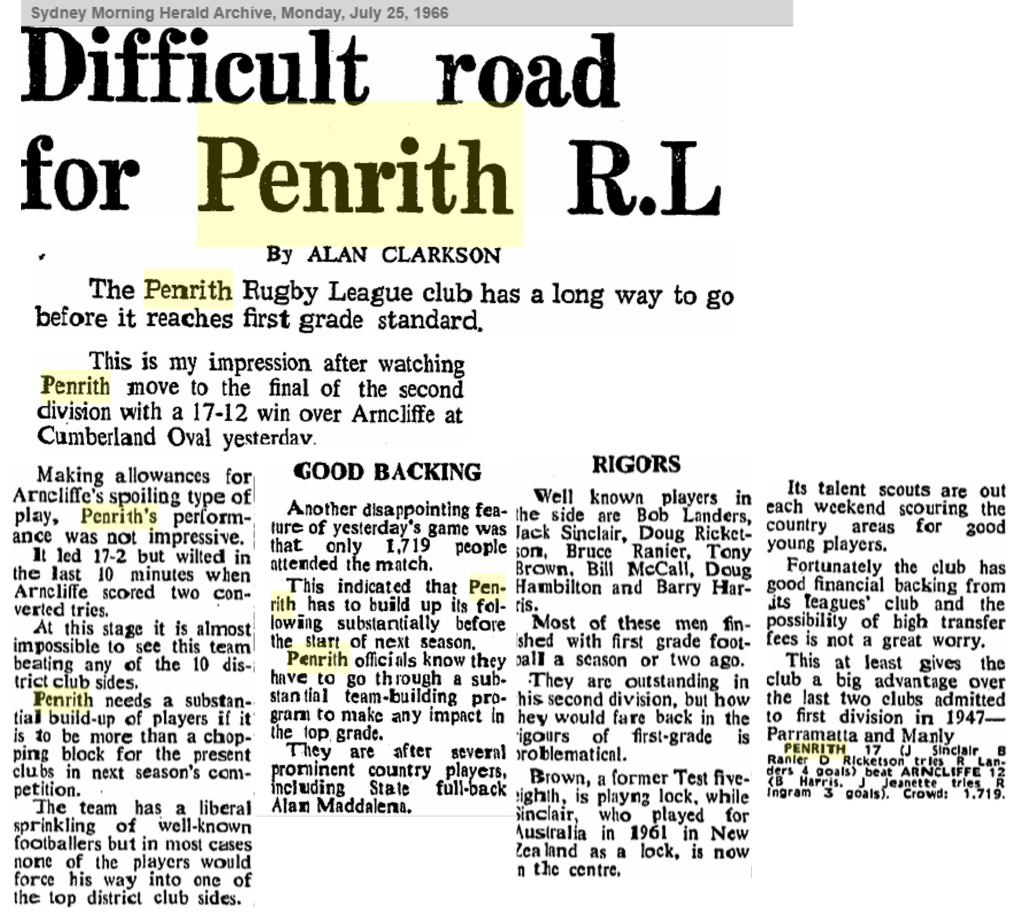
Three weeks later, Sydney Morning Herald journalist Alan Clarkson published a more cautious assessment of Penrith’s prospects, while acknowledging the club’s improving financial position and the support provided by the leagues club.

For Penrith, however, the significance was clear. Entry into First Division marked the transition from ambition to reality — and the beginning of a new phase in the club’s development.


Related Topics


Related Themes

Football Club · Growth · Milestones


To receive new Parts and occasional project updates by email, you may subscribe below.

Readers who hold recollections, documents, or material relevant to this history are welcome to contribute via the Commentary & Contributions page.

Project Updates

Receive updates when new parts are published.

The Bid For First Division

This article forms part of the serialised republication of Panthers, Passion & Politics – The Roger Cowan Years.

Start · Reader’s Guide · All Parts


The financial stability that had recently been established allowed Penrith to pursue something that had previously been out of reach — entry into the NSW Rugby League First Division.  

Not long after Cowan took over as CEO1, the Penrith club had started making a push for one of two new spots that were being created in the First Division of the NSW Rugby League. It appeared that one of those holes had pretty much been filled by Cronulla. And while the credentials of the Penrith team were strong enough to give it a chance, the financial woes of the licensed club had to be overcome. Penrith needed to prove it had the resources to support a first division club. It also had to have sufficient player strength to be competitive.

The main rival for the position was Wentworthville. It was one of the most successful registered clubs in the state, had been the leading club in the Second Division competition for a number of years and was favoured to win the 1966 competition. It was a David and Goliath match up!

Early in 1966, Cowan advised the football committee that the club could confidently forecast a profit. The licensed club committee agreed it would support the bid for a place in the First Division competition. With a bit of extra money, the committee was able to pick up a number of established first grade players.

All stops were pulled out to build local support for the bid.

One of the more deliberate moves was the establishment of a monthly club magazine for members, largely written and produced by Cowan. Its aim was to push the First Division claim and stir up local support.2

Cowan also began to foster ties with Penrith mayor Bill Chapman and the town clerk, Harold Corr, both of whom would play key roles in Penrith’s promotion to first division.

The football committee led by Secretary Merv Cartwright, had worked strongly throughout the campaign.3

Another factor in Penrith’s favour was that Jack Argent, the Parramatta delegate to the New South Wales Rugby League, didn’t want Wentworthville in there, and he was very influential in those days. Roger Cowan s

Halfway through 1966, Penrith was able to prove to the NSW rugby league that it was profitable. Many factors contributed to the success of the bid, but we would never have got into First Division if the club had remained in the financial state it was. It was a narrow decision and we made it by the skin of our teeth. Six months earlier we would have had no chance of showing we could finance it.

Looking back, it seems logical that Penrith would be a better choice than Wentworthville, situated so close to Parramatta and competing for supporters. It was different back then though.  Souths, Easts and Balmain were good examples of successful clubs competing in the same areas. The NSWRL showed great foresight in considering the geographical qualifications and Jack Argent made sure they did.

Penrith supporters today can reflect that it was a very close call. Just a couple of votes and Penrith would have remained in Second Division.

The entry of the Penrith Panthers into first grade was a time of great celebration in the young city of Penrith. The team would have mixed fortunes over the next 24 years. They first made the semi-finals in 1985 and won their first premiership in 1991.


To receive new Parts and occasional project updates by email, you may subscribe below.

Readers who hold recollections, documents, or material relevant to this history are welcome to contribute via the Commentary & Contributions page.

Project Updates

Receive updates when new parts are published.


  1. Cowan’s formal title was Secretary-Manager, the standard senior administrative role used by rugby league clubs at the time.
    ↩︎
  2. The monthjly Club Journal is the precursor to The Panthers Magazine – which later becomes central to a number of governance issues. See Beyond the Book — The Panthers Magazine
    ↩︎
  3. The campaign involved the efforts of many people, including club officials, local supporters and civic leaders such as Penrith mayor Bill Chapman and town clerk Harold Corr. Chapman and Corr were instrumental to the process. ↩︎

Part 6 · All Parts · Part 8

Commentary and Contributions

Major Player: Leo Trevena

Leo Trevena

Leo “Trapper” Trevena

Premiership-winning halfback / five-eighth (Wests,1952), Penrith Panthers first coach, Licensed club management team

Leo “Trapper” Trevena was a highly regarded rugby league footballer and coach whose involvement with Penrith spanned both its formative years in the Parramatta District Junior League and its early seasons in the NSWRL competition.

A member of Western Suburbs’ 1952 premiership-winning side, Trevena brought first-grade experience and leadership to Penrith at a time when the club was beginning to define its identity and ambitions.

Role in the Narrative

Trevena’s presence in the Panthers, Passion and Politics narrative extends beyond the early development of the club into the period immediately preceding and following its entry into the NSWRL in 1967.

His recruitment as captain-coach — at a reported £500 for the season — reflected a willingness by the club to invest in experience and leadership well before its entry into the NSWRL competition. His time at Penrith coincided with the emergence of a more assertive and self-directed club culture.

He represents a continuity of leadership across eras — from the club’s emergence within the Parramatta district competition to its establishment as a first-grade entity, and into the early years of the licensed club.

Background

Born: 1929
Died: 2013

Playing Career:

  • Western Suburbs (First Grade) — 1950-53, Premiership winner, 1952
  • Canterbury (First Grade) — 1954
  • Young (Maher Cup) — Captain-Coach, premierships 1955–56

Penrith (Junior & District Era):

  • Captain-Coach, A Grade — 1957–1959
  • Premierships — 1958, 1959

Coaching (Senior Level):

  • Penrith — 2nd Division Premiership, 1966
  • Penrith Panthers — First Grade Coach, 1967
  • Penrith Panthers — First Grade Coach, 1973

Club Administration:

Assistant Manager, Penrith Leagues Club — 1968–1973

Recognition by Panthers
• Life Membership, Penrith Rugby League Club (1981)

Relevance to Events Described

An early and defining episode in Trevena’s time at Penrith occurred in 1957.

After just three matches with the club, he was called upon by Parramatta to return to first grade for a match against St George. Trevena refused, choosing instead to honour his commitment to Penrith. Parramatta responded by banning him from playing in the junior competition, a decision supported by the NSW Rugby League.

The consequence was that Trevena was unable to take the field for the remainder of the season, continuing only in his coaching role. Penrith were subsequently beaten in the final.

The episode highlighted an early tension between district authority and club autonomy, and reflected a developing sense of identity within Penrith — one grounded in loyalty and commitment.

Trevena returned to playing the following season, contributing to consecutive A-grade premierships in 1958 and 1959. His influence, however, extended well beyond this period.

As first-grade coach, he guided Penrith to a Second Division premiership in 1966 — an achievement that immediately preceded the club’s entry into the NSWRL competition. He then took on the role of first-grade coach in Penrith’s inaugural season in 1967, and again took the role in 1973.

In parallel with his coaching responsibilities, Trevena also served as Assistant Manager of the Penrith Leagues Club from 1968 to 1973, contributing to the early development of the licensed club during a critical phase of its growth.

Related Material


Related Themes

Football Club · First Division Admission · Milestones


Additional Material


Editorial Note

This profile is presented as contextual background.
Additional material may be introduced as the narrative progresses.


To receive new Parts and occasional project updates by email, you may subscribe below.

Readers who hold recollections, documents, or material relevant to this history are welcome to contribute via the Commentary & Contributions page.

Project Updates

Receive updates when new parts are published.

From Small Beginnings – Rugby League Takes Off In Penrith

This article forms part of the serialised republication of Panthers, Passion & Politics – The Roger Cowan Years.

Start · Reader’s Guide · All Parts


Just over twenty years after the First Fleet arrived at Port Jackson, the first land grant in the Penrith district was awarded to Captain Daniel Woodriffe. As the colony grew, the town, with its strategic location on the Nepean River, became an important stop on the Western Road over the mountains, and later on the rail route to Katoomba and beyond.

Some readers may even remember taking the steam train to the Blue Mountains and having a cuppa or a snack while the train paused for ten minutes at Penrith, midway through the journey.

Rugby League came to Penrith around 1912, following the code’s breakaway from the traditional rugby union game. A regular competition was in operation by 1913 but there was reportedly friction in town between the two codes.

The first Penrith team was called the Waratahs, but for much of its history the Club simply played under the name of Penrith. The name ‘Panthers’ was adopted in 1964, after a public competition.

During the First World War times were sometimes tough for the club. One year, when the club was unable to buy shorts for the players, they ran onto the field in cut-down trousers.

Like many country clubs of the period, Penrith rugby league survived largely through the enthusiasm of local volunteers and the loyalty of its players and supporters.

The struggles continued through the 1920s, and in 1926 the club was reformed as the Penrith Rugby League Club. It was at this time that it applied for entry into the Western Division [Country] League, although there was some local opposition due to the travel demands involved.

Rugby League continued to grow in Penrith through the 1940s and 50s — and was, by all accounts, not a game for the faint-hearted. These were hard, tough men, and there was plenty of ‘biff’.  They were paid little, or nothing and played for the honour of their town — and also because they obviously enjoyed it.

Max Connors was first a committeeman, and later a director at the club, in the years between 1956 and 1981. He says football games used to be played on a paddock just out of town.

They moved to the showground around ’42-43. Cricket was played there in the summer, and the pitch had to be broken up each year so rugby league could be played. It eventually got to be a problem between the two groups.

Connors speaks of his boyhood in Penrith when the guesthouses at Wallacia were a popular holiday destination for city people. When the steam trains would pull in, he and his friends would descend on them and offer to carry the travelers’ bags to the bus to earn some money.

In the early 1950s, Penrith was still a small town on the outer fringes of suburbia. Its one department store was Western Stores — later to become Myer1. The largest other business in town was Max Young’s produce business, which supplied feed, saddlery and other farming essentials to the district’s many rural properties.

In 1955, the first electric train service came to Penrith2. and former player Merv Cartwright became secretary of the football club. Two other players came onto the scene around the same time — Leo “Trapper” Trevena and Reginald Ronald “Rocky” Davis. Both would have an impact on the growth of the club.

The mid-50s also saw the advent of the ‘district club’. Penrith was part of the Parramatta District and competed in the Parramatta A Grade Competition against clubs from Parramatta, Guildford, Merrylands, Liverpool, Richmond and other teams from a huge geographical area. This large area would later be broken up when Penrith became a District Club in its own right in 1967. Today Penrith and Parramatta have the largest rugby league districts of any Sydney team.

Even in 1956, the Penrith club was already showing its potential as an innovator. It was the first junior rugby league club to be granted a liquor license, and its first licensed club building was completed the same year. It was located in a back street of Penrith.3 It had two regular rooms, and a larger function room that was used for Saturday night dances and presentations, etc. 

For almost 20 years, the club also doubled as a boys’ club, and the club funded boxing and gymnastics activities for local youngsters. Its activities were transferred when the club agreed in the early seventies to jointly fund, with Penrith City Council, the Police Citizens Boys Club.

Connors remembers the first club as pretty much just a large garage in Station Street. He says they also bought the house next door, and that was where they held their meetings. The house had previously been a riding school — perhaps an indication of just how ‘country’ Penrith was in those days.

In an ironic twist, the first club building was financed by a gambling venture. Josie Haining — the wife of Bill Haining, a former player – won £100,00 in the Tasmanian Golden Casket, and the club was built using voluntary labour and a loan from Mrs Haining.

Don Feltis has a long history with the Club. He has been a player, football committeeman, football CEO, and is now junior league boss and a director on Panthers’ group board.

He remembers the day that a group of volunteers met to start digging the foundations for the new club:

We decided that the fairest way to work out who would have the honour of turning the first sod was to draw straws. So there we are, standing around organising the straws and sorting out lengths when we hear a ruckus behind us. We turn around and here’s one of the group — a fellow called Nobby Hunter — throwing a pick on the ground and very proudly showing us a hole the size of a bucket he’s just dug.

The building at first had six poker machines — three sixpenny and three one-shilling machines4.

Through the early sixties the club industry was just beginning to show its potential. St George Leagues Club was known as the Taj Mahal, and clubs like Easts Leagues and Souths Juniors were already an established part of the Sydney entertainment scene.

The Penrith Leagues Club, on the other hand, was a very small player. It had a couple of hundred members. It had never really been the mythical ‘tin shed’, but Max Connors, a director between 1956 and 1981, provided some insight into how the story came about.

The tin shed that people talk about was actually a kiosk on the showground where they used to play. It was run by the ladies, and the players used to get three free tickets each, and the supporters could buy three tickets for two shillings.

The kiosk doubled as a dressing-shed for players.

As the 1960s arrived, the club committee began pushing to join the league’s new inter-district competition — later to become Second Division. There was strong opposition from the club’s junior league. It was around this time, Trevena and Davis, along with Cartwright were joined on the football committee by a young high school teacher and player named Roger Cowan.

In 1962, the club joined the new competition, along with nine other Sydney clubs, including two much larger clubs, Ryde Eastwood and Wentworthville. Five years later, Penrith would leapfrog both these clubs to take a spot in the First Division competition.

The following year the licensed club underwent a major refurbishment, at a cost of £150,000. The new club had 26 poker machines. The 27 year old Cowan retired from playing football, but became football club treasurer. It was a move that would change his life.

It was the responsibility of the licensed club to fund rugby league, but at the end of the 1964 season Cowan was astounded to discover there were insufficient funds to pay the players. That year he stood for election for the licensed club committee, and became club treasurer, while still working as a teacher. He immediately began to implement controls and measures to improve the club’s finances. The club had embarked on an association with the man who would define its future.

What were the influences that made Panthers’ future CEO the person he turned out to be? What were the drivers behind the culture he encouraged at Panthers? And why much later did he allow conflict to escalate rather than backing away when the odds were stacking against him?


To receive new Parts and occasional project updates by email, you may subscribe below.

Readers who hold recollections, documents, or material relevant to this history are welcome to contribute via the Commentary & Contributions page.

Project Updates

Receive updates when new parts are published.


  1. The store referred to was Fletcher’s, which opened in 1941 as a gentleman’s outfitter. By the late 1950s and early 1960s it had become the largest department store in Penrith, employing more than 100 people. Fletcher’s became part of the Myer group in 1962.
    (Source: John Carvan, Standing Under the Weir: Penrith Memories.)
    ↩︎
  2. The electrification of the railway line to Penrith in 1955 was a major local event. Prior to this, services had been operated by steam trains. The town formed an “Electrification Committee” to organise celebrations for the arrival of the first electric service. Dave Fitzgerald, President of Penrith Rugby League, served on that committee.
    ↩︎
  3. Although described as a “back street” at the time, the club was located on the corner of Park and Station Streets. Park Street branched off Station Street roughly opposite the southern end of the swimming pool (near the showground). The area now forms part of the Nepean Village precinct.
    ↩︎
  4. Other accounts place the initial poker machine fleet at ten machines, split evenly between sixpenny and one-shilling machines. See Bound for Glory (Greg Prichard and Gary Lester, p.30). ↩︎

Part 3 · All Parts · Part 5

Commentary and Contributions