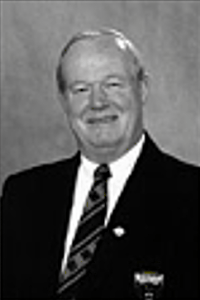
Major Player: Barry Walsh OAM

Barry Walsh OAM

Barry John Walsh

Press Room Manager, Director, Chairman

Barry Walsh’s association with the Penrith Panthers extended across almost four decades and encompassed both sides of an organisation that, for much of its early history, struggled to reconcile the competing interests of football and the licensed club.

A Football Club director from the early 1970s, Walsh became a director of the Licensed Club in the 1980s and ultimately Chairman of Panthers. Along the way he served for decades as a delegate to the NSW Rugby League, managed a NSW representative side, became a Life Member of Panthers in 1987 and a Life Member of the NSW Rugby League in 2002.

His importance to the events described in Panthers, Passion & Politics, however, extends well beyond his longevity.

At several critical points in Panthers’ history, Walsh occupied a position between competing interests.

Around 1980 he helped bridge the deep divide between the Football Club and Licensed Club.

Almost two decades later, he became Chairman as divisions within the Panthers Board were becoming increasingly bitter.

He would occupy the chair through the Parramatta merger controversy, the expansion of the Panthers Group through amalgamations, the Board conflicts of 2002 and the subsequent Temby Inquiry.

Throughout much of that period he was also a longstanding colleague, supporter and friend of Roger Cowan. It was a relationship that placed Walsh close to many of the events that dominate the later chapters of this story, but one that did not always mean agreement.

Role in the Narrative

Barry Walsh first assumes particular significance in the narrative during one of the earliest struggles over how Panthers should be governed.

By the end of the 1970s, relations between the Licensed Club — which generated the money — and the Football Club — which needed much of it — had become increasingly difficult. Roger Cowan believed the answer was to bring both organisations under the control of a single board.

Walsh was then acting secretary (CEO) of the Football Club after replacing Ian Maurice — Walsh’s roots were therefore firmly on the football side of the divide.

According to Walsh’s later recollection, published in Men in Black, Cowan convinced him that the existing arrangement was becoming untenable. Walsh then took the argument back to his fellow Football Club directors. There were 14 directors on the Football Club Board and 12 on the Licensed Club Board and, as Walsh recalled it, the two groups were increasingly pulling in different directions. He urged his colleagues to think about Penrith rather than about themselves.

Eventually both boards agreed to amalgamate.

The decision placed the positions of 14 directors in jeopardy — so there were no guarantees for anyone. When the new Board was elected in December 1980, the Licensed Club directors had the numbers and secured all 12 positions. Not one Football Club director was elected.

Walsh had therefore helped persuade his colleagues to support a structural change that ultimately cost all of them their Board positions.

In December 1983, Walsh was elected to the combined Board until he resigned in 2010.

The episode established a role that would recur during his Panthers career.

Walsh was fundamentally a rugby league man, but this episode demonstrated his willingness to look beyond the immediate interests of the Football Club and towards what he believed were the wider interests of Panthers and its future.

Background

Away from Panthers, Walsh spent his working career with John Fairfax, where he was a press room manager before his retirement.

His involvement with Penrith rugby league began in the early 1970s and developed into what was effectively a second career. By the time he retired from the Panthers Board in December 2010, he had effectively recorded 37 years as a Football Director, and 28 years as a Panthers director. He was highly regarded and was affectionately known as The Football Director by many.

His rugby league involvement extended well beyond the Board room. He managed the NSW Rugby League representative side in 1978, served for some 30 years as a delegate to the NSW Rugby League and was Patron of the Penrith District Junior Rugby League. He was also closely involved with Panthers on the Prowl and served as its Chairman.

Walsh was made a Life Member of Panthers in 1987. In 2002 his contribution to the game was recognised more broadly when he became a Life Member of the NSW Rugby League.

In 2006 the City of Penrith recognized Barry’s contribution to the City by assigning him a position on their Wall of Achievement.

As part of the Queen’s Birthday Honours on 8 June 2009, Barry Walsh was awarded the Medal of the Order of Australia (OAM) for service to Rugby League football through administrative roles in the Penrith district.

These were not incidental associations. Rugby league — and Penrith rugby league in particular—formed the foundation of Walsh’s involvement with Panthers and are important to understanding the positions he subsequently took during some of the organisation’s most contentious periods.

Recognition & Awards
• Life Membership, Penrith Panthers (1987)
• Life Membership, New South Wales Rugby League (2002)
• City of Penrith, Wall of Achievement (2006)
• Medal of the Order of Australia (2009)

Relevance to Events Described

The struggle for Penrith’s survival

By the late 1990s Australian rugby league had emerged from the Super League war into another period of uncertainty. The newly formed National Rugby League intended to reduce the number of teams, and Penrith’s place in the competition could not be assumed.

Cowan wanted the Board to investigate all available options, including a possible merger with Parramatta. The proposal became extraordinarily contentious.

Walsh later drew a clear distinction between investigating the possibility and supporting it. He said he had made it clear from the beginning that he would never vote for a merger with Parramatta, but believed the Board nevertheless had an obligation to investigate the option.

Walsh was a member of the Stand-Alone Committee established to develop and pursue initiatives aimed at advancing the Club’s position on “The Criteria”.

His position therefore reflected something already evident in the Board amalgamation debate almost two decades earlier: a willingness to investigate structural change without necessarily supporting the outcome being investigated.

Becoming Chairman

At about the same time, the composition and culture of the Panthers Board were changing.

Following the death of Deputy Chairman Vern Mychael, Walsh joined the Board Executive. As new directors arrived and began making their mark, the previously stable Board became increasingly divided.

In 1999 Leo Armstrong was replaced as Chairman by Walsh.

Walsh’s elevation occurred in unusual circumstances. He had been a supporter of Armstrong and was not part of the group seeking his removal. John Bateman initially approached Keith Rhind to take the position. When Rhind refused, Bateman approached Walsh. Faced with the reality that Armstrong no longer had the numbers, Walsh accepted the chair.

His subsequent description of his position was telling:

I never had control of the Board.

It was a difficult environment in which to chair an organisation. The Board was becoming divided between directors demanding greater scrutiny of management and others who retained greater confidence in Cowan and the existing management structure. Walsh’s longstanding relationship with Cowan inevitably placed him closer to the latter group, but the events that followed demonstrate that his support was not automatic.

Amalgamation and expansion

As Chairman, Walsh was closely involved when Panthers began pursuing amalgamations with financially troubled clubs elsewhere in New South Wales.

Walsh recalled that management had researched the concept extensively and that it had been discussed for more than a year. He saw potential advantages in expanding the Panthers brand, developing a broader rugby league following and building assets and cash flow. Because many of the clubs being considered were in financial difficulty, he also believed Panthers could acquire substantial assets on favourable terms.

His involvement was therefore more than ceremonial. Walsh understood and supported the strategic rationale behind what became one of the most significant expansions in Panthers’ history.

The expansion would, however, produce unforeseen governance problems — particularly over the voting rights of members joining Panthers through amalgamation.

The aborted election

Those problems came to a head in March 2002.

An election was underway in which members of the newly amalgamated clubs were voting in unexpectedly large numbers. Faced with the possibility of a substantial change in the composition of the Board, the directors unanimously decided to abort the election.

Walsh voted with the other directors to cancel it, despite Cowan strongly opposing that decision.

The episode provides an important qualification to any portrayal of Walsh simply as a dependable Cowan vote.

Walsh subsequently recorded concerns about how the actions of the Board might be viewed by the Department of Gaming and Racing. He stressed that he did not himself believe the directors were improperly manipulating the process, but worried that some recent Board actions might be perceived by the regulator as an attempt to influence the election outcome.

His concern was not merely about what the Board believed it was doing, but about how its actions might appear to an external regulator.

The controversy did not end there. The eventual Football Club election in October 2002 removed five sitting directors. Walsh, Leo Armstrong, Keith Rhind and Terry Heidtmann survived, while Greg Alexander, Greg Chapman, Don Feltis, Kerry Lowe and Col Bentley were elected.

Temby would later describe Walsh, Armstrong and Rhind as strong Cowan supporters. That was Temby’s characterisation, and Walsh’s longstanding friendship and confidence in Cowan certainly formed an important part of his position within the Board. But the cancelled election itself demonstrated that the relationship did not prevent Walsh from supporting a course Cowan strongly opposed.

The Temby Inquiry

As Chairman, Walsh inevitably became an important witness when the NSW Government established the Penrith Rugby League Club Inquiry under Ian Temby QC.

Temby found that significant elements of the information conveyed were incorrect and concluded that Walsh had misled the Board, although he considered this probably resulted from “confusion, rather than mendacity”, on Walsh’s part.

The episode exposed one of the tensions inherent in Walsh’s position. His relationship with Cowan had developed over decades and involved considerable personal trust. But as Chairman and a member of the Executive, Walsh also carried responsibility for independently scrutinising the arrangements surrounding the Chief Executive.

The Inquiry therefore forms an important part of Walsh’s record. It identified shortcomings in governance and oversight for which, as Chairman and an Executive member, he shared responsibility. At the same time, its findings need to be viewed within a much longer Panthers career rather than allowed to define it.

Beyond the Cowan years

Walsh remained Chairman after the Temby Inquiry and after Cowan’s retirement in 2005.

An episode recalled by Glenn Matthews provides an insight into the relationship between Chairman, Board and Chief Executive during this later period.

Matthews had decided to sign Matt Elliott as Penrith’s next first-grade coach before informing the Board. When he approached Walsh at a function and said he needed to speak with him, Walsh immediately asked:

“What have you done?”

On being told that Elliott had already been signed, Walsh responded:

“You what?”

Matthews subsequently prepared a paper explaining his decision for the directors. After considering his reasoning, he recalled that the Board supported him completely.

The episode is revealing. Walsh was plainly surprised that such an important decision had been made before the Board was consulted, but the Board was nevertheless prepared to consider the case Matthews put before it rather than simply react to the way the decision had been made.

Walsh continued as Chairman through much of the decade that followed. He was replaced as Chairman by Don Feltis in 2009.

He resigned from the Board on 22 December 2010, ending an association as a director stretching back almost four decades.

Legacy

Barry Walsh’s contribution to Panthers cannot readily be reduced to a single achievement or controversy.

He was, first and foremost, a rugby league man. His 37 years as a Football Director, decades representing Penrith within the NSW Rugby League, Life Memberships of both Panthers and the NSW Rugby League, and the award of the Medal of the Order of Australia for his service to Rugby League administration attest to that.

But his importance to the Panthers story lies equally in the positions he occupied when the organisation was changing.

Around 1980, he helped persuade Football Club directors to look beyond their own positions and support a governance structure bringing the football and licensed clubs closer together. Nearly two decades later, he became Chairman as another struggle over the organisation’s governance was beginning.

He subsequently presided through the fight to preserve Penrith’s place in the elite competition, the expansion of the Panthers Group, the bitter Board conflicts of 2002 and the searching scrutiny of the Temby Inquiry. He then remained Chairman as Panthers moved into the post-Cowan era.

His longstanding loyalty to Roger Cowan was part of that history, but it does not fully explain Walsh’s actions. At important moments he took positions independently of Cowan, including supporting cancellation of the 2002 election despite Cowan’s opposition.

Their friendship nevertheless survived the conflicts and controversies surrounding the final years of Cowan’s career.

When Cowan was later incapacitated by strokes and living in a nursing home, Walsh was among the relatively small number of former Panthers colleagues who continued to visit him.

Following Cowan’s death in 2017, Walsh reflected on the man with whom he had shared so much of Panthers’ modern history:

He added that Cowan was one of those who had “put Penrith on the map”.

Walsh’s own place in that history is different, but substantial.

He began as a representative of the football side of a divided Panthers, helped bridge the gap between its competing arms, and eventually chaired the much larger organisation that emerged. Across almost four decades, he experienced—and at important moments helped shape—the transformation of Penrith from a football club struggling for its place into one of rugby league’s largest and most complex organisations.

Related Topics


Related Themes:

Governance · Conflict · Board Decisions · Football Club


To receive new Parts and occasional project updates by email, you may subscribe below.

Readers who hold recollections, documents, or material relevant to this history are welcome to contribute via the Commentary & Contributions page.

Project Updates

Receive updates when new parts are published.


Editorial Note

This profile is presented as contextual background.
Additional material may be introduced as the narrative progresses.

The Battle for the Board

This article forms part of the serialised republication of Panthers, Passion & Politics – The Roger Cowan Years.

Start · Reader’s Guide · All Parts

The proposed changes to the constitutions of both Penrith District Rugby League Football Club (PDRLFC, the district club) and Penrith Rugby League Club Ltd (PRLC, the licensed club) were put to the Penrith members on 15 September, approved, and implemented. The sitting Board was in the box seat to be re-elected. Traditionally, sitting directors were all returned in a Panthers’ election. The system of placing an asterisk beside the name of each current director, and the apathy with which board elections were viewed by members, had seen few incumbents removed over the years.

The Five needed to retain at least five positions to maintain their majority on the nine-person Penrith Football Club Board. Those directors would then automatically take positions on the newly constituted Group Board.

But five seats would no longer constitute a majority at Group level. On the 14-person Board, additional support would be needed to command a majority.

They needed more than five on their team.

In changing the constitution, Brett Boon and the Board appeared to have missed one vital point.

Boon told the Inquiry that if persons who were members of the football club voted, there would be no breach of either the letter or the spirit of the Act. But, he said, he had no idea that hundreds of club employees were members of the Club.1

During September, another unexpected element came into play. It arrived in the form of Greg Alexander.

Alexander was one of Penrith’s most prominent rugby league figures. In an exemplary career, he captained the Club’s 1991 premiership-winning side and represented Australia on numerous occasions. He was also a good friend of Glenn Matthews, who for the previous couple of years had been encouraging him to stand for the Board.

When it became known that he intended to stand, those close to the situation said that the Five felt confident of building a good relationship with him.

Alexander announced his candidature in the Penrith Press on Tuesday 24 September. In the accompanying interview he referred to the vote of no confidence in Cowan and said the CEO had his support.

That was a blow to the Footy Five.

Their preferred election ticket would have almost certainly included Alexander, the Five and two associates of Greg Evans. Had Alexander supported them — and had they secured the votes — it would have given them eight of the nine seats on the Penrith Board and eight on the 14-person group board.  But now, Alexander had come out publicly with a statement of support for Cowan.

It was on the night of 24–25 September — immediately after the Alexander story appeared in the Penrith Press — that the mysterious envelope described at the beginning of this chapter (Part 61) was reportedly delivered to the Western Weekender.

The battle lines were now drawn.

Despite Alexander’s profile and popularity, his name was not among the eight candidates identified on the Weekender’s election ticket. Candidates numbered one to eight were listed, while beside number nine appeared the words ‘YOUR CHOICE’.2

It was another mistake. The ‘YOUR CHOICE’ instruction left “Footy Five” supporters following the ticket to select a ninth candidate for themselves — the option to vote for some of the people the Footy Five wanted to defeat.

Only six months earlier, some members of the Five had complained that the distribution of how-to-vote tickets in Port Macquarie and Newcastle breached the Club’s constitution. By September 2002, how-to-vote material was being used by them in support of candidates in the Penrith election.

In the two weeks leading up to the election, Weekender readers were bombarded with headlines, articles and photos relating to the election, along with advertisements and letters endorsed by Ron Mulock and Merv Cartwright. Many stories featured allegations and insinuations against other directors and Cowan.

Their supporters were handing out voting advice at many locations including the railway stations and the traffic lights outside the Penrith club.

The Footy Five’s election strategy was obvious — discredit Cowan and make it appear it was them, and only them, who had the Club’s interest at heart. Cowan and the four other directors — Cowan’s Four Kinsmen, as they were called in Mulock’s advertisement — were thwarting the Five in their effort to do the best for Panthers.

The Weekender continued to carry extensive election material through the end of the election. The result, however, was precisely the opposite to what it was pushing — perhaps sending an unfavourable signal to potential advertisers.


To receive new Parts and occasional project updates by email, you may subscribe below.

Readers who hold recollections, documents, or material relevant to this history are welcome to contribute via the Commentary & Contributions page.

Project Updates

Receive updates when new parts are published.


  1. At the time of the Panthers constitutional amendment, s 30(1)(h) of the Registered Clubs Act 1976 provided: An employee of the club shall not vote at any meeting of the club or of the governing body of the club, or at any election of the governing body of the club or hold office as a member of the governing body of the club. In November 2006, the section was amended to add a further restriction: An employee of the club must not vote at any election of the governing body of another club or association if any member of that governing body would, as the result of that election, be entitled or qualified to be appointed (or be nominated for appointment) to the governing body of the registered club. The later amendment therefore expressly extended the prohibition to the type of indirect election arrangement created by the remodelled Panthers constitution.
    ↩︎
  2. The ticket needed to provide for a ninth preference because voters were required to number all nine boxes. A ballot numbered only from 1 to 8 would have been informal. ↩︎

← Part 63 · All Parts · Part 65 →

Commentary and Contributions

The Constitutional Way Through

This article forms part of the serialised republication of Panthers, Passion & Politics – The Roger Cowan Years.

Start · Reader’s Guide · All Parts

Accepting that the Board was set on the path of another constitutional change, Cowan continued to advocate a federalist model, presenting numerous variations.

Craig Terry told the inquiry,

The general manager refused to accept that the board did not wish to accept his federalist model. He repeatedly presented papers on the concept to the board.

Former director Max Connors spoke of Cowan’s methods in the boardroom.

Roger would bring things to the board, sometimes we’d say yes. Sometimes we’d say no, so he’d go away and change it and bring it back again.

Cowan says that in previous years, with previous boards, it was always a bit of a joke.

If I took what I thought was a good idea to the board and it was defeated, I would often think I had failed to present it convincingly enough. So I’d go away and do some more work on it, and then go back and re-present it. I did it for 14 years trying to convince boards we had to have a united effort to run Rugby League. I did it for several months before the Board was convinced to buy the Mulgoa Road property.

Sometimes the failure to bring about change is caused by inadequate information in the presentation of the idea. Sometimes it is caused by the inability of directors to think outside the square. Sometimes irrational argument or incorrect information becomes dominant. At other times the debate in the boardroom raises good reasons for rejection and that’s the end of it.

The culture we had developed over the years encouraged thinking laterally and arguing a point of view strongly no matter who disagreed. One very good example is the amalgamation concept. John Wilson did not take no for an answer. It took him a few meetings to convince us.

It was like that when I presented that first group board model. It was defeated out of hand. I still thought that a board with wider representation was the appropriate way to go, so I looked for modifications that might suit everyone. I really thought it was amusing that making suggestions for change would be greeted with hostility.

Imagine if I had responded that way to John Wilson when he brought up amalgamations. If I had adopted what I saw Craig Terry’s approach, I might have said:

“John, stop wasting our time with that stupid bloody idea. We told you we were not interested, so why do you keep bringing it up.”

We would have missed out on a strategy that will go down in Panther history as one of the best we ever adopted.

It probably demonstrates one of the problems we had at the time. There was a significant gap between the management culture we had developed and the way Craig Terry and other members of the Footy Five believed the Board should operate.

Our team concepts encouraged people to participate and raise ideas without fear of crashing.  Listening to the ideas of others and building on them was something we often practiced through brainstorming workshops.

All the board has to do is say yes or no. That’s the easy part.

The Footy Five had the numbers and they could have said no in less than ten seconds. They could do that every time I raised another modification until they found what they wanted.

I considered that it was my responsibility to come to the Board with every suggestion I could raise that might make the Club better in any way.

The Board continued working with Acuiti, receiving further advice through June, July and August. The Registered Clubs Act required a majority of the a registered club’s membership to be entitled to vote in elections for its governing body.1

Panthers’ total membership was now around 130,000. If voting rights were restricted to the approximately 50,000 Penrith members, as one proposal contemplated, the requirement could not be met. Another mechanism was needed.

It was decided to increase board numbers to 14, at the same time introducing a qualification for election to the group board. The Penrith District Rugby League Football Club (PDRLFC) was a separate legal entity, and not covered by The Registered Clubs Act. It also had a board of nine. Under the proposed structure, any director elected to PDRLFC would automatically have a place on the Board of the licensed club. The structure would give the nine directors elected to the PDRLFC Board nine of the 14 positions on the licensed club Board. The other clubs would be guaranteed places on the Board, but there could be no more than two from any one club.2

This proposed change would overcome the problem caused by the 50% requirement.

Brett Boon said he ultimately employed a model similar to those used at some RSL clubs, where board members must have a qualification, such as having served overseas, or being a member of a sub-branch.

Temby and counsel questioned whether the proposed structure amounted to a device for circumventing requirements of the Act.

Craig Terry felt that,

The mechanics of it may, in a tenuous way, still comply with the legal requirements in the Registered Clubs Act.

We were reminded [by Boon] and it was really self-evident, that there were many other models out there employed by other clubs which had the same notion of qualification of directors before they could form part of the board.

At the Inquiry he, and others of the Five, stressed continuously that they had been taking advice from Acuiti as to the model’s legality. Craig Terry said,

I would fully expect Mr. Boon to have been fully knowledgeable on these sections and if he thought the model we were proposing incorrect that he would have highlighted that to us.

Boon, on the other hand, stressed that he was under instruction from the Board.

The proposed change would overcome the 50% problem, and remove some other restrictions covered by the Act. This decision, to transfer the election of nine directors from the licensed club members to the members of the district football club, had some unforeseen repercussions.

It was another little tile in the mosaic that was forming in September 2002.


To receive new Parts and occasional project updates by email, you may subscribe below.

Readers who hold recollections, documents, or material relevant to this history are welcome to contribute via the Commentary & Contributions page.

Project Updates

Receive updates when new parts are published.


  1. The requirement that a majority of members be entitled to vote in Board elections is discussed more fully in Part 51 — A Simple Change, Made So Difficult. Section 30(9)(a) of the Registered Clubs Act required a majority of a club’s full members to be entitled to vote in elections for the governing body. Social Members were legally a subclass of Ordinary Members and were therefore included as full members. In 2006, the required proportion was reduced to 25%, provided the change was approved by a majority of full members.
    ↩︎
  2. The Panthers organisation comprised two separate legal entities: Penrith District Rugby League Football Club (PDRLFC — the Football Club) and Penrith Rugby League Club Ltd (PRLC — the licensed club). In 1980, the two Boards were brought together. This did not merge the two legal entities or create a single Board governing both. Each entity retained its own Board, but the same people served on both, helping ensure that the two organisations operated with a common direction. See Part 19 — A Solution — Of Sorts. ↩︎

← Part 62 · All Parts · Part 64 →

Commentary and Contributions

Promises, Voting Rights and Penrith Control

This article forms part of the serialised republication of Panthers, Passion & Politics – The Roger Cowan Years.

Start · Reader’s Guide · All Parts

Acuiti delivered its report on Panthers’ amalgamation processes to the Board in May 2002.

Walsh said that although the exercise cost the Club a lot of money it was carried out with no input from him. Not one of the managers involved in formulating or carrying through the amalgamation process was consulted.

It appears that the only people from Panthers who contributed to the preparation of this report were from the Five directors. The report contained 42 separate criticisms of the way Panthers had undertaken its amalgamations, many of them directed at management.

Those involved in the amalgamation process attended a series of meetings, spending around 50 hours dealing with the issues raised. A detailed response addressing each point was prepared and tabled for the Board. It was never discussed at a Board meeting.

On 31 July 2003, more than a year later, Roger Cowan received a letter from Boon. Boon explained that his report had been prepared as ‘essentially a discussion paper for the forthcoming board meeting’. He said his company had envisaged the report would facilitate discussion, and that further information would be provided to clarify the issues raised. Acuiti would then, taking everything into account, make its final comments and recommendations.

Boon’s letter continued that unfortunately neither management nor Acuiti itself was given an opportunity to discuss the report in any detail at any meeting. It acknowledged management’s responses to the 2002 report. It also concluded that Cowan and management had nothing to answer.

Barry Walsh estimated that the Acuiti exercise ultimately cost the Club far more than $400,000. He included the management time spent preparing a response, the diversion of managers from other Club responsibilities and other incidental costs that could not be accurately assessed.

A new election had to be scheduled. But by mid-2002 the Board had decided that the new nine-seat structure, which guaranteed five seats to Penrith, was not satisfactory. Craig Terry told the Inquiry that the simple majority model of five out of nine was not very ‘robust’, because it did not necessarily ensure that Penrith members retained ‘decent control of the organisation’.

There was a logical explanation for why a simple majority might not have been considered sufficiently ‘robust’. The model allowed up to four directors from non-Penrith sites to be elected. Even the election of one non-Penrith director would necessarily displace a sitting board member. If that person were a member of the Footy Five, their five-four majority would disappear.

By now, members from the clubs outside Penrith had been confirmed as Panthers members and, as such, had the right to vote – and stand for the Board. The distinction between Penrith members and members of the amalgamated clubs was evident in Terry’s explanation. He said that ‘the Penrith members were pre-eminent in our minds because they were the ones where we had a duty’.

Cowan took a different view. He argued that the memoranda of understanding had promised members of the amalgamating clubs particular rights in return for the transfer of substantial assets to Panthers, and that those commitments also had to be honoured.

The memoranda of understanding promising certain rights in return for the transfer of millions of dollars in assets to Panthers apparently had no effect on Terry’s sense of duty, according to Cowan.

After the cancelled election, Cowan continued trying to find a solution that would preserve the rights promised to members of the amalgamating clubs. The Board majority, however, had placed greater weight on ensuring continuing Penrith control.

Dennis Coffey was asked in the Inquiry if it concerned him that promises that had been made by Cowan would be broken by the constitutional changes, and that those members would be denied the rights they had been promised.

When I realised the problems that it could have caused our club, it didn’t concern me at all.

He agreed with counsel’s statement that he saw his duties as protecting the interests of Penrith members.

Ian Temby responded,

And if promises were broken, too bad?

Temby asked if Coffey knew that Cowan had been given authority by the Club Board to enter into negotiations for amalgamations. He said yes and then denied that he knew the amalgamating members would receive full voting rights. He had however been being a director on the Board that helped to devise – and approve – the amalgamation criteria, and entered into a memorandum of understanding setting out the rights of amalgamating members for each amalgamation.

All the directors of that time agree that Cowan strongly opposed the changes that would lessen the rights of the new members. John Bateman confirmed that Cowan repeatedly objected to both the cancellation of the election and later constitutional amendments on the basis that they were both unnecessary and meant that promises would be broken.

Temby asked Bateman,

Why shouldn’t it be thought that the Club behaved dishonourably in effecting that change?

Bateman replied,

Dishonourably is a strong word.

Temby:

I am not mincing my words and it is right that I shouldn’t.


To receive new Parts and occasional project updates by email, you may subscribe below.

Readers who hold recollections, documents, or material relevant to this history are welcome to contribute via the Commentary & Contributions page.

Project Updates

Receive updates when new parts are published.


← Part 61 · All Parts · Part 63 →

Commentary and Contributions

Board Wars

This article forms part of the serialised republication of Panthers, Passion & Politics – The Roger Cowan Years.

Start · Reader’s Guide · All Parts

It is sometime between midnight and dawn on Wednesday 25 September 2002. A shadowy figure approaches the offices of The Western Weekender newspaper in Abel Street, Penrith. He wears dark clothes and a hat pulled down over his eyes. He carries something in his hand.

A car cruises slowly past, and he jumps back into the doorway of the neighbouring building. Safe once again, he steps out onto the lonely street. After a quick glance each way, he climbs the few stairs to the door of the office. The arc of the streetlight now reveals what he is carrying. He reaches out and places a large envelope on the doorstep of the building.

His mission is accomplished. Visibly relieved, he walks briskly away from the scene, not once looking back.

The scenario above is a dramatised version of a purported incident that would have a significant bearing on the campaign leading to the replacement election in October 2002.

According to the Western Weekender editor, when he arrived on the morning of 25 September, he discovered an envelope on the doorstep. The envelope, he said, contained what appeared to be ‘authentic documents’ relating to Panthers, some dating back to 1998. The documents became the basis of a front-page story in the newspaper, published that very same day. Although the date on the newspaper is Friday, 27 September, numerous people report seeing it late on the Wednesday, 25 September.

On that account, in the space of only a few hours the anonymously delivered material had apparently been assessed, sources confirmed, interviews conducted, the story written, and the newspaper laid out and printed by Wednesday afternoon.

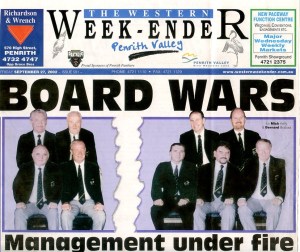
The banner headline screamed ‘Board Wars’, and a full-width photograph show the Panthers Board of Directors, but the image was ripped down the middle.

Front page of 'The Western Week-Ender' newspaper featuring the headline 'BOARD WARS' with the subheading 'Management under fire', accompanied by a group photo of eight men in formal attire.
Western Weekender 27 September 2002. Front Page. Clipping from the Weaver Collection

The story underneath spoke of a split in the Board, revisited in detail the proposed Parramatta merger, the stand-alone committee, and spoke of the ‘now famous FOOTY FIVE’. The story quoted John Bateman as a member of the Five, but failed to mention that Greg Evans, the owner of the newspaper, was also a member of the group. It also contained criticisms of Cowan and the remaining four directors, labelling them Cowan’s ‘Four Kinsmen’.1 It exhorted Panthers’ members to get rid of this ‘old guard’.

Until that week nobody, few people outside Panthers’ directors, senior managers and their families, were aware of the extent of the rift and tension in the Board. There had been a concerted effort by everyone to keep the conflict quiet and try to get on with business.

At management meetings, serious consideration had been given to calling an extraordinary meeting to make members aware of the degree of dysfunction at Board and management level.

The management team always reached the same conclusion. Such a radical move would harm the Club and make the bank nervous. In hindsight many believe it would not have been such a bad idea. Keeping the problems under wraps had not prevented serious damage. What followed included aborted elections, substantial legal expenses, a crippling inquiry, damaged management morale, loss of market share and other flow-on effects.

The Weekender story was a declaration of open war. It made the people of Penrith aware there was a serious problem at Board level. And the Club’s staff also became aware of the situation.

Long-time director Keith Rhind says the months following the aborted election of March 2002 were a terrible time. He would leave his home in the Blue Mountains to drive to a board meeting, hoping all the way that his car would break down so he would not have to go.

Board meetings would go till midnight or later. Matthews calls the behaviour of some of the Five ‘disgraceful’.

I just can’t believe that intelligent people can get in a room and they just want to play the man and not the ball. Some of the board meetings were really dysfunctional. They’d ask you for some information again and again. A couple of times one of them attended the meeting after having far too much alcohol. Bateman and Evans would often pass notes to each other.

According to Matthews one meeting almost ended in physical violence. Evans was screaming abuse at Cowan and Wilson, accusing them of being liars. Matthews himself was also accused of lying. Finally, chairman Barry Walsh exploded. His efforts to call the meeting to order had been ignored, leapt out of his chair and headed for the director who appeared to be drunk and was disrupting the meeting. Cowan intercepted Walsh, slowed things down and helped restore order.

Brett Boon said the situation was a nightmare. He told the Temby Inquiry,

There was a very long period, with board meeting after board meeting which lasted five, six, sometimes seven hours. They were very hostile, aggressive meetings, a lot of politics going on with different factions of the Board.

During questioning by DGR counsel Vicki Hartstein about the constitutional changes, Walsh said the Board had given Acuiti full control to take the Club to the next point.

She asked him about a letter of complaint from the Port Macquarie club asking for an explanation of the constitutional changes. She says,

… you were the chairman of the board of this club and it seems from this letter that complaints about the integrity of the club are being made. Didn’t you regard that with some concern?

Walsh replied,

The scene was changing. Acuiti had the reins, and they were being directed by Mr Terry and Mr Bateman and the Footy Five. Of course I was concerned, but our legal people were handling it and I was not privy to what Mr Boon was doing.

Not once did they contact me to give an opinion. Not about anything. For a better word, the Footy Five had control of the Board and they had the ear of Acuiti..

Hartstein asked, ‘You didn’t follow it up?’

Walsh answered,

It’s not that I didn’t follow it up. I never had control of the Board.


To receive new Parts and occasional project updates by email, you may subscribe below.

Readers who hold recollections, documents, or material relevant to this history are welcome to contribute via the Commentary & Contributions page.

Project Updates

Receive updates when new parts are published.


  1. The front page story doesn’t refer to the “Cowan’s Four Kinsmen” quip. That appears later in the same issue of The Western Weekender. The issue carried a number of stories related to the imminent election of the Penrith District Rugby League Club Board. ↩︎

← Part 60 · All Parts · Part 62 →

Commentary and Contributions

On a Lighter Note

A removed section from the original Chapter 17: Aborting the Election. It has been removed from the main Series because it sits apart from the chapter’s account of the decision to stop the 2002 Board election and its consequences. It is retained here because it provides a revealing—and rather lighter—glimpse of what happened afterwards, when Roger Cowan and members of his management team informally reconstructed what the result might have been had voting continued.

The aborted election at Panthers in March 2002 added a little comedy to a stressful period. Voting was a subject of conjecture by Ian Temby and counsel at the Inquiry. The conclusions they reached were not accurate, according to Cowan.

On the Saturday after the election was cancelled, Cowan invited the management team and their partners to a barbecue at his home. To add interest, he promised they would find out who would have been elected had the ballot not been aborted. At first there was a little soul searching about the legality of counting an aborted ballot, but a quick call to the club’s legal expert soon put everybody at ease.

The clubs other than Penrith were a simple matter. They had all completed voting before the ballot was aborted. Penrith was a little more complicated because there were still two days of voting to go when the election was called off. But there were sufficient votes in to determine the trend. Up to the cancellation, a certain percentage of voters had, for example, voted for Barry Walsh. It was likely that the percentage would be similar in next lot of votes.

There was also sufficient experience of elections at Penrith to estimate the number of votes that would likely have been cast in those final two days. It then became a simple calculation to arrive at the probable number of votes that each candidate at the Penrith site would have received. These estimates could then be added to the actual votes from the other sites that would be very close to the outcome the election might have delivered.

The missing two days of voting at Penrith was vital to the calculation, and it was not taken into account by the Inquiry.

It was a pleasant evening. A few good bottles of red wine had added a bit of sparkle to proceedings and everyone took a place around a table that would serve as the tally room.

Who would have been elected had the ballot been completed?

There were a few guesses – even a few friendly challenges. Would the How-to-Vote ticket at Newcastle and Port Macquarie swamp the Penrith votes, and fulfil the fears of the Five? If Newcastle and Port Macquarie were successful in getting their four candidates elected, which four of the current Board would miss out? In that gathering it was a unanimous hope that it would be the Footy Five.

The total number of votes cast for all clubs including Penrith was only a little over 3,000. Penrith accounted for more than 1,000, around 900 voted at Newcastle and about 700 at Port Macquarie. The other clubs made up the total.1

The ticket distributed by Newcastle and Port was partly effective, but there was another voting result that came as no surprise to the management team. A large proportion of the voters at both sites supported the re-election of the existing board in its entirety.

Before the counting of the Penrith votes, the candidates at Port Macquarie and Newcastle
were in front of some of the Penrith candidates.

The votes cast at the Penrith site were strongly in support of retaining all sitting directors. As the votes mounted, the candidates from the other clubs continued to slide down towards defeat. At the end of the exercise, the management team and their partners erupted in laughter and called for more wine.

For those around the table, the irony was irresistible. Their reconstruction suggested that, by aborting the election, the Footy Five may have outsmarted themselves. All but one appeared likely to have been returned with a clear majority. Evans would have missed out. He had resigned the previous year, and as a non-sitting director, his name did not have the customary asterisk beside it on the voting form. Terry Heidtmann was in a neck and neck battle for the ninth seat. With only a few more votes than the number estimate for the missing two days of voting, the reconstruction indicated that he too was likely to have been re-elected.


Related Topics


Related Themes

Conflict · Board Decisions · Governance


To receive new Parts and occasional project updates by email, you may subscribe below.

Readers who hold recollections, documents, or material relevant to this history are welcome to contribute via the Commentary & Contributions page.

Project Updates

Receive updates when new parts are published.

  1. The 2002 ballot was not a conventional Panthers election. It was the first in which members from the amalgamating clubs participated and voting had been completed at the other sites before the election was stopped. The reconstructed result therefore combined actual votes already cast with an estimate of the remaining two days of voting at Penrith; it should be understood as an informed reconstruction rather than an official election result. ↩︎

The Consequences of a Decision

This article forms part of the serialised republication of Panthers, Passion & Politics – The Roger Cowan Years.

Start · Reader’s Guide · All Parts

At a board meeting on 27 March, a joint advice from barristers Robertson Wright and Robert Bromwich was tabled. In their opinion, members of the two clubs had not been transferred properly and the club should go to the Supreme Court to verify this.

At the same meeting, the Board voted to re-appoint Greg Evans to the Board. The tension in the aftermath of the aborted election saw Terry Heidtmann briefly align himself with the group. Heidtmann voted for the reappointment of Evans, restoring the Five’s numbers on the Board.

On the weekend of the cancelled election, a group of managers had a session with Terrence Lynch, a barrister who specialises in the field of licensing and had appeared many times on behalf of the Department of Gaming and Racing (DGR).

The management team used Steve Bowers to brief Bernie Coles QC and Lynch for an opinion on the transfer process that had been used. Putting together the amalgamation strategy had been a painstaking and meticulous exercise. It had been put under the microscope many times because of the concerns of some directors. They were confident that they had followed a properly executed amalgamation policy, but now they needed a legal opinion to support that position.

Coles and Lynch advised that the management’s understanding of amalgamation was correct and that the Club had acted correctly. However, if there were any irregularities in the process, they could very easily be overcome by the court. 

According to Cowan, Steve Bowers estimated that in order to fix this problem – assuming there was a problem – it would cost a maximum of $25,000. Coles and Lynch did not think it necessary to go to the Supreme Court at all. They only suggested it because the other legal team thought there were irregularities.

The Supreme Court may have ruled that nothing needed to be done – that the transfer of membership had been done correctly. If it had ruled in favour of the other team – that then transfers had been illegal – it had the power to rule that they were all members of Panthers. Either outcome offered a way of resolving the membership question, although neither necessarily produced the result being sought by the Five.

Lynch says,

The essential difference between the two advices was that – if you accepted that there had been a problem about the memberships, their approach said “let’s not make them members” and our advice said “here’s how we can get them in”.

That was the fundamental difference. They wanted declarations that people weren’t members and we suggested means by which they could be confirmed as members, if it was the case that they weren’t.

The competing legal opinions reflected very different briefs and very different objectives. Brett Boon briefed Wright and Bromwich, and communication between the club and Boon was through members of the Five. Their evidence indicates that the outcome they were seeking was one that would prevent Newcastle and Port Macquarie members from voting or standing for the Board.

From management’s perspective, the distinction was stark: one side was asking, “How can we keep our promises?”; the other, “How can we break those promises?”

Lynch says his view concurs with that of John Ralston as to when amalgamation occurs and memberships combine.

The licensing act provisions never really say at what point an amalgamation actually occurs. The court cancels the old club’s certification, and there’s really not much of a notion of amalgamation. There’s some things that happen that tell you it’s before the event, and then these provisions in the law say this has occurred, but you never really know when it does happen …

So, if the members are part of the whole entity that is the club, and then two clubs merge and become one, how can you separate one part of the entity from the rest?

Wright and Bromwich had recommended an application to the Supreme Court. Steve Bowers points out that this would also not have been acceptable to the Five.

Their proposal was to make application to the Supreme Court to have all the members from the amalgamating clubs removed from Panthers’ membership register. I attended an urgent conference in the chambers of Robertson Wright SC with Robert Bromwich, barrister, and Brett Boon, for the purpose of discussing how the matter could be expedited before the Court.

I met Terrence Lynch immediately prior to the Wright conference to seek his advice. This was a very significant issue – Panthers was going to take action to toss out its amalgamating members. I listened carefully to [Wright’s and Bromwich’s] discussion about the nature and seriousness of the membership problem and how it should be resolved. Lynch believed that there was an insurmountable problem in this approach. It would require evidence that Panthers never intended that the amalgamating members become members of Panthers.

I asked them;

“Who will we get to give evidence that the Club never intended to make them members? Roger Cowan can’t do it. He is on the record as having stated that membership of Panthers was a condition of amalgamation.”

I pointed out that no senior manager could give evidence for the same reason.

The mood in the room changed. The futility of approaching the Supreme Court under these circumstances was apparent. I realised at that moment there would be no urgent application to the Supreme Court – in fact there would be no application at all.1

The vote was unanimously in favour.

Roger Cowan says he was extremely concerned at what Panthers was doing to the other clubs.

We had told them that they would start out as full members. When the time came to renew their membership, they could opt for a lower membership fee or remain as full members.

Now, we were being told that members of the Newcastle club should have applied for membership of a new entity. … Every one of the 30,000 members of Newcastle would have had to find a member of Panthers to sign a nomination. Furthermore, the Newcastle member would have had to be known by the nominator. Very few would be able to become members under that set of rules.

Just imagine the stupidity of it. We address a meeting of Newcastle
members and say to them:

“We want you to agree to sign over more than $40 million worth of your assets to us. In return we will pay out your debt of $14 million and we will treat you fairly and equitably as members of the company that will own all those assets”.

After the assets are signed over and the debt rearranged, we go back to the members and tell them:

“Sorry but now we have decided that you cannot become members of the entity that has taken over your assets unless you can find an existing member who will recommend you for membership”.

The opinion of Coles and Lynch was presented to the Board at a meeting on 23 April, but the minutes record no substantive discussion of it. Instead, the Footy Five group commissioned the Acuiti solicitors to find a solution to the membership problem. Acuiti was also asked to carry out a thorough review of the procedures used by management in amalgamations.

Steve Bowers warned the Board that their solution would probably cost more than $400,000. He suggested that the matter could be handled much more quickly by asking for a court ruling, which would probably cost around $25,000. The Five dismissed the suggestion and accused Bowers of trying to mislead the board. As it turned out, Bowers had underestimated the final cost.

But there were other costs that were harder to quantify — wasted management time, stress, interruption to the more important tasks of running the club, legal costs, lost opportunities and the diversion of resources. Some examples have already been documented.

Roger Cowan also noticed a toll on his management team:

The cancellation of the election strengthened the resolve of some managers who were already growing weary of the constant bickering and obstruction in the boardroom to find other employment.

John Wilson was a good example. The management team had done quite a lot of management exercises on recognising and understanding values, and honesty came out as the most important value for John. He was resentful that the Board had put that value to the sword by breaking promises that he had made to members and directors of other clubs. He said he could not work comfortably in such an environment.

There are many other values that drive individuals. Barry Walsh, for example, would be high in the value of loyalty. He was not in the management team, but it seems obvious. If Barry is in a team, he will never let the team down. Keith Rhind has a good way of describing this value – “If we are ever struggling through the desert, I will be happy to let Barry carry our water”. Clashes in values almost always lead to irresolvable conflict. The secret is to understand and respect the differences and avoid clashes.

The atmosphere in Panthers’ boardroom during this period has been described as ‘horrendous’, and a ‘never-ending nightmare’ by those who experienced it. Meetings went on for many hours and left everybody drained and frustrated. Management saw the Acuiti review as a cynical exercise by the Five to find something to discredit management, and to justify the decision to cancel the election, which they knew was being investigated by the DGR.

A 70-page report was prepared by Brett Boon and his associate and presented to the Board in May.

Ian Temby found in the conclusion to his report,

… the club aborted the March 2002 election because of some apprehension that, if carried through to conclusion, it would or might lead to loss of power by the existing board’.

He continued,

Most [directors] were more concerned about outcome than principle.

He said the decision stemmed partly from their distrust of management, and partly because Boon’s advice was ‘palatable’.

His [Temby’s] report attached no blame to the management team for any problems relating to amalgamation of the cancelled election. It says,

Cowan fought hard to deliver on the promises he had made, and he was pursuing the interests of all members, not just those from the Penrith site.

He adds that most members of the board, however, saw their principal allegiance as being to the Penrith members. He went on,

Cowan’s approach is to my mind distinctly preferable to theirs.

Allegiance to Penrith members may have been one factor. But Temby’s findings also identified apprehension about the existing Board losing power, while the evidence of some directors acknowledged concerns about their positions. The aborted election had exposed divisions that were now becoming increasingly difficult to contain. Those divisions would soon move into a new and more destructive phase.

Removed from The Series
The original Chapter 17 concluded with a lighter account of what happened when members of the Panthers management team informally reconstructed the result of the abandoned election. Read: On a Lighter Note


To receive new Parts and occasional project updates by email, you may subscribe below.

Readers who hold recollections, documents, or material relevant to this history are welcome to contribute via the Commentary & Contributions page.

Project Updates

Receive updates when new parts are published.


  1. No Supreme Court proceedings were ultimately commenced over the membership issue. Ian Temby later recorded that an administrative solution was pursued instead. ↩︎

← Part 59 · All Parts · Part 61 →

Commentary and Contributions

The Ballot That Never Finished

This article forms part of the serialised republication of Panthers, Passion & Politics – The Roger Cowan Years.

Start · Reader’s Guide · All Parts

On 21 March 2002, the Panthers Board voted to cancel an election for the Board.

Voting was already well underway. The action was unprecedented at Panthers, and almost certainly in most other clubs or businesses. The cancellation was the subject of extensive questioning and examination by Ian Temby at the Inquiry in 2004.

This was the first election at which members of amalgamating clubs could vote, and they were voting for a board that would oversee the entire Panthers organisation.

In January 2002, nominations opened for the new board, and it soon became obvious that there were a number of nominations coming in from other sites, in particular Newcastle and Port Macquarie.

Roger Cowan, Keith Rhind and John Wilson were on a business trip in New Zealand when the ClubNova amalgamation transformed from a simmering cauldron into an active volcano. A board meeting saw chairman Barry Walsh and Terry Heidtmann completely outnumbered. An argument was raging about Panthers pulling out of the amalgamation.

Walsh, the Chairman, was aghast that the board might be about to break promises that he knew had been made to Newcastle.1 He told the meeting,

You can’t pull out. Panthers does not break its word. We don’t do things like that. It’s against everything we stand for.

He was fighting a losing battle. But a breakthrough was about to come.

Observers who attended board meetings in those times remember that Craig Terry had a habit of suddenly jumping out of his seat and heading outside for a cigarette. One of them said,

He would seem nervous and jumpy, and act as though he had an urgent and desperate need.

On this occasion, Terry pushed back his chair and made to rise.

Walsh reacted. An important issue was on the table. He asked Terry to resume his seat until the discussions were over, but he was ignored. Walsh then angrily told Terry that he had no right to leave the meeting; if he did he could forget about coming back.

Terry ignored him and left the room.

It all became too much for Walsh. His values were being abused and now he was also being treated with contempt. He bounded after Terry with an uncharacteristic aggressiveness that induced some nervousness in those left in the boardroom, where stunned silence reigned. A short time later Terry returned and sat down. He was followed closely by the angry chairman.

Walsh said,

I am going to put this to the meeting now. We’ve had enough discussion. And I can tell you we are not breaking our word. Now who is in favour of continuing with the amalgamation?

The vote was unanimously in favour.

Terry Heidtmann quipped,

Mr Chairman, I don’t know what you did, but why couldn’t you have done it earlier? We could have saved ourselves hours of argument.

In early February, despite the promises made to the Newcastle club, the Board asked the club’s Group General Counsel, Steve Bowers, to have the club’s legal team investigate the eligibility of members of other clubs to vote.

Bateman told the inquiry that he still had concerns – in the first instance, that candidates from ClubNova were even standing, and secondly, that they may be elected. He acknowledged that all nine sitting directors at Penrith could be re-elected, but the ‘two directors from one club’ stipulation could still see some of them voted out.

There would still be a minimum of five Penrith directors on the Board, but which five?

Later in February the legal advice that the Board had sought from John Ralston, on the constitutional question, was received and tabled at a board meeting. It said members of amalgamating clubs had become Panthers members on 7 January, in accordance with the Board’s resolution of November.

It added that under the Corporations Act, the Club’s register of members was proof of membership, and that the Club could not disavow members of amalgamating clubs once their names had been entered in the register.

This was not what the Footy Five alliance wanted to hear. Cowan was astounded by their next strategy.

They decided that they would seek the support of the amalgamated clubs to help ensure their seats on the new group board. They approached the other clubs asking them to back the existing Panthers directors in the election. The understanding was that each club would – obviously – canvas votes for their own candidates, but not for those from any other club.

For anyone who could apply simple logic, this meant that the Board of Panthers was saying to the members of those clubs: “Yes, you can run people, but we will be also asking the other clubs in the group not to vote for your candidates”. Such a strategy would give candidates from other sites no chance whatsoever of being elected. 

To me, it was an unbelievably bad strategy. I saw it as a clear signal that some directors were far more interested in their own seats than in the big picture.

The Newcastle and Port Macquarie clubs were interested in having a say in the future of the club, and each had stood two candidates. Now here was Penrith asking Newcastle not to vote for Port Macquarie candidates, and Port Macquarie not to vote for Newcastle candidates. After some discussion about the ramifications of the Penrith approaches, the two clubs decided to combine resources and create a joint voting ticket. It was distributed at the clubs in their areas. In Newcastle, a supporting letter from union headquarters accompanied the ticket.

In mid-March, Craig Terry obtained a copy of the ticket and the letter. The news created great consternation among the Five. The ticket featured only one of their number – John Bateman.

The fact that Panthers’ constitution banned the distribution of electioneering material on club premises also became part of the strategy.

It appears that although Terry had the ticket on 15 March, the day before voting was to start, he did nothing until the following Monday18 March when the election was already in progress. Voting at other clubs closed on 21 March but was not scheduled to end at Penrith until 23 March. By 18 March, it was clear that people were voting in fairly large numbers at other sites.

The same day, Terry decided to obtain his own legal advice. He contacted ClubsNSW and was given the name of a law firm. The company, Acuiti Legal, was a specialist in club law, and the representative that Terry spoke to was Brett Boon.

Terry told the Temby Inquiry,

I would have got into that discussion because we were talking about ClubNova, and an election ticket that was mostly related to the Newcastle area. It was probably just a natural progression that I started to talk about issues concerning the administrative processes behind the amalgamation activity. The dialogue progressed from there, and it seemed that the more that I discussed this issue the more that Brett thought there were some grave or serious issues in respect to the way that the club had been administering the amalgamation process.

Boon’s initial opinion could only have been based on the information provided to him by Craig Terry. The completeness of that information was therefore important to any assessment he could make at that stage — if that information were incomplete, it would have been virtually impossible for Boon to analyse the situation properly.

Terry’s action prompted counsel at the Inquiry to ask why he went outside Panthers to seek legal advice. He answered,

At that point I was not completely happy in respect to the completeness or veracity of the advice we were getting at board level on amalgamations.

Terry’s evidence indicates that the discussion began with the ClubNova election ticket and then broadened into questions about the administration of the amalgamation. How a concern about election material developed so quickly into fundamental questions about the membership status of the amalgamating clubs became an important issue at the Inquiry.

However it happened, the advice he received, going beyond the ticket issue, was – in the words of Ian Temby – ‘timely’ and ‘convenient’.

At a scheduled board meeting on 19 March, there was a phone hook-up with Boon. He reiterated his opinion that Port Macquarie and ClubNova were still separate clubs, and thus not eligible to either stand for the Board, or vote. This opinion was the opposite of that of John Ralston, delivered to the Board three weeks earlier. Boon told the board that he was ‘nervous about the consequences of having the elections.’

At the meeting Roger Cowan and Steve Bowers cited the Ralston opinion and warned of the ramifications from the DGR. But the group of four, as it then was, argued that there was a real threat. The evidence indicates that John Bateman spoke strongly on the subject and, because of his legal background, his opinion helped sway other directors in the direction they ultimately took.

Bateman summed up the mood of directors in his testimony.

The reaction of the board was to say: “Hey, these people are electioneering. That is not permitted under the constitution. Do we still wish to be associated or involved with these people”?2

Cowan sees such statements as a bit unrealistic to say the least.

There is always some electioneering and I doubt if any nominee, including Bateman, has not asked someone to vote in a certain way. For years there has been controversy about the retiring3 directors being denoted by asterisk on ballot papers and election material. The asterisks make it an effective how to vote ticket, especially when all the directors are in harmony and can advise their friends to tick the boxes with the asterisks.

The rules barring electioneering on the premises could never prevent electioneering off the premises.

The 19 March board meeting resolved to seek urgent legal advice from Acuiti on whether Panthers could withdraw from its amalgamation with ClubNova. The Board requested that management provide information on the consequences from the financial, public relations and marketing, and political perspectives? How would Westpac, the group’s banker, react?

Management was disturbed. From its perspective, withdrawing would mean breaking the promises made to Newcastle and potentially throwing away $26 million. Cowan and his management team regarded such a course as dishonourable and dishonest, as well as extremely costly — through the loss of assets and reputation, and the possibility of a damages claim by the Newcastle club.

Bateman acknowledged to the Inquiry that calling for cancellation of the amalgamation with ClubNova may have been a ‘knee-jerk reaction’ because they were well into the process. Coincidentally, Craig Terry used exactly the same words – ‘knee-jerk reaction’ – when describing his feelings about pulling out of the ClubNova agreement.

A further meeting on 21 March was attended by senior managers including Roger Cowan, and solicitors Boon and Johnston from Acuiti Legal.

There is some variation on who said what at this meeting. All board members agree that Brett Boon did not actually advise them to cancel the election. However, most said that they felt that his advice left them little choice but to do so.

The 21 March meeting dropped any thought of cancelling the Newcastle amalgamation after legal advice on the consequences of pulling out, and particularly after the tabling of a letter from Westpac spelling out the club’s obligations from the bank’s perspective.

Brett Boon agreed with Ian Temby’s suggestion that it was his [Boon’s] preferred position to carry the voting through to its conclusion, at the same time making an urgent approach to the Supreme Court for a declaration as to the membership of the two clubs in question. Boon also told the Board he was prepared to leave the board meeting and immediately start to get those processes in motion.

Neither of the legal teams saw a problem with still holding the AGM scheduled for 24 March, and just not declaring the ballot.

Terry continues to maintain that he and other directors saw it as their duty as directors to cancel the election, saying they had been given ‘concrete advice’ about the legality of the memberships. Ian Temby reminded him that there was another legal opinion – from a source just as reliable – that was completely opposite.

In fact, in his final report, Temby referred to advice given by John Ralston, saying he is ‘a solicitor with a high reputation for work involving clubs, and on the evidence is perhaps the most eminent in the field in Sydney’.

At one time in his questioning, Temby asked Terry if he saw himself as ‘the guardian of the constitution’. Terry agreed that this was how he saw his role, missing the irony.

Temby asked,

Why shouldn’t I conclude that another factor driving the directors who wished to seriously examine the pull-the-plug option was the information which had been received as to voting figures to that stage?

While the majority of the directors at the meeting maintain that they aborted the election because of legal advice, Boon says it was never one of the options he offered.

Barry Walsh says that he spoke against aborting the election.

But there were three solicitors in that room, Mr Boon and his associate – and John Bateman, who is my own solicitor. They all said that it looked like the club had got it wrong. Then somebody got up and moved that the election be aborted. This really concerned me, but at that time I didn’t have any information to disagree and say, “no, we shouldn’t do this”.

Other directors agreed that Bateman’s position as a solicitor and his opinions on the issue reinforced their resolve to take the action they did, even though all acknowledge in their evidence that Boon did not specifically advise it. Craig Terry said in evidence that Bateman recommended to his fellow directors that they cancel the election.

Bateman told the inquiry,

Whether they listened to what I had to say or my view, I can’t comment on. I’m not an expert in club law. I accepted the advice that was given by Mr Boon. I believed the other board members accepted it as well, because they voted in favour of it.

Eventually, the executive staff and solicitors were asked to leave, leaving the directors alone to deliberate.. Former Panthers operations manager, Tony Lackey says they waited outside for around 45 minutes. Boon said he was nervous at the idea that they would cancel the election when he was out of the room, but was still surprised when they actually did it.

The directors then considered the matter behind closed doors, without the executive staff or solicitors present. They already knew that Cowan was vehemently opposed to stopping the election. There had also been a previous occasion when James had initially supported a resolution opposed by four of the Five, before changing his vote after staff had been asked to leave.

Whatever the reason for excluding the others on this occasion, the decision that emerged from the closed session was to stop the election.

We were brought back into the room and they dumped, they just dumped.

The Board resolved to stop the current election,

… having regard to legal advice received in relation to the issue of the validity of the persons listed on the Register of Members of Penrith Rugby League Club Limited in relation to such persons eligibility to stand for election as a Group Director and, to vote …

The Board also instructed Acuiti, through Brett Boon, to obtain advice on the legal status of the members of Port Macquarie and ClubNova Panthers members.

Early on the morning of Friday 22 March, voting was stopped at Penrith, two days early. The ballot boxes were removed and stored, the other clubs in the group were notified and a media release was issued.


To receive new Parts and occasional project updates by email, you may subscribe below.

Readers who hold recollections, documents, or material relevant to this history are welcome to contribute via the Commentary & Contributions page.

Project Updates

Receive updates when new parts are published.


  1. Walsh lived by the same ethos as Cowan and the management team. Once his word had been given, he believed in sticking to it ‘come hell or high water’.
    ↩︎
  2. Remember, the Board approached the Port Macquarie and Newcastle clubs requesting them to vote only for their own candidates (and not each other’s) ensuring the existing Board would all be returned. This was undoubtedly electioneering and it encouraged those clubs to electioneer on behalf of the Penrith directors. Against that background, Bateman’s criticism of electioneering by the other clubs appears difficult to reconcile with the earlier approach made on behalf of the Penrith directors.
    ↩︎
  3. I am certain this was meant to say, “sitting directors”. Retiring directors don’t appear on ballot papers at all. ↩︎

← Part 58 · All Parts · Part 60 →

Commentary and Contributions

A Threat — But of What?

This article forms part of the serialised republication of Panthers, Passion & Politics – The Roger Cowan Years.

Start · Reader’s Guide · All Parts

The question of whether the amalgamation strategy increased the risk that Panthers could be taken over by a group hostile to the interests of the Penrith members was first raised when the Board was discussing the Mekong Club.

Someone floated the idea that Panthers could be taken over by the Vietnamese community. Greg Evans scoffed at the fears. Any organised group could take over Panthers just as easily from inside Panthers as from another club, he said.

That was true.

Out of the 50,000 Penrith members, it was unusual for more than 900 people to vote in a board election. Any well organised group with quite a small number of members could take control of the Board.

The constitutional change went through in January 2002 and ensured Penrith the protection that the Five had been arguing for. By then, although the group continued to support one another, the Five had become four following Greg Evans’s resignation in September 2001.

In the early months of 2002, with some of the Five (now Four) still alleging that he was trying to ‘sell off’ Panthers, Cowan argued that having the organisation spread over 14 sites gave added protection, not less. An attempted takeover has to become obvious. It would need a lot of promotion to succeed. But some of the Four continued to portray Newcastle as a significant threat

As the membership issue blew up into conflict between management and Board, Cowan tried to explain to the Five the difficulties facing anyone mounting a takeover strategy.

If, for instance, Newcastle wanted to get control, it would have to win two places in its own right, and then organise others to be elected on the Penrith ticket. But if there was the slightest suspicion that this was happening, the members of the 12 other clubs would hear about it and be motivated into action.

And of course, the largest membership of them all, Penrith, would have been opposed. And why would the members of any club in the group support a back door takeover by another club? Newcastle would have to set up candidates in other clubs – and in Penrith – and then persuade enough members to vote for them. The more clubs in the group, the greater the logistical hurdle would become.

Cowan is convinced that there was never the slightest possibility of a reverse takeover.

In an interview in 2006, Greg Evans said he had been told that the union was definitely planning a takeover of Panthers.

Reverse takeover was not a furphy. The union movement was very strong, and I know someone in the union movement who said that that’s what they were planning to do.

Evans did not produce evidence to the Inquiry of the broader union takeover plan he later described. The Inquiry was presented with evidence of organised electioneering by people associated with ClubNova. A “Friends of ClubNova” communication urged members to elect two Newcastle representatives and support “like minded candidates from other clubs” as part of a nine-person ticket.

Temby found that most of the existing directors believed the election would change the composition of the Board and were worried by that prospect. He also found that legal doubt had arisen over whether the ClubNova and Port Macquarie members were entitled to vote. That legal uncertainty became the principal basis on which the Board cancelled the election.

Group board director Gary Kennedy, from Panthers ClubNova in Newcastle, is also the secretary of the Trades Hall in that city.1 He laughs at the suggestion that they wanted to take over Panthers.

We had enough problems trying to keep our own club operating. Why would we even think about taking on something as big as Panthers? It’s just ridiculous!

David Meidling was also a member of Panthers’ Group Board and is on the Port Macquarie Panthers Advisory Board.2

I can confidently tell you that the whole thing was a furphy, probably developed by some people as a type of scare tactic. It had absolutely no basis of fact in Port Macquarie during the lead-up to the amalgamation, or any time after.

There is an important distinction in the evidence presented to the Inquiry. There was organised electioneering involving ClubNova members and a nine-person ticket. But that is not the same thing as evidence of a planned union takeover of Panthers. Temby recorded the directors’ fears of a reverse takeover, but did not find that such a takeover was actually being planned.


To receive new Parts and occasional project updates by email, you may subscribe below.

Readers who hold recollections, documents, or material relevant to this history are welcome to contribute via the Commentary & Contributions page.

Project Updates

Receive updates when new parts are published.


  1. Gary has since retired from Trades Hall, and the ClubNova clubs were purchased by Wests Newcastle, so he is no longer involved with Panthers. A great pity, as he is whip-smart and a firebrand who will always be upfront with his thoughts.
    ↩︎
  2. While Port Macquarie Panthers remains in the Panthers Group, there is no longer a Group Board – or, if it called a Group Board it is effectively the Penrith Board. ↩︎

← Part 57 · All Parts · Part 59→

Commentary and Contributions

When Membership Became a Threat

This article forms part of the serialised republication of Panthers, Passion & Politics – The Roger Cowan Years.

Start · Reader’s Guide · All Parts

In Cowan’s view some of the most damaging – or potentially damaging – decisions made by a Panthers Board have been rationalised by claims that the Club was in danger of a reverse takeover – a loss of control to directors voted in from amalgamated clubs. The direct costs of these decisions were far in excess of a million dollars. The indirect costs – in reduced market share, lost opportunities and image battering – would have been much greater.

It could have been much worse. There were some close calls. On a couple of occasions, members of the Footy Five were forced to withdraw motions that would have been disastrous. One of these would have eventually cost Panthers far in excess of a hundred million dollars, perhaps double that amount.

The word ‘takeover’ had long been erased from Panthers’ management dictionary – and from its psyche, but in the minds of some of those directors, it was what was really going on in 2000-2002. This became blatantly evident during their testimony at the inquiry. And given that their understanding was that these clubs were being ‘taken over’, then their members should always remain secondary to the members of what some of them called the ‘mother club’, Penrith. It was a view that was diametrically opposed to that of Cowan, the Club’s management, the other members of the Board, and the Licensing Court.

It is difficult to reconcile that view of amalgamation with the memoranda of understanding approved by the Board for each amalgamation. Each clearly spelled out the rights of members.Each one clearly spelled out the rights of members. The very first such memorandum approved by the board was for the Hawkesbury Sporting Club on 11 June, 1999.The memorandum was part of the evidence supporting the application to the Licensing Court.

The fifth clause is unambiguous:

e) Members
– members of Hawkesbury Sporting Club [HSC] have full membership rights at Penrith Rugby League Club [PRLC]
– all entitlements and rights of members of HSC (such as 3yr, 5yr, 10yr, permanent) be preserved in their membership of PRLC

During the inquiry, all of the Five claimed they were justified in aborting an election because they were protecting the Penrith members from a reverse takeover by interests that would not support rugby league. Some said they had been misled by management as to the rights of members of the amalgamating clubs. The criticisms became a significant part of Ian Temby’s Instrument of Appointment for the inquiry.

While the amalgamating clubs were small, with few members, the Board seemed to have no problems with the process.

Roger Cowan and his management team had authorisation from the Board to take the program out into the world and sell it. Hawkesbury Sporting Club was a good example of management thinking. That club had about 2,000 members and Panthers, at that time had about 50,000 members. After amalgamation, Panthers would have 52,000 members and they could all choose between two locations. To management it was one club, one membership and two sites. As members of a club amalgamating with Panthers, the 2000 would have equal rights with all Panthers members – and there were no qualifications with that. They could vote in elections and stand for the Board. For Cowan, his management team – and some members of the board – that thinking never changed.

Port Macquarie RSL and Club Nova in Newcastle had large memberships, and each consisted of two clubs. To make matters worse in the eyes of some people, the Newcastle
clubs were strongly affiliated with the union movement.

Club Nova had a book value in excess of $40 million, and a debt that could be paid out with about $14 million.  It had 30,000 members and the city had a first-grade rugby league team with a very strong supporter base. These factors, combined with the potential for significant improvement for both clubs, meant it fitted Panthers’ criteria perfectly.

The Panthers/Club Nova deed of amalgamation was signed in October 2001, but the transfer of members was delayed by the Board, fearing that such a large membership was a threat. As soon as the amalgamation was approved by the licensing court, the Newcastle members would be entitled to vote, and nominate for the Board.

The first ever group board election was to be held early in 2002, and some of the Five had expressed discomfort about elections being influenced by the larger clubs.

Around the same time, Roger Cowan presented a paper advocating that a group board would work better if it were made up of directors from a number of clubs. He envisaged that each local club would have its own internal board (or committee) and the group board would make the major decisions relating to the entire enterprise. Penrith would hold no more than three seats on that board, and other clubs could hold a maximum of two.

Cowan felt that such a board would provide valuable input on matters affecting all clubs in the group.

His model was rejected by the majority of the Board, which resolved to instruct the club’s Group General Counsel to put the Club Nova amalgamation on hold. Evidently Cowan’s vision for a diverse board was not going to materialise.

The following day, Panthers’ Board called an extraordinary meeting.  It requested the club’s legal adviser on registered club issues, John Ralston, a specialist in the area, to investigate a constitutional amendment that would guarantee five Penrith board seats.

They proposed an amendment to the constitution, which would ensure that at least five out of the nine directors on the group board had to come from Penrith, with a maximum of two from any other club. It guaranteed Penrith five seats on the Board, and left it open for the Penrith club to hold all nine.

Former director Evans told the Inquiry he viewed amalgamations as Panthers being a ‘white knight saving these clubs from going under’. Yet one of the original criteria endorsed by the Board was that an amalgamation would have to be potentially profitable for Panthers.

Evans told the inquiry,

We would still provide the facilities for the people of those communities. Perhaps we could use our expertise and charge ourselves out to those clubs to make some money, which then could be channeled back into football.

For Cowan, the ‘white knight’ connotation always had to be overcome before his team even proposed an amalgamation to the Board. It had to be a properly thought-out business decision with the potential to improve Panthers’ financial position.

Club Nova was a particular problem for Evans.

I believe the football club is the primary reason for the Penrith club’s existence, the primary reason. Therefore, those people involved in football in Penrith should maintain overall control, because I don’t see what synergy there is between a member of a union-based club in Newcastle and a club wanting to promote rugby league football in the Penrith region.

Cowan remembers Evans as always appearing quite studious in his approach to Board papers. Yet comments such as these reveal a very different understanding of what amalgamation should ultimately mean for the governance of Panthers.

But while Panthers had started out as purely a rugby league club, it was now a multi-million-dollar enterprise. Members of the group board would be overseeing that business. Even if they had no interest in rugby league, they could still be capable of doing an excellent job as directors of a large, diversified business.

On another level, it was quite likely that some of the members and visitors that attended all the clubs, including Penrith, had no interest in rugby league, and had possibly never even seen a game.

Evans had voted in favour of amalgamating with the Mekong Club, which had no interest in sport. Where was the synergy in that case?

John Bateman told the inquiry he had similar misgivings about Newcastle.

It just did not sit kindly with me – it was an organisation that had a political base, and to me was more of a threat than any other club that we amalgamated with. It was a union entity. Not that I have any problem with the unions, but my personal view is that they could galvanise numbers, could galvanise power. That’s the nature of that type of organisation. I was against our amalgamation with ClubNova from the start.

Bateman continued to emphasise his opposition to the amalgamation to the point that Ian Temby asked him why he was ‘pushing this line’.

Ian Temby put a question to Evans about his preferred board.

Your ideal solution would have been, perhaps, that the football club board should become the leagues club board and if the amalgamated clubs were given some degree of autonomy, you didn’t care?

To which Evans answered, ‘yes’. He agreed with Temby’s suggestion that he would have preferred not to have people from any of the other clubs on the Board.

Despite having agreed to the amalgamation and the memorandum for it, the Five voted to delay the scheduled transfer of Newcastle members until after the proposed change to the constitution could be implemented. Newcastle members would then be ineligible to vote against the changes.

It was a delay of around six weeks, a cost in excess of $50,000 and a watering down of the promises that Cowan had made to Newcastle members. The delay brought no apparent operational advantage to the business. It did, however, mean the constitutional changes could be considered before the Newcastle members acquired voting rights.

The Panthers Board then asked the CEO and chairman of ClubNova to attend an upcoming board meeting. At the meeting the Board asked for, and was given, a written undertaking by Newcastle that they would not oppose the amendments, even though they were not in the memorandum that had been agreed by both parties a few months earlier.

The undertaking therefore placed a limitation on the Newcastle members’ position that had not appeared in the memorandum agreed by the parties only months earlier.

In this period, and in 2004 at the Inquiry, the Five justified their actions on membership, constitutional changes and elections by claiming that they were misled by management.

Yet there had been more than a year of discussions before the Board agreed to an amalgamation program. Criteria were eventually set and approved by the Board. Then, each amalgamation was subjected to enormous scrutiny before it too, went to the Board. A memorandum of understanding was approved and signed off – by the Board. Each of the Five told the Inquiry that they had read the memoranda.

So how were they misled?


To receive new Parts and occasional project updates by email, you may subscribe below.

Readers who hold recollections, documents, or material relevant to this history are welcome to contribute via the Commentary & Contributions page.

Project Updates

Receive updates when new parts are published.


← Part 56 · All Parts · Part 58→

Commentary and Contributions