
Part 10 of 70 — Original Chapter: Chapter 5: Building Basics – Business Principles and Property
This article forms part of the serialised republication of Panthers, Passion & Politics – The Roger Cowan Years.
Clubland in the fifties and sixties was overwhelmingly a male domain — more a bastion than a business.
When Roger Cowan arrived, the ‘Long Bar’ extended the length of the building, and it was for men only. There was also the Sports Lounge, with its dartboards and pool tables. It too was restricted to men.
As in most clubs and hotels in those days there was The Ladies Lounge. This small room was the only place in the entire club where women — or couples — could go. It had poker machines and couches but didn’t have its own bar. The women were served by stewards from the other bars. In those very early days of the women’s liberation movement, the room had acquired the unflattering nickname, the ‘sow pen’.
Women were only admitted to the club as associate members. Full membership was restricted to men. Keith Rhind, who was a young director at the time, recalls:
One of Roger’s early pushes against the Board was to allow women into the bar, but there was a lot of resistance. One of the directors at the time was Lou Brown. Lou was real old school, a man’s man, and he used to growl, “Women! They’re like white ants. Once you let ‘em in, you’ll never get rid of ‘em”.
Contemporary attitudes within the licensed club industry could still be remarkably conservative. A 1971 Sydney Morning Herald article captured some of the prevailing assumptions of the era:
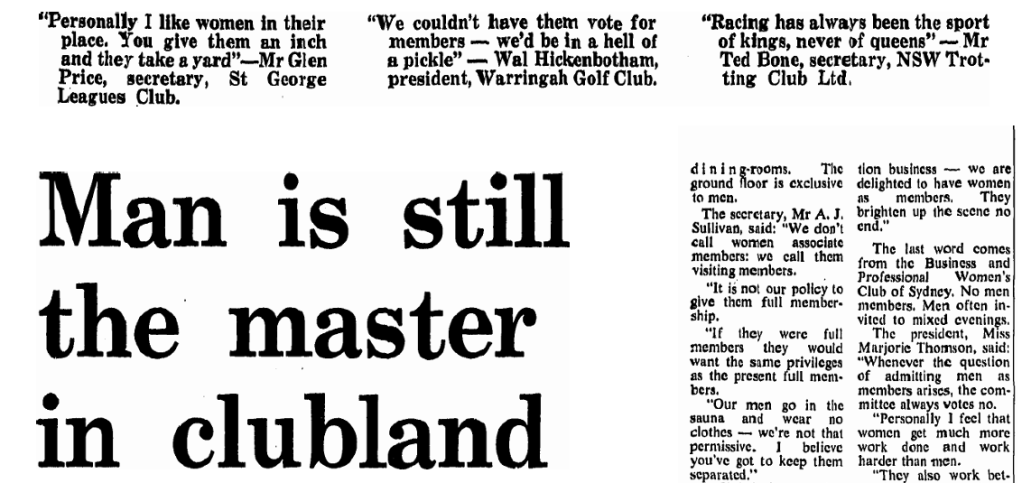
Read the full article: PDF
Bryn Miller also remembers that time.
Cowan had analysed the figures — the men’s bar took up 80 per cent of the space but only brought in 20 per cent of the revenue.
By 9 o’clock at night, there might be only three people in the men’s bar and the ladies area would be full to overflowing to the point that some couples would just leave and go to the RSL.
This was especially so on Saturday night — traditionally the time for couples to have a night out – or on big trading nights like New Year’s Eve.
The revenue figures were common knowledge, but the men were very possessive of their space, and this certainly carried through to most of the directors.
Roger used to wander around every night, often quite late, keeping an eye on things. One late Thursday night after the trots at the local showground, he and a duty manager were watching a couple of men. One had big pockets inside his coat, the other was keeping watch while he cleaned out the drawers. They caught them and went to their car which was full of calico bags filled with ten and twenty cent pieces.
Kevin McGrath recalls how this played out in practice,
When a football game was on, it was stand aside or be swept up in the rush.
On game days they would pull the shutters down in the men’s bar so that the drinkers would go over the road to the game. After the game was finished, they would pour dozens and dozens of half schooners and have them lined up. There would be a mad rush from the football ground as hundreds of thirsty fans descended on the bar.The schooners were filled and the shutters went up. If you only wanted a middy — or perish the thought, a scotch — you just had to wait.
Cowan later said the changes were not a conscious move to overcome discrimination, but simply, a commercial reality.
We were trying to make ourselves more popular. We had to be all the time working out what was needed and then responding. The demand at the time was for much bigger accommodation for mixed company. We were squeezing them into one tiny corner of the club, where they were uncomfortable. There was no space, people were pushing and shoving each other, and often there would be fights in there.
I always thought that to run a club, or any business, you have to give the people what they want. At that time, it was being run for the convenience of a fairly small group of men who wanted to protect it for themselves.
The real shift came one New Year’s Eve — Cowan had convinced the Board to do a one-off and allow women into the Long Bar.
The Board finally relented, at first creating a small, partitioned area of the bar where women could go. “Roger persisted, and they were eventually persuaded to have a proper mixed bar, and the sales increased dramatically”, says Rhind.
“It took women a while to really want to go in there,” Miller says, “because that whole male bastion thing was all so entrenched. But the barriers were starting to come down.”
As those barriers began to shift, the club was changing not just who it welcomed, but what it offered — and how people experienced it.
To receive new Parts and occasional project updates by email, you may subscribe below.
Readers who hold recollections, documents, or material relevant to this history are welcome to contribute via the Commentary & Contributions page.
Project Updates
Receive updates when new parts are published.

