
Roger Cowan and the Rugby League Judiciary
For Roger Cowan, a problem was rarely just the incident that brought it to attention.
His instinct was to pull it apart. What was actually going wrong? Who was affected? What outcome was required? And, most importantly, could a system be designed that would produce that outcome more consistently?
It was an approach to problem-solving and decision-making he was embedding across the Panthers organisation throughout the 1990s — and one he believed was important to its continuing success.
Few examples illustrate that approach better than his work on rugby league’s judiciary.
The problem had bothered him for decades.
“Sit down, Mr Cowan”
As Roger recalled in Panthers, Passion & Politics, when he served on the NSW Rugby League executive committee in the early 1970s, judiciary decisions regularly created controversy. Penalties appeared inconsistent and clubs sometimes believed others were receiving more favourable treatment.
Eventually he tried to raise the issue at an executive meeting.
“I want to make a suggestion about the judiciary system,” he told chairman Bill Buckley.
“Sit down, Mr Cowan, you’re not here to talk about judiciary.”
Roger tried again.
“Sit down Mr Cowan or leave the meeting. You are out of order.”
That was the end of the discussion.
More than twenty years later, rugby league had changed dramatically — and was in the process of changing even more.
During the planning for Super League, the judiciary came up for discussion. Roger said he had “always had a passion for judiciary” and offered to prepare a paper.
This time the response was different.
“Terrific! Go ahead, do it.”
So he did.
Start with the outcome
The surviving working paper is dated 24 November 1995.
Its opening is revealing.
Roger did not begin by deciding who should sit on the judiciary or what punishment should apply to a high tackle.
He began by identifying what a better judiciary system should achieve. What is the outcome — what evidence will demonstrate the system is a success?
Among a list of outcomes were: reduced levels of public criticism of judiciary decisions; elimination of the perception that penalties were inconsistent or favoured particular clubs; less involvement of solicitors; reduced number of hearings and shorter duration; and elimination of appeals based simply on the severity of a sentence.
Before designing the machinery, he defined what the machinery was supposed to accomplish.
That changed the nature of the problem.
It wasn’t simply a question of whether an individual judiciary panel made the right or wrong decision. A system could produce perfectly defensible individual decisions and still create inconsistency, expense, delay and a perception of unfairness.
Roger’s proposal therefore attempted to move responsibility for consistency away from the discretion of whichever individuals happened to be sitting on a particular night and place much more of it within the system itself.
Separate guilt from penalty
At the centre of the proposal was a relatively simple distinction.
The judiciary should determine whether a player was guilty and, if so, what offence had been committed.
Ordinarily, it should not then decide the penalty from scratch.
Offences would instead be divided into clearly defined categories carrying predetermined penalties. Discounts and additional penalties could be applied according to defined circumstances.
A player whose guilt was clear could plead guilty, receive the appropriate discount and avoid a hearing altogether. A player maintaining innocence retained the right to have the case heard.
By January 1996, when Roger presented the proposal to Super League, the concept had been distilled into five principal elements:
- experts should be used where necessary;
- a Head of Judiciary should control the process;
- there should be incentives for guilty pleas;
- penalties should be predetermined, with the judiciary principally deciding guilt rather than sentence; and
- hearings should generally occur only where a player pleaded not guilty.
The objective was not simply tougher or softer penalties.
It was greater consistency.
Design the process, not just the idea
Roger’s November paper went well beyond the broad concept.
It worked through what should happen from the time an incident occurred.
The Head of Judiciary would identify an appropriate charge and notify the player. Where necessary, expert analysis could be obtained. If that evidence exonerated the player, the matter ended. If it supported the charge, the player had another opportunity to plead guilty. If the player continued to maintain innocence, a judiciary hearing followed.
The proposal dealt with who should pay for expert evidence. It considered appeals and appeal fees. It provided for records of previous offences, discounts for guilty pleas and additional penalties in defined circumstances.
Roger even tried to anticipate the objections to what he was proposing.
Argue against your own idea1
One obvious objection to predetermined penalties was that no two incidents were exactly alike.
Surely a judiciary panel needed discretion to recognise the difference?
Roger’s answer wasn’t to ignore those differences and he produced the principle that offences a more precisely defined and graded.
A high tackle, for example, might be divided into 20 or more categories, each carrying its own penalty.
He also recognised the potential danger in relying upon expert analysis. If a new system placed greater weight on expert evidence and that evidence was subsequently shown to be wrong, confidence in the entire system could be damaged.
One proposed safeguard was a second expert opinion in controversial cases.
Even the media were considered part of the process.
Journalists and editors should have access to the schedules of offences, penalties, discounts and additions. Expert reports should be available and journalists invited to see the video evidence supporting them.
Public understanding wasn’t something to worry about after a decision had been made.
It was part of the system.
From weeks to points
Perhaps one of the most interesting ideas appears under the rather modest heading “Future Considerations.”
Roger had identified another problem.
If suspensions were expressed only in whole weeks, a carefully graded series of offences could still end up producing the same penalty. Several different levels of seriousness might all result in a one-week suspension.
So he considered a points system.
One hundred points could represent a one-week suspension. A penalty of 275 points could produce an immediate two-week suspension, with 75 points carried forward. Discounts and additions could also be expressed as points.
It allowed much finer distinctions between offences and circumstances.
The significance for this story is not simply the points themselves.
The working paper captures Roger’s thought process while it was happening:
If we solve this problem, what new problem might our solution create? And how might we solve that?
Not entirely Roger’s system
The proposal did not simply emerge from Roger’s office and become the Super League judiciary unchanged.
Roger himself was quite clear about that.
Many people became involved in developing the final system and compromises were made. His original submission was not adopted in its entirety, although he believed most of its principles survived.
That distinction becomes particularly important when the story reaches 1998.
By then Super League and the Australian Rugby League had come together in the new National Rugby League, and a decision had to be made about which judiciary system the unified competition would use.
The two systems were fundamentally different.
Roger attended meetings between representatives of the ARL and Super League attempting to reach agreement. According to his later account, those meetings achieved little and the question was eventually referred to the chief executives of the 20 clubs.
They heard submissions supporting both alternatives.
The result, Roger recorded, was 18 votes to two in favour of the Super League system — including support from 10 of the 12 former ARL clubs.
It appeared that the argument had been won.
Roger soon became convinced that something very different had happened.
The system meets the real world
By June 1998, the new NRL judiciary was attracting considerable public criticism.
This was the first season of the unified competition and the clubs had overwhelmingly chosen the Super League judiciary model. Yet some early decisions were already raising questions about whether the system being implemented was actually operating according to the principles the clubs had endorsed.
Two cases involving prominent players became particularly contentious.
Glenn Lazarus, playing for the Melbourne Storm on the eve of a State of Origin match, had received 130 points for a high tackle. With 100 points producing an automatic one-match suspension, the penalty would have ruled him out of State of Origin. The penalty was reduced to 99 points — allowing Lazarus to play Origin, leaving the 99 points to be carried forward.
Geoff Toovey’s circumstances were different. Due to his past judicial recorded any offences attracted a loading on a standard penalty. He — again enough for an automatic one-match suspension. Toovey’s points were reduced back to 75 Concerned that suspending a prominent and respected captain for such a minor offence would appear unreasonable, the authorities reduced his points to 75.2
Whatever the merits of either decision, both exposed a problem at the heart of a system intended to produce consistency.
If Lazarus’s circumstances justified reducing 130 points to 99, what would happen when the next player accumulated 130 points but did not have a State of Origin match approaching?
If Toovey’s standing in the game, or the relatively minor nature of the offence that triggered his suspension, justified reducing his accumulated points, would the same consideration be available to a less prominent player?
These were among the controversies being discussed publicly by radio broadcaster Ray Hadley.
Roger had been listening.
On 15 June 1998, he wrote Hadley a five-page letter. He agreed that a number of decisions during the season appeared “absurd from the public’s point of view”.
But Roger believed the controversy was being blamed on the wrong thing.
The problem, as he saw it, was not that the principles developed for the Super League judiciary had failed. It was that the NRL judiciary had departed from what he regarded as the most fundamental of those principles.
The difference came down to a deceptively simple question:
Who was responsible for consistency?
Under the old system, that responsibility rested substantially with the judiciary panel. Change the people and the interpretation — and potentially the outcomes — could change with them.
The Super League philosophy put much greater responsibility upon the administrators of the game.
The judiciary determined guilt. The rules and schedules provided consistency in penalty.
Those rules could be changed.
But when they changed, they changed for everyone.
Learn from the bad decision
This is where the Hadley letter perhaps reveals more about Roger’s thinking than the original proposal.
He did not suggest that his system would prevent every bad or controversial outcome.
Quite the opposite:
“No judiciary system will ever be perfect.”
What mattered was what happened when an imperfection became apparent.
A good system, he wrote, should produce greater consistency and generate its own improvements.
If a particular case exposed an unfair penalty, the administrators could change the schedule.
The next player committing the same or a closely comparable offence would then receive the new penalty.
The lesson from the controversial decision had been captured by the system.
That was fundamentally different from allowing a panel to produce a different result next time simply because its members regarded the circumstances differently.
The first approach changed the rule for everyone.
The second changed the decision for one person.
Lazarus, Toovey — and the next player
Roger’s response to the Lazarus and Toovey controversies was revealing.
He was not necessarily arguing that the concessions made to either player were wrong.
His concern was what happened the next time.
If there was a legitimate reason why Lazarus’s 130-point penalty should be reduced to 99, that reason should be identified and incorporated into the rules. Every future player satisfying the same conditions should then receive the same treatment.
The same principle applied to Toovey. If there was a legitimate reason why his circumstances warranted reducing the points that would otherwise have resulted in suspension, define that circumstance and make the concession available to every player who subsequently qualified for it.
The individual decision therefore became evidence.
If it revealed something wrong with the existing rules, fix the rules.
If it revealed a legitimate circumstance that had not previously been anticipated, incorporate that circumstance into the rules.
Either way, the system became better.
But not a system without judgement
Roger was not arguing for a completely mechanical judiciary.
His letter makes that clear.
Under the Super League system, the judiciary retained discretion to alter a penalty where it considered the circumstances of a particular case genuinely unusual. As far as Roger knew, that discretion had not been used during the Super League season.
The distinction is important.
His objective was not to eliminate judgement.
It was to prevent routine decisions from depending unnecessarily upon individual judgement — while retaining discretion for the genuinely exceptional case.
Consistency was the default.
Departure from it needed a reason.
Who cares what the system is?
Another surviving set of Roger’s notes from 1998 approaches the same issue from a different direction.
At the top of the page he posed a simple question:
Players cared. They wanted less time spent travelling to and attending hearings, equal treatment and a safer game.
Coaches cared. Judiciary appearances interfered with training; they wanted their players treated fairly and protected from dangerous play.
Chief executives cared about the time consumed by judiciary matters and the treatment of their players.
Financial managers cared about the cost of solicitors, witnesses and travel.
Supporters wanted confidence that their team was being treated equally. They also wanted the game’s best players playing rather than injured or suspended.
And the media?
Roger’s assessment was characteristically dry:
“As many opportunities as possible to create controversy.”
There is humour in the line, but the exercise itself is revealing.
Before judging whether a system was working, Roger was asking what the different people affected by it actually required from it.
Don’t fix the decision. Fix the system.
The surviving judiciary papers stretch from the original Super League proposal in November 1995, through its presentation and development in 1996, to Roger’s defence of its underlying principles in 1998.
Together they provide something more interesting than a claim about who devised rugby league’s judiciary.
They provide a small window into how Roger Cowan approached a problem.
Start by defining what you are trying to achieve.
Identify who is affected.
Separate the problem from the personalities involved.
Design a process rather than relying upon good intentions.
Build incentives into that process.
Anticipate objections.
Allow for exceptional circumstances.
And when the system produces an outcome that exposes a weakness, don’t simply correct the outcome.
Learn from it.
Change the system.
Then apply the improvement consistently to everyone who comes next.
It was an approach Roger applied repeatedly during his years at Panthers — to organisational structures, financial controls, strategic planning and football administration.
The judiciary happens to leave behind an unusually clear documentary trail showing that approach at work.
There is also a certain symmetry to the story.
In the early 1970s, Roger tried to suggest there might be a better way to administer rugby league’s judiciary.
He was told to sit down.
More than twenty years later, he was finally invited to develop the idea.
And when the new National Rugby League had to choose between two fundamentally different approaches, 18 of its 20 clubs voted for the system that had grown from that proposal.
For Roger, however, winning that argument was never quite the point.
The system still had to work.
And if it didn’t, the answer was not to abandon the principles behind it.
It was to find out why — and make the system better.
From the Panthers Passion Politics Digital Archives
The surviving documents behind this story provide an unusual opportunity to follow the development of Roger Cowan’s thinking about the rugby league judiciary — from his original proposal, through its presentation to Super League, to his response when he believed the principles behind the system were being compromised.
November 1995 — The Original Judiciary Proposal
Roger Cowan, 24 November 1995
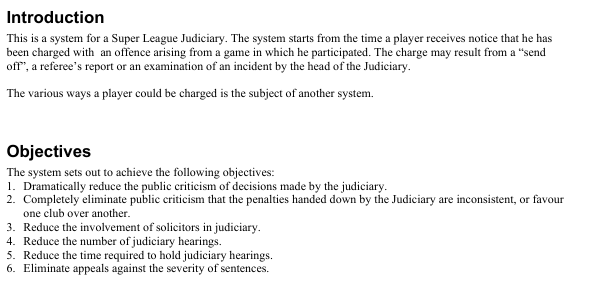
Roger’s original working paper setting out the objectives of a proposed Super League judiciary system, its procedures and safeguards, and the problems it was intended to overcome. The document also includes his early consideration of replacing suspensions expressed solely in weeks with a points-based system.
January 1996 — Presentation to Super League
Roger Cowan, 8 January 1996

The presentation prepared from the earlier working paper, distilling the proposal into its principal elements for consideration by Super League. It shows how the more detailed November proposal was developed into a practical model for discussion and implementation.
January 1998 — Who Cares What the System Is?
Roger Cowan, 18 January 1998
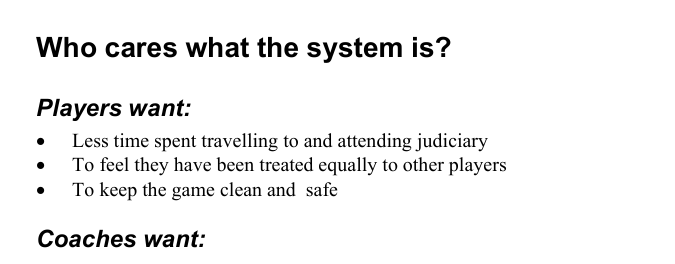
These working notes approach the judiciary from another direction: who is affected by the system, and what does each group need from it? Roger considers the interests of players, coaches, chief executives, financial managers, supporters, administrators and the media.
June 1998 — Letter to Ray Hadley
Roger Cowan to Ray Hadley, 15 June 1998
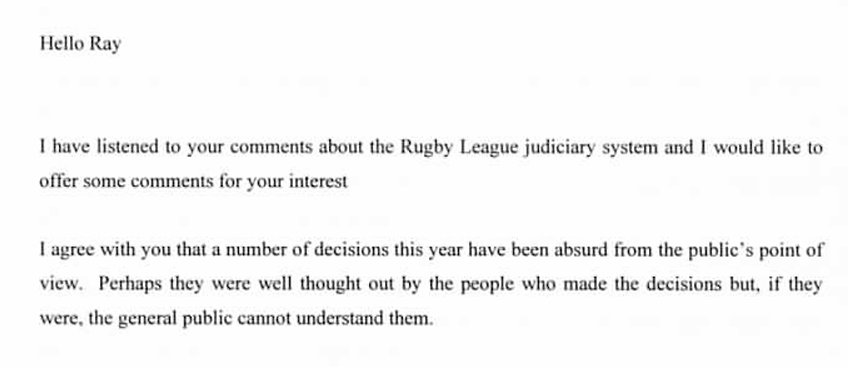
Written during controversy surrounding the judiciary in the first NRL season, this five-page letter explains Roger’s concern that the system being implemented had departed from a fundamental principle of the Super League model: consistency should reside principally in the rules and procedures rather than depend upon individual decisions. The letter discusses the Glenn Lazarus and Geoff Toovey cases and explains how Roger believed apparent anomalies should be used to improve the system.
Related Topics
- Part 40 — Anti-Football — Joke or Paradox
- Beyond the Book — Super League — The Panthers Move
- Beyond the Book — Education by Experience
Related Themes
Innovation · Governance · Football Club
To receive new Parts and occasional project updates by email, you may subscribe below.
Readers who hold recollections, documents, or material relevant to this history are welcome to contribute via the Commentary & Contributions page.
Project Updates
Receive updates when new parts are published.
- This was another technique Roger encouraged in the decision-making process throughout Panthers — this took various forms and names depending on the specific circumstance. One was use deBono’s “Six Hat Thinking” where the Black Hat was engaged to argue against the idea. Using the process developed by Mike Basch of Federal Express, there was a section title “Things We Must Overcome” where the challenges were listed and anything that “killed” the diea identified.
↩︎ - In Round 1 of the 1998 unified season Brisbane played Manly in Brisbane. Bill Harrigan was the referee. Early in the match Harrigan sent Toovey to the sin-bin for dissent about a decision. In the last 30 seconds of the game John Hopoate was sent of for referee abuse. Wtin seconds Toovey was also sent and the charge was also abuse. ↩︎

