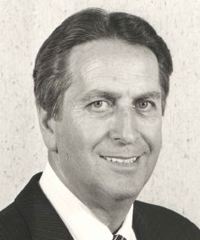
Major Player: Ron Mulock

Ron Mulock
Source: Parliament NSW

Ronald J Mulock OA, KCSG

Deputy Premier of New South Wales; Founding Member and Patron, Penrith District Rugby League Football Club

Ron Mulock was a long-serving member of the Australian Labor Party who served as councillor, mayor, state parliamentary representative, senior minister, and Deputy Premier of New South Wales. He was a founding member and Patron of the Penrith District Rugby League Football Club.

Role in the Narrative

Ron has a significant presence in the Panthers, Passion and Politics narrative.

Ron Mulock has a significant presence in the Panthers, Passion and Politics narrative.

His association with Panthers dates to the earliest days of the club, and he emerges as an influential figure during the conflicts that unfolded in the later years of Roger Cowan’s tenure. He also contributed to the efforts supporting the award of the Order of Australia Medal to Roger Cowan.

Background

Born: 1930
Died: 2014

Profession: Lawyer – admitted as Solicitor of the Supreme Court in 1955.

Public Roles:
• Mayor of Penrith: 1968–71
• NSW State Parliamentarian: 1971–1988
• Deputy Premier of NSW: 1984–1988

Honours:
• Officer of the Order of Australia (1988)
• Knight Commander of the Order of St Gregory the Great (2013)

Relevance to Events Described

Ron Mulock is closely connected to one of the central strands of this story.

During the late 1990s, he opposed aspects of the expansion strategy undertaken by Panthers and was aligned with the group of five directors who became known as the “Footy Five”. The four minority directors were referred to as “Roger’s Four Kinsmen” — a phrase that drew on the name of a well-known musical group closely associated with Panthers.1

Mulock’s long-standing connections within the Australian Labor Party, and his prominence in public life, contributed to a broader perception at the time that he was influential in political attention being directed toward Panthers.

Related Material

Ron Mulock – Public Tribute (Western Weekender, 2014)


Editorial Note

This profile is presented as contextual background.
Additional material may be introduced as the narrative progresses.


  1. The Four Kinsmen were a popular Australian vocal group who performed regularly at Panthers over many years and developed a close association with the club. ↩︎
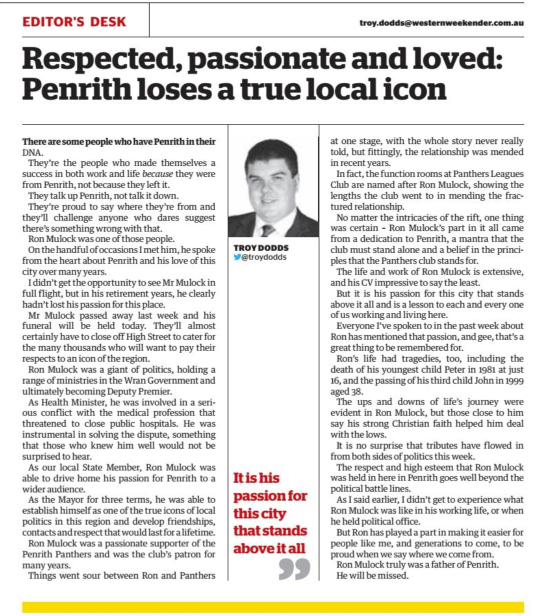

Ron Mulock – Public Tribute (Western Weekender, 2014)

The following article was published in The Western Weekender following the passing of Ron Mulock in 2014.

It provides a contemporary reflection on Mulock’s standing within the Penrith community.

Western Weekender article titled “Respected, passionate and loved: Penrith loses a true local icon” featuring Ron Mulock (2014)
The Western Weekender, 12 September 2014

To receive new Parts and occasional project updates by email, you may subscribe below.

Readers who hold recollections, documents, or material relevant to this history are welcome to contribute via the Commentary & Contributions page.

Stay Updated

Receive new Parts and occasional project updates by email.

The Impact of a Turnover Tax

A turnover tax on gambling is a tax imposed on the total amount of money wagered or “turned over” in a gambling activity, rather than on the profits generated by the gambling operators.

For example, imagine you take $100 to the races, and you place a $100 on the first race, it wins and you now have $350. You continue to bet $50 on each of the 7 remaining races. So, if you add up the amount you bet it comes to $450 – your first bet of $100 plus 7 bets of $50.

A turnover tax on this activity means the tax is calculated on the total value of the the bets placed, $450. Yet, the amount spent by the punter was only $100.

This example shows the very best result for the betting provider would be for the punter to finish the day broke – and the provider would have a revenue of $100. But they would be paying tax on $450.

Of course, it would be possible for the provider to lose hundreds of dollars to this punter, yet still pay tax on the $450 turned over.

Industry opponents of turnover taxation argued that the structure materially reduced operators’ capacity to improve return-to-player rates.

The mathematics of a turnover tax make it extremely restrictive – and, in fact, for some gambling games (like blackjack) even a small turnover tax would mean the game would not be viable.

For example, poker machines in NSW have a minimum return to player rate of 87%.

At a theoretical level this means a couple of things:

  • Firstly, it means the theoretical revenue for the operator is 13% – that is the operator can expect to retain $13 in every $100 staked on their games.
  • Secondly, it means the theoretical turnover for the player is 3.42 times their orginal stake. So, starting $100 and playing until depleted will generate a theoretical turnover of $342.

In the case of a starting stake of $100, theoretically the operator will retain $13. If a 3% turnover tax is applied their obligation to the tax office will be 3% of $342, which is $10.25.

Now, imagine an operator wants to offer a better deal to their patrons with a 90% return to player. So $100 stake produces a theoretical $10 revenue for the operator. The turnover is $388 and a 3% turnover tax will produce a tax obligation of $11.74 – so the tax office will take all the operator’s revenue plus more.

Critics maintained that turnover taxation limited pricing flexibility and distorted game viability.


To receive new Parts and occasional project updates by email, you may subscribe below.

Readers who hold recollections, documents, or material relevant to this history are welcome to contribute via the Commentary & Contributions page.

Stay Updated

Receive new Parts and occasional project updates by email.