The poker-machine transaction examined in Part 24 did not disappear when the NSW investigation ended. Four years later, the same transaction surfaced in the Queensland Criminal Justice Commission’s 1990 report on gaming machines, where Cowan believed the facts were misstated and the implications left uncorrected.
Somehow the Queensland Justice Commission accepted the false proposition, from an undisclosed source, that Panthers had paid $7,000 per machine when the list price was only $5,300. Every piece of documentation Howe had seen had clearly shown that the club paid only $5,300.
The poker machine purchase from Len Ainsworth’s company, Aristocrat, was mentioned in the Commission’s 1990 report on gaming machines. The QCJC used the purchase to illustrate what it called the ‘Byzantine transactions’ that it said were common in the club industry at the time.
‘Various manufacturers are alleged to have engaged in the offer of inducements of one sort or another to buy gaming machines’, said the report. It continues, ‘There is room in such contorted transactions for any number of corrupt arrangements.’
It quotes the same information that was in the original NSW police allegations, including the listing of only 90 machines. It provides all the figures, and mentions Ainsworth’s subsidisation of the interest, without providing any explanation of the circumstances. The report emphasised the payment by Panthers of an inflated price of $7,000.
After the report was released, Cowan had a solicitor write to the Commission asking that the report be amended to reflect the true facts of the transaction – that Panthers paid $5,300, not $7000, and that the list price was $7000, not $5300. The request was ignored. A subsequent approach was also ignored. No response was ever received, and the false representation still stands in the records.
Although Panthers had been cleared of all the original charges, with no action taken by the NSW police or the Liquor Administration Board, here was the very same information finding its way into the QCJC report. Cowan is mentioned specifically in the same report, saying he ‘has come to the notice of NSW police on a number of occasions and had been unsuccessfully prosecuted once’. No evidence was ever recorded of any specific occasions on which Cowan had ‘come to the notice of police’.
Phil Bennett also read the report, and, knowing the real facts of the transaction, sent a personal response to the QCJC, explaining his own knowledge of the sale. He told the Commission: ‘It was clearly established that there was nothing illegal or improper about this transaction and no action was taken, nor was the matter raised as an objection in Ainsworth’s licence application.
The Commission’s suggestion that this transaction was an example of an inducement paid to people in exchange for their club buying machines is clearly not sustainable.
Bennett also noted in his response that the prices of poker machines quoted in the QCJC report were ‘a nonsense’.
The QCJC did nothing to rectify its erroneous report. The blatant untruth still stands in its records.
The second part of the police investigation was about the club’s purchase of 100 poker machines.
Bob Donaghy was one of the club’s two assistant managers, and his responsibilities included purchase of poker machines. Aristocrat was the largest manufacturer in the industry, but the Club had not bought any of its machines for quite a long period. Donaghy believed the quality of their machine design and security had slipped. But when the club was ready to freshen up its gaming area with 100 new machines, Donaghy recommended the latest release by Aristocrat, telling Cowan he now had confidence in their products.
They began to talk about cost. The listed price of the machines was $7,000 each. Cowan suggested that they go to Aristocrat with an offer. It was a large purchase, maybe even unprecedented in Australia. As such, it should warrant a considerable discount. They decided to offer $5,000 per machine. conditional on Aristocrat arranging the finance for leasing and subsidising the interest rate.
Aristocrat mostly agreed with the proposal but set a total price of $530,000 for the 100 machines; still an extraordinarily large discount on the $700,000 they would have paid at list price. Cowan and Donaghy were celebrating. It was a straightforward transaction, and they had done a great deal. The complications arose for Panthers in the accounting offices of Aristocrat.
Aristocrat had obtained leasing finance for the total amount of $530,000, and that was correct. But they had listed only 90 machines on their sale documents. In effect, they had financed 90 machines for $530,000 and given Panthers ten machines at no charge. It made no difference to the club, and it was Aristocrat’s own choice to account for the machines the way they did, but the ramifications moved even beyond the police investigations at Panthers in 1985, to resound in the Queensland Criminal Justice Commission in 1990.1
The purchase was the subject of almost a full hour of questioning by Mick Howe after the fraud squad officer had left having no more interest. Cowan tried in vain to explain how the price of the machines and the interest rate had been discounted. He says the long conversation seemed to travel around in circles but it can be summarised easily in just a few paragraphs:2
Mick Howe: I have been to the Liquor Administration Board to examine the records of your poker machine purchases and I found that you had applied for the purchase of 100 machines. There were 100 serial numbers listed. I then did a survey of the machines in the club and found all 100 machines with those serial numbers. However, when I looked at the finance company records I found only 90 machines listed on their records.
Cowan: I don’t know what is listed in the finance company records, but I cannot understand what the problem is. We bought 100 machines at a heavily discounted price, and we correctly submitted licence numbers to the department. You know that all the machines have been installed, and you know that Aristocrat has been paid for them. I don’t understand what you think is wrong with the transaction?
Mick Howe: You know, that’s what I have been trying to figure out, and now I can see it. If the club goes broke, the finance company will only be able to repossess 90 machines, yet they have financed the payment for 100.
Reflecting on this exchange Cowan commented,
I was astounded at the detective’s logic: “Well so what!” I said. “We would hardly buy 100 machines if we thought we were likely to be going broke. In any event, if we had paid the list price for the machines, the borrowings would have been a lot more and the finance company’s security a lot less.”
Mick Howe remained unconvinced. He just did not get it.
The third matter for police investigation was the sale of the Station Street property. Rumours of something questionable in that transaction were investigated. Most of the police and government officers involved in the police raids on Panthers walked away satisfied that Cowan and the Club had nothing to answer on the original allegations.
Mick Howe stood out as the expectation.
The Station Street property transactions, discussed earlier in this series as part of the Club’s property strategy3, were also examined. Again, investigators found no evidence of criminal wrongdoing.
By now, most of the allegations that had prompted the raids had failed to produce the evidence investigators had hoped to find. For many involved, the matter appeared to be drawing to a close. Detective Sergeant Mick Howe saw things differently.
To receive new Parts and occasional project updates by email, you may subscribe below.
Readers who hold recollections, documents, or material relevant to this history are welcome to contribute via the Commentary & Contributions page.
The following paragraphs are not a verbatim conversation but a paraphrasing of the conversation that eliminates the repetition and redundancy that characterises these types of discussion. ↩︎
The first few questions of the interview, led by Detective-sergeant Mick Howe, implied that Phyro Holdings1 was acting fraudulently, secretly, and without the knowledge of the Board. This complaint seemed of great interest to the fraud squad officer.
Cowan explained that Phyro was his family company, and it had a contract to provide certain services to the club. He reached into his desk drawer and handed over a contract. Some minutes passed as they went through the document. The fraud squad detective paused and drew Howe’s attention to one specific part on the last page of the contract. They both seemed surprised, and a quick look passed between them.
The fraud squad officer asked Cowan a few more questions, then made to leave. He said to Cowan,
I’ve heard enough. Mick might want to ask a few questions about some other matters, but I don’t need to be involved any further.
And he left the office.
Cowan says it took him a while to catch on to what had happened to cause the quick exit by the fraud squad officer.
That night I was lying in bed still trying to figure it out. What was in the contract that was such a surprise? They had not reacted until they reached the end of it. What was on the last page? Suddenly it hit me. The only thing on that page was the signatures of the parties to the agreement! Why would those signatures surprise them? Certainly, there was no surprise in mine being there, so it must have been one of the others.
It could only mean that the person who signed the letter of complaint to the Assistant Commissioner must have been the same person who had signed the Phyro contract. The person who wrote that the Board knew nothing of Phyro had actually signed the Phyro contract. No wonder the fraud squad detective signed himself off the case so quickly.2
The detectives had also told him that the informant was someone who was seen by the police as highly credible. A director who was a long-standing ex-chairman would certainly fill that description.
The letter of complaint has never been seen by any officer of the club, so its contents — and its signatory — can only be assumed. Whatever was in it, however, had brought large numbers of police and government officers on the Club. To prompt such strong action, the allegations must have led them to suspect dishonesty and breaches of the Registered Clubs Act.
What really bothers me about this affair is that the first part of the complaint had been discredited in the first half hour of the interview. The fraud squad officer acted accordingly. He was not wasting any more time once he saw that the complaint was flawed.
But Mick Howe was not so easily satisfied.
Current group chairman Barry Walsh3 was a director in 1985. He says it was the big topic of conversation around Penrith that the detective was after Cowan, and he was a very determined man.
‘But Phyro was no secret anyway’, says Walsh. It just wasn’t a big deal for anybody.’
Phil Bennett agrees with Barry Walsh that Phyro’s role and ownership were no secret. He says the investigative accountants went through everything at the time of the investigations.
I think one of them stayed on after the rest of us left. At that time Phyro Holdings was common knowledge. You would always read in the annual report, stuff about Phyro owning certain property.
Bennett points out that the name is “obviously compounded from Phyllis and Roger”.
Cowan remembers the several months of continuous inquiry as one of the most stressful periods he has ever experienced. The investigation itself was not a problem, he says, it was the rumours of Howe’s determination to ‘get him’.
The rumours were strong that Mick Howe had stated that he did not like Panthers, did not like me, and was confident he would find incriminating evidence. At that stage we were already a big organisation, with 850 employees. It is easy to make mistakes running a business that size. We had good systems in place, but there was always the fear that there might be something wrong that I knew nothing about, and it would be used against me.
I had that constant feeling of being in deadly competition with a well-armed predator and I was the defenceless prey. The hunter had all the time and resources he wanted, and he could attack from any angle. I had two choices, stand out in the open and let him see every side of the target, or go into defence mode by employing a good legal advisor.
I had chosen to stand out in the open. With the benefit of hindsight, it was a dumb move on my part.4
Barry Hubbard was also a director at the time of the police raid. He says everybody was feeling the pressures of Howe’s campaign.
Roger wondered if someone in the club was ‘talking’ to the police and giving them information. He went to each of the directors and asked us.
‘I told him “no”’, says Hubbard. But he was upset by the question.
I said, “Roger, if I knew of anything illegal that was going on in this club, I would first take it to the Board, and if nothing was done, only then would I go to the police”.
Hubbard says that around the time of the licensing raid, he was also questioned by a Penrith detective about a house he had bought from the club. The detective suggested that he had bought the house for nothing, or at a token fee. It was a ridiculous claim, says Hubbard, and he was easily able to prove that he’d paid the right amount for the house.
The same policeman later got in touch with him, asking did he know of anything dishonest that was going on in the club, and suggesting that he keep his eyes open. Hubbard assured him there was nothing, but the calls continued over the next couple of months, asking the same questions.
I wrote to the detective, telling him what I had told Roger. If I knew of anything untoward in the club, it would go straight to the board. If they did nothing, I would take it to the police. I also asked him to stop calling me.
For directors such as Hubbard, the repeated approaches from Howe and his colleagues reinforced the impression that the investigation was not winding down, despite the failure of the original allegations.
To receive new Parts and occasional project updates by email, you may subscribe below.
Readers who hold recollections, documents, or material relevant to this history are welcome to contribute via the Commentary & Contributions page.
Project Updates
Receive updates when new parts are published.
Phyro Holdings Pty Ltd is the family company of Roger & Phyllis Cowan contracted to Penrith Rugby League Club Ltd to supply various services including the publications of The Panthers Magazine. ↩︎
Some 20 years later this scenario was replicated. Directors or former directors publicly asserting they had no knowledge of Phyro Holdings and the slipping on their story, showing they must have had knowledge. The final “slip-up” was during the Temby Inquiry when testimony by a former director in one session was recanted the next morning for fear of being in contempt. ↩︎
Barry Walsh was appointed Chairman when Leo Armstrong retired, and he held that position until 2009 when Don Feltis took the Chair. ↩︎
This approach was not unusual for Cowan, his belief that it was besst to be very open with investigators was considered naive by many colleagues and supporters of Cowan’s. Many saw it as a weakness that made him vulnerable to being ambushed. ↩︎
One afternoon in 1986, Roger Cowan was driving back from a meeting of the Registered Clubs Association in Sydney when he received a phone call from the club.
The call was to advise him that about 12 police and officers from the Liquor Administration Board had arrived at the club. They were demanding to see all the club records including minutes of meetings and financial records. There had been no prior notification of the raid. In Cowan’s absence, the task of meeting the officers fell to Glenn Matthews, then a young accountant. Nobody at the club had any idea of the purpose of the visit, or what they were looking for.
Phil Bennett1, now with his own computer graphics company, was a gaming machine inspector for the LAB at the time and had worked with some of the police officers before. The officer leading the investigation was Detective Sergeant Mick Howe from the NSW Poker Machine Task Force. Howe had requested that Bennett join in the raid.
The group descended on the Club believing that Cowan would be on the premises. It was a logical assumption – he was there most days, from quite early in the morning. When he wasn’t, they jumped to the conclusion that he had seen them coming and left, adding fuel to the notion that he had something to hide.
Cowan, as we know, had not been in the club that day because of the meeting in Sydney. There was no way he could have known of the police visit.
At the time it was seen as a big deal, says Bennett. Mick had brought in a whole lot of people from other units – the Fraud Squad, Corporate Affairs, and the Sydney police unit that did all their accounting investigations.
The NSW police Poker Machine Task Force had been set up to overcome gaming machine crime. Steve Foote2 came to Penrith as a police constable soon after the raid on Panthers. He was later to become part of the NSW police’s Licensed Gaming Investigation section. He is no longer in the police force, but he is aware of the raid, and of the task force and its history. The Task Force was, he says, ‘a clandestine operation that had special powers from the commissioner’.
Nothing like this had ever happened at the Club. The LAB investigated complaints from time to time, and made regular routine visits, but this was unprecedented. Before returning to the club, Cowan contacted the club’s solicitor, John Ffrench, to see if he knew anything about it and to ask for advice.
Ffrench’s first reaction was very cautious. He tactfully suggested to Cowan that if he was aware of anything that the police might find in their investigations, he should ‘come clean’.
The idea was, if there were any ‘snakes in the woodpile’, it would be better for John to know in advance rather than be surprised later. He satisfied himself that I had no knowledge of anything that could be of interest to the police, and we talked about what we should do next.
My preference was to simply answer all their inquiries and be quite open with the records. As far as I was concerned there was nothing to hide. But it was obvious that the police thought they had something, just because of the gung-ho way they were approaching the whole thing.
I wondered if I should have a solicitor with me when I was interviewed, but I still didn’t see the need. At first, John Ffrench thought that I should, but we finally agreed that I would go without legal representation and give the police every co-operation. In that way it would all be over quickly, and the club would be cleared of all suspicion.
That strategy backfired badly, but much later and for different reasons.
Ffrench called the officer in charge and set up an interview in my office for the following morning. In fact, that was the last involvement of the club’s solicitor in that chain of events. In hindsight that proved to be a serious mistake.
The officers conducting the interview were Mick Howe and a detective sergeant from the fraud squad. Cowan remembers being impressed by the fraud squad detective. He was highly qualified academically, asked probing questions, seemed to understand situations quickly and was all business and no nonsense. He seemed to assess what was happening quickly and then lose interest.
At that moment though, Cowan was asking himself how had he come to that point? Later, things would slowly fall into place and he would see a strong connection to an innocent event that caused some friction 2 years earlier at the end of Season 1984.3
The connections — between the end of season event and the police raid – began to fall in place for Cowan after the first police interview.
At the outset of the police interview, Cowan was told that the investigation arose from a written complaint to the Assistant Commissioner of Police. It would cover a number of issues, but there were three specific matters of importance. Cowan’s family company, Phyro Holdings Pty Ltd, was one matter. The second was related to the club’s purchase of 100 poker machines from Aristocrat. The third matter was the sale of a property in Station Street, Penrith, the site of the club’s premises before it moved to Mulgoa Road.
To receive new Parts and occasional project updates by email, you may subscribe below.
Readers who hold recollections, documents, or material relevant to this history are welcome to contribute via the Commentary & Contributions page.
Project Updates
Receive updates when new parts are published.
Phil Bennett is the principal of Phil Bennett Consulting, established in 1989 to provide gaming consultancy services to clubs, hotels and casinos. ↩︎
Steve Foote grew up in the Penrith region, attending Penrith High School. After leaving the NSW Police Force, he took various roles in the safety & security sector. He is now retired and focuses on art. ↩︎
Readers of Parts 19–21 may wonder why Roger Cowan spent more than sixteen years arguing for what appeared to be a relatively simple administrative reform. Why did the issue matter so much to him? Why did he keep returning to it despite repeated setbacks, opposition and criticism?
The answer lies in a question that had troubled Panthers almost from the beginning:
How could the Club pursue a unified direction when rugby league and the licensed club were governed separately?
The issue was not new.
Readers familiar with the events of 1971 may recognise some familiar themes. The removal of football club secretary Merv Cartwright and treasurer Ron Partridge arose from concerns about the administration of rugby league affairs and accountability for financial decisions. Although the circumstances were different, the disputes that emerged again in the late 1970s centred on many of the same questions. Who should make decisions? Who should be accountable for those decisions? And what happened when agreements were not honoured?
From the time Penrith entered first grade rugby league in 1967, the football club and licensed club operated under separate governance structures. The arrangement was common in rugby league, but Roger increasingly came to believe it created problems that could never be fully resolved.
It would be easy to assume the conflict was simply about money. Certainly finances played a part. Rugby league required increasing investment, while the licensed club was trying to strengthen its financial position and pursue long-term development projects. Yet Roger’s frustration was not that football sought resources. In his view, the licensed club had repeatedly demonstrated a willingness to support rugby league and invest heavily in its future.
The real problem arose after decisions had been made.
Budgets would be negotiated. Agreements would be reached. Plans would be approved. Yet time and again, football expenditure exceeded agreed limits or new commitments were entered into without the knowledge or approval of those responsible for managing the Club’s overall finances.
From Roger’s perspective, this was not simply a financial problem. It made long-term planning almost impossible.
A licensed club board could approve a football budget, commit to major development projects and make decisions based upon expected cash flows. If those assumptions later proved incorrect because spending commitments had changed, the consequences extended well beyond rugby league. The entire organisation could be affected.
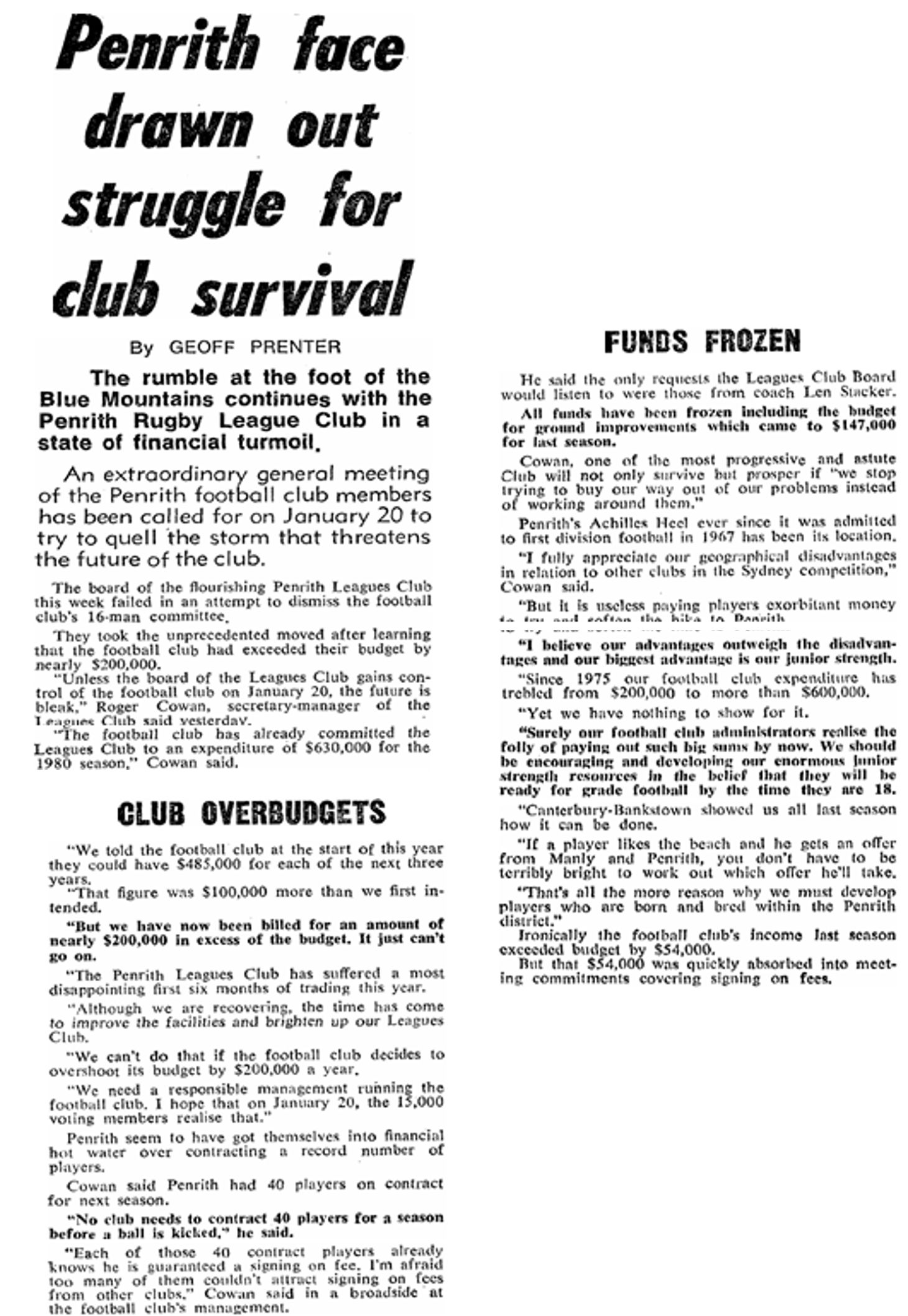
By the late 1970s, these tensions had become increasingly public. In December 1979, the Sydney Morning Herald reported on financial difficulties and disagreements between the football and licensed club administrations. Around the same time, Panthers was preparing for the enormous financial challenge of constructing its new Mulgoa Road complex.
SMH 1979 Dec 9 – click image for full article.
Reports to members in 1980 revealed the extent of the concern. Directors reported that the football club had exceeded an agreed annual budget of $485,000 by more than $100,000 during 1979, while additional commitments had already been entered into for the following season. To the licensed club board, the issue was not simply the amount involved. It was that decisions affecting the future of the entire organisation had been made outside the framework that had previously been agreed.
These events helped bring the governance debate to a head, but they do not fully explain Roger’s determination.
For him, the issue was ultimately one of organisational unity.
He believed Panthers would never achieve its potential while parts of the organisation operated according to different priorities, different assumptions and different lines of accountability. A football club and licensed club could share the same colours, the same members and the same ambitions, yet still find themselves working against each other.
His solution was straightforward.
One board would determine policy and direction for the entire organisation. Management would then be responsible for implementing those decisions. Everyone would work towards the same agreed objectives and everyone would be accountable to the same governing body.
Not everyone agreed.
Some viewed Roger’s campaign as an attempt to centralise power. The perception is understandable. After all, he was advocating a structure that would eventually place responsibility for football and licensed club operations under a single administration. His persistence over sixteen years inevitably raised questions about motive.
Yet there is another interpretation.
Roger was not arguing that football should receive less support. Nor was he arguing that rugby league was less important than the licensed club. Rather, he believed the entire organisation should operate according to a common plan and that all parts of Panthers should be accountable to that plan.
Many years later, Panthers would use concepts such as “twin citizenship” to describe the idea that people belonged not only to their immediate team but also to the wider organisation. While that language did not exist in the 1970s, the philosophy behind it helps explain Roger’s thinking. He wanted rugby league, club management, directors and staff to see themselves as contributors to a single enterprise rather than separate interests competing for influence.
The first major breakthrough came in 1980 when a single board was finally established. Yet even then, the model remained incomplete. Rugby league and the licensed club continued under separate chief executives. As described in Parts 20 and 21, the compromise produced its own difficulties and did not resolve the underlying tensions.
It was not until the end of 1983 that the structure Roger had advocated for so long was fully implemented. One board and one chief executive became responsible for the entire organisation.
Whether that decision alone explains the improvements that followed is impossible to know. Organisations are rarely transformed by a single reform. Nevertheless, the years that followed saw a stronger emphasis on cooperation, planning and shared ownership. The workshops that led to the Five by Five program, closer relationships throughout the rugby league district and a more integrated approach to football and club operations all emerged during this period.
Reasonable people may still disagree about whether Roger was right. They may also disagree about the extent to which later successes flowed from the governance reforms he championed.
What is difficult to dispute is that he regarded the issue as fundamental. For more than sixteen years he returned to the same argument, often in the face of resistance and disappointment.
Ironically, that persistence contributed to one of the enduring myths about Roger Cowan — that he was somehow anti-rugby league.
The evidence suggests a more complex reality.
His long campaign for “One Board, One CEO” was not driven by a desire to diminish rugby league, but by a belief that Panthers could only achieve lasting success when every part of the organisation was working towards the same goals and operating under the same commitments.
Whether one agrees with that belief or not, it became one of the defining ideas in the history of Panthers.
Source Material*
The following documents are extracts of the relevant sections of larger reports:
With Mulgoa Road established, the focus shifted to sustaining momentum and extending Panthers’ presence beyond the club itself.
After the blaze of publicity that followed the 1984 opening of the Mulgoa Road premises, Cowan and the management team were looking for ways to keep up the momentum of the Panthers brand.
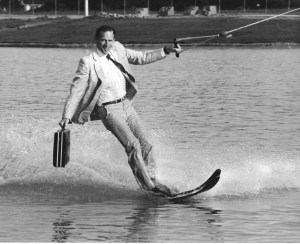
Around the same time as Mulgoa Road opened its doors, a new water-ski concept had been developed in a Perth suburb. A man-made lake had been created for water-skiing with a novel twist. There was no need for boats. Water skiers queued and were given instructions as they waited their turn. As they neared the top of the queue, they were handed a ski rope. The operator would pull a lever, the rope would become attached to the moving cable and the skier would take off for two or three circuits of the lake.
When the managers of the Perth enterprise heard of Panthers, they made contact. They approached the Club to explore whether such a park might be feasible for Penrith. Representatives of the Club inspected the WA operation and carried out studies to determine whether it could be a worthwhile investment.
Here was a unique and interesting way to build the Panthers brand and generate publicity.
Further, there was a large area of land that had been earmarked for future use, but it was too low-lying for any development – it needed to be filled. Excavating two large lakes would provide the hundreds of thousands of cubic metres of fill for this low area. They would not be paying to dump the excavated fill, nor would they need to buy any to raise the land.
One important point was overlooked in assessing the financial feasibility of this venture – the climates of Perth and Penrith are similar, except that Perth gets most of its rainfall in winter, whereas Penrith is wettest in summer.
In 1987-88, its first year, the park – named Cable’s Ski Park -made a profit, generated enormous publicity and provided all the fill needed for the lower areas of property. It was a win all round.
In the second year, it started to rain in December and continued through most of January – the summer school holiday period, and the most important revenue generating part of the year. The following year the weather pattern was repeated.
It turned out that a dry December-January period was the difference between profit and loss for the entire year. When the novelty died away after a few years, so did the publicity, and the park struggled to break even. For a while it was a great attraction, helping to raise the city’s profile, along with Panthers. Eventually repeated losses could not be justified, and Cable’s was closed in 2002.1
The ski park decision has been criticised by some, but Cowan later reflected that factoring in the fill requirements for other parts of the property meant the real cost of building the park was quite low. He says:.
On the one hand, the fact that it had to be closed down says very clearly that it was a failure. There is another perspective. If we were able to go back and I was faced with the same situation, I would have no hesitation in making the same decision. The gains far exceeded the losses. The ski park did more to boost the Panthers name throughout Australia than anything else we did, apart from moving to Mulgoa Road.
The iconic promotional photo of Roger Cowan at Cables Ski Park.
Another ‘outside the square’ decision for Panthers was the purchase, in 1993, of Nepean Shores. It was an upmarket mobile home village located close to the Nepean River. It had more than 80 cabins, all fully occupied, and several function rooms. The developers had overspent on it and been forced to appoint an administrator, so it came on the market for much less than its cost.
Management inspected the site. They discovered that the current income was less than the holding costs of interest, rates and maintenance – but not much less.
The conference rooms were a strong attraction. They had been tastefully constructed and were practical and functional. The Club’s conference market was growing, and business was often limited by availability of rooms. Nepean Shores could open up new opportunities.
Cowan says Nepean Shores had been finished to a high standard, in fact it was probably overdone for the income it could generate. The infrastructure, although a bit run-down, could be revitalised at a relatively small cost. The purchase price was $3 million. To the Board and management, it seemed an excellent investment with the potential to be further developed for a good cash flow.
Nepean Shores enhanced the status of Panthers as a provider of a range of conference facilities. It became a venue of choice for Panthers’ management and Board conferences. It remained part of the Panthers portfolio for many years and proved to be one of the Club’s most successful commercial investments.
Roger Cowan believes that the physical side of building a business – the buildings, infrastructure, equipment and systems – make up only a very small part of the whole when compared with the other side – the people.
It’s the people who make it work, the relationships and networks, the supporters and the critics. The culture of a company develops automatically as the various influences take dominance for periods. The philosophies, values, beliefs, tall stories and historical landmarks combine to affect decision making and strategy in a dramatic way.
Strange to say, culture was an important concept at Panthers even before the word became a recognised part of the management language.
Behind each of these decisions was a consistent thread — the belief that while buildings and assets matter, it is people, relationships and culture that ultimately determine success – a theme that would continue to shape the Club in years ahead.
To receive new Parts and occasional project updates by email, you may subscribe below.
Readers who hold recollections, documents, or material relevant to this history are welcome to contribute via the Commentary & Contributions page.
Project Updates
Receive updates when new parts are published.
Cables reopened in 2009 as Cables Wake Park and continues operate under a lease from Penrith Rugby League Club Ltd. ↩︎
Long before Mulgoa Road, the Club had already begun to adopt a deliberate approach to property.
From the time that Cowan took on the job, the Club’s philosophy was to invest in property that could support future development – even if it meant increasing debt.
In 1965 the Penrith Rugby League Club was boxed in on all sides. The main parking area for its customers was the Council Swimming Pool on the opposite side of Station Street, or on the streets nearby. The old clubhouse had been built in 1955 and provided facilities for a Boy’s Club. In 1963, a new clubhouse was completed next door, and the old building was dedicated to Boys Club Facilities.
By 1970, the Club needed a major extension, and the Boys Club building had to be demolished. It was replaced by the Police Youth Club, further North on Station Street, in a project funded, uniquely at the time, jointly by the Club and Penrith City Council.
From the time the Club had overcome its financial problems and secured a position in the first division rugby league competition, Cowan and the committee looked for solutions to a parking problem that could only become worse as business grew. The Club quietly began to buy the houses surrounding the site. When the strategy became known, two of the closest residents decided to dig their heels in and hold out for some absolutely extraordinary prices.
As the Club’s fortunes improved, management increasingly found itself paying premium prices for properties it wished to acquire. One five-acre property on the opposite side of Reserve Street would make an ideal car parking area. This and an adjacent property were on the market, but the owners were adamant they would not sell to the Club.
By this time Cowan had established the private family company, Phyro Holdings Pty Ltd.1 When that company made a lower — but still very reasonable — offer to the owners they happily accepted. After settlement, the properties were transferred to the Club at the same cost. Gradually, the Club acquired all the properties around it and on both sides of Reserve Street. Some houses along Station Street were also purchased and rented out until the land would be needed.2
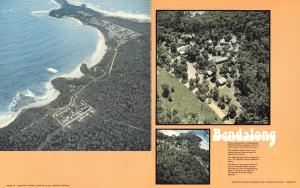
In the late 60s, the Club had also purchased some holiday cabins at Bendalong, south of Nowra, for $25,000. The club sponsored an active fishing club at that time, and it was a popular venue for members looking for a subsidised holiday. A ballot was held each year to see who the lucky tenants over the Christmas holidays would be. That property was sold in the 1990s for $900,000.
Allawah Cabins — Bendalong. Click image to enlarge.
Mulgoa Road was added to the property portfolio in 1971.
Even with the properties it had purchased, the Club was still boxed in and very limited in its potential for growth. Parking would always be a nightmare on this site and the use of the swimming pool carpark by the Club’s customers was causing conflict. It was in the middle of a residential area and noise complaints were building momentum. Long-term planning for this site would be difficult.
However, if all the properties were consolidated, it would be an ideal site for a shopping centre, and around 1978 there was interest from a developer. A price of $3.25 million was negotiated subject to council approval of a shopping centre and the consolidation of all the properties including some roads.3 That caused difficulties, lengthy delays, unforeseen charges and a lot of bitterness but it was finally achieved. At that time, the book value of the properties was less than $1 million and it was a good profit for the club.
But it all hinged on Council approval of a shopping centre. Cowan says the first response was an almost blunt: “no chance”.
More work, feasibilities, and growth forecasts eventually led to agreement for a major retailer — but no specialty shops.
However, shopping centres depend on specialty shops. Further negotiations led to a revised proposal, but the permitted mix remained too limited to be viable, and time was passing.
In the meantime, the developer was spending more money on buying neighbouring properties and updating plans and information for Council.Finally, the development application was approved, and the Club was paid. Within a few days the developer sold the site to another developer for $7 million. The other properties purchased by the developer would allow for a shopping centre quite a bit better than the one we had approved. Nearly four years had elapsed from the time the deal had been agreed. A relatively small annual appreciation would have added well over a million to the value of the Club’s portion. Long delays cost money. And we did not have the experience of developers who could see other ways of doing things for a better result.
The first developer certainly made a nice profit and, eventually, so did Panthers. However, the sequence of events gave rise to one of the enduring myths surrounding Cowan and later became one of the matters that prompted a police investigation.4
This willingness to think beyond conventional boundaries would continue to shape decisions — not just in land, but in how the Panthers brand evolved.
To receive new Parts and occasional project updates by email, you may subscribe below.
Readers who hold recollections, documents, or material relevant to this history are welcome to contribute via the Commentary & Contributions page.
Project Updates
Receive updates when new parts are published.
Phyro Holdings Pty Ltd becomes very important in this narrative. Phyro is derived from the names Phyllis and Roger. ↩︎
One of these houses was 138 Station St, where the Cowan family lived from 1968-1972. ↩︎
There was one more monumental event for the Penrith Leagues Club in the seventies.
In 1971, the club became aware of a property on Mulgoa Road that was for sale for around $2 million. It was nearly 100 hectares, with large sections of swampy dairy farmland. Parts of it extended all the way to the Nepean River.
In Cowan’s eyes, Mulgoa Road was destined to be a major link in the future. The part of the property fronting Mulgoa Road, about 10 hectares, had already been zoned for residential development. Because of the residential zoning, he saw the purchase as a low-risk strategy, although it would be a massive investment for such a small club. The land would provide enormous development options for both the registered club and the football club. He became a passionate advocate of acquiring the property.
When he first floated the idea of buying the Mulgoa Road property, most people thought he was crazy. The price on the property was $2.25 million, not an amount that could be shrugged off easily. It had to be financed and the Club’s bankers refused. Undaunted, Cowan negotiated to transfer financial dealings to another bank where the management could see that the Club was going places and was worthy of support.
The criticism came from many quarters. One local newspaper ran the headline, “Roger’s Pipe Dream”.
‘People called it Frog Hollow’, says Don Ellks, one of the senior managers at the time. He says people were either laughing or sceptical. ‘It was very difficult to convince the Board, but Roger persisted and eventually won out. It showed enormous vision when he was being ridiculed from every quarter.’
Don Feltis, later a director at Panthers, was at the time a member of the police force in Penrith. He remembers a police inspector friend telling him the purchase was the worst decision the Club ever made. ‘It’s too far out of town. No-one is going to go that far to go to a club.’
Anyone who has ever visited Panthers’ Penrith club, exiting the M4 and travelling along Mulgoa Road, will know that the club is the focal point of a thriving commercial centre outside the city’s CBD.
But in 1971, once it left Penrith’s main street, Mulgoa Road was little more than a country road. It paralleled the Nepean River, heading out in the direction of Warragamba Dam. Along the way it passed through Wallacia, with its impressive Tudor-style hotel, seen by some at the time as an alternative to Medlow Bath’s Hydro Majestic for honeymoons and romantic trysts.
Former director Tom Wilson agreed that many people thought Roger was mad when he proposed the purchase.
But they thought he was mad about a lot of things. At one time we went and had a look at Australiana Village, out along the Hawkesbury near Windsor,when it came up for sale. We looked at buying other land in Penrith too, but at the time we thought it might be overextending. But Roger could see how that whole area was going to go ahead.
Phyllis Cowan remembers that Jamison Park — now one of Penrith’s major parklands with playing fields and recreational areas — was also considered by Cowan as a possibility to expand the club. It was covered in thick scrub and even further out of town.1
There was a lot of discussion about the land purchase, Max Connors recalls.
Many people in town were against it and some on the Board were not sure. But Roger was very persuasive, he saw it as a great opportunity.
Barry Hubbard said the criticism came from locals, club members and from Council. People were saying,
Why on Earth would they want to buy that swamp? You’ll never be able to build anything on it.
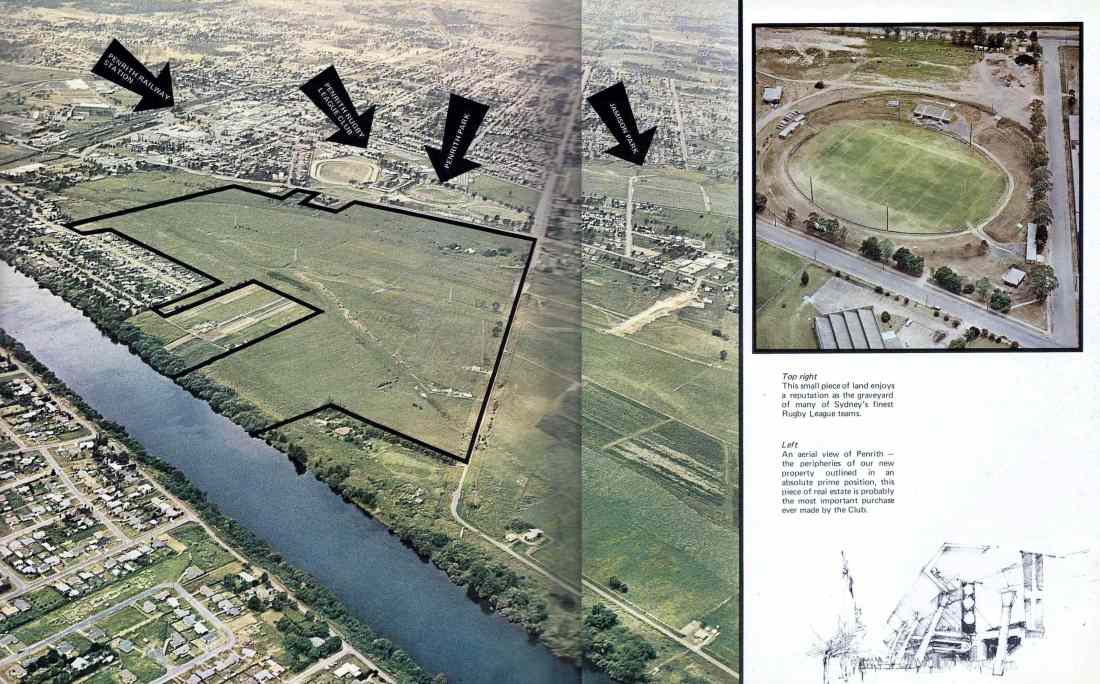
The view from corner of Mulgoa & Jamison Rds looking west. (Unknown source.)
After about four months of deliberations, the Board finally agreed to the purchase.
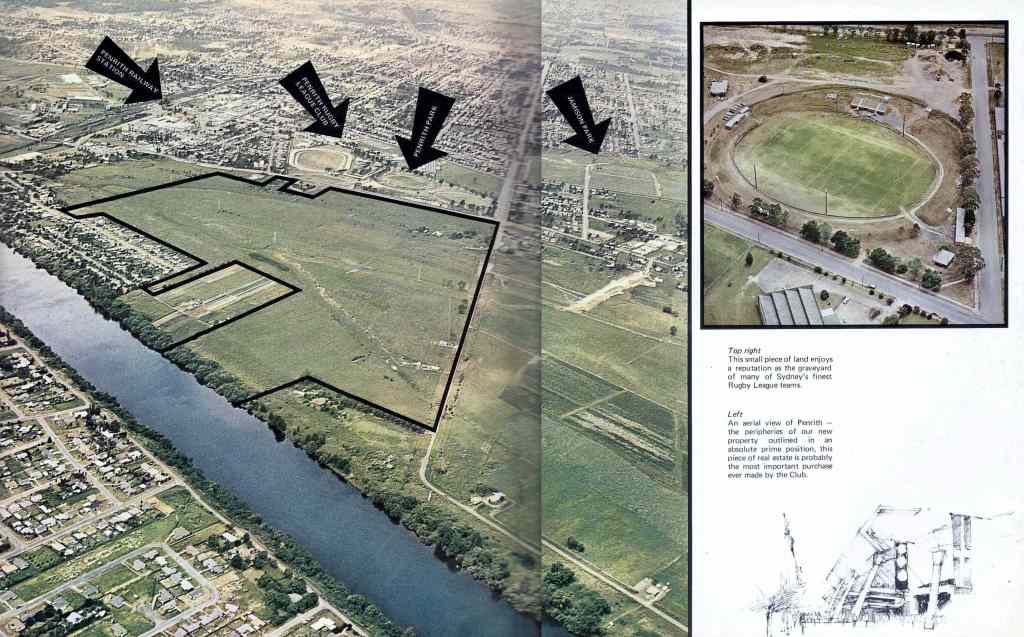
Penrith Rugby League Club 1973 Annual Report – middle page spread. Main image shows the Mulgoa Rd property with various points of interest. The smaller images are an early aerial shot of Penrith Park and an artsis impression of a club design. Click image to enlarge.
Hubbard’s first visit to the property did not go well. He had seen the property from the road, but once the decision was made, he and another director, Murray Clarke, decided they wanted a closer look.
We were in Murray’s four-wheel drive. We drove in about 100 metres, and the car was up to its axles in mud. “You’d better get out and have a look”, Murray said. I stepped down, and I was up to my knees. We eventually got the car out, and I went back to the club to clean myself up before I went home.
The boardroom had its own bathroom, so Hubbard decided to wash his trousers in the basin. It was the classic scenario of ‘one of these days, you’re going to get caught …’ . When sprung by the chairman, in his boxers, doing his laundry in the washbasin, he explained that he had just inspected the club’s new site.
Phyllis Cowan says she could never have imagined in 1971 what the Club would become. She could see the drive her husband had, though.
I think that Roger knew, right from the start. And I think if he was still there, he’d still have the same dreams and visions. He was always very conscious of what it was doing for Penrith, that it was putting the area on the map. His sense of community was very strong. Even in the early days he often talked about Penrith becoming a major centre in the state, and how the Club could help.
Pat Sheehy has been on Penrith Council since 19872, he says:
Panthers has been an asset to the city of Penrith for the very simple reason that people found out where we were. So, we benefited as a community by that exposure – and that advertising didn’t cost us anything.
The relationship between Panthers and Council has at times been symbiotic, and at others almost parasitic, says Sheehy.
What stage it was at depended on where you were standing. Often Panthers thought that we were the greatest mongrels on Earth, and just as often council thought the same about Panthers.
But the two have worked together on many community projects and are always ready to forget their differences in times of local crisis, such as bushfires and floods.
Council was particularly opposed to the development of a club on Mulgoa Road. One of the reasons given was the land’s proximity to the Jamison Hospital and the noise that a new club might generate. But the current club was quite close to the town, in what was essentially a residential area. Ellks says the neighbours were already starting to complain about the noise, and there were some problems with young people hanging around in the street. The Club was growing, so the complaints could only increase.
Although he wasn’t on council at the time of the purchase, Sheehy was living and working in Penrith, and has heard much of the history from council colleagues.
Roger had the vision for that land long before anyone else ever saw it. All the pundits around town were saying, “What do they want to move there for? It’s on the edge of bloody town, no-one’s going to go there”.
He was able to cut through a lot of the wowserism that was current in council in those days. I would think that most councillors were middle-aged men in grey suits, who were not really into the whole club scene.
And he had no background in clubs – it was quite brave. What he was seeing was enormous potential, where most of us were still seeing the country town where we’d grown up. He had this whole concept of what Panthers could become, which I don’t believe was shared by many people. He certainly had to convince the board – and he didn’t get a lot of support from the people on council at the time.
Yes, he was definitely seen as an upstart. Especially wanting to set up this huge expanse of club-land. They thought he was biting off more than he can chew, driving too far, too quickly. To some extent, I think the belief – and hope – in council was that this bloke will end up being put in his place.
That thinking was to continue, at least in some quarters, over the entire Cowan years at Panthers. One particular aspect irked Cowan for the rest of his life — how Council managed the disposal of two roads on the Station Street property. For further background seeBeyond the Book — Negotiating with Council: The Station Street Road Closures.
With the purchase of the Mulgoa Road property going ahead, Roger Cowan faced the prospect of raising the money to develop the site. Cowan came up with some unusual ideas about how to do it, says Tom Wilson.
Anyone who knows Penrith knows that there’s vast deposits of sand and gravel under the land all along the river, right through to Castlereagh. The quarries on the northern side of the city have been operating for many years. One of Roger’s early concepts to finance the development was to mine some of the blue metal under the new site. The idea was to sub-contract the work out to BMG, who would take it over the river to Emu Plains and process it.
The concept did not get very far. There was no way it would ever be approved, given the position and the need for thousands of noisy trucks plying back and forth on the edge of town, holding up traffic on the narrow bridge across the river. But he said it was typical of Cowan’s style, to look beyond what’s in front of your face and see what could be.
To receive new Parts and occasional project updates by email, you may subscribe below.
Readers who hold recollections, documents, or material relevant to this history are welcome to contribute via the Commentary & Contributions page.
Project Updates
Receive updates when new parts are published.
Jamison Park already included playing fields, the scrub referred to here was at the southern end of the Park. ↩︎
Pat Sheehy retired from Penrith City Council in 2008. He passed away in 2025. ↩︎
The following material draws upon club publications from the early and mid-1970s, later interviews and recollections from former Panthers staff and executives.
By the mid-1970s, Penrith Rugby League Club was doing something few licensed clubs in Australia would even have contemplated — experimenting with computerised gaming and security systems.
The project emerged from a practical problem. As poker machine revenue increased across the club industry, so too did concerns about theft, scams, inefficient cash handling and poor operational oversight. Panthers had already experienced some of these issues directly. Roger Cowan believed tighter systems and better information could reduce losses and improve efficiency.
What followed was an ambitious venture into electronics and computer technology through a company known as F.C. Electronics Pty Ltd.
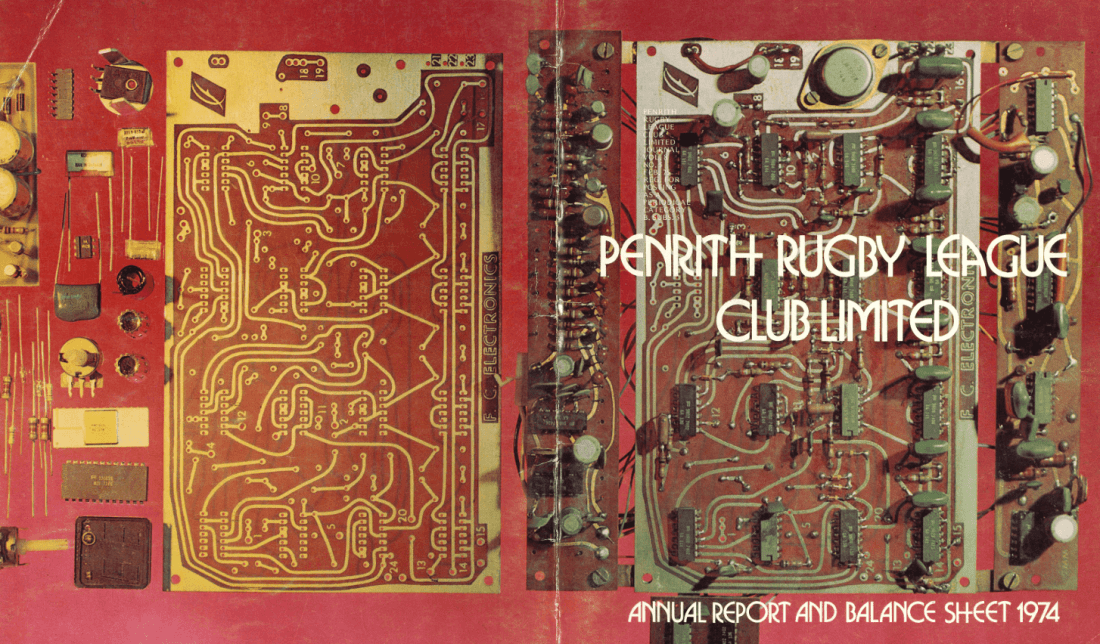
Contemporary club material described F.C. Electronics as producing “probably the world’s most sophisticated poker machine security system”. While that language reflected the promotional enthusiasm of the period, there is little doubt the system was unusually advanced for an Australian club environment of the 1970s.
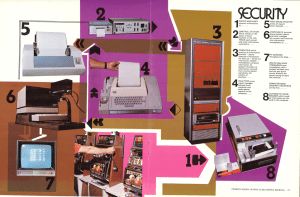
The system attempted to electronically monitor poker machine activity from a central control point.
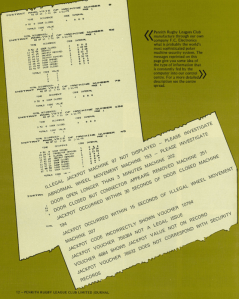
Early F.C. Electronics monitoring reports published by Panthers during the 1970s showed the system identifying jackpots, abnormal machine activity and security irregularities. Click image to enlarge.
According to material published by the club, poker machine events were coded and transmitted to television monitors around the club, allowing supervisors to immediately identify jackpots and machine activity. The system also attempted to monitor irregularities including abnormal wheel movement, door openings and jackpot inconsistencies.
The operation relied on technology that, at the time, would have appeared extraordinary to most club employees and patrons. The club’s own promotional material featured computer consoles, printers, monitoring screens and electronic reporting systems — all at a time when many organisations still relied entirely on manual record keeping.
Promotional page for F.C. Electronics showed an interconnected monitoring and reporting system linking poker machines to central computer and television displays. Click image to enlarge.
Former Panthers executive Bryn Miller later recalled that the system was “so far ahead of its time” that most clubs did not even possess a computer when Panthers was experimenting with electronic monitoring and reporting.
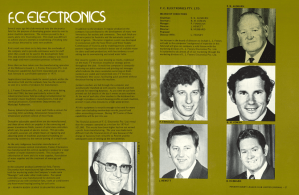
The project extended beyond poker machine security. F.C. Electronics also produced industrial control equipment and commercial products including lighting dimmers and environmental control systems. Club publications noted that the company’s capabilities had expanded sufficiently for it to seek work beyond the club industry itself.
Yet the venture also carried substantial cost and risk.
Club material acknowledged that F.C. Electronics operated at a financial loss during part of this period, while Roger Cowan later conceded that Panthers may have persisted with the project longer than it should have. Had the technology evolved commercially the way he hoped, the rewards may have been significant. Instead, the project became one of several ambitious experiments that pushed the club into areas rarely explored by licensed clubs of the era.
Club journal material outlined the broader ambitions of F.C. Electronics, which expanded into industrial and commercial electronic products beyond gaming systems. Click image to enlarge.
Even so, many who observed the system believed its core ideas eventually became standard throughout the gaming industry. Automated monitoring, centralised reporting, electronic jackpot recording and machine data analysis are now routine parts of modern club gaming operations.
In that sense, the Feeney Electronics project reflected something larger about the Panthers administration during the Cowan years. The club was rarely content simply to follow established practice. Whether the experiments succeeded or failed, there was often a willingness to try ideas that others considered unrealistic, premature or unnecessarily ambitious.
Feeney Electronics was one of the clearest examples of that philosophy in action.
Image Credits: All images in this post — including the feature image — are from Panthers Annual Reports. These were kindly provided by The Ausburn Collection.
To receive new Parts and occasional project updates by email, you may subscribe below.
Readers who hold recollections, documents, or material relevant to this history are welcome to contribute via the Commentary & Contributions page.
Members accumulate points through gaming, dining and entertainment spending, redeeming them for meals, prizes, discounts or benefits through sophisticated computerised systems linked to membership cards and databases.
Security surrounding gaming operations was often basic, particularly in smaller or rapidly growing clubs where staffing and oversight systems struggled to keep pace with expansion.
Long before those systems became standard across the club industry, Panthers experimented with an early version of the same idea.
It was called Panther Stamps.
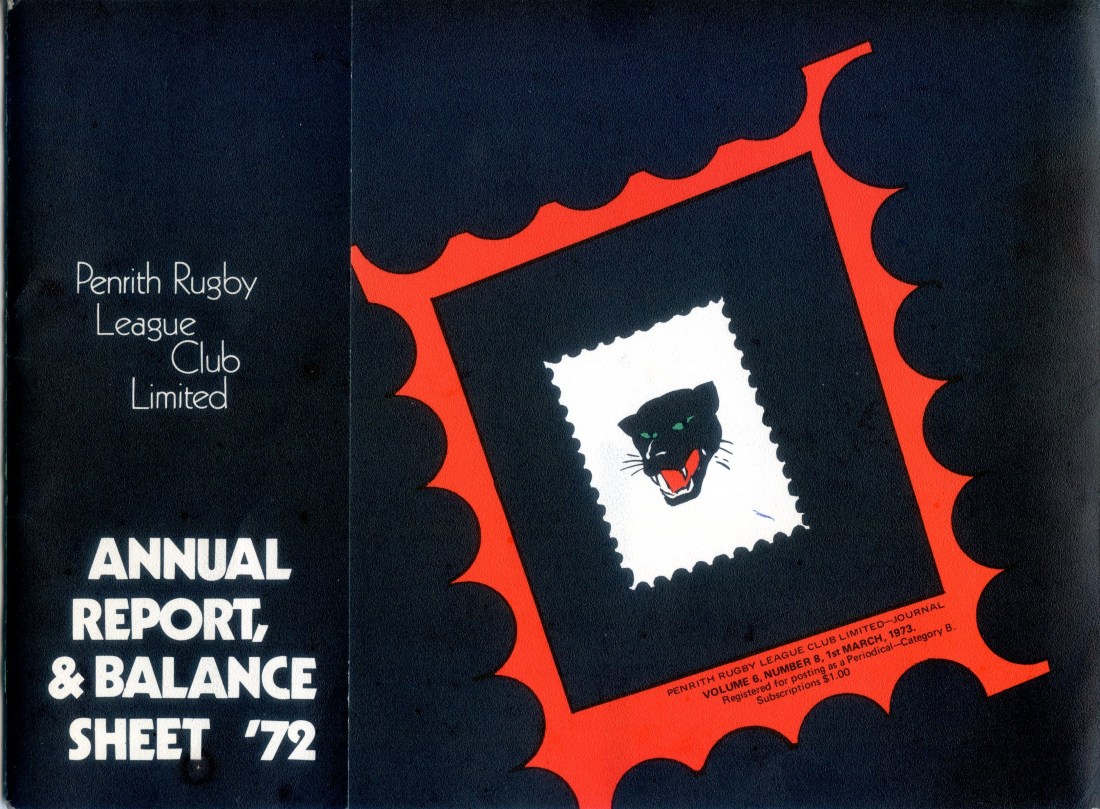
Introduced in 1972, the scheme rewarded patrons — with bonus stamps that could later be exchanged for prizes and trophies. While simple by modern standards, the concept reflected a surprisingly advanced understanding of customer loyalty, repeat visitation and member engagement
The Panthers Annual Report for 1972 described the program as:
“one of the most outstanding successes we have ever had.”
The scheme had officially commenced on 10 July 1972 after several months of delay caused by what the club described as “security and administrative problems involved.”
Even at this early stage, Panthers recognised that a rewards system required careful operational controls, stock management and accounting procedures.
Within less than six months:
and prizes worth approximately $22,000 at cost price had been distributed.
members had collected more than 150,000 stamps
over 90,000 had already been redeemed
The prizes ranged from trophies and sporting awards through to toys and household items. The report noted that demand became particularly intense in the weeks before Christmas, with thousands of dollars’ worth of toys redeemed by members.
Importantly, Panthers did not present the scheme simply as generosity or entertainment.
Club management acknowledged that while the program carried significant administrative costs — including staffing, storage, stationery and prize purchasing — they believed the increased engagement from members more than justified the expense.
In effect, Panthers had identified an idea that would later become central to the modern club and gaming industries: reward loyalty, encourage repeat visitation, and strengthen the relationship between the member and the venue.
The system also demonstrated the increasingly sophisticated operational mindset developing within Panthers during the early 1970s. By this period, the club was not merely expanding physically — it was experimenting with new forms of marketing, patron engagement and gaming promotion that were relatively advanced for the time.
Although Panther Stamps relied on physical booklets and manual administration rather than computers and swipe cards, the underlying principle was remarkably familiar to modern readers.
Today’s digital loyalty programs — with their points systems, rewards catalogues and member incentives — are built upon many of the same ideas.
While modest by modern standards, Panther Stamps reflected the growing importance of structured member engagement within the evolving licensed club industry of the period.
Panther Stamps were simply an early analogue version of that future.

 Panthers, Passion & Politics - The Roger Cowan Years