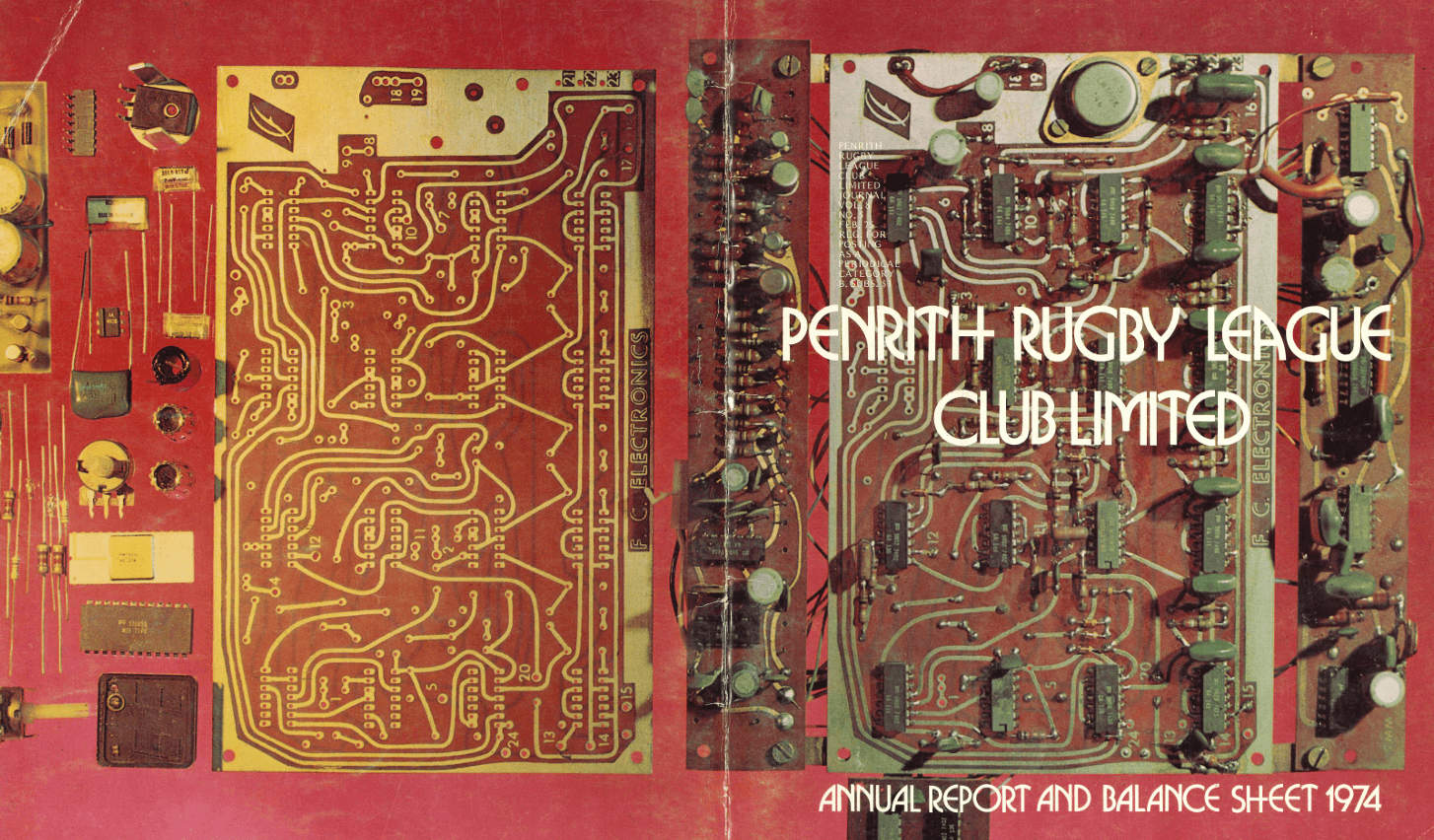
The following material draws upon club publications from the early and mid-1970s, later interviews and recollections from former Panthers staff and executives.
By the mid-1970s, Penrith Rugby League Club was doing something few licensed clubs in Australia would even have contemplated — experimenting with computerised gaming and security systems.
The project emerged from a practical problem. As poker machine revenue increased across the club industry, so too did concerns about theft, scams, inefficient cash handling and poor operational oversight. Panthers had already experienced some of these issues directly. Roger Cowan believed tighter systems and better information could reduce losses and improve efficiency.
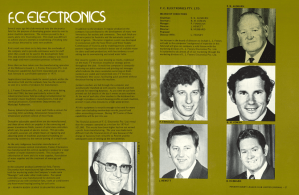
What followed was an ambitious venture into electronics and computer technology through a company known as F.C. Electronics Pty Ltd.
Contemporary club material described F.C. Electronics as producing “probably the world’s most sophisticated poker machine security system”. While that language reflected the promotional enthusiasm of the period, there is little doubt the system was unusually advanced for an Australian club environment of the 1970s.
The system attempted to electronically monitor poker machine activity from a central control point.
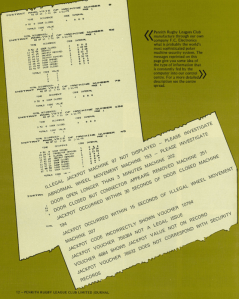
According to material published by the club, poker machine events were coded and transmitted to television monitors around the club, allowing supervisors to immediately identify jackpots and machine activity. The system also attempted to monitor irregularities including abnormal wheel movement, door openings and jackpot inconsistencies.
The operation relied on technology that, at the time, would have appeared extraordinary to most club employees and patrons. The club’s own promotional material featured computer consoles, printers, monitoring screens and electronic reporting systems — all at a time when many organisations still relied entirely on manual record keeping.
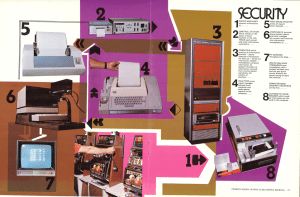
Former Panthers executive Bryn Miller later recalled that the system was “so far ahead of its time” that most clubs did not even possess a computer when Panthers was experimenting with electronic monitoring and reporting.
The project extended beyond poker machine security. F.C. Electronics also produced industrial control equipment and commercial products including lighting dimmers and environmental control systems. Club publications noted that the company’s capabilities had expanded sufficiently for it to seek work beyond the club industry itself.
Yet the venture also carried substantial cost and risk.
Club material acknowledged that F.C. Electronics operated at a financial loss during part of this period, while Roger Cowan later conceded that Panthers may have persisted with the project longer than it should have. Had the technology evolved commercially the way he hoped, the rewards may have been significant. Instead, the project became one of several ambitious experiments that pushed the club into areas rarely explored by licensed clubs of the era.
Even so, many who observed the system believed its core ideas eventually became standard throughout the gaming industry. Automated monitoring, centralised reporting, electronic jackpot recording and machine data analysis are now routine parts of modern club gaming operations.
In that sense, the Feeney Electronics project reflected something larger about the Panthers administration during the Cowan years. The club was rarely content simply to follow established practice. Whether the experiments succeeded or failed, there was often a willingness to try ideas that others considered unrealistic, premature or unnecessarily ambitious.
Feeney Electronics was one of the clearest examples of that philosophy in action.
Related Topics
- Part 9 — Eliminating Scams with Innovation and Systems
- Historical Context — Wires, Magnets and Monitoring
Related Themes
Financial Management · Innovation
Image Credits: All images in this post — including the feature image — are from Panthers Annual Reports. These were kindly provided by The Ausburn Collection.
To receive new Parts and occasional project updates by email, you may subscribe below.
Readers who hold recollections, documents, or material relevant to this history are welcome to contribute via the Commentary & Contributions page.
Project Updates
Receive updates when new parts are published.

