When the Super League war finally ended, it was conditional.
Twenty clubs would compete in the National Rugby League during 1998 and 1999 before the competition contracted to just fourteen teams for the 2000 season. Which clubs survived would not be determined by tradition, supporter loyalty or even on-field performance.
There was an attempt to determine the clubs that would compete from Season 2000 onwards by more objective means. So, a detailed set of selection criteria was created to decide who’d be eliminated.
Although Panthers’ management was pleased the NRL had tried to apply some science to the process, there was great concern that it was compromised right from the start.
The criteria relied upon historical information that could not easily be audited. For example, attendance figures formed an important part of the assessment, yet clubs reported their own crowds and there appeared to be no independent verification.
In fact, Panthers was encouraged, by the game’s governing body during Season 1997, to “boost” the attendances. They resisted but believed the practice was widespread.
Panthers repeatedly challenged aspects of the criteria, arguing that several measures lacked transparency. Panthers raised its concerns privately and directly with the NRL rather than through the media.
The attitude within Panthers was to formally advise the authorities of the Club’s concerns about serious flaws in the criteria, alerting them that they could easily be challenged. The internal emphasis on evidence, analysis and measurement was applied to this problem — and although there was no solution in sight, the management and Board at least had a solid understanding of the challenges.
That philosophy gave birth to one of the more unusual projects undertaken during the fight for survival.
A War of Words
The immediate catalyst arrived in early May 1998.
Sydney City (The Roosters) chairman Nick Politis publicly criticised Penrith — labelling the Panthers, and Canterbury, “basket cases”. The restrained approach consciously adopted by Cowan had been interpreted as weakness.
Not wanting to exchange insults in the public arena, a decision was made to present evidence that would serve as a “return shot” at the Roosters while alerting Panthers fans that the Club’s public silence did not mean they were sitting on their hands.
Importantly, it also would send a message to the NRL, the other clubs and the general public about the fragility of the measures that were being used to cull clubs.
This was an opportunity for Cowan and the Panthers to go public with evidence demonstrating one of the significant flaws in the criteria.
Cameras Instead of Opinions
The Roosters were scheduled to play the Auckland Warriors at the Sydney Football Stadium on Saturday 2 May. Panthers management team knew the crowd would be relatively small and also had a strong suspicion that their official crowd would be inflated.
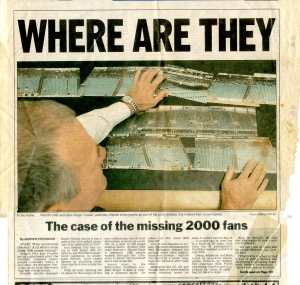
So, photographer Neil Billington was dispatched to the Sydney Football Stadium with the task of photographing every section of the stadium. Neil’s media accreditation allowed him to take the photos from the field area and his instruction was to take the photos 5 minutes into the second half when attendees would have returned to their seats.
The resulting enlarged photographs allowed individual seating bays to be examined and the spectators counted manually. The counting was done by members of the Panthers management and marketing teams — sometimes with magnifying glasses deployed. Each count was verified against the others.
The conclusion was clear, the official attendance announced by the Roosters significantly overstated the number of spectators actually present.
The photographs became the basis of a dramatic Daily Telegraph back-page story under the headline “Where Are They?”, accompanied by enlarged photographs of the stadium and detailed comparisons between the official crowd and Panthers’ own calculations.
What began as an off-the-cuff comment aimed at belittling the Penrith Panthers, became a public debate about the integrity of the selection criteria.
The Project Expands
Encouraged by the clarity of the photographic evidence, Panthers broadened the exercise. Panthers Media & Communications Manager, Rob Weaver, directed Neil Billington’s work.
Contrary to later recollections that suggested almost every match was photographed, the research concentrated on two or three Sydney-based games each round, particularly those involving clubs competing with Penrith for the final places under the criteria. The process was painstaking. Every photograph had to be examined manually and individual spectators counted section by section.
The objective was not to embarrass rival clubs.
It was to determine whether attendance figures—the very figures helping decide which clubs lived and which disappeared—were reliable. In fact Cowan also required at least one Panthers home game to be given the same attention.
According to Roger Cowan, the accumulated material may eventually have supported a legal challenge if Panthers found themselves excluded from the competition. He never regarded it as a particularly attractive strategy, but believed the circumstances justified examining every possible option.
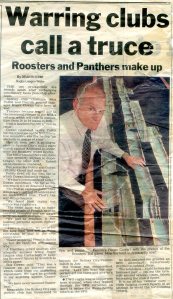
Roger and Nick Declare Peace
Within days, the public dispute subsided.
Correspondence between Roger Cowan and Nick Politis helped calm tensions, and both clubs publicly agreed to move on. There was nothing personal about the exchange — both men were doing what they saw as necessary for their clubs.
The underlying issue, however, remained unresolved.
Whether official attendance figures accurately reflected the crowds attending NRL matches was never independently tested.
Looking Back
With the benefit of hindsight, the crowd-counting exercise could appear excessive.
Yet it reflected the reality confronting Panthers during 1998.
Management believed the club was sitting outside the fourteen places destined for Season 2000. Every point on the criteria mattered. Every category was scrutinised. While substantial resources were invested in increasing Panthers’ own crowds and commercial performance, management also continued examining the assumptions upon which the criteria rested. At the same time the club quietly but substantially increased the budget for marketing initiatives designed to improve attendances and strengthen its own position.
Ironically, the photographs were never called upon.
When South Sydney later challenged its exclusion from the competition, Panthers’ collection of crowd photographs was not requested. Whether they would ever have carried legal weight remains unknown.
Perhaps that is not their greatest significance.
The Panthers / Roosters “Where Are They” conflict may have been a dispute over attendance figures, but it was evidence of something more important — a management team, led by Roger Cowan, determined and prepared to investigate every possible avenue in the fight to preserve first-grade rugby league in Penrith.
Postscript
Nick Politis added a postscript to the letter he sent Roger Cowan. It said:
I hope all this controversy between our clubs results in a great crowd for you when the Roosters visit the Panthers in Round 18 (July 10-12)!
The attendance at Penrith Stadium for the Rooster’s game was 11,156—around 20 per cent higher than the club’s average home crowd for the 1998 season. Whether the controversy contributed is impossible to know, but the irony was sweet.
Final Note: The fate of the hundreds upon hundreds of photograph prints from those 1998 games? It is said they were burned.
Related Topics
- Part 29 — Joining Super League
- Part 30 — The Criteria
- Survival Becomes a Numbers Game — The NRL Criteria
Related Themes
Conflict · Financial Management
To receive new Parts and occasional project updates by email, you may subscribe below.
Readers who hold recollections, documents, or material relevant to this history are welcome to contribute via the Commentary & Contributions page.
Project Updates
Receive updates when new parts are published.

