
Readers of Parts 19–21 may wonder why Roger Cowan spent more than sixteen years arguing for what appeared to be a relatively simple administrative reform. Why did the issue matter so much to him? Why did he keep returning to it despite repeated setbacks, opposition and criticism?
The answer lies in a question that had troubled Panthers almost from the beginning:
How could the Club pursue a unified direction when rugby league and the licensed club were governed separately?
The issue was not new.
Readers familiar with the events of 1971 may recognise some familiar themes. The removal of football club secretary Merv Cartwright and treasurer Ron Partridge arose from concerns about the administration of rugby league affairs and accountability for financial decisions. Although the circumstances were different, the disputes that emerged again in the late 1970s centred on many of the same questions. Who should make decisions? Who should be accountable for those decisions? And what happened when agreements were not honoured?
From the time Penrith entered first grade rugby league in 1967, the football club and licensed club operated under separate governance structures. The arrangement was common in rugby league, but Roger increasingly came to believe it created problems that could never be fully resolved.
It would be easy to assume the conflict was simply about money. Certainly finances played a part. Rugby league required increasing investment, while the licensed club was trying to strengthen its financial position and pursue long-term development projects. Yet Roger’s frustration was not that football sought resources. In his view, the licensed club had repeatedly demonstrated a willingness to support rugby league and invest heavily in its future.
The real problem arose after decisions had been made.
Budgets would be negotiated. Agreements would be reached. Plans would be approved. Yet time and again, football expenditure exceeded agreed limits or new commitments were entered into without the knowledge or approval of those responsible for managing the Club’s overall finances.
From Roger’s perspective, this was not simply a financial problem. It made long-term planning almost impossible.
A licensed club board could approve a football budget, commit to major development projects and make decisions based upon expected cash flows. If those assumptions later proved incorrect because spending commitments had changed, the consequences extended well beyond rugby league. The entire organisation could be affected.
By the late 1970s, these tensions had become increasingly public. In December 1979, the Sydney Morning Herald reported on financial difficulties and disagreements between the football and licensed club administrations. Around the same time, Panthers was preparing for the enormous financial challenge of constructing its new Mulgoa Road complex.
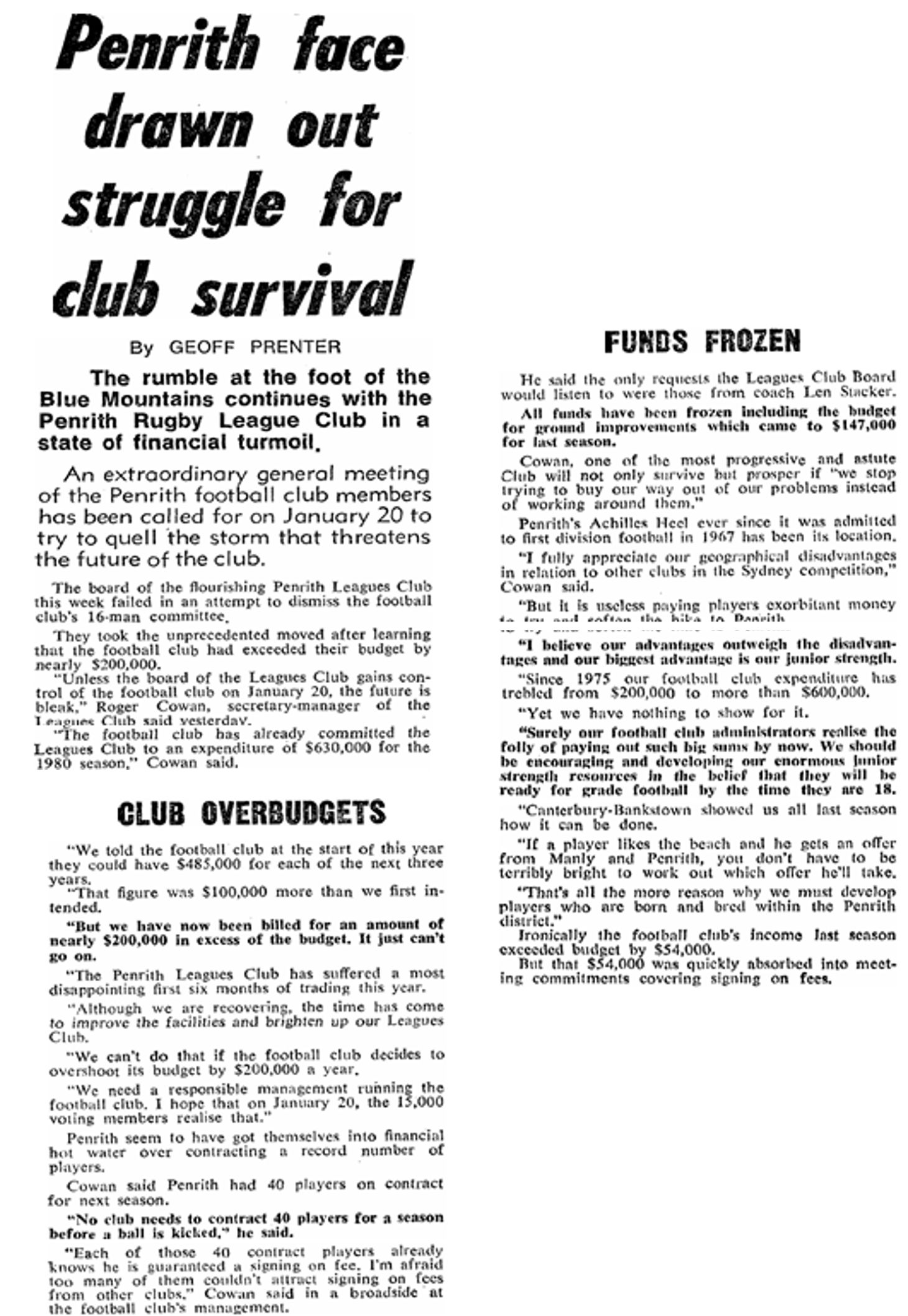
Reports to members in 1980 revealed the extent of the concern. Directors reported that the football club had exceeded an agreed annual budget of $485,000 by more than $100,000 during 1979, while additional commitments had already been entered into for the following season. To the licensed club board, the issue was not simply the amount involved. It was that decisions affecting the future of the entire organisation had been made outside the framework that had previously been agreed.
These events helped bring the governance debate to a head, but they do not fully explain Roger’s determination.
For him, the issue was ultimately one of organisational unity.
He believed Panthers would never achieve its potential while parts of the organisation operated according to different priorities, different assumptions and different lines of accountability. A football club and licensed club could share the same colours, the same members and the same ambitions, yet still find themselves working against each other.
His solution was straightforward.
One board would determine policy and direction for the entire organisation. Management would then be responsible for implementing those decisions. Everyone would work towards the same agreed objectives and everyone would be accountable to the same governing body.
Not everyone agreed.
Some viewed Roger’s campaign as an attempt to centralise power. The perception is understandable. After all, he was advocating a structure that would eventually place responsibility for football and licensed club operations under a single administration. His persistence over sixteen years inevitably raised questions about motive.
Yet there is another interpretation.
Roger was not arguing that football should receive less support. Nor was he arguing that rugby league was less important than the licensed club. Rather, he believed the entire organisation should operate according to a common plan and that all parts of Panthers should be accountable to that plan.
Many years later, Panthers would use concepts such as “twin citizenship” to describe the idea that people belonged not only to their immediate team but also to the wider organisation. While that language did not exist in the 1970s, the philosophy behind it helps explain Roger’s thinking. He wanted rugby league, club management, directors and staff to see themselves as contributors to a single enterprise rather than separate interests competing for influence.
The first major breakthrough came in 1980 when a single board was finally established. Yet even then, the model remained incomplete. Rugby league and the licensed club continued under separate chief executives. As described in Parts 20 and 21, the compromise produced its own difficulties and did not resolve the underlying tensions.
It was not until the end of 1983 that the structure Roger had advocated for so long was fully implemented. One board and one chief executive became responsible for the entire organisation.
Whether that decision alone explains the improvements that followed is impossible to know. Organisations are rarely transformed by a single reform. Nevertheless, the years that followed saw a stronger emphasis on cooperation, planning and shared ownership. The workshops that led to the Five by Five program, closer relationships throughout the rugby league district and a more integrated approach to football and club operations all emerged during this period.
Reasonable people may still disagree about whether Roger was right. They may also disagree about the extent to which later successes flowed from the governance reforms he championed.
What is difficult to dispute is that he regarded the issue as fundamental. For more than sixteen years he returned to the same argument, often in the face of resistance and disappointment.
Ironically, that persistence contributed to one of the enduring myths about Roger Cowan — that he was somehow anti-rugby league.
The evidence suggests a more complex reality.
His long campaign for “One Board, One CEO” was not driven by a desire to diminish rugby league, but by a belief that Panthers could only achieve lasting success when every part of the organisation was working towards the same goals and operating under the same commitments.
Whether one agrees with that belief or not, it became one of the defining ideas in the history of Panthers.
Source Material*
The following documents are extracts of the relevant sections of larger reports:
- Chairman’s Report (John Hewett) from PRLC News Magazine March/April 1980
- Secretary’s Report (Roger Cowan) from PRLC News Magazine March/April 1980
- Chairman’s Report (John Hewett) from PRLC News Magazine Novemebr 1980
- Secretary’s Report (Roger Cowan) from PRLC News Magazine November 1980
Related Topics
- Part 19 — A Solution —Of Sorts
- Part 20 — Charlie Gibson and the Culture Clash
- Part 21 — The Right Structure. Finally!
- Beyond the Book — The Removal of the Secretary and Treasurer
Related Themes
Financial Management · Governance · Board Decisions · Culture · Club Structure
* Resource material courtesy of The Ausburn Collection
To receive new Parts and occasional project updates by email, you may subscribe below.
Readers who hold recollections, documents, or material relevant to this history are welcome to contribute via the Commentary & Contributions page.
Project Updates
Receive updates when new parts are published.

