
In the winter of 1973, Penrith found itself searching for answers.
The club had entered the first-grade competition only six years earlier and was struggling badly. Results were poor, confidence was low and the future looked uncertain. The low point came when Manly-Warringah inflicted a humiliating 70–7 defeat on the Panthers. The result became part of club folklore and reinforced the belief that dramatic action was needed.
Penrith’s response was bold. Rather than look only within Australia, the club turned its attention to England.
Club president Wally Ward and director Bruce Welladsen travelled to England with a clear objective: find experienced players who could strengthen the team and help establish a culture of professionalism. Their first target was Bill Ashurst, one of Britain’s leading second-row forwards. Negotiations were successful and Penrith secured his signature for what was reported at the time as a record rugby league transfer fee. Contemporary reports noted that Penrith had committed more than $27,000 to secure Ashurst’s services.
But Penrith wanted more than a forward. They also wanted leadership.
While in England, Ward and Welladsen turned their attention to Mike Stephenson, captain of the English champions, Dewsbury. Stephenson later recalled receiving an unexpected approach while working on a building site in Yorkshire. A workmate shouted up a ladder asking whether he was Mike Stephenson. When he answered yes, he was told that visitors from Australia wanted to speak with him.
The meeting that followed would change the course of Stephenson’s career.
Ward and Welladsen outlined their vision for Penrith and offered Stephenson a long-term contract. At first he was uncertain. Penrith sat at the bottom of the premiership table and had just suffered one of the heaviest defeats in its history. Yet the honesty of the approach impressed him. Rather than paint an unrealistic picture, the Penrith representatives openly explained the club’s position and their plans for the future.
Stephenson later said that this honesty was one of the decisive factors in his decision. The club was struggling, but it had ambition. Just as importantly, it had a strong junior base and a growing district. He believed there was an opportunity to help build something meaningful rather than simply join an established powerhouse.
Penrith eventually secured Stephenson’s release after complex negotiations with Dewsbury. The reported transfer fee of almost $40,000 established a new benchmark and attracted national attention. The press described the signing as a record-breaking deal and evidence of Penrith’s determination to improve its fortunes.
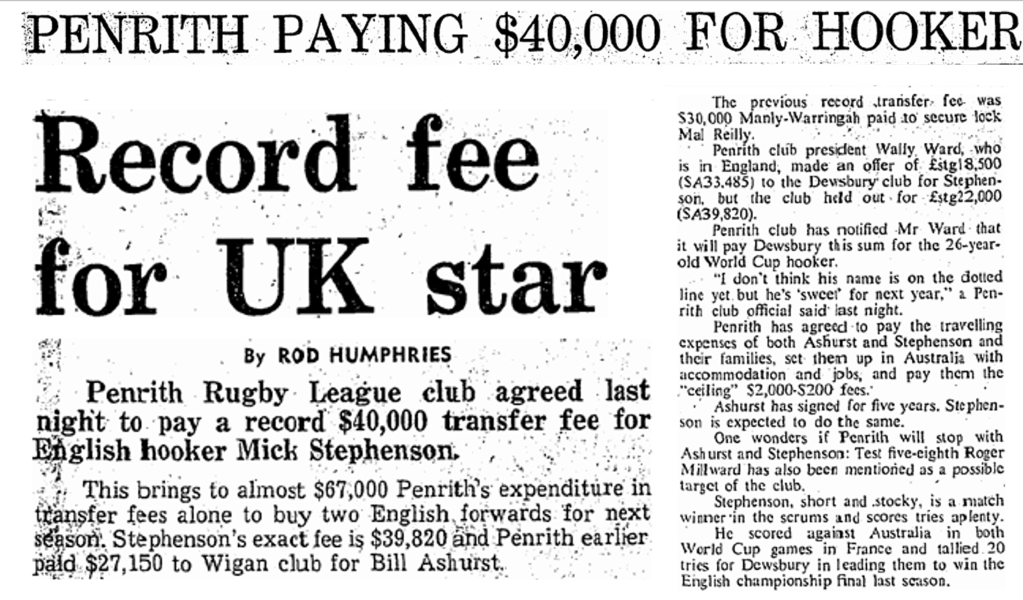
The arrival of Ashurst and Stephenson generated enormous excitement. Two of Britain’s finest players were heading to Penrith. Expectations rose accordingly.
The results, however, were mixed. Despite the quality and commitment of both men, rugby league success remained elusive. Penrith finished with the wooden spoon in 1973 and continued to struggle for consistency. Yet the significance of the signings went beyond wins and losses. They demonstrated that Penrith was prepared to think differently, act boldly and invest in its future.
Those qualities would become recurring themes throughout the Roger Cowan years.
Related Topics
Related Themes
To receive new Parts and occasional project updates by email, you may subscribe below.
Readers who hold recollections, documents, or material relevant to this history are welcome to contribute via the Commentary & Contributions page.
Project Updates
Receive updates when new parts are published.

