
Membership of a NSW registered club is more than a commercial relationship between a business and its customers. Members constitute the club and, depending upon their class of membership, have important governance rights.
Those rights include voting on constitutional changes and electing the directors who govern the organisation.
Before amalgamating with other clubs, Panthers membership was very simple. Members paid $20 annually, pensioners paid $10 for membership.1 Penrith had approximately 60,000 ordinary members. All members were eligible to participate in the governance of Panthers through voting in Board election, voting on constitutional matters and attendance at general meetings.
Amalgamations brought with it a challenge around the pricing of membership — the membership fees for all the amalgamating clubs was less than half the fee charge at the Penrith club.
To accommodate the price differential, a new category of membership was created — Social Membership. This allowed members from amalgamating clubs to retain their membership at a low rate. Taking Social Membership meant forgoing their rights to participate in the governance of the wider Panthers group.
As the number of amalgamations grew, so did the number of members — 120,000 members in total.
The membership offer was still relatively simple — Ordinary Membership $20; Social Membership $2.
However, Panthers was running the risk of breaching the Registered Clubs Act, which required a majority of the club’s members to be entitled to vote in Board elections and on changes to the constitution.
With Social Memberships proving popular at regional clubs and also with members who held membership in both Penrith and one or more of the other clubs in the group, there was a high potential for Social Members to become the majority.
This was still not regarded as a difficult problem.
A simple price reduction in Ordinary Membership would be the solution.
The recommendation of a lower-fee ($8 +GST) ordinary membership was being urged by every one of the fourteen club venues, the Panthers marketing team and all the management team.
This should have been a relatively straightforward commercial decision.
It turned out not to be so simple.
This recommendation was delivered to the Board who repeatedly rejected it and responded with requests for more information, more research — even asking for an analysis of the price elasticity of membership.
Recommendations to the Board set out the reasoning behind them. Although a potential 60 per cent reduction in membership revenue was an obvious concern, management believed there were strong commercial arguments supporting the change.
After months of rejection, it became clear that the recommendation was going nowhere. It also raised the possibility that the real obstacle was no longer the price of membership at all.
Roger Cowan took an extraordinary step as a final resort.
He went into a Board meeting with a three-page media release already prepared, ready to publicly accuse five directors of putting their own positions ahead of the interests of Panthers members.
As described in Part 51 of The Series, the release was never distributed. The Board eventually agreed to the lower fee.
But the document survives — and it helps explain why something as apparently simple as the price of membership had become so difficult.
From the Digital Archive: Read the original three-page media release prepared on 27 July 2002 — The Membership Media Release: The Art of Brinkmanship.
The document reveals that what began as a relatively simple commercial and marketing issue had become entangled in arguments about voting rights and the future control of Panthers.
The three-page media release was headed.
“Directors put themselves ahead of members” — Cowan
It was dated 27 July 2002 and had been prepared for public distribution if the Board again rejected management’s recommendation.
According to the release, the Board had rejected the $8.80 proposal at its meeting the previous Tuesday.
Cowan said the reason was that the cheaper membership would be available to members across the Panthers Group and would give those members the right to vote at a meeting scheduled for 15 September to consider a constitutional change.
That constitutional change was itself significant.
At the time, Penrith members were guaranteed at least five positions on the nine-member Panthers Board. The proposed change would create a 14-member Group Board, with nine positions elected by Penrith members.
Cowan alleged that some directors wanted to prevent members from the other Panthers clubs from voting or attending the September meeting.
He also said some members of the Board had argued that increasing the number of voting members at the amalgamated clubs could result in Penrith losing control of the Group.
Cowan’s response was blunt. Penrith already had guaranteed majority representation on the existing nine-member Board and, under the proposed structure, Penrith members would elect nine of fourteen directors. If that was insufficient to protect Penrith’s position, he argued, he did not know what would be.
He also claimed that treating long-term members of Port Macquarie Panthers and ClubNova as Social rather than Ordinary Members would deny some 25,000 people the voting rights they had been promised.
These were Cowan’s allegations in a media release prepared during an increasingly bitter Board dispute. They do not, by themselves, establish the motives of the directors he was criticising.
While the Board agree to the new $8 membership — $8.80 including GST — being offered from August 2002. It was still far from simple because this membership price was introduced as an extra option rather than simply changing the price of ordinary membership.
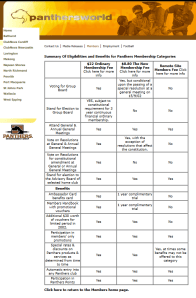
Panthers now had a membership with 3 tiers with prices including GST:
- Ordinary Membership: $22
- The New Membership: $8.80
- Social Membership: $2.20 (Note: this is also referred to as Remote Site Membership – it not available to those whose home club was Penrith)
Ordinary members paying $22 could vote for the Group Board and, subject to constitutional requirements, stand for election to it.
Members paying the new $8.80 fee could attend general and annual general meetings and vote on most resolutions. Their right to vote for the Group Board was initially shown as conditional upon the passage of a special resolution at the general meeting scheduled for 15 September 2002. They could not stand for election to the Group Board
Social members paying $2.20 could attend general and annual general meetings, but could not vote for or stand for election to the Group Board.
All three categories could stand for election to the Advisory Board of their selected home club.
The membership structure was therefore attempting to accommodate different kinds of members within an organisation that had changed enormously in only a few years.
When this was placed into communications for members it confused more than clarified. The following table is an extract the Panthers website circa Sptember 2002:
The September Change
The next step came on 15 September 2002, when a special general meeting approved changes to the Group Board structure.
The existing nine-member Board would increase to fourteen directors. Nine positions would be elected by Penrith members, while five would be guaranteed to nominees from other clubs within the Panthers Group.
A Panthers website announcement published the following day also confirmed that all members except Social Members would have the right to vote.

What had begun as an argument about the price of membership had therefore become part of a much wider restructuring of membership rights and representation within the growing Panthers Group.
More Than a Price Cut
The dispute described in Part 51 began with what management regarded as a straightforward commercial problem. Penrith’s membership was expensive compared with other clubs, while amalgamation was creating a rapidly growing number of cheaper Social Members.
But solving one problem created another.
Membership price became connected to voting eligibility; voting eligibility became connected to Board representation; and Board representation became caught up in the increasingly bitter argument about who would control the expanding Panthers Group.
The $8.80 membership was therefore more than a price cut. It was part of the much larger challenge of adapting the governance of Panthers to an organisation that had grown far beyond Penrith.
That was why something apparently so simple became so difficult.
Related Topics
- Part 51 — A Simple Change, Made So Difficult
- Beyond the Book — Not Your Everyday Amalgamation
- The Myth of the Footy Five
Related Themes
Governance · Growth · Conflict
To receive new Parts and occasional project updates by email, you may subscribe below.
Readers who hold recollections, documents, or material relevant to this history are welcome to contribute via the Commentary & Contributions page.
Project Updates
Receive updates when new parts are published.
- There was also the innovative Permanent Membership which in this era was $475. With this membership – an ordinary membership carrying full voting rights – there was no annual renewal and the fee was refundable in full if the member resigned, or payable to their estate on their death. Many who held this “perpetual” membership mistakenly referred to themselves as “life” members. Life Membership is an honour awarded to those who have served the club with distinction. ↩︎

